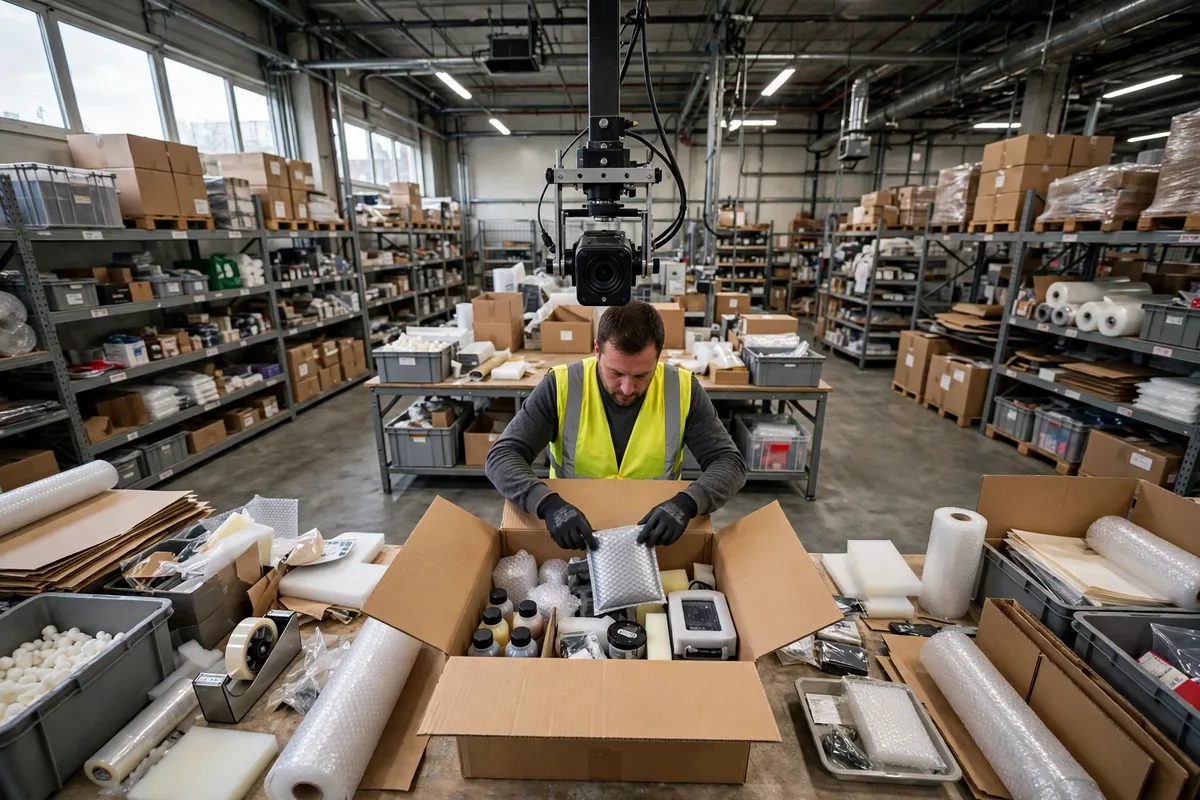
Start with the ledger, not the demo: ai packing verification vision warehouse means a camera above the packing bench takes one frame before the carton is sealed, counts the items, checks them against the order, and stops the box when something is short, extra, or wrong. It sounds modern. My only question is colder: how many orders do you mis-ship in a year, what does one mis-shipment actually cost you, and is that loss big enough to carry this system. If you cannot answer those three numbers, do not buy anything yet.
I have watched warehouses buy systems on words like efficiency and intelligence, then do the math on gut feeling. Gut feeling is worth nothing. Whether vision checking pays depends on three accounts only: how much it cuts error losses, what manual checking costs today, and what the system costs over its whole life.
The first ai packing account: what one wrong order really costs
Most managers price a shipping error as one return label. That is undercounting, and undercounting is how bad projects get approved. A single wrong order breaks into at least six cost blocks. Fill this table with your own data before you listen to any vendor.
| Cost block | What it includes | Where to get the number |
|---|---|---|
| Reverse freight | Return shipping plus reshipment | Carrier invoices, averaged |
| Rehandling | Receiving, inspection, restocking labor | Handling hours times loaded rate |
| Goods loss | Downgraded, expired, or damaged returns | Historical loss rate by category |
| Service and platform | Support time, platform penalties, chargebacks | Ticket records and platform rules |
| Rating damage | Lost conversion after bad reviews | Estimate the magnitude only |
| Management time | Investigation, reconciliation, reviews | Actual hours spent |
The last two rows are the ones everyone skips, and they are not small. One error that triggers a retailer chargeback can cost more than many ordinary errors combined. So step one is pulling your own mis-shipments from the last three months, sorting them by type, and building a credible range for average loss per error. Without that range, every projection is fiction.
Here is a labelled hypothetical example, not a benchmark: assume two thousand orders a day with an error rate of three per thousand, roughly six wrong orders daily; assume the blended loss per error lands in the tens-to-low-hundreds range in local currency, and the monthly error bill becomes a five-figure magnitude of silent cost. Whether that justifies a system depends on the next two accounts.
The vision warehouse labor account: manual checking is not free
The second account is manual verification. Many sites rely on a person glancing into the carton and counting before sealing, and the boss assumes it costs nothing because the person is already standing there. That is a classic missed cost. Checking consumes cycle time, and cycle time is most expensive exactly when the bench is busiest.
Second hypothetical example: assume two dedicated checking positions at your local fully loaded cost, and assume checking slows each bench by roughly a tenth of its pace. The true cost is two positions per year, plus capacity lost to slower cycle time, plus residual errors tired eyes still miss late in a night shift. Manual checking is not free insurance. It is a recurring expense buying an interception rate that fluctuates with fatigue.
The opposite case matters just as much. If you have no dedicated checkers and packers self-check, then ai packing verification vision warehouse is not replacing labor cost at all. It is buying a reduction in error losses, full stop. Those are two completely different business cases, and mixing them produces garbage conclusions. Decide which warehouse you are before you run any numbers.
The packing verification break-even: the formula matters more than the quote
The third account is system cost. Do not look at the camera price alone. Below the waterline sit the mount and lighting, an edge computer, software licensing, integration with your order system, deployment and tuning, and ongoing maintenance. Vendor quotes vary widely, so treat every specific price and performance figure as subject to vendor testing and the latest quotation. I give you the framework, not fake numbers.
The break-even math is plain arithmetic:
Annual net benefit = annual errors × interception rate × average loss per error + labor saved − annualized system cost
Annualized system cost = upfront investment ÷ expected service years + annual maintenance and subscription
Break-even months = upfront investment ÷ (monthly error-loss reduction + monthly labor saved − monthly maintenance)
One worked hypothetical, every figure labelled an assumption: suppose upfront investment is ten money units, annual maintenance is one unit, and the system saves one and a half units per month in reduced errors and labor. Net of maintenance, payback lands around a year. I invented those units to demonstrate the formula; they represent no vendor's real price or performance. Replace the assumptions with your own ledger and a formal quote, then run it again. Formulas do not lie. Assumptions do.
Now the counterintuitive point: a higher interception rate is not automatically better. Push interception up and false alarms usually climb with it. Every false alarm stops the bench, forces a worker to reopen and recount the carton, and breaks the packing rhythm. When alarms fire too often, workers learn to tap confirm without looking, and your expensive system becomes decoration. What you must price is net interception value: the saving from each caught error minus the stoppage cost of false alarms. A proposal that talks interception and never mentions false alarms has shown you only half the ledger.
Which warehouses should buy, and which should walk away
With three accounts settled, the decision rule is simple. Buyers share three traits: mixed assortments with multi-item cartons, kits, and look-alike packaging where human eyes fail; high error consequences, meaning valuable goods, marketplace or enterprise customers, and real chargeback exposure; and enough daily volume that absolute error counts can carry the amortization. Two of the three traits usually means the math can work.
Walk away if your operation is mostly single-item single-unit orders, where a barcode scan already validates nearly everything; if your daily volume is so low that a year's errors would not cover maintenance; or if you ship oversized and irregular goods where camera positioning and recognition tuning cost more than the errors do. Forcing ai packing verification vision warehouse into those sites trades certain spending for trivial savings. Spend the small money first: tighten barcode validation and add a checkweigh step. Weight is an underrated cheap auditor. A wrong count or wrong variant usually shifts total carton weight, and a scale costs a fraction of a camera system.
The middle case is seasonal: error rates spike when temporary labor floods in at peak. Pilot on core benches only, buy one peak season of your own data, then decide on expansion. That evidence is worth more than any demo.
Shadow mode first: record everything, block nothing
The final method is the step most often skipped and most worth paying for: shadow mode. Install the system, let it photograph, recognize, and log, but block nothing. Reconcile its judgment against orders and actual shipments, line by line, across a full cycle that includes both normal days and a promotion peak. Only then do you own two numbers from your own floor: how many errors it would have caught, and how many false alarms it would have raised. Before that reconciliation, every accuracy claim remains subject to vendor testing and the latest quotation, and none of it belongs in a purchase decision.
During shadow mode, label every disagreement: was the system wrong, or was the carton truly wrong. That labelled set becomes your acceptance evidence and tuning material. Once data shows positive net interception value, switch on blocking for one bench, watch cycle time for a week, then expand. Reverse the order and you lose the ability to attribute any problem.
Here is the computable conclusion I promised. Fill four cells: monthly error count, average loss per error, current monthly checking labor cost, and monthly amortized system cost. Multiply the first two and you get your monthly error loss. If that figure is not at least twice the amortized system cost, walk away. If it clearly exceeds amortization plus false-alarm stoppage cost, proceed to shadow mode and verify. At that point the decision is no longer opinion. It is arithmetic, and arithmetic does not take sides. It only tells you whether this money is well spent, or spent for nothing.
By Lao Zhou, Logistics Cost Analyst