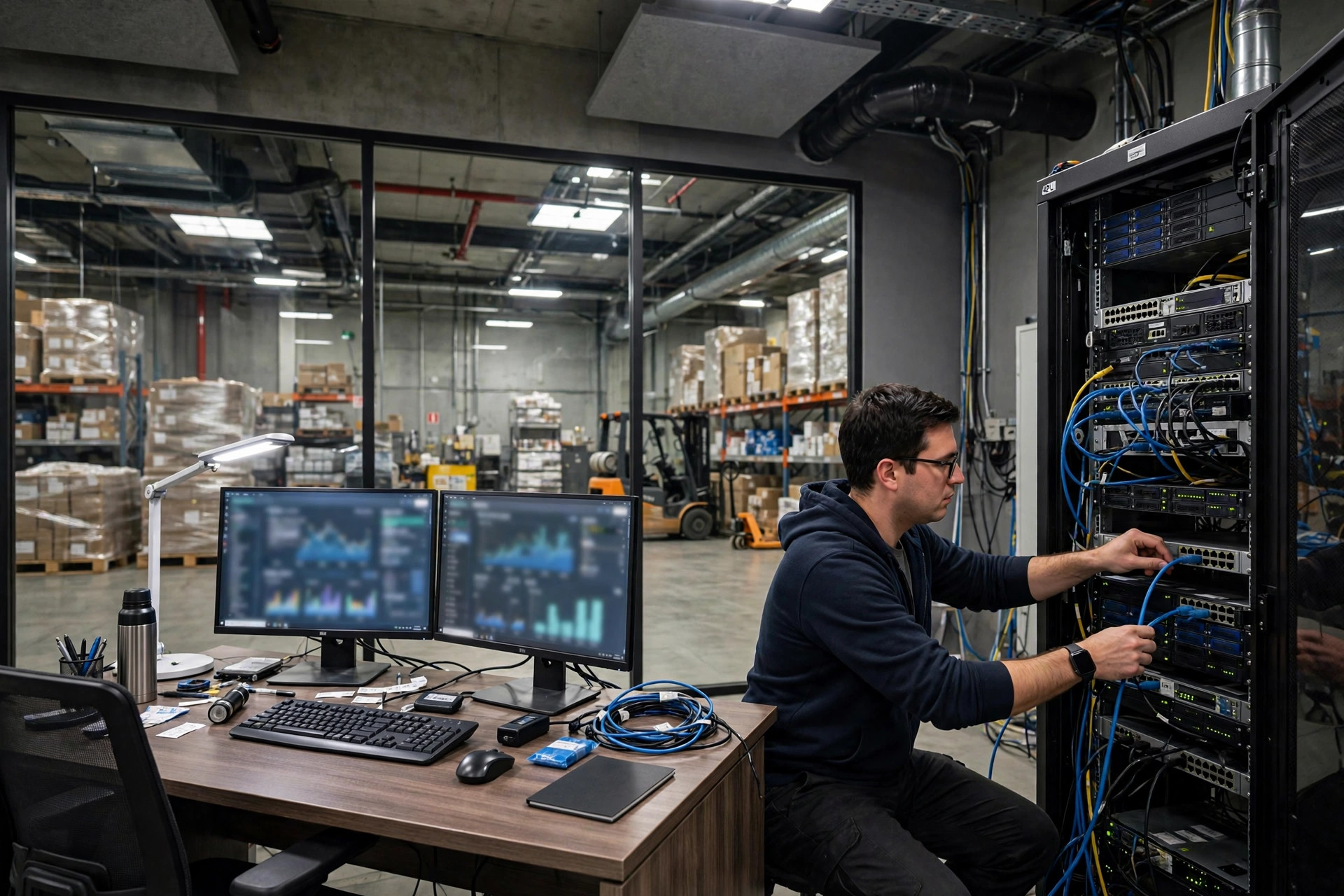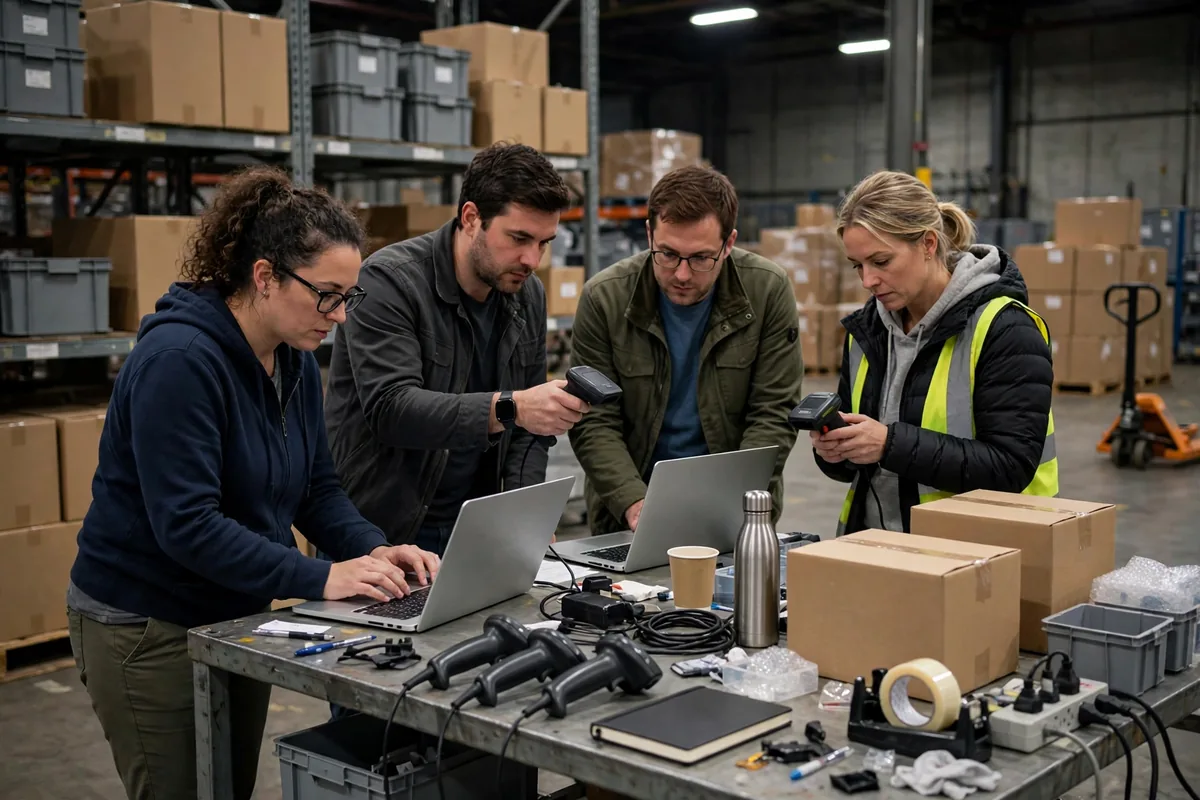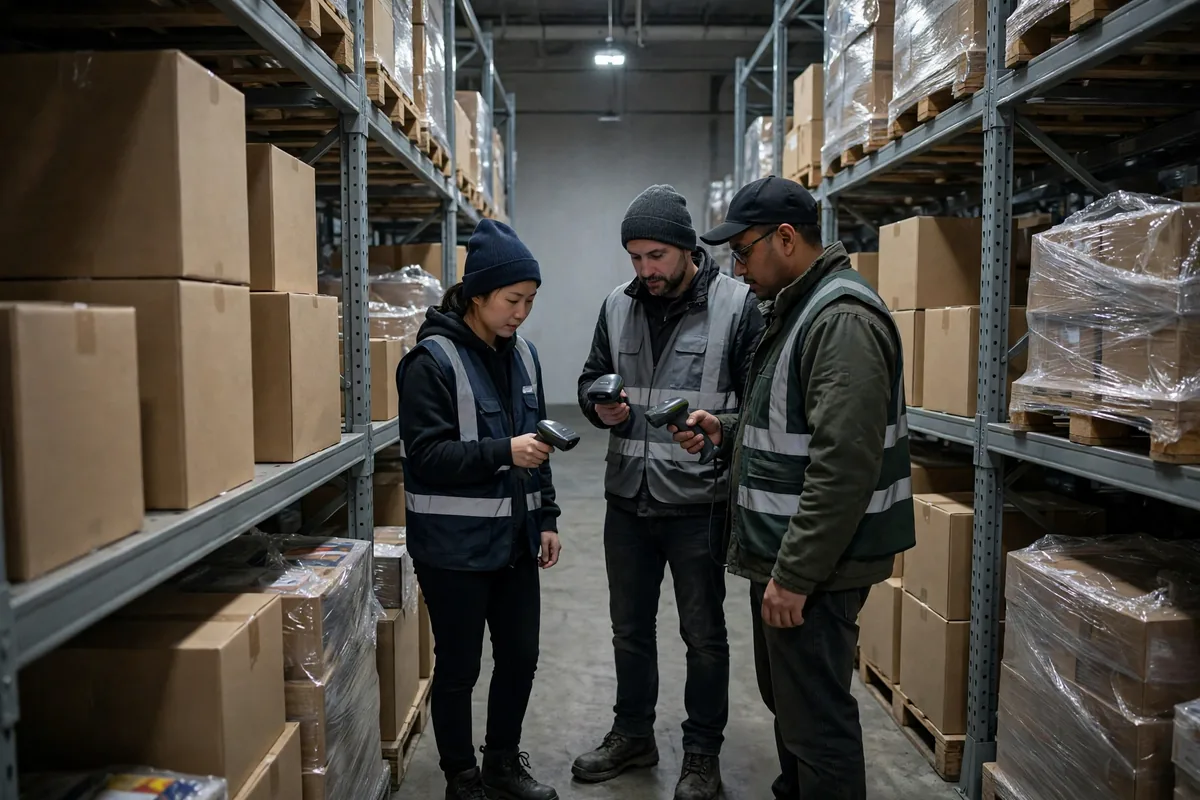
We have a client — a household goods distributor we have served for years — who lost system access on the second morning of their biggest promotion of the year. That is the day wms offline mode warehouse outage contingency stopped being a slide in our proposal and became a live test. More than a hundred people stood between the racks waiting for instructions, scanners would not log in, labels would not print, and inventory could not be checked. The warehouse survived that day, but it paid tuition. Here is what we learned, told the way providers discuss it among ourselves: what actually keeps a 3PL warehouse moving when the system stops, and what your contract should say before it ever happens.
The Day It Happened: wms offline mode warehouse outage contingency Under Load
Our distributor's promotional volume runs several times their normal level. At a little after ten that morning, the cloud service failed. The warehouse manager called me with the tightest voice I have heard from him. Fortunately, that site kept a paper fallback ready: printed receiving logs, pre-printed wave sheets for picking, and a rule that every outbound order was crossed off on paper and signed by two people. Output fell hard for a few hours, but freight kept moving and no truck left empty because of us.
The bill arrived afterwards. Once the system came back, every paper line had to be keyed back in by hand. Reconciliation took two days. A handful of orders went out wrong because handwritten locations were misread, and the client spent the following week apologizing to their customers. That is why I tell every prospect the same thing: paper keeps you alive; it does not keep you accurate. It works for a few hours, at modest volume, with simple products. In a high-volume building with batch and expiry control, half a day on paper can create an inventory mess you will be cleaning up for a week.
Our second client, an auto parts business, is the mirror image. Their contract carried an outage annex from day one, and they had actually rehearsed it. Their handhelds switch to a local mode when the network drops: scans keep working, transactions are stored on the device, and everything syncs back in time order when service returns. When a regional network failure hit them the following year, the shift supervisor followed the annex, updated the client every hour, and the outage became a non-event. At renewal, the client mentioned that day by name. Same kind of failure, two completely different outcomes — the difference was written down and practiced in advance.
Three Layers of Cover: wms offline mode warehouse outage contingency in Practice
When I walk a prospect through offline arrangements, I insist on separating three layers, because vendors love to blur them.
| Layer | What it protects | What it does not protect |
|---|---|---|
| Paper fallback | Receiving logs, pick-by-sheet, signed outbound check-off | Live inventory, batch traceability, speed; every line must be re-entered and reconciled |
| Device local mode | Continuous scanning with on-device storage and time-ordered sync on recovery | Real-time coordination between devices; two workers on one location can create conflicts |
| Written plan and drills | Clear authority, client notification rhythm, no improvisation | Anything, if it has never been rehearsed — an untested plan is just a document |
Now the insider detail most buyers never hear: many systems advertise offline capability that covers only part of the workflow. Receiving may scan offline while putaway and counting cannot. On-device storage may hold only a limited queue of transactions, after which the "offline mode" quietly stops being a mode at all. So before you sign, do not listen to the story. Ask the provider to pull the network cable in front of you and demonstrate: how many transactions the device holds, which tasks still work, how sync behaves on recovery, and whose record wins when two records collide.
Sync conflicts deserve their own rule, agreed in advance. Illustrative example: during an outage, two workers handle the same location an hour apart, one on paper and one on a device. On recovery, the system can only post one version cleanly; the other becomes a variance. Our standard rule is that the timestamped record leads, the conflicting entry is parked for manual review, and nothing is silently overwritten. Without that rule, recovery day becomes argument day.
Paper discipline matters just as much. Fallback forms should be pre-printed with sequential numbers, logged when used, and kept even when voided, so re-entry can be reconciled line by line. Entries are written legibly, corrections are struck through and initialled, never scribbled out, and forms are filed by hour and task type at every shift handover. Re-entry order matters too: outbound and shipping first, because that is what the client is watching; receiving and putaway next; count variances last, with two-person verification. The distributor from my first story adopted exactly this discipline after their bad week; their next short outage was reconciled in half a day instead of two.
And rehearse. A drill does not need drama: pick a quiet afternoon, cut the network for two hours, and run receiving, putaway, picking, and shipping on the plan. Note every stumble — who cannot find the paper forms, whose device will not switch modes, who forgets the client notification order — then fix the plan and keep the new version where the shift supervisor can grab it. I always include a new hire in the drill, because on the real day, the person on shift may well be the newest one in the building. A plan is written for the least experienced person who will ever use it.
What the Contract Should Say, and How the Client Should Hear It
Here is a provider's honest confession: a precise wms offline mode warehouse outage contingency clause protects both sides, and vague language is where relationships go to die. At minimum, I want four things written down. What counts as an outage, in plain terms. How quickly the client must be notified, and how often updates follow. What the recovery target is, in hours, and who owns data re-entry and variance resolution afterwards, on what timeline. And where responsibility sits for each failure type — cloud service, local network, client-owned equipment — because lumping them together guarantees a fight. Beware contracts that hide everything behind an unlimited force majeure clause; they look convenient at signing and turn poisonous at the first incident.
Communication has a rhythm, and we train our teams on it. Report the fact of the outage immediately, without guessing at causes or promising a recovery time you do not control. Then update on the agreed schedule even when there is nothing new, because silence is what clients actually fear. Within two days of recovery, deliver a short written review: which orders were affected, what was done about them, and what changes so the next one hurts less. Clients forgive outages. They do not forgive being kept in the dark.
There is also a longer bill nobody quotes at signing: the real cost of an outage is rarely the freight that moved slowly for a few hours. It is the reconciliation labour, the reshipments, and the trust repair that trails behind for months. Handled badly, one outage gets remembered at every future rate review. Handled cleanly, it can genuinely strengthen the relationship — I have watched it happen.
So, next time you negotiate a warehousing contract, remember to ask these three questions. First: show me, on a live device, exactly what your warehouse does when the network drops. Second: how fast do you notify me, and how often do you update me — and will you put that in the contract? Third: after recovery, who owns re-entry and variances, and within how many days will the books be clean? Ask those three, and you will know within minutes whether the provider in front of you has a plan, or just a paragraph.
By Susan, 3PL Sales Director