Here's my verdict up front: for a mid-sized warehouse, one eight-hour power outage usually costs several times what the generator itself costs. So there's not much to debate. A warehouse backup generator isn't a question of whether to buy one. It's a question of how big, and how you run it.
Look, a blackout has two sides. One side you can't control: the grid trips, a transformer fails, a storm rolls through. When it comes, it comes. The other side you can control: whether your warehouse can still ship. In the summer of 2023, a 3PL warehouse in California's Inland Empire lost power at 2 p.m. on a 100-degree day. Their UPS kept the WMS servers alive for 40 minutes. After that, the system went dark. Picking stopped. Packing stopped. Trucks sat at the dock waiting for paperwork. They lost close to 900 orders that day. The owner told me later that losing the orders was the small part. Losing the customer's trust was the real damage.
The Cost of a Power Outage vs. the Cost of a Backup Generator
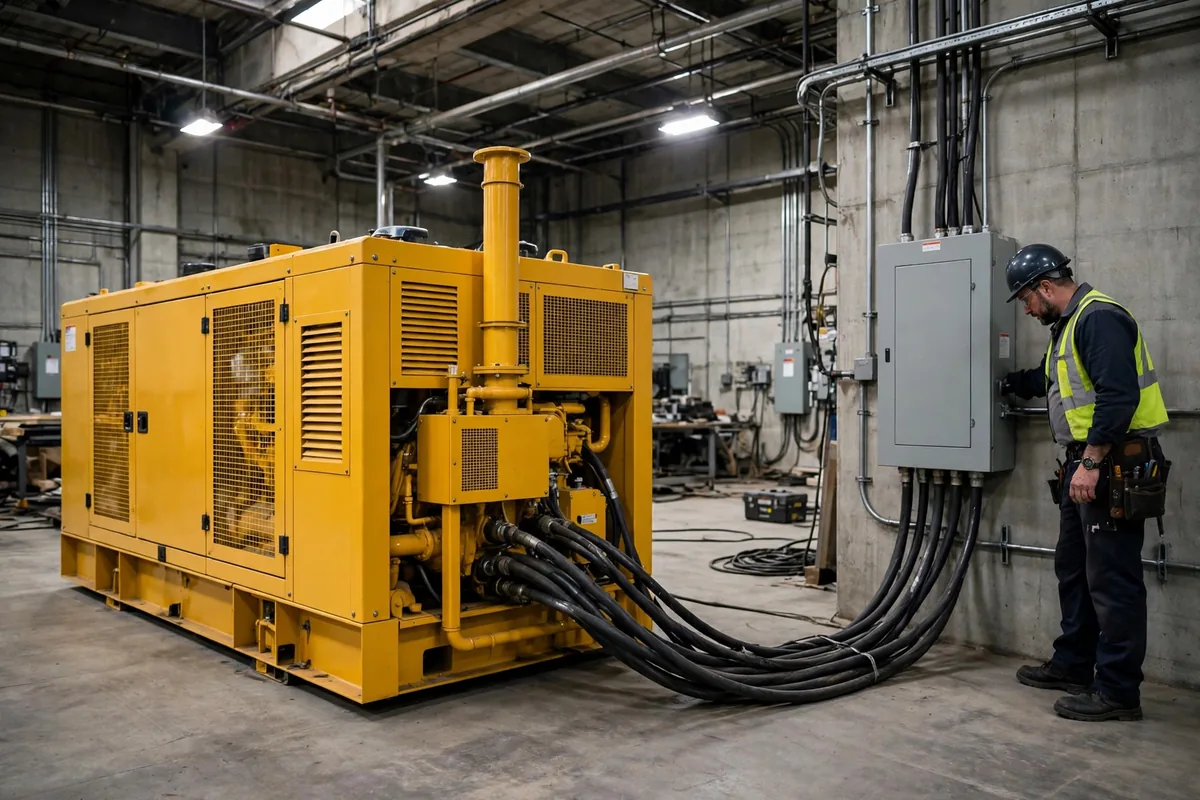
I've seen too many owners do this math wrong. When they price the generator, they stare at the purchase price. A 200 kW diesel unit, purchase plus installation — I won't quote a number here, because prices vary widely by region and vendor; get a current quote. But when they price the outage, they only count "orders we didn't ship" and miss three bigger bills. First, cold-chain losses: two hours without power and temperature-controlled stock starts going bad. Second, claims and lost customers: in 3PL, losing one client takes six months to replace. Third, data damage from a hard shutdown: if your WMS inventory numbers get corrupted, your team spends a week recounting.
Now the other side of the trade-off: bigger is not better. A generator that's oversized is a lump of iron sitting in the corner — it takes space, needs maintenance, and the fuel goes stale. One that's undersized can't carry the load when it matters, which is the same as not having one. The right way is to list your must-keep loads first: WMS servers and network, cold storage compressors, lighting and security doors, packing lines and charger stations. Everything else can go dark: office air conditioning, non-essential lighting, the admin area. When you add up that list, you'll usually find the critical load is only 40% to 60% of the building's peak draw. Size the machine to that number, and the money lands where it counts.
Fuel is the second bill. A diesel generator's hourly consumption at full load is on the manufacturer's spec sheet, but don't take it as gospel — real consumption varies with load. My rule: stock fuel at 1.2 times the rated consumption, enough for at least eight hours at full load. And diesel goes bad sitting in a tank. Rotate stored fuel every six months to a year, following your fuel supplier's guidance. In early 2024, a warehouse in Texas learned this the expensive way: their generator hadn't started in three years, the diesel in the tank had gone bad, and on outage day the machine fired up and died three minutes later. The machine was fine. The fuel was dead.
Sizing Your Backup Generator Is Three Math Problems
When I help a client pick a generator, I make them do three calculations. One: the one-time cost of purchase and installation. Two: the annual holding cost — maintenance, fuel rotation, test runs. Three: the expected cost of one power outage — local outage frequency over the past few years multiplied by the loss per incident. Put the three numbers side by side and the decision makes itself. For most mid-sized warehouses and up, the answer is "buy one." The only real question is the size.
The switchover method matters just as much. Manual transfer versus automatic transfer isn't just a price difference — it's a time difference. A manual switchover takes a trained electrician 15 to 30 minutes from blackout to restored power. An automatic transfer switch does it in under a minute, with the UPS bridging the gap. Is that 20-minute difference worth the cost of the automatic switch? My call: if you run cold chain or high-priority orders, yes. If you're a small ambient warehouse with loose delivery windows, start manual and upgrade later. Either way, you need a UPS — at minimum, one that keeps servers and network alive. A blacked-out system costs more to recover than the outage itself.
The Drill Is the Real Test
Here's the thing most people get wrong: buying the backup generator is the beginning, not the end. A diesel engine sitting idle is a machine rotting in place. Oil settles, batteries drain, coolant degrades. My rule is a no-load test run every month, at least 15 minutes, so the machine actually turns over — not just pressing the start button and listening for a noise. Replace the starter batteries every two years whether they look fine or not. A backup generator that won't start on power outage day is scrap metal.
The drill itself is where most warehouses fail. I've seen generators sit for three years without a single real outage drill. A real drill means pulling the main breaker: does the transfer switch engage, does the load hold, is there enough fuel, does the night shift know what to do? I recommend a full drill every quarter and a no-load test every month. Write down every problem the drill finds. One drill revealed the picking area's lights weren't wired into the emergency circuit — a night outage would have left the floor pitch black. Another time we found the generator room's exhaust vent half-blocked by pallets, and the machine overheated ten minutes in. These things are invisible on a normal day. On outage day, they're everything.
Site selection matters too. The generator room needs ventilation, rain protection, and distance from the office — noise and exhaust are real problems. And keep the doorway clear. The exhaust vent I just mentioned was blocked by storage that had crept in over months.
So here's the deal, both sides of it: the machine is your confidence, the drill is your proof. Buying the backup generator is step one. Whether it actually carries you through a power outage depends on how often you've practiced. When was the last time your warehouse pulled the breaker on purpose?
By Lao Mi, Supply Chain Veteran (20 yrs)