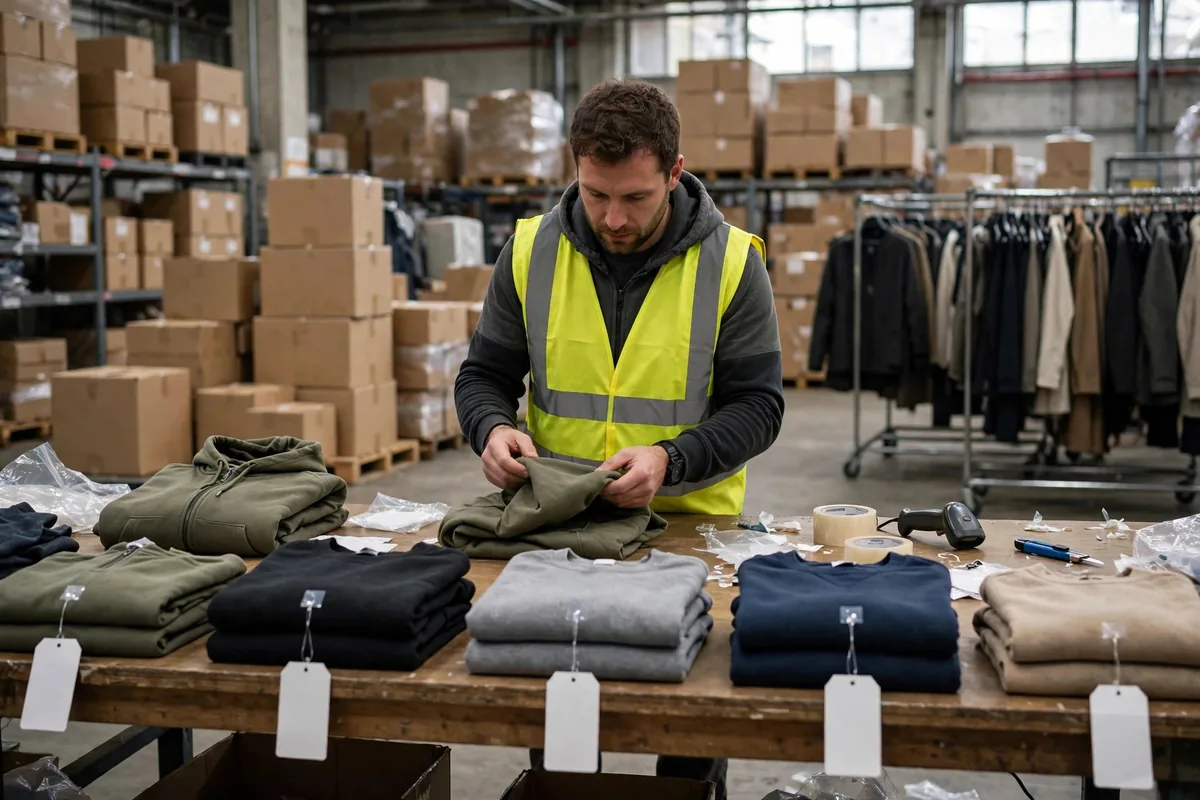
Apparel ecommerce returns sound simple on paper. The customer sends it back, you get it back, done. Anyone who has actually worked a returns bench knows better. The real question starts the moment a returned garment lands in the warehouse: can this thing make money again, or is it already a loss?
I have sold apparel online for five years. When returned clothes pile up on the inspection table, I only care about one thing: where does each piece go next? Apparel ecommerce returns are not a return-rate number. They are a sorting problem, piece by piece.
Apparel Ecommerce Returns Start at the Tag, Not the Garment
When a return arrives, the first thing we check is not the garment. It is the hang tag. Tag intact, string unbroken, barcode scannable, and the item still has a shot at the normal flow. Tag missing or cut off, and the garment has basically lost its identity. Re-listing it means new tags, new photos, new size info, and the labor cost jumps immediately.
I use tag condition as the first sorting gate. During a big sale in November 2024, my warehouse took in more than 300 returns in a single day. Two inspectors, one job: sort by tag first. Intact tags went straight to fit inspection. Missing tags went into their own bin. Swapped tags went straight to the exceptions area. That day I timed it. An item with an intact tag took about 40 seconds to process. One with a missing tag took more than 3 minutes. That gap looks small until returns spike, and then labor hours disappear into it.
Care labels matter too. A garment with its care label cut out often cannot be resold at all, depending on the platform. Check the latest policy on each platform's official site before deciding. I learned this the hard way. Early on, I re-listed a batch of hoodies with cut care labels to save time. The platform took them down for a violation and docked my store score. Since then, a missing care label means C-grade, no debate.
Checking Apparel Ecommerce Returns: Try-On Marks, Smell and Stains
Once the tag passes, the garment itself gets checked. Three things: try-on marks, smell, stains. Simple to say, full of judgment calls in practice.
Try-on marks are the hardest to judge. Stretched cuffs, a deformed collar, a zipper that sticks, a missing button. You have to handle each piece. In March 2025, a batch of returned knit cardigans came back with all tags intact and looking clean. My inspector picked one up and the cuffs had been stretched out of shape. Sell that again and the next buyer returns it too. That is a second round of shipping and a second round of inspection labor, wasted.
Smell is the second hurdle. Cigarette smoke, perfume, hot-pot smell. One of those sticks and the item is trouble. My rule is three levels: no smell goes through, light odor hangs in the airing area for 24 hours and gets re-checked, strong odor gets downgraded right away. A lot of sellers skip the airing step because it feels slow. Run the numbers and it pays. A $29 sweater that airs for a day can sell at full price instead of 30% off. That saves about $9 a piece, hypothetical example for illustration only.
Stains are the most direct. If it can be washed out, it goes to cleaning. If it cannot, it gets downgraded. Lipstick and foundation marks are the worst offenders in apparel ecommerce returns, usually on collars and cuffs. I added a note on my product pages asking buyers to be careful when trying items on. Those returns dropped a bit, but you cannot fix this one completely.
The A/B/C Grade That Decides What Happens Next
After inspection, everything gets a grade. My warehouse uses A, B and C, and the rules are posted on the wall so a new hire can read them on day one:
| Grade | Standard | Destination |
|---|---|---|
| A | Tag intact, no try-on marks, no odor, no stains | Re-list at full price |
| B | Tag intact, light try-on marks or light odor, fixable | Clean or air, then re-list at a discount |
| C | Missing tag, visible stains, strong odor, deformed | Clearance, donation or disposal |
The table looks easy. Execution is where it breaks. Grade B causes the most trouble, because "light" means something different to everyone. I require inspectors to photograph every B-grade item and keep the photos for three months. If a buyer complains, we have evidence. Grade A is not worry-free either. For A-grade re-listings, I disclose honestly that the item is a returned item being resold, following each platform's rules. Check the latest policy on the platform's official site. Do not try to pass it off as brand new.
Grade C needs a destination decided in advance. Clearance pricing works for items still wearable. Donation works for bulk. Disposal is for items that genuinely cannot circulate again. My rule is that C-grade stock never sits overnight. Every Friday we clear it in one go. Let it pile up and it eats shelf space and headspace.
Here is the counterintuitive part: a higher A-grade rate is not always good news. I once had my A-grade rate climb above 90%, and I felt great about it for about a week. Then I dug in and found inspectors were pushing borderline B items into A to avoid the extra work. The re-listed return rate went up instead. Grading is a promise to the buyer, not a scoreboard for the team. Set the bar strict and keep it there.
Fixing Size-Level Returns Before You Reorder
There is one more ledger most sellers miss: size. High returns often do not mean bad quality. They mean the sizing is off. Every month I pull return data by size and look for the size band running clearly above the average.
In May 2025, the M size of one dress hit a 35% return rate while S and L sat around 15%. The M ran small. Buyers ordered their usual size, found it tight, sent it back. I did not slash M inventory. I changed the size guidance on the listing, telling M-size buyers in a certain height and weight range to size up. The next month, M returns fell back to around 20%. Those are my own store numbers, not an industry benchmark, for reference only.
The reorder logic follows the data. Size bands with high return rates get fewer units next order, and that stock shifts to the sizes with low return rates. At the same time, clearer size guidance cuts "wrong size" returns at the source. Hypothetical example: a style sells 1,000 units a month. Cutting the return rate from 25% to 20% means 50 fewer returns to process each month. At a rough handling cost per piece, the saving covers half an inspector's time.
Three warnings before I stop. First, returns do not end when the parcel comes back. The grading bench is the real cost center. Second, write the grading rules down and post them on the wall. Rules passed by word of mouth fall apart the moment a senior inspector leaves. Third, disclose re-listed returns honestly and follow platform rules. Check the latest policy on each platform's official site. The money you save by cutting corners comes back as penalties and lost store score.
Get the grading ledger right, and apparel ecommerce returns stop being pure loss. They become a process you can actually improve. This one I tested myself, and it works.
By Ah K, E-commerce Seller (5 yrs)