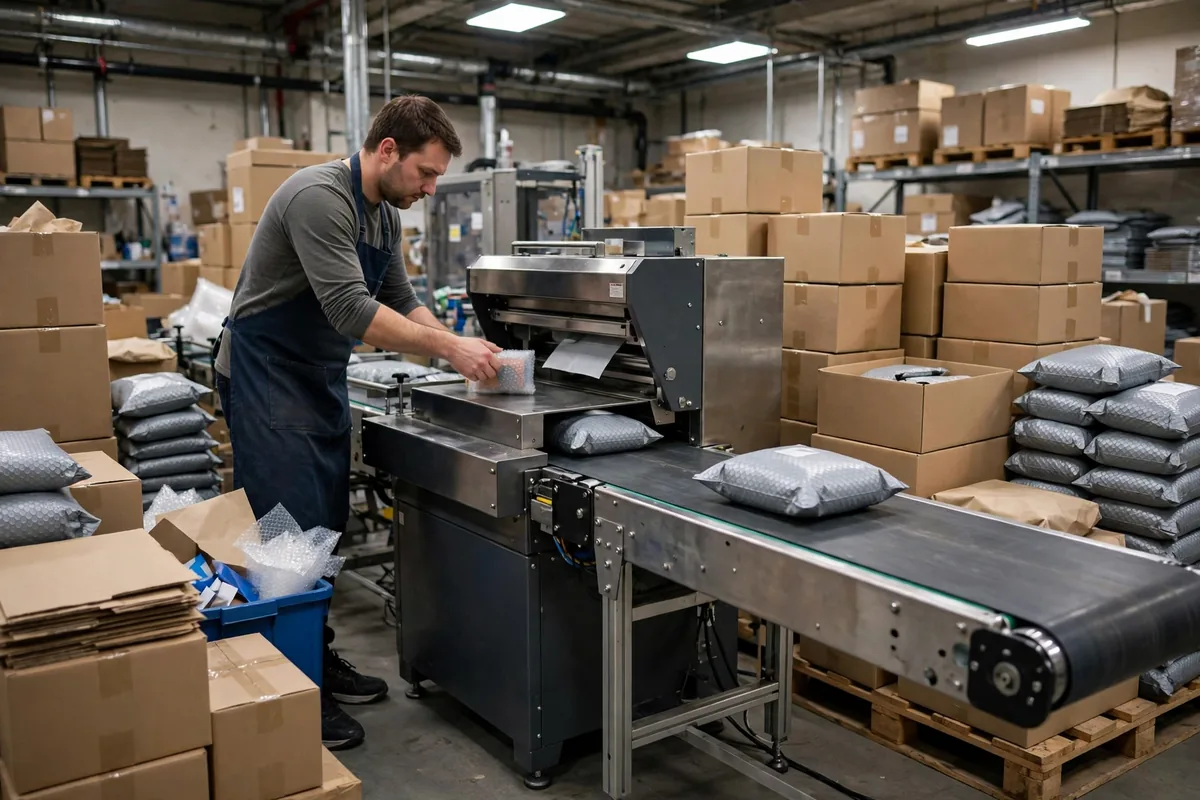
"We can't afford to burn money on that" — that was the first sentence in my head when I first heard the price of an automated bagging machine. Our warehouse is 3,000 square meters, a dozen people, maybe a little over 1,000 orders a day in peak season and six or seven hundred when it is slow. The salesperson said the machine could bag six or seven hundred parcels an hour. I thought, what good is that speed? I only have so many orders a day. A machine cannot go out and win orders for me.
And yet, every evening, the packing bench looked like a disaster zone, and I could not stand watching it. Bags, labels, tape, scissors all over the table. Two people scrambling, one tearing bags open, one sticking labels on. One wrong label meant one more customer complaint. One night before a big sale, we worked until 2 a.m., the floor covered in bags we had opened by mistake and had to redo. I was squatting there picking up labels, thinking only one thing: if we keep working like this, the people will break down before we ever buy a machine.
So this is not a piece trying to sell you a machine. It is a piece to help you do the math with me. Once the math is clear, buying or not buying is your own call.
How Our Warehouse Did the Bagging Machine Math
First, a clear warning: every number below is a hypothetical worked example based on our warehouse. It is not an industry average, and it is not anyone's quotation. Use it as a reference if you like, but do not place an order based on it. Redo the math with your own warehouse's numbers.
Say one automated bagging machine, installation and commissioning included, costs 180,000 yuan as a one-off investment in this hypothetical example. The bags cost a little more than the ones we use by hand — say 0.05 yuan extra per bag. On labor, say packing one small parcel by hand takes 40 seconds, and with the machine one person watching two machines brings that down to 12 seconds per parcel. Wages at 25 yuan an hour — again, a hypothetical figure, not a job advertisement.
That puts labor cost per parcel at 0.28 yuan by hand and 0.08 yuan with the machine, saving 0.20 yuan. Subtract the extra 0.05 yuan for bags, and the net saving is 0.15 yuan per parcel. Divide 180,000 yuan by 0.15 yuan and you get 1.2 million parcels. At 1,000 orders a day, that is 1,200 days — more than three years to break even. Three years, and the machine is almost out of warranty. When I finished that calculation, I closed the quotation and put it away.
But the math was not that simple. I later realized it left out two things. One is mis-shipping and rework: hand bagging means wrong labels and wrong items, a few dozen orders a month, and the return shipping plus repacking labor adds up to, say, 2,000 yuan a month in this hypothetical example. A machine cuts most of that, which is more than 20,000 yuan a year. The other is peak season. On a normal day we do 1,000 orders. In peak season we can hit 3,000 a day. Hand packing cannot keep up, so we hire temporary workers, and you know how fast and how accurate temporary workers are. In peak season, the machine does not save money. It saves the operation.
| Item | Hand bagging (hypothetical) | Automated bagging machine (hypothetical) |
|---|---|---|
| Labor time per parcel | About 40 seconds | About 12 seconds |
| Labor cost per parcel | About 0.28 yuan | About 0.08 yuan |
| Bag cost | 0.05 yuan cheaper | 0.05 yuan more |
| Net saving per parcel | — | About 0.15 yuan |
| Peak-season capacity | Depends on temp hiring | One machine covers two people |
| Mis-ship rework | A few dozen orders a month | Noticeably less |
At What Order Volume Does a Bagging Machine Pay for a Small Warehouse
Based on our warehouse's hypothetical example, I drew my own dividing line. Below 800 orders a day on average, forget it. Sort out the hand process first: sort bags by size into separate bins, do not put the label printer three meters from the packing bench, scan the goods before sticking the label on. These low-tech fixes cost nothing and work right away. We did all of that first, cut our mis-ship rate in half, and only then had the confidence to talk about a machine.
Between 800 and 1,500 orders a day is the awkward middle. That is when you can rent, buy second-hand, or share one machine with the warehouse next door. Do not listen to salespeople telling you to buy the top model in one step. A small warehouse survives first and worries about looking proper later. I know a clothing warehouse owner doing 1,200 orders a day who bought a second-hand machine, runs it hard in peak season, covers it up in slow season, and does just fine.
Above 1,500 orders a day, sustained for three months in a row, is when you should seriously talk about buying new. At that point the machine is not a luxury, it is a capacity bottleneck. You cannot hire fast enough, peak season means overtime until midnight every night, and mis-ship complaints keep piling up. If two of those three signs are true, stop hesitating.
Here is a counterintuitive point the salesperson will never tell you: the first thing a machine saves is not necessarily money. It is the gap left when a person walks out. What small warehouses fear most is not low order volume. It is the veteran packer who takes leave or quits without warning, and suddenly the packing bench loses half its capacity. A machine never takes leave and never has a bad mood. That sounds cold, but every small warehouse owner understands it.
Fix the Low-Tech Way First, Then Talk Machines
One last honest word. For a big warehouse, an automated bagging machine is standard equipment. For a small warehouse, it is a choice. We still have not bought a new one. We run a second-hand machine plus a set of low-tech fixes: bags sorted by size, double-checking by a second person replaced with scan verification, and consumables stocked two weeks before peak season. With that combination, life at a little over 1,000 orders a day is perfectly manageable.
Small warehouses have their own way of surviving. Do not force yourself to buy a machine before you can afford it, and do not puff yourself up to buy one you do not need. Work out three numbers honestly first: your daily average orders, your mis-ship cost, and your peak-season volume. Then go look at the quotation. By then you will not be looking at a machine. You will be looking at your own numbers.
By Xiao Ma, Small Warehouse Owner