Think of a forklift battery as the truck's appetite and its eating habits. A lead-acid battery is a big eater that needs a long meal and a long nap afterwards. A lithium battery is the office worker who grabs a quick bite whenever there is a gap and gets straight back to work. That one difference is enough to swing the cost of a single forklift over five years by a wide margin. But let me say this first: there is no standard answer to the forklift battery lithium vs lead acid warehouse cost question. The answer lives in your shift pattern.
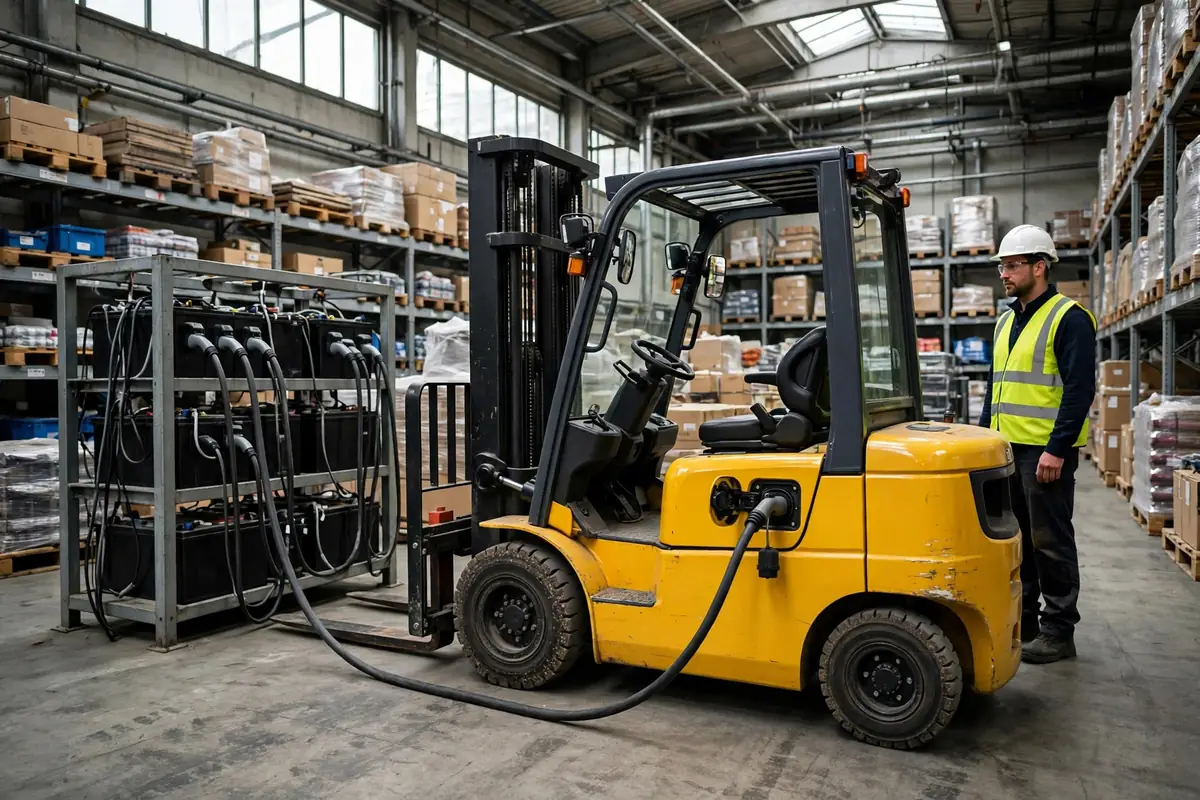
Start with the principle, because once the principle is clear, the selection stops being a guessing game. A lead-acid battery takes about 8 hours to charge, plus about 8 hours to cool down. In other words, from empty to ready for work again takes most of a day. You can think of it as a "charge overnight" player: charge at night, work in the day, and the rhythm is fixed. Lithium is different. It charges in 2–4 hours and supports opportunity charging — plug it in during a lunch break or a shift change and it picks up charge while you are not looking. It is the difference between fast charging a phone and using an old slow charger. The two run on different ideas of time.
Efficiency is just as clear-cut. Lead-acid energy efficiency runs about 80–85%. Lithium runs about 95%. For every hundred units of electricity you put in, lead-acid turns a good chunk of it into heat and throws it away, while lithium wastes only a small slice. Do not dismiss that gap as small print. A forklift runs every day, and over a year the electricity difference speaks for itself. But here is the blunt part up front: higher efficiency does not automatically mean cheaper. Whether it pays depends on how many shifts you run a day.
Forklift Battery Lithium vs Lead-Acid: The Dividing Line Is Shifts
Look at the purchase price first. A lead-acid battery costs about $2,000–$6,000. A lithium battery costs about $6,000–$25,000, and high-end 48V/80V packs cost more. On purchase price alone, lithium looks frighteningly expensive, and plenty of people stop right there and pick lead-acid. This is exactly where I want to push back: choosing a battery on purchase price alone is fake-demand math. A battery is not a decoration you buy and admire. It is a consumable that gets charged and discharged every day, and the purchase price is only the first payment.
Then look at cycle life. Lead-acid lasts about 1,000–1,500 cycles. Lithium lasts about 2,500–4,000 cycles. Think of cycle life as the battery's lifespan. Lead-acid lives a short life, lithium lives a long one — more than twice as long. A short life means you may have to replace the battery within five years, and a replacement is not just another payment. It means downtime, a reshuffled shift plan, and a new charging schedule. None of those hidden costs appears on the quotation.
Let me run two costings for you, and I will be explicit about where they come from: both are worked examples from published buyer guides, not measurements from our own warehouse. Single-shift, five-year example: lead-acid about $15,000, lithium about $17,500. On a single shift, lead-acid is cheaper, and the electricity and time that lithium saves cannot make up the difference. Double-shift, five-year example: lead-acid about $30,000, lithium about $17,500. Double the shifts and the lead-acid bill doubles — spare batteries, charging room, and labor to swap batteries around. The lithium bill barely moves, because opportunity charging carries the second shift.
| Item | Lead-acid | Lithium |
|---|---|---|
| Purchase price | About $2,000–$6,000 | About $6,000–$25,000; high-end 48V/80V packs more |
| Cycle life | About 1,000–1,500 cycles | About 2,500–4,000 cycles |
| Charging time | About 8 hours + about 8 hours cooling | 2–4 hours, opportunity charging |
| Energy efficiency | About 80–85% | About 95% |
| Single-shift, five-year example | About $15,000 | About $17,500 |
| Double-shift, five-year example | About $30,000 | About $17,500 |
Do you see it? TCO worked examples from different sources use different assumptions, so the conclusion depends on shifts — that point has to be nailed down. The same forklift on a single shift and on a double shift is two different account books. Anyone who quotes one worked example and tells you "lithium always saves money" or "lead-acid is always cheaper" is not doing math. Across multi-shift operations, lithium's five-year TCO runs about 20–40% lower than lead-acid by several industry comparisons. On a single shift, lead-acid is usually the cheaper option. The conclusion is not in the battery. It is in your roster.
Here are two scenes you will recognize from this industry, using the same published worked-example figures above as a reference for selection — not as our own measured quotes. First scene: a single-shift warehouse. The forklift works in the day and charges at night. The lead-acid battery charges slowly overnight, cools down slowly, and starts the next day fully charged. Over five years that roughly $15,000 lead-acid bill is simply the cheaper deal, and the extra money for lithium does not pay itself back. Second scene: a double-shift warehouse where the forklift barely stops. Lead-acid needs spare batteries, cooling time, and someone dedicated to swapping them, and the five-year bill runs to about $30,000. Lithium tops up in the gaps and the five-year bill stays around $17,500. Same forklift, same warehouse logic, different shift pattern, opposite answer.
There is also a trend worth watching: lithium accounts for over 40% of new electric forklift sales, up from about 15% in 2020. The market is moving toward lithium, and that is a fact. But where the market is moving is not the same as where your warehouse should move. That trend was driven by multi-shift, large warehouses. If you run a single-shift operation and follow the crowd, you are spending your own money on someone else's trend.
Forklift Battery Maintenance Traps: Lead-Acid Needs Looking After, Lithium Hates Improvisation
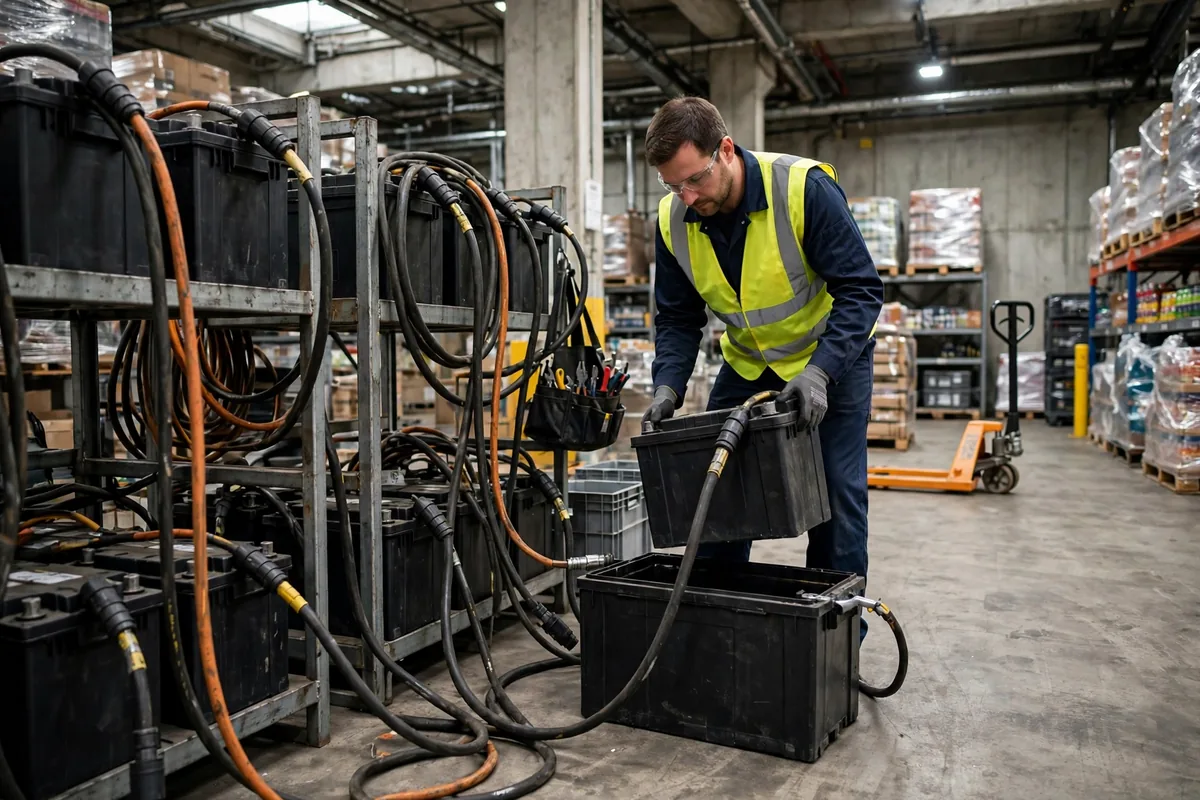
The dividing line is drawn. Now the maintenance traps, which is where the forklift battery lithium vs lead acid warehouse cost debate usually gets decided in practice. A lead-acid battery is a high-maintenance guest: the rhythm of about 8 hours charging plus about 8 hours cooling cannot be messed with, or the cycle life takes the hit. Swapping batteries needs people, equipment, and floor space, and the charging room needs ventilation. None of that looks expensive on its own. Over five years it all adds up, and every bit of it shows up as a hole in the shift plan.
Lithium's trap sits at the other end: do not improvise. Lithium hates being run outside the rules. The charger and the battery management system have to match — do not mix and match to save a few dollars. Opportunity charging is lithium's biggest strength, but it is not "plug in whenever you feel like it and yank it out whenever you feel like it." It follows the battery management system's rules. One more thing: ask about residual value and recycling channels before you buy, not on the day you need to replace the battery and discover nobody will take it.
Here is the counterintuitive judgment: a lot of people think buying lithium means "buying advanced technology" and buying lead-acid means "being cheap." Wrong. On a single shift, lead-acid is careful money. On double shifts and beyond, lithium is careful money. Neither advanced nor cheap is the standard for choosing a battery. Shifts are. The forklift battery lithium vs lead acid warehouse cost question is not set by the battery makers. It is set by your shift roster.
So let me close it the way I always close it. That is the whole point of the forklift battery lithium vs lead acid warehouse cost debate. Whether the money is worth spending comes down to one number: how many shifts a day does your forklift run? Single shift, and the lead-acid bill will most likely be cheaper. Double shift and up, and the battery swaps, the swap labor, and the downtime that lithium saves will eat back the higher purchase price. Count the shifts first, then choose the battery. Do not get the order backwards.
By Da Liu, Automation Engineer