Let's start with the bill.
"How much does warehouse automation cost per square foot?" I get asked some version of this every single month. And my answer is always the same: wrong first question. Ask which tier you're buying instead. The same 50,000-square-foot building can cost twenty times more to automate with a shuttle-based AS/RS than with pick-to-light. Cost per square foot is just a translation layer — the real ledger has four lines: equipment, integration, commissioning, and downtime.
Here is the short version, then the math. Light retrofits land around $5–$50 per square foot. Conveyor systems run roughly $10–$40. An AMR fleet comes in around $5–$20. Full AS/RS territory starts near $25–$75 per square foot and climbs from there. Treat those as orders of magnitude, not quotes — always get current numbers from an integrator. But the relative gaps between the tiers are real, and they are enormous.
Cost Per Square Foot by Tier
I sort retrofit projects into four tiers by how hard they burn cash. The project totals below come from publicly reported industry ranges — small point solutions $50K–$500K, mid-size semi-automated builds $500K–$5M, large highly automated facilities $5M–$15M+. The per-square-foot column converts those totals at a reference building size, so read it for the relative picture:
| Tier | Typical scope | Project total (order of magnitude) | Reference building | Per sq ft (converted) |
|---|---|---|---|---|
| Light | Pick-to-light, single VLM units, scan-and-weigh stations | $50K–$500K | 10K sq ft | $5–$50 |
| Conveyor | Roller/belt conveyor lines, sortation loops | $500K–$2M | 50K sq ft | $10–$40 |
| AMR fleet | 20–50 mobile robots plus fleet software | $500K–$2M | 100K sq ft | $5–$20 |
| AS/RS tier | Shuttle systems, high-bay automation | $5M–$15M+ | 200K sq ft | $25–$75+ |
The first reaction most people have to this table is: an AMR fleet is cheaper per square foot than conveyor? Not so fast — the reference buildings differ. The AMR row converts at 100,000 square feet; the conveyor row at 50,000. That is the first trap in the metric: the denominator is floor area, but automation spend correlates weakly with area and strongly with order volume and SKU structure. The denominator is doing quiet work here. Most integrators will not quote you a flat warehouse automation cost per square foot for exactly this reason — the number moves with your order profile, not your floor plan.
Now the cost structure, using the conveyor tier as the example. Most quotes show you a single total. I split it into four lines:
| Line item | Magnitude | Note |
|---|---|---|
| Conveyor hardware | $165–$360 per linear foot | Published equipment price lists; install excluded |
| Electrical controls + software interface | Separate line | PLC panels, WCS integration |
| Installation, integration, commissioning | 20%–40% of hardware + software | The line item most often buried |
| Civil, power, fire-sprinkler rework | Site-dependent | Old buildings blow this budget routinely |
That third row is where budgets go to die. Twenty to forty percent of hardware-and-software spend on integration is the documented industry norm; the worst case I have personally seen hit half the equipment price. Any quote that waves "integration and commissioning" through in a single line is a quote that will grow later.
Two Warehouses, Two Real Ledgers
In 2024, a 50,000-square-foot 3PL in Ontario, California asked me to sanity-check a conveyor retrofit. Four thousand orders a day, fourteen people in pick, overtime stretching past midnight in peak season. The design called for roughly 900 linear feet of roller conveyor tying pick, audit, and pack together. The math: per-foot hardware pricing is public information — 900 feet lands in the low-to-mid six figures on equipment alone. Add controls, the WCS interface, and integration at roughly 30%, and the all-in number reaches the high six figures. Divided by 50,000 square feet: low teens per square foot, squarely inside the conveyor band in the table above.
Worth it? Judge by ROI, not by unit price. Headcount in pick dropped by nearly half, mis-pick rates fell, and at their order volume and labor cost the payback penciled out to roughly two to three years — consistent with the 18-to-36-month payback band commonly reported for mobile-robot projects. I told them to sign.
The counter-example came in 2023: a 12,000-square-foot e-commerce warehouse in the Inland Empire, 7,000–8,000 small-parcel orders a day, doing nothing but pick-to-light across roughly 800 pick faces. Total project: low six figures. Per square foot, that number looks outrageous — which is exactly the wrong calculation. A small warehouse should never price automation per square foot; it should price it per order. Spread the project total over five years of order volume and the amortized cost is a few cents per order. Two months of peak-season overtime savings paid the ledger flat. The owner balked at the per-square-foot number; I made him swap the denominator to orders, and he signed ten minutes later.
The Cheapest Cost Per Square Foot Can Be the Most Expensive
Here is the contrarian take: the tier with the lowest warehouse automation cost per square foot does not necessarily carry the lowest total cost of ownership. The gap lives in two costs that never appear on the quote: integration and downtime.
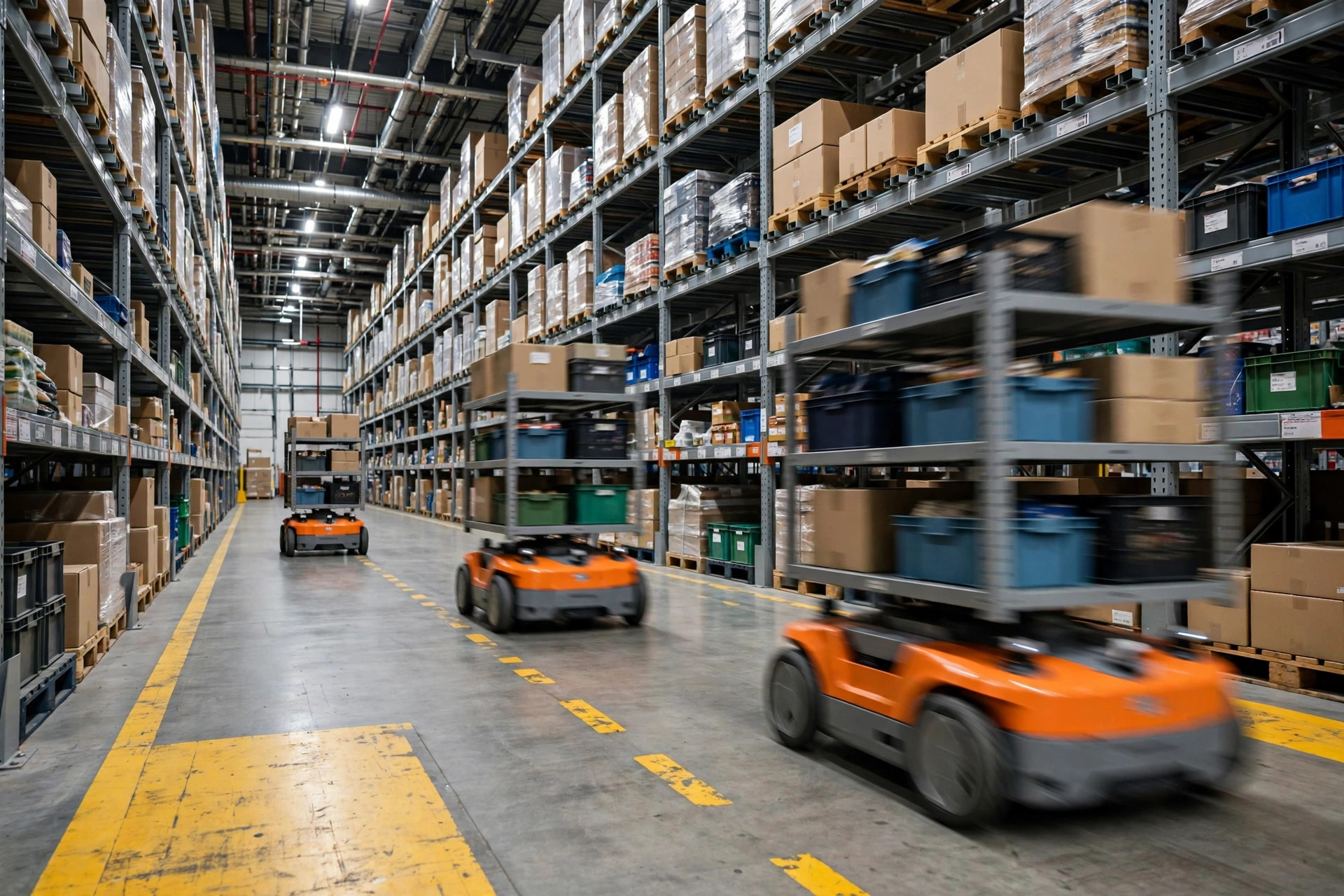
Conveyor hardware looks honest on a per-foot basis, but it is a "one break, all break" system — one jammed carton or one failed controls segment stops the entire line, and audit and pack wait with it. AMRs start in the five figures per unit, which is not cheap, but one dead robot is just one dead robot; the fleet keeps running. And when volume grows, you add ten robots instead of having paid, on day one, for a conveyor sized for year five. A telling detail from published industry data: a single AMR is a five-figure purchase, but a full-facility rollout with software, integration, and service lands in seven figures. The delta is all integration and software — not the vehicle.
So the trade-off is simple: volatile order profiles and fast-changing SKU mixes favor the "expensive per unit but scalable and fault-isolated" option. Stable volume and a process that will not change for a decade favor the conveyor's low sticker price. Buy the wrong script and whatever you saved per square foot gets handed back in a single peak-season outage.
Three Levers That Actually Save Money
First, force every quote into two lines: equipment price, and integration/commissioning. Twenty to forty percent of hardware-plus-software spend is the industry norm for integration; any lump-sum quote is quietly charging you for the integrator's uncertainty. Bid equipment on magnitude, and lock integration by man-day.
Second, do not buy for year five's volume. Poured-concrete conveyor is a sunk cost; AMRs and shuttles scale in phases. If annual order growth tops 30%, pick the system that lets you buy twenty robots this year and ten more next year.
Third, put downtime into the TCO. Ask the integrator for three numbers: MTBF, MTTR, and spare-parts lead time. Any ROI that cannot price downtime is a paper ROI.
And a quick locator framework:
| Your profile | Tier to look at | Denominator for the math |
|---|---|---|
| Under 2,000 orders/day, under 20K sq ft | Light | Per order, not per square foot |
| 2,000–10,000 orders/day | Conveyor or AMR fleet | Cross-check per order and per sq ft |
| Over 10,000 orders/day, concentrated SKUs | AS/RS tier | Per sq ft and per pallet position |
One calculable conclusion to take home:
Automation cost per order = project total ÷ (5 years × annual order volume). If that number sits under 30% of your current labor cost per order, talk to integrators. Over 50% — that money is being wasted; go fix your processes and ABC slotting first. Get current quotes from integrators — but the formula does not change.
By Lao Zhou, Logistics Cost Analyst