
After fifteen years hauling food freight, I've learned that warehouse allergen storage segregation usually exists on paper long before it exists on the floor. Here are the 6 things FDA and SQF auditors really look at — how to zone your locations, how to stack pallets, how to label, how people and forklifts should move, and what records to keep. All from things I've seen with my own eyes at warehouse doors.
Let me tell you, the first time I understood how serious the word "allergen" is, it wasn't in any training class. It was at a warehouse dock door.
Fall of 2019, Ontario, California. I rolled into a 3PL food warehouse at night to pick up a load of cookie ingredients. The staging area was bright, and I could see it plain as day: pallets of peanut snack bars on the left, pallets of "gluten-free" oats on the right, maybe two feet apart, forklifts weaving between them. I joked with the receiving guy: "Peanuts next to the gluten-free stuff — not worried about cross-contact?" He waved me off. "Just for tonight. Separate trucks tomorrow. No big deal."
Next morning it was a big deal. The loading crew rushed and put two pallets of oats on the peanut-bar order. The customer was a school-channel distributor — they checked labels, rejected the whole truck. The warehouse ate the freight both ways, and that customer had been about to sign a long-term contract. Deal dead. The owner told me over beers that the annual revenue he lost could have paid two full-time QA people for three years.
Fifteen years behind the wheel, and I've noticed a pattern: nine times out of ten, allergen problems don't start on the racks — they start at receiving and staging. On the racks people at least try to keep things apart. At receiving, when it gets busy, everything lands on the floor "just for now" — and that's where segregation goes to die.
Another one I saw myself, 2022, south of Chicago. A big bag of milk powder split open at the receiving dock, white powder everywhere, and six feet away sat pallets of "dairy-free" cookie premix headed for school cafeterias. The receiver swept it up, wrapped the broken bag, done. I know that manager well, so I said, "Buddy, milk powder is dust, and dust drifts. You sweep, the dust settles on those boxes, those boxes roll into your allergen-free zone — you just un-segregated everything."
Three months later FDA asked for the cross-contact records for receiving. The warehouse had nothing and got written up — an FDA observation makes the customer's next SQF audit ten times harder. Six months of corrective action followed. "Two lines of paint and a few signs," he told me, "would've done it."
Here's what those stories tell me: allergen segregation isn't about keeping things clean, it's about keeping things apart. A warehouse with gleaming floors can have terrible allergen management. Auditors don't care how shiny your floor is. They care whether allergen and allergen-free product are truly separated — physically, in your system, in the paths people walk — and whether you can prove it.
Now the counterintuitive part: plenty of warehouse managers treat segregation as the enemy of efficiency — "it eats floor space." Let me tell you, it's the opposite. Segregation is the cheapest insurance a warehouse can buy. Paint lines and signs cost a few hundred dollars, once. Training and a daily walkthrough cost next to nothing. Compare that with one incident:
| What you spend | Rough magnitude | What one incident costs |
|---|---|---|
| Floor zoning + signage | A few hundred dollars, one-time | A recall: pull product, reverse logistics, destruction — any one of these runs into the hundreds of thousands |
| Training + daily checks | Practically free | Claims + losing a big account: one school-channel customer gone takes years to replace |
| Allergen attribute in your WMS | Half a day of setup | FDA observations + SQF non-conformances: months of corrective action |
The trade-off is obvious: the floor space you "save" by skipping segregation isn't a rounding error next to one recall. You don't bet the whole warehouse on a maybe.
The 6 points below sit inside FDA's 21 CFR 117 framework (good manufacturing practice and preventive controls) and reflect what SQF auditors actually check on site. Regulations change, so when in doubt go by the latest requirements on FDA's official site — what follows is what I've learned watching warehouses from the driver's seat.
1. Warehouse Allergen Storage Segregation Starts with Location Planning
The first step isn't buying equipment — it's drawing a map. Allergen and allergen-free product need clearly defined zones: whole rack rows or painted floor zones. What matters is the boundary is visible, and nobody "borrows it temporarily."
The good warehouses I've seen: peanut, soy, and dairy products each in their own zone, a forklift lane as buffer between them. The bad ones? Zones exist in the WMS, but there's nothing on the floor — drivers place pallets from memory, and memory quits when it gets busy.
My advice to shippers: tour the floor, not the office. A zone with no lines is no zone at all.
2. Stacking Rules — Allergens Go Low
Standard industry practice, and the logic is simple: things fall down, never up. Allergen pallets go on low rack levels or the ground floor; allergen-free goes up high. If a bag breaks upstairs, clean product falls. If allergen product were upstairs and broke, dust would drift down over every row below — all of it quarantined and assessed.
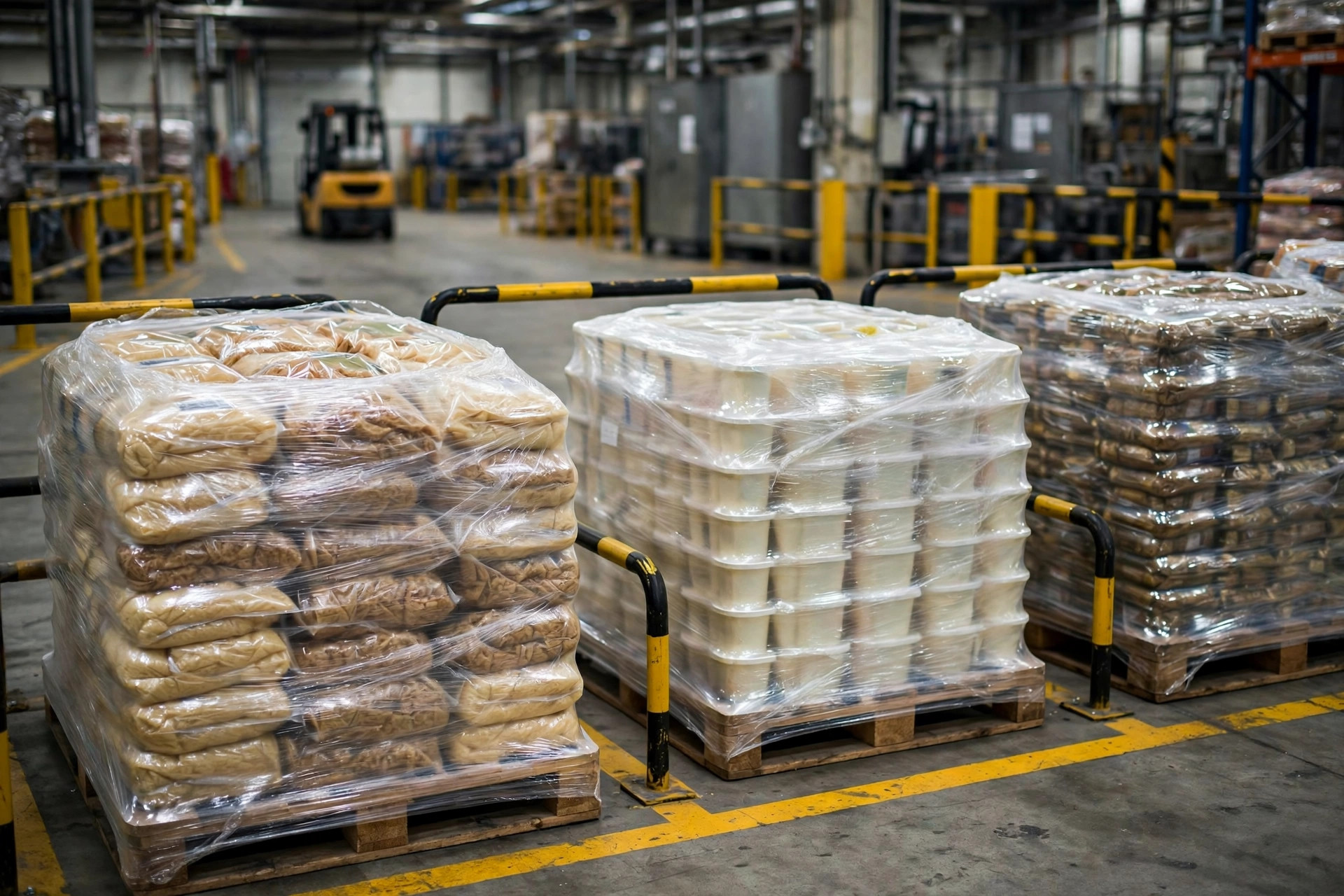
And don't mix pallets. A pallet that carried peanut flour has powder in every crack of the wood — put clean product on it and your segregation was for nothing. Good warehouses color-code pallets for allergen zones. Color is the cheapest management language there is.
3. Labeling Has to Work for People Who Can't Read
The iron rule: never depend on anyone's memory. Shifts change, people call in sick, new hires arrive. Only the sign on the wall doesn't forget.
Three pieces: zone signs (what this zone is), pallet cards (what allergen this pallet contains), floor lines (inside the line is the boundary). Keep colors consistent warehouse-wide. An SQF auditor's first check is whether the system agrees with itself — sign, floor paint, and WMS not matching means a non-conformance on the spot.
4. People Routes and Forklift Routes Need Segregation Too
The one almost everybody misses. The product is separated, but the people aren't — which means it isn't separated at all.
I've watched it: a warehouse with decent zoning, but the allergen-zone forklift driver helped out in the clean zone at noon, and the dust on his tires rode along. The fix: keep people and equipment assigned to allergen zones; when they must cross over, clean first. Workers leaving an allergen zone change gloves and brush off — in the SOP, checked off daily.
One layout trick: the route from receiving to the allergen zone should be short, straight, and never cut through the allergen-free zone. Plenty of warehouses are laid out backwards — allergen product travels halfway across the building to get home, passing through clean zones the whole way.
5. Receiving and Staging Are the Front Door of Warehouse Allergen Storage Segregation
Both my stories happened here, so I'll say it again: when auditors check segregation, receiving and staging is where they look first.
Three requirements. First, check the label at receiving — allergen product goes straight to the allergen staging spot, never "on the floor for now." Second, breakage and spills get the allergen procedure on the spot: sweeping isn't the end of it, you record it and assess everything nearby. Third, the staging area itself has to be zoned — "just for one night" doesn't excuse mixing. Every "just for one night" I've seen turned into an incident.
6. Segregation Without Records Doesn't Count
The one that stings under both FDA and SQF: you did it but didn't record it = you didn't do it.
Four kinds of records, minimum: allergen identification at receiving (what's in this shipment, where it went), daily walkthrough checks (lines intact, signs in place), training records (who, when, what), incident records (how spills and mix-ups were handled). They don't need to be fancy — a checked-off form works. What matters: continuous, honest, traceable.
Most owners dread audits. But auditors are people too — they need one sentence proven: "You say you're segregated — show me." Four sets of records on the table beats any explanation.
One piece of advice each, for shippers and warehouses.
For shippers: choosing a 3PL, don't just compare prices. Walk the floor — zone lines on the ground, allergen info on pallet cards, receiving dock in order or chaos? Those three tell you everything. I've seen plenty of warehouses twenty percent cheaper — and one recall wiped out every penny of savings.
For warehouses: don't treat allergen management as audit theater. It's the foundation. Today you think zoning wastes space; after a recall you'll learn space isn't saved, it's paid for.
There's an old saying where I come from: hope for the best, prepare for the worst. With allergens, you're preparing for the worst and betting the whole business on it. Two lines of paint on the floor — worth it.
By Shifu Zhao, Trucking Veteran (15 yrs)