It's 6:40 in the morning. I haven't even made coffee when the front gate calls: "Chen, there are two guys in dress shirts at the door. They say they're from the FDA."
I'll be straight with you — my stomach dropped. Not because our warehouse was dirty. We run a dry-goods-plus-refrigerated food 3PL, floors mopped twice a day, pest control on a monthly contract. It dropped because the inspector's first sentence was: "Show me your employee hygiene training records."
What did we have? A stack of new-hire sign-in sheets that said "attended safety training" with a row of signatures. Who got trained on food hygiene, on what, and whether they actually learned it — we couldn't prove a thing.
That day sent me deep into 21 CFR Part 117. Here's what the FDA's food warehouse employee hygiene training requirements actually say: what you must train, who must be trained, how often, and what records survive an inspection.
What the FDA's food warehouse employee hygiene training requirements actually say
The core requirement is one paragraph — 117.4(b)(2): every individual engaged in manufacturing, processing, packing, or holding food, including temporary and seasonal personnel, must receive training in the principles of food hygiene and food safety, including the importance of employee health and personal hygiene, as appropriate to the food, the facility, and the individual's assigned duties.
Three things jump out. First, warehousing counts as "holding food" — the whole building is covered. There's no "I only drive the forklift" exemption. Second, temps and seasonal workers are explicitly included. The twenty temps you bring in for peak season? Every one of them needs the training. Third, 117.4(c) pins responsibility on supervisors: ensuring compliance must be clearly assigned to supervisory personnel. Translation: HR can organize it, but the shift supervisor owns it.
What to train: three blocks, none optional
Block one is personal hygiene, and Subpart B's 117.10 gets specific: wash hands before starting work, after every absence from the workstation, and whenever hands get soiled; remove unsecured jewelry that could fall into food; wear outer garments suited to the operation. These aren't suggestions — they're cGMP requirements.
Block two is health reporting. 117.10 requires workers with open lesions, boils, or infected wounds to report to supervisors, and to stay off food and food-contact surfaces until the condition is handled. Plenty of warehouses cover this with a poster nobody reads. I'll tell you how we actually train it below.
Block three is allergen awareness. The rule calls for training on "the importance of employee health and personal hygiene," and all of Part 117 hammers on allergen cross-contact. In a food warehouse, teach it with your own SKUs: which customer's product contains peanuts, which has dairy, how to segregate during picking and mixed-pallet builds.
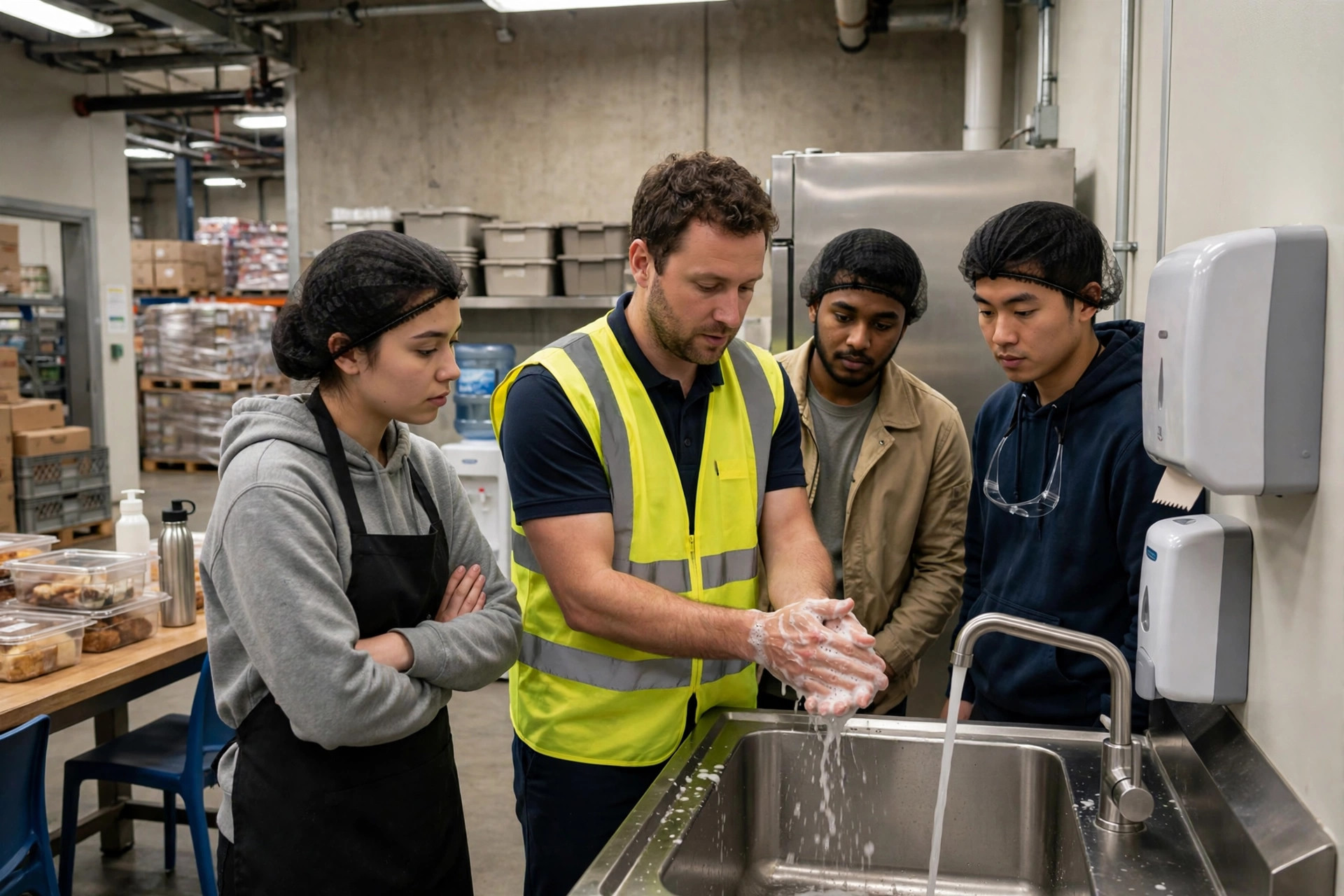
Here's the uncomfortable truth: a lot of warehouses run "watch a 30-minute video, sign here." The FDA doesn't care that you played a video. It cares whether the worker actually learned it. Our pass standard: demonstrate the seven-step handwash live, miss one step and redo it; name three allergen-segregation examples from our own SKUs. Can't do both? The signature means nothing.
Two real stories, paid for in blood and money
March 2024, a dry-goods warehouse in California. Inspector walks in at 8 a.m. and asks for the training records of three pickers by name. The warehouse had sign-in sheets — but two of the three were peak-season temps with no hygiene training entries anywhere in the files. It went on the 483, and the corrective-action follow-up dragged on for two months. Missed temp training is the most common gap I see. Not even close.
Winter 2022, a cold-chain 3PL in Texas. A veteran employee cut his finger, decided "it's just a scratch," didn't report it, and kept hand-stacking cases. The customer's micro testing came back hot, the whole lot was recalled, two batches destroyed — a six-figure loss before you count the customer walking away the next year. In the postmortem, the guy knew the reporting rule. It had just been one throwaway line in training, and he never took it seriously. Training that doesn't land is training that didn't happen.
How often: what food warehouse employee hygiene training requirements don't spell out
Honest answer: 117.4 never says "annual refresher." It requires that training happened and that records exist. But industry practice — and inspector expectations — have settled on an annual full-staff refresher as the floor, plus retraining after any incident.
Here's the rhythm we run now: a 7-day onboarding plus annual refresher.
| Day | Content | Owner |
|---|---|---|
| Day 1 | Hygiene rules briefing + live seven-step handwash test | Shift lead |
| Day 2 | Shadow a veteran — observe only, no solo work | Buddy |
| Day 3 | Allergens and cross-contact, taught with our own SKUs | Shift lead |
| Day 4 | Health reporting: what must be reported, to whom | Supervisor |
| Day 5 | Floor hygiene habits: garments, jewelry, eating areas | Buddy |
| Day 6 | Pre-release exam: 20 written questions + practical spot check | Shift lead |
| Day 7 | Buddy signs off, file goes to records | Supervisor |
Annual refresher is four hours, once a year: regulatory updates, a review of the year's incidents, and practical spot checks. Every quarter we add a 15-minute toolbox talk on a rotating theme — handwashing, wound reporting, allergens, pest control. After any hygiene incident, targeted retraining within 48 hours, no exceptions.
Do the math: one recall costs six figures minimum plus a lost customer. Annual refresher for a 200-person warehouse costs a day of labor plus an instructor — low four figures. You can do this arithmetic yourself.
Records: the inspector checks four things
117.4(d) says it plainly: records documenting the required training must be established and maintained. When the inspector opens a file, four things have to line up: who was trained (name, role, date), on what (the actual curriculum outline, not the words "hygiene training"), by whom (the trainer's qualifications), and whether it stuck (assessment results).
Our system: one training file per person, paper plus scanned copy, active and separated employees filed separately. How long to keep separated employees' records? 117.315 has specific retention rules — don't guess; go with the latest on the FDA's website.
One last reminder for fellow operators: FDA inspections don't care how many posters are on your walls. They care about two things — is the floor clean, and do the records line up. Go check one thing this week: do you have hygiene training records for every temp from last peak season? If not, make it up this week. Don't wait for an inspector to find the gap for you.
By Chen Feng, Warehouse Operations Manager