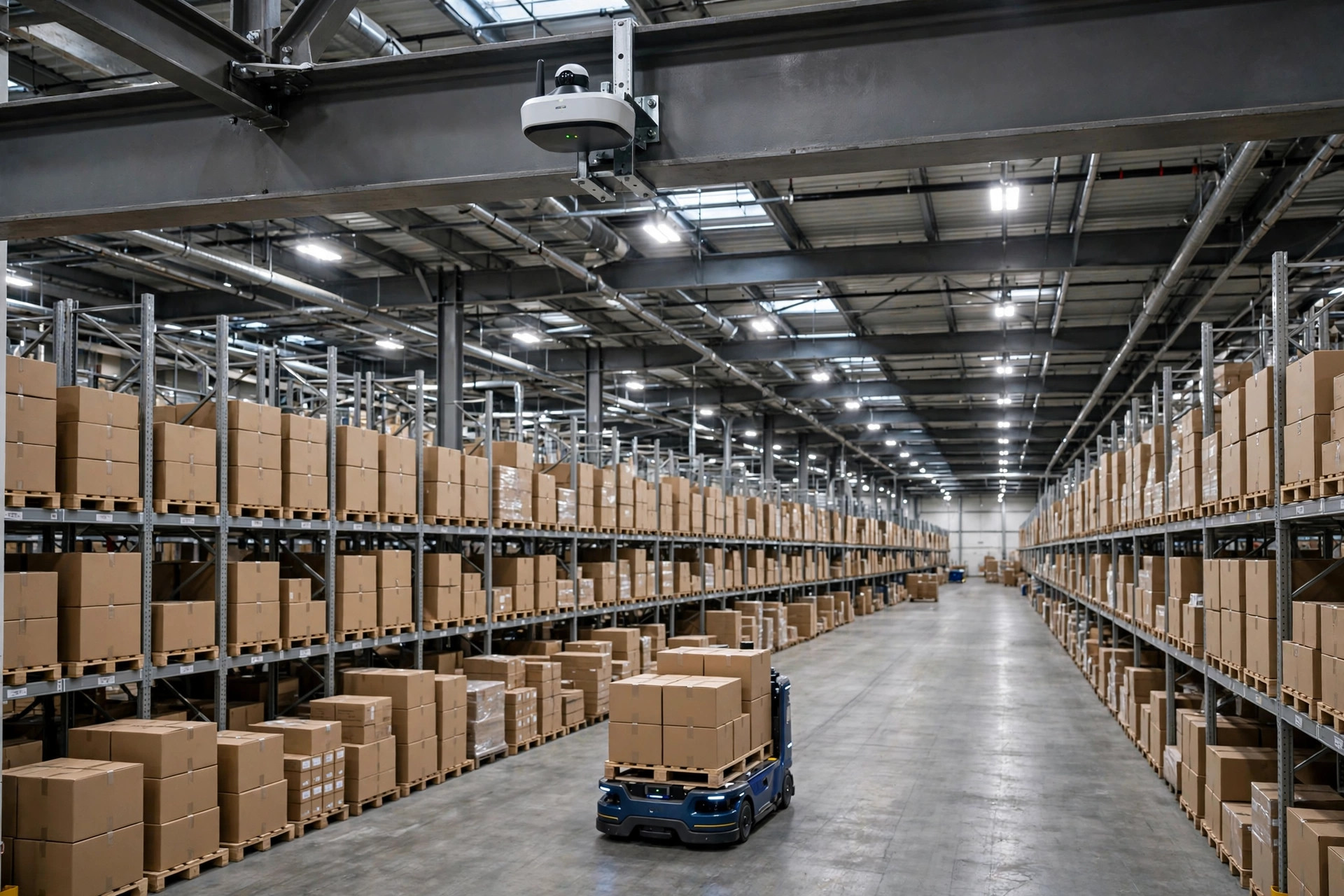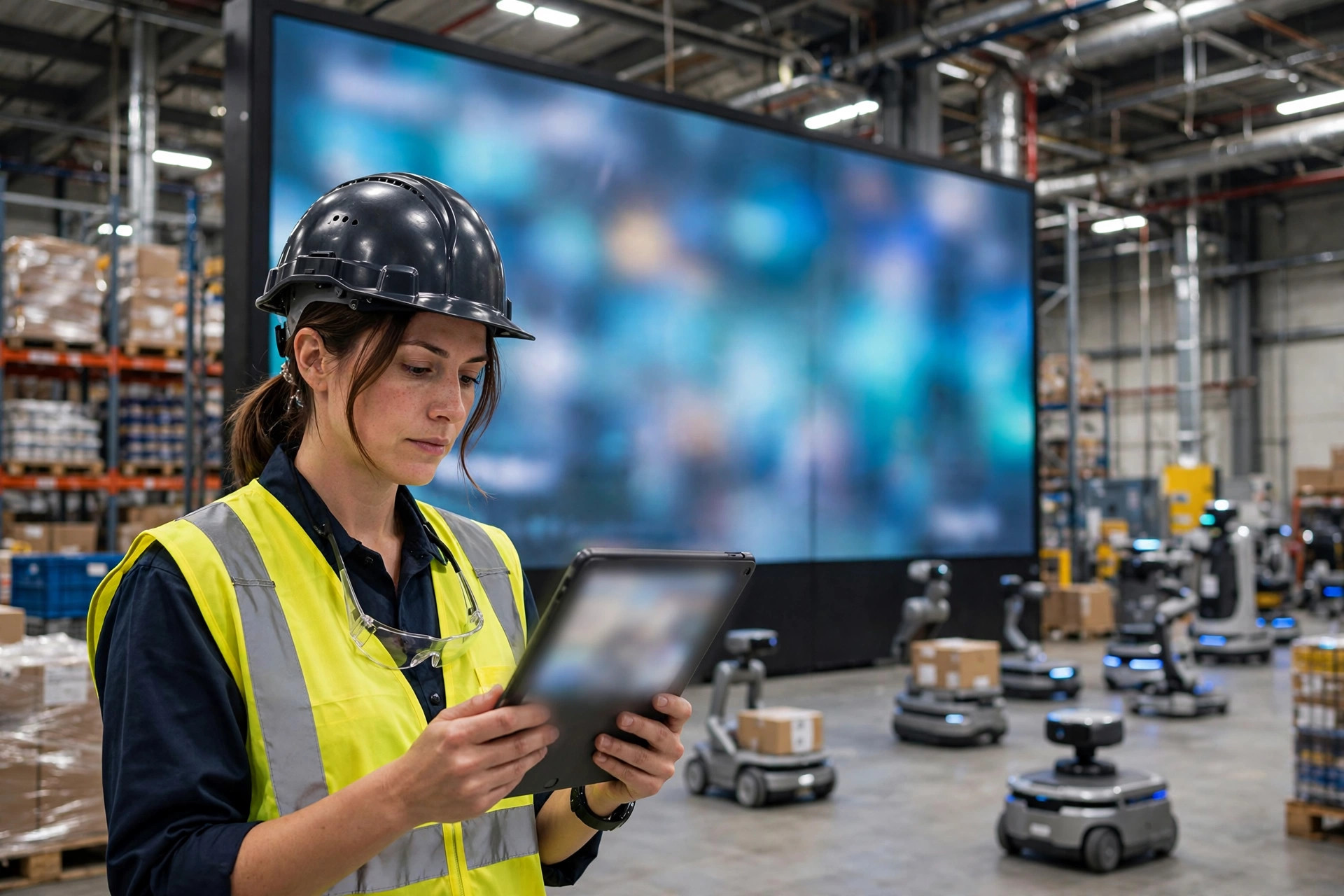
Over the past two years, something has shifted in the solution libraries and trade shows I follow: warehouse AI vision inspection shows up everywhere. Read tunnels over sortation lines, damage-detection cameras at outbound docks, label-verification modules on AMRs — vision inspection is moving from optional add-on to standard equipment. But like many hot technology terms, its popularity has outrun a question nobody has properly answered: what exactly are these cameras looking at, and on what grounds should we believe what they see?
What warehouse cameras actually look at: three real jobs
First, let's unpack the umbrella term. In a warehouse, cameras do three kinds of work, and each comes with a different level of maturity — and a different meaning of "reliable."
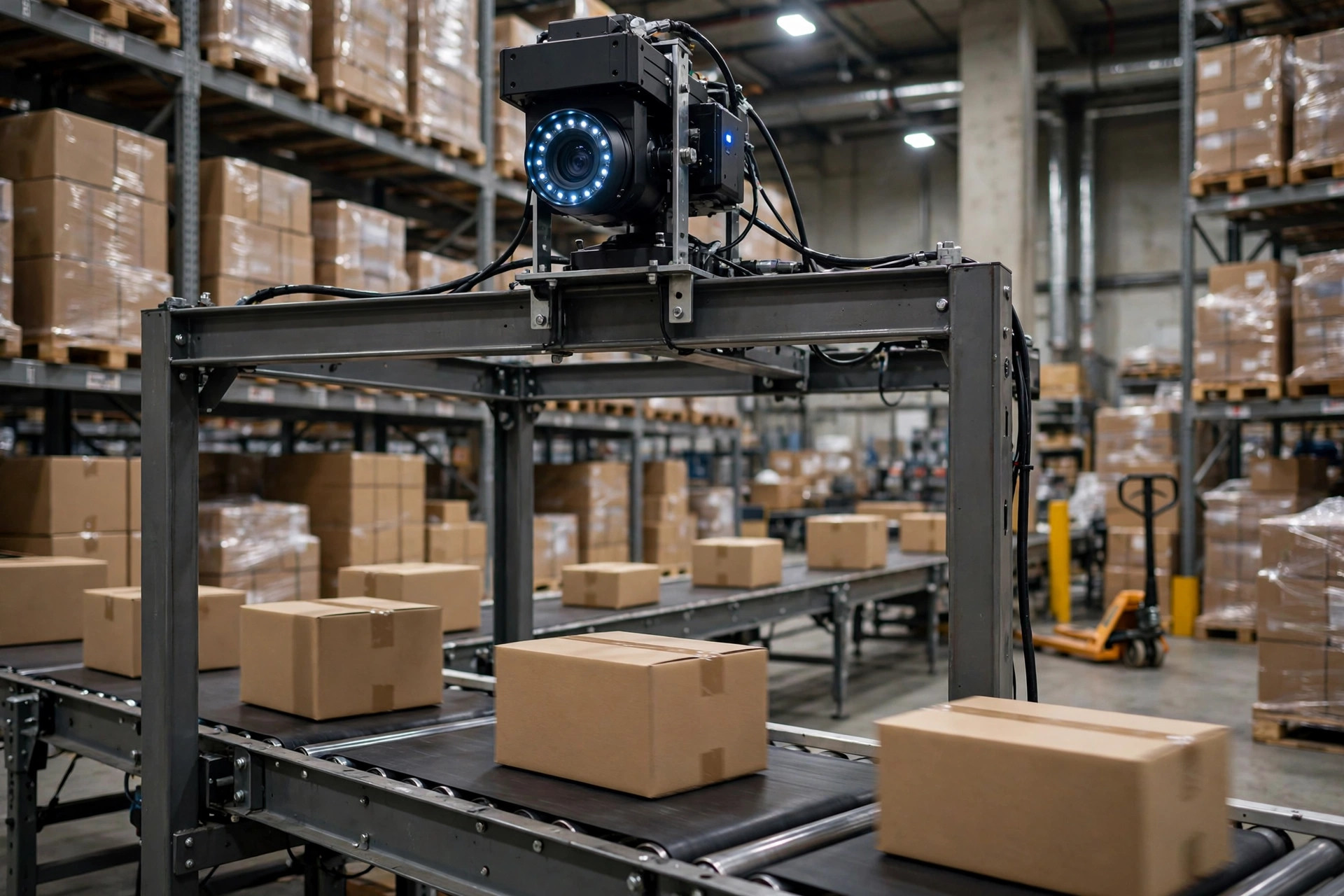
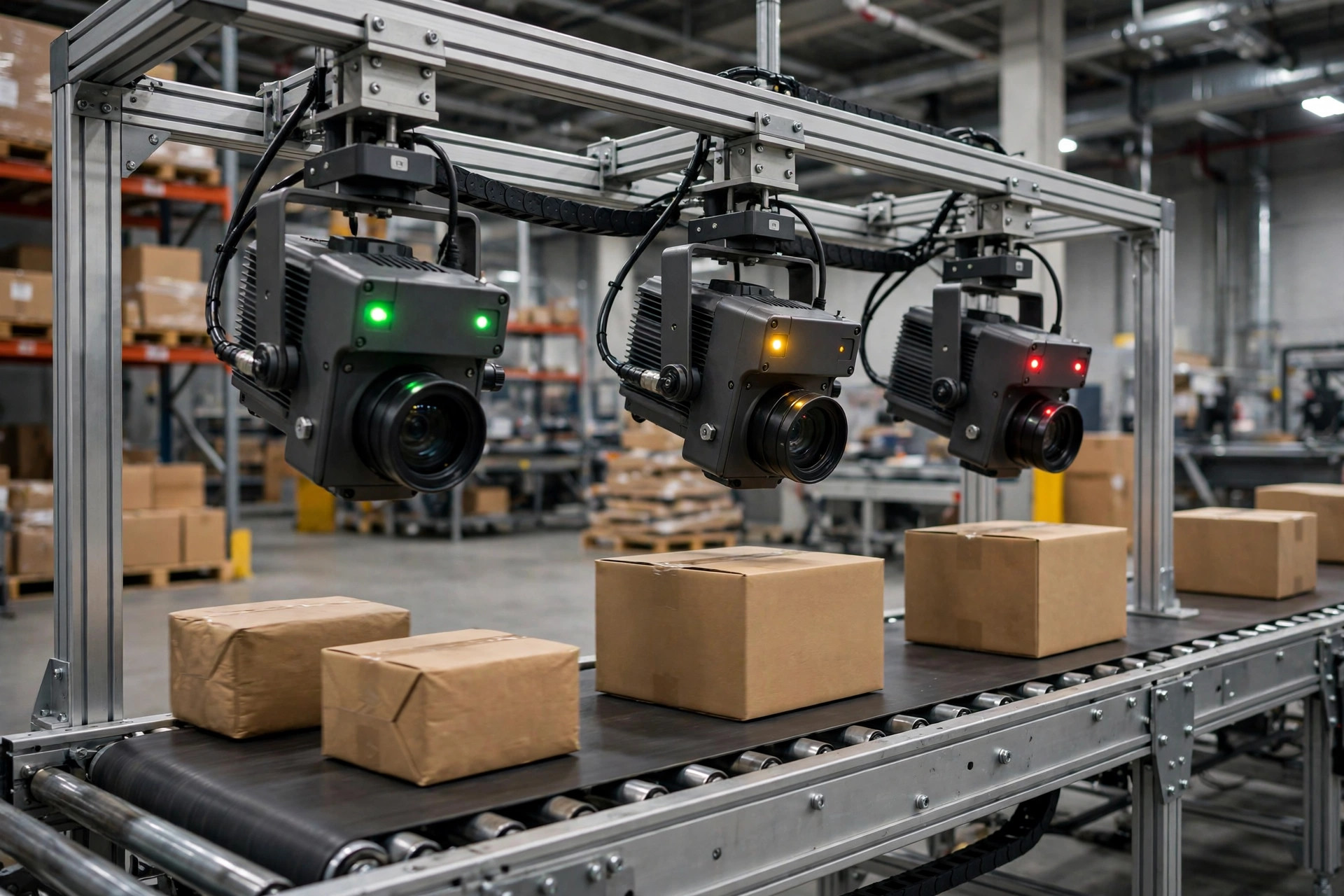
The first job is code reading: barcodes, QR codes, and OCR on shipping labels. This is the most mature application of warehouse vision. Industrial code reading does two things: decoding and grading. The international standard ISO/IEC 15416 grades barcode quality from A to F, and a camera assigns a quality score while decoding. The classic setup is the multi-camera scan tunnel — parcels pass through while cameras capture them from several angles, and the system stitches the reads into one identity record per parcel. Cognex, for instance, claims read rates "up to 99.9%" for its logistics tunnels, including damaged or reflective codes. Note the word "claims" — the conditions behind that number are the subject of the next section.
The second job is damage detection: dents, tears, water damage, deformation, loose sealing tape. This relies on deep-learning anomaly detection — the model learns what a normal box looks like, then flags deviations. Academic results give a reference frame: a 2026 IJIRT paper reported 92% accuracy for a CNN-based parcel damage detector in a lab setting, and a 2022 MDPI study using MobileNet reached 84.6% on classifying damaged courier boxes. Respectable — but lab numbers, captured under controlled lighting with stationary parcels. The field is a different story.
The third job is label verification: crooked or duplicate labels, labels whose data doesn't match the order, missing hazmat markings. Its distinctive feature is that it usually closes a loop with the label applicator — when the camera rejects a label, the signal goes straight back to reprint and reapply. The value here is not in "seeing" but in "stopping": intercepting the problem before it ships.
Why lab accuracy shrinks in the field: three variables behind vision inspection performance
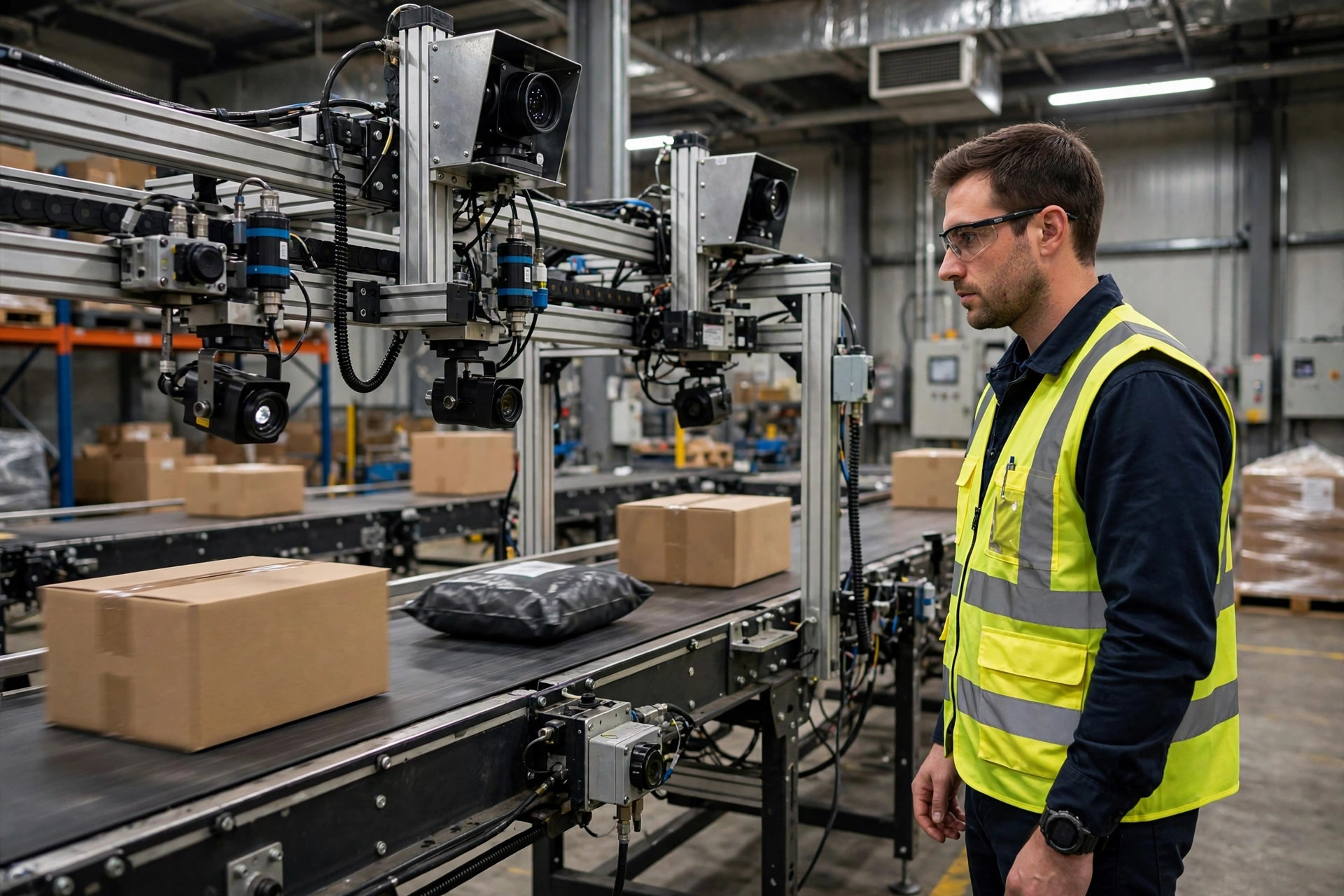
Once we know what the cameras look at, the next question is how much of the advertised accuracy materializes. Three variables decide field accuracy — and these are precisely the variables lab environments optimize away.
The first variable is light. There is an old saying in the industrial vision world: seventy percent of a camera system's success is the lighting. Overhead lights, reflective parcel surfaces, and the low contrast of black labels on dark cartons all degrade image quality directly. A sample photographed under a carefully arranged ring light and a parcel moving under warehouse high-bays are two entirely different inputs. When vision projects underperform after go-live, the post-mortem often points not at the algorithm but at the lighting design that was value-engineered out of the budget.
The second variable is data. Anomaly detection models depend on large volumes of labeled samples, and the very definition of "damage" is subjective — how deep must a dent be to count? If the labeling team applies inconsistent standards, the model learns noise. Worse is the long-tail problem: 95% of parcels are fine, genuine damage samples are scarce, and the damage patterns seen in training are a small subset of what the field produces. Encounter an unseen damage type, and the miss rate climbs.
The third variable is takt time. The lab photographs stationary boxes; the field moves them at one to two meters per second. The faster the belt, the worse the motion blur, the higher the frame rate and the shorter the exposure the camera needs — which in turn demands stronger lighting. The three variables lock into a triangle of mutual constraints.
ElifTech's public case study on parcel quality inspection reports that automated vision detection improved detection accuracy by 85% and cut inspection time by 40% versus manual spot checks, with per-parcel cost falling to a quarter. The comparator matters: manual spot checks typically cover only a single-digit percentage of volume. The lesson is that the first question about any accuracy number is what it was measured against, and under what conditions.
Here is a counterintuitive judgment worth isolating: what usually decides whether a vision system succeeds is not the miss rate but the false-positive rate. A miss costs linearly — one parcel slips through, you pay for one parcel. A false positive multiplies — every point of false-positive rate adds parcels to manual review, conveyor stops, and review-station labor, until humans are rescuing the machine. I have seen projects with a beautiful detection rate get switched off by floor operators, because to them a system that cries wolf is worse than no system at all.
| Dimension | AI vision inspection | Manual spot check | Fixed laser code reader |
|---|---|---|---|
| Best at | Code reading + damage + label verification | Judgment on odd-shaped items | High-speed barcode reading |
| Coverage | 100% of units passing through | Sampled (usually under 10%) | 100% (barcodes only) |
| Speed bottleneck | Compute and frame rate | Labor and fatigue | Practically none |
| Main risk | False positives exploding review labor | High and unstable miss rate | Fails on any damaged code |
| Cost structure | High upfront, low marginal cost | Marginal cost rises linearly with volume | Cheap hardware, single function |
Is it worth it: a five-step framework for evaluating a vision system
With "what it looks at" and "how accurate it is" established, here is a framework you can apply directly — five steps, in order.
Step one: define the defect list. Write down every problem you want to catch — mis-ships, damaged outbound parcels, missing labels — and attach a cost to each miss. What does one mis-ship cost in total (customer service, return, reshipment, marketplace penalties)?
Step two: collect field samples. Cover at least one full business cycle — a peak week, for example. Lighting, product mix, and packaging variety must all be representative.
Step three: run a small-scale validation. On your own samples, measure recall (of the defective units, how many were caught) and precision (of the flagged units, how many were genuinely defective). Ignore the vendor's demo-dataset scores; look at scores on your samples. Precision matters especially, for the reason explained above: false positives multiply.
Step four: test at real takt time. Run at least one full shift at production line speed and confirm the camera's frame rate and the algorithm's processing latency keep up with the belt. Many proofs of concept look perfect at lab line speed and start dropping frames at real speed — and a dropped frame is a miss.
Step five: compute total cost of ownership and payback. Hardware, integration, sample labeling, annual maintenance and model retraining — against saved manual-review hours and avoided mis-ship and damage costs. A rough method: divide total investment by the monthly value of intercepted defects (from step one's defect costs) to get payback months. If that exceeds 24 months, think hard — vision algorithms iterate fast, and the solution two years from now will likely cost a third less.
On the trend side, the data points one way. Reports and Data puts the machine vision market in logistics and warehouse automation at about $2.5 billion in 2024, projected to reach $6.5 billion by 2034 at roughly 9.8% CAGR. Dataintelo uses a broader definition of "computer vision in warehousing" and forecasts $5.8 billion in 2025 growing to $22.4 billion by 2034. Scopes differ, so the range is wide — but the direction agrees: the next five to eight years are the window in which vision inspection penetrates from flagship distribution centers into mid-size warehouses. Three forces drive it: labor costs keep rising, the downstream cost of mis-ships and damage keeps being amplified by marketplace rules, and cameras plus edge compute keep getting cheaper. In June 2026, Zebra launched a warehouse solution in the US combining AI-powered vision inspection with real-time barcode reading — when leading vendors productize vision inspection, the technology is leaving the custom-project stage.
So the question may never have been "is vision inspection reliable," but rather "which part of our uncertainty do we want it to absorb." Machines excel at executing a defined standard tirelessly; they are poor at defining the standard itself — what counts as damage, how crooked is too crooked. Those judgments still sit with people today, and they are the harder questions no camera can answer for you.
By Dr. Chen, Supply Chain Researcher