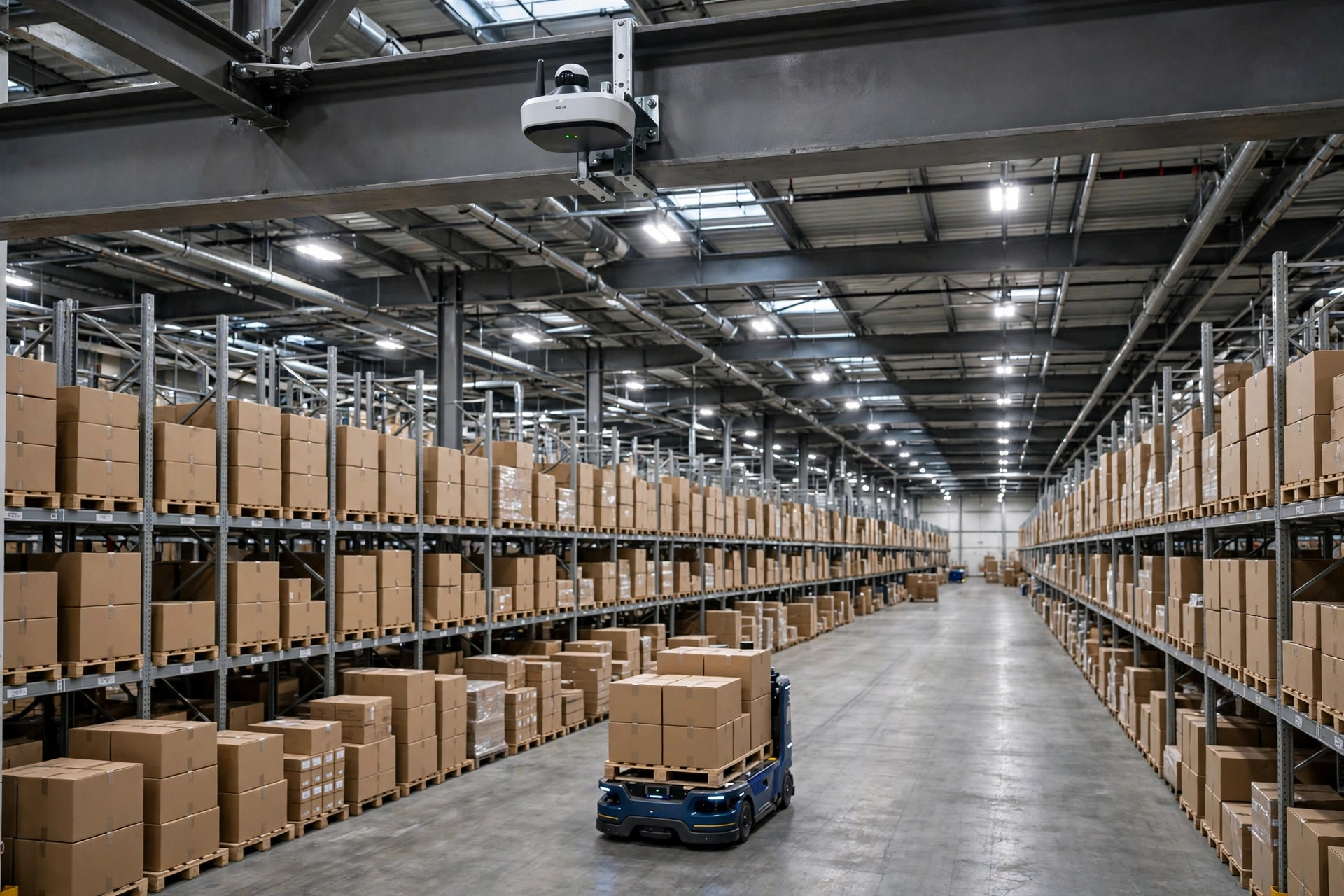
I got asked the same question at least twenty times last year: "Da, should our warehouse deploy private 5G?" Half had been worked over by a vendor sales rep; the other half were genuinely tortured by AMRs dropping offline. My answer never changed: don't open your wallet yet. Wi-Fi 6 and private 5G aren't an old-versus-new story — they're two different species. For 90% of warehouses, a well-tuned Wi-Fi 6 network is plenty. Let me show you what the other 10% looks like.
Different DNA: Wi-Fi 6 and Private 5G Were Built for Different Jobs
Start with Wi-Fi 6. That's 802.11ax, ratified in 2021, running on unlicensed spectrum — 2.4 GHz, 5 GHz, and now 6 GHz with Wi-Fi 6E. OFDMA, MU-MIMO, BSS coloring: every one of these features exists to solve the same problem, which is too many devices talking at once. Think of it this way: old Wi-Fi made everyone take turns with one microphone; Wi-Fi 6 slices the microphone into pieces so many can talk simultaneously.
Private 5G is the cellular family gone private: a standalone 3GPP network on dedicated or locally-licensed spectrum (the US CBRS 3.5 GHz band went commercial in 2020), SIM-based authentication, base-station-coordinated everything. Data never leaves the facility; latency and reliability are engineered for industrial use. The URLLC design target is 1 ms latency with 99.999% reliability — the IMT-2020 paper spec, which real deployments discount.
The biggest genetic difference isn't bandwidth. It's who decides the roam.
In Wi-Fi, the client decides. Your AMR picks when to roam and which AP to join; the AP can only offer advice (802.11k/v) or speed up the handshake (802.11r fast roaming, designed to keep the interruption under 50 ms). It's like changing lanes: the signs are there, but the driver decides when to turn the wheel. A good driver roams smoothly; a stubborn one clings to a distant AP with one bar of signal, and the AP can do nothing about it.
In 5G, the network decides. Base stations continuously measure every device's signal and command the handover when the moment is right; the device just obeys. That's air traffic control clearing a plane to switch runways — the pilot doesn't decide, the tower does. The first model is flexible and cheap but uncontrollable; the second is controllable — but you must build the tower (core plus management) and issue every device a boarding pass (a SIM).
The second genetic difference is spectrum. Wi-Fi runs on a public road — unlicensed bands anyone can use. If the warehouse next door cranks its AP power to max, your clients suffer. Private 5G runs on a private driveway inside your own fence — dedicated or licensed spectrum, no strangers, controllable interference. But you pave the driveway yourself: getting the spectrum is a line item of its own.
| Wi-Fi 6 | Private 5G | |
|---|---|---|
| Roaming decided by | The client device | The network |
| Handover interruption | Under 50 ms with 802.11r tuning — if the client cooperates | Network-directed, generally more consistent |
| Per-node coverage | 5 GHz dies fast through racking; high-bay needs dense APs | One small cell covers more than one AP, but metal still demands propagation planning |
| Interference | Public band — you're on your own | Private band — clean by design |
| Cost per node | Enterprise AP plus cabling: low thousands of RMB per drop | A small cell runs several times to 10x an AP, plus the core |
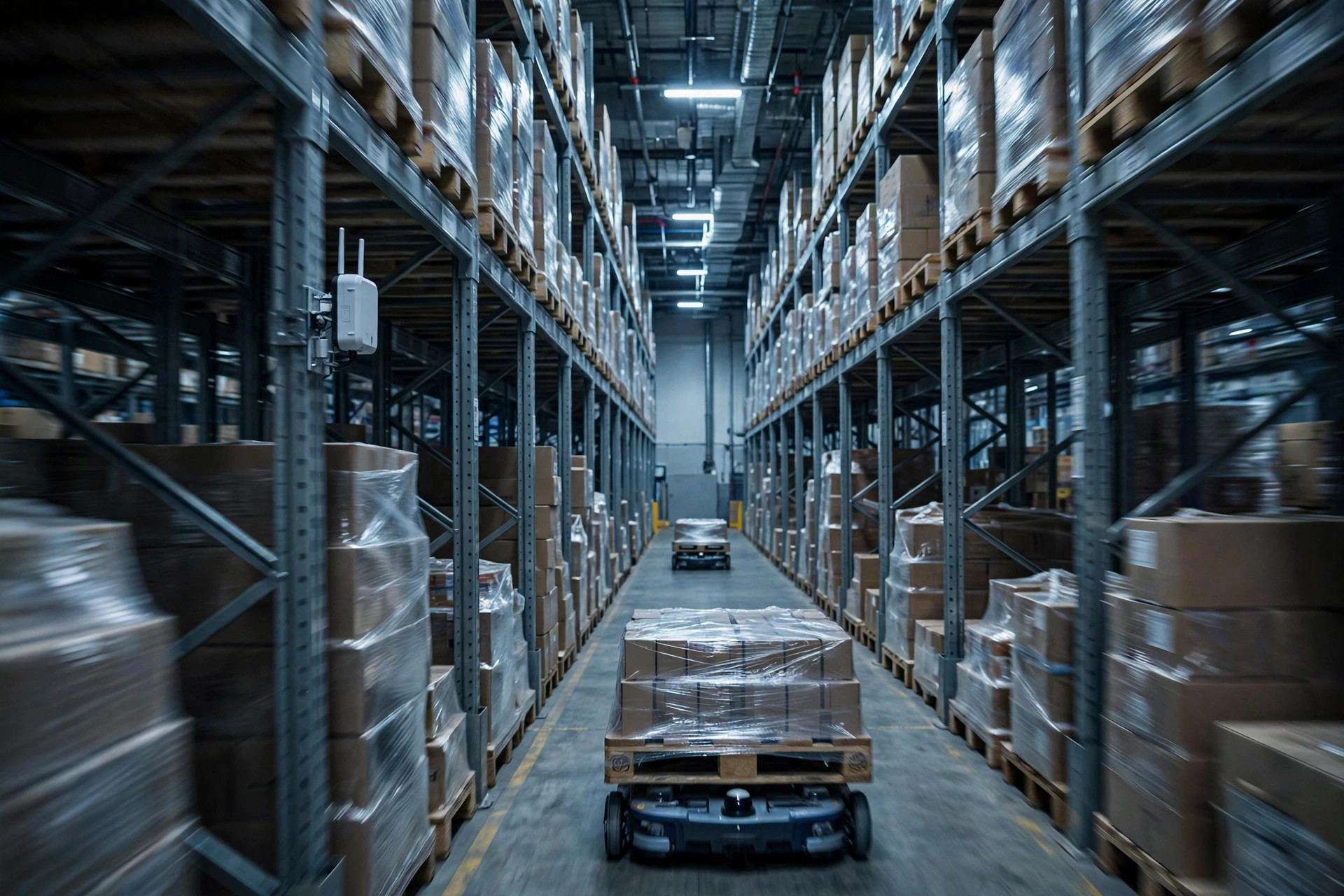
Three Dividing Lines: Wi-Fi 6 or Private 5G?
Line one: roaming intensity. Multiply two numbers — how many AMRs/AGVs you run, and how often they roam across APs. A people-first operation where handhelds take an occasional stroll? Wi-Fi, eyes closed. Dozens or hundreds of AMRs running around the clock, roaming as routinely as breathing? That's 5G's comfort zone. The hard metric: AMR vendors typically demand roaming interruptions under 100 ms, beyond which the robot may e-stop. Tuned Wi-Fi with 802.11r/k/v can get under 50 ms — but one catch survives all tuning: you bought the APs, yet the roaming algorithm in the client's radio was written by the device vendor, and whether it cooperates is not your call. That ceiling is written into Wi-Fi's DNA.
Line two: the interference environment. A plain flat warehouse with low racks and quiet neighbors — Wi-Fi is fine. Dense metal high-bay racking, a cold store (metal plus moisture, a signal killer), or a logistics park where neighboring warehouses blast their APs at each other — there, Wi-Fi's public-road nature turns into a disaster, and the private driveway starts earning its keep.
Line three: cost. Take a 30,000 m² warehouse: a Wi-Fi 6 design typically needs dozens of AP drops; a private 5G design might need only a dozen-odd small cells — but each small cell costs several times to an order of magnitude more than an AP, plus the core network and management system. All in, a private 5G build usually runs several times the cost of Wi-Fi, with a similar three-year TCO gap. Unless the first two lines have you cornered, paying several times more for the word "advanced" is setting money on fire.
The Maintenance Pits: Each Has Its Own Misery
Wi-Fi's misery is all in tuning. Pit one: AP transmit power cranked to max. Integrators do this to cut the AP count — signal bars look full, but clients stick to distant APs and never roam. The fix is the opposite: turn power down, densify APs, force clients to roam on time. Pit two: keep data devices off 2.4 GHz — that's for scanners and IoT; AMRs and handhelds go on 5 GHz, no exceptions. Pit three: the 802.11r/k/v trio — is it even enabled? I've seen warehouses running Wi-Fi 6 APs on decade-old roaming logic with those switches off: regular gas in a Ferrari. 5G's misery is all about people and process. Pit one: SIM lifecycle management — provisioning and reconciling SIMs across hundreds of devices is a real operations job; if nobody owns it, chaos. Pit two: coverage is engineered, not installed. In metal-heavy environments you need propagation modeling; a poorly planned private network has dead zones just like Wi-Fi does. Pit three: you can't tune the parameters yourself. When something breaks, you wait on the integrator or carrier — get their response SLA in the contract, and don't sign if it isn't there. Two fake requirements, shot down. Fake one: "Wi-Fi 6 does 9.6 Gbps theoretical, so bandwidth is plenty." No warehouse application saturates that; an AMR heartbeat is a few kilobytes. The bottleneck is always roaming and interference, never throughput — any sales rep leading with bandwidth can see themselves out. Fake two: "Let's do 5G because it's the future." I've watched warehouses pay for "the future" and end up paying for maintenance instead. Selection looks at today's needs and three-year TCO, not keynote slides.
Two Real-World Scenes
In 2024, a 20,000 m² 3PL warehouse in southern China ran 40-odd AMRs for goods-to-person. During peak hours the AMRs e-stopped constantly — a dozen-plus times a day. A month of digging traced it to sticky clients during cross-AP roams: handovers dragging past hundreds of milliseconds, the AMR declaring comms lost and e-stopping. The fix wasn't 5G: turn down AP transmit power, enable 802.11r/k/v, lock the AMRs to 5 GHz, reposition APs out of rack shadows. Two weeks later, e-stops were down to single digits — the disease was roaming policy, not the technology generation.
In 2025, a 50,000 m² auto-parts high-bay warehouse in eastern China ran 200-plus AGVs/AMRs around the clock under dense metal racking, with neighboring warehouses' Wi-Fi blasting interference. Two rounds of Wi-Fi tuning couldn't get the drop rate down, so they went private 5G — standalone, built with a carrier partner. Dedicated spectrum dodged the interference; network-directed handovers replaced client guesswork; AGV comms drops essentially vanished after cutover. The price? Several times the Wi-Fi option, plus two more months of SIM management and coverage optimization. That's the 10% — expensive, and worth it.
Worth It or Not? One Number Decides
Run one calculation: average cost of a single AMR comms outage × outages per month × number of AMRs × 36 months, versus the three-year TCO gap between private 5G and Wi-Fi 6. First number wins, go 5G with confidence. Second wins, tune your Wi-Fi 6 roaming properly — the savings buy two more AMRs.
Remember this: the real enemy of warehouse wireless was never bandwidth. It's roaming and interference. Wi-Fi 6 loses on roaming because the client calls the shots; private 5G wins because the network does — but that control costs you several times over. Whether it's worth it, that one number decides.
By Da Liu, Automation Engineer