Send a photo of a parcel to a cloud vision API and you pay about $1 per 1,000 images at AWS's published rates. Run the same photo through a box bolted to the conveyor and the marginal cost drops below a tenth of that. That statement about warehouse vision inspection costs is only true above a few thousand images a day — below it, the answer flips. This piece works through the numbers, because in my experience the industry talks about model accuracy far more than it talks about the bill.
Where vision inspection actually runs in warehouses
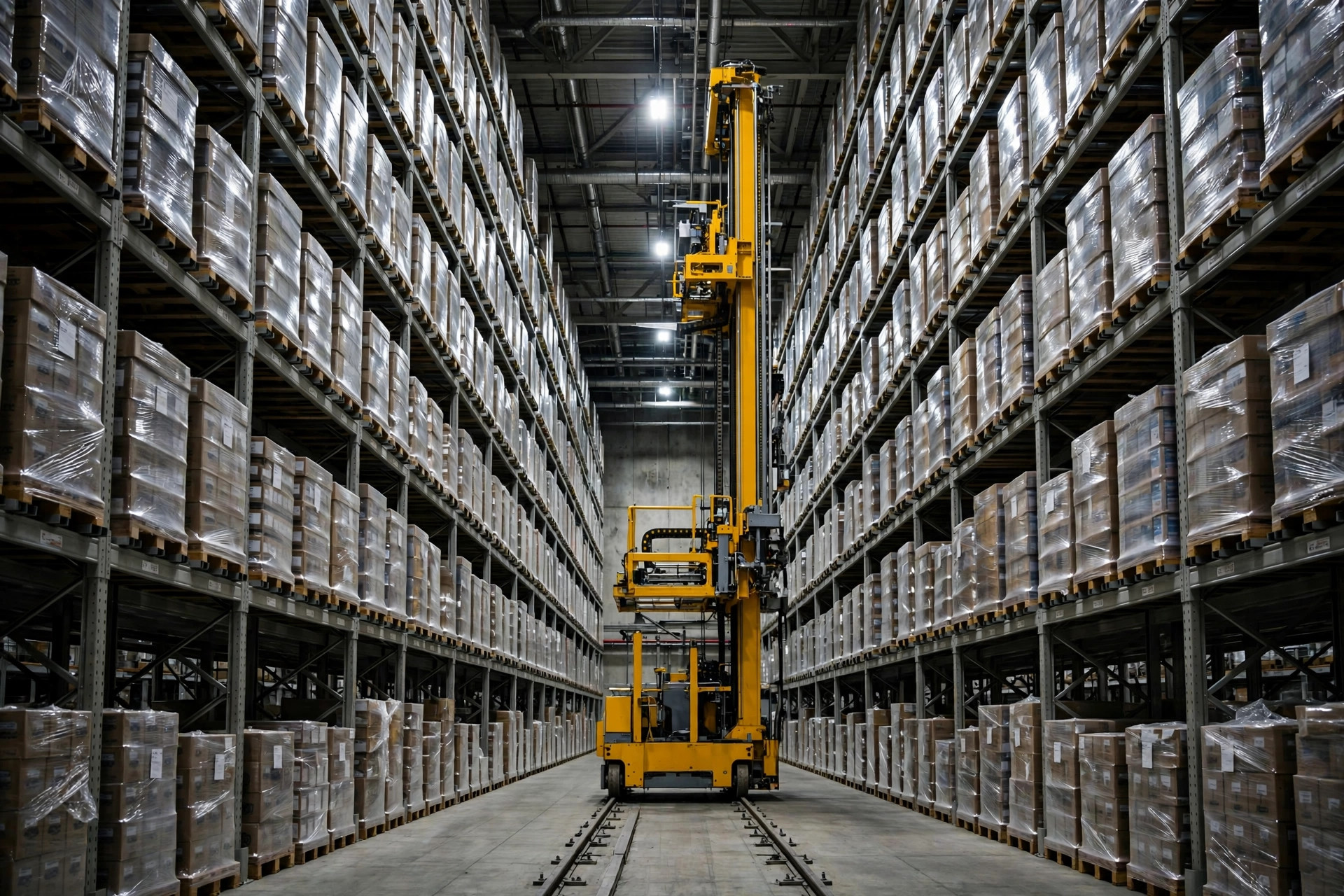
Strip away the marketing and warehouse vision inspection comes down to three jobs: detecting crushed or deformed cartons at receiving, verifying shipping labels at outbound (text recognition plus barcode matching), and automatically auditing empty versus occupied pallets and slots. All three share the same profile: high frequency, repetitive, and latency-sensitive. A conveyor belt does not wait for a round trip to a distant data center.
According to NVIDIA's public announcements in August 2026, Wing's delivery drones, Doosan Bobcat's construction equipment, and Cognex's industrial vision systems are all adopting its new edge AI platform for onboard real-time perception. The inference here is straightforward: real-time vision is moving from the cloud to the edge, and this is deployment, not forecast. For warehouse operators the question was never whether to use vision; it is where to run the inference at the lowest total cost.
The cloud bill: $1 per 1,000 images is only the starting price
Start with published pricing. AWS Rekognition's DetectLabels is $1.00 per 1,000 images at the first-million-per-month tier, stepping down to $0.80, $0.60, and $0.40 at higher volumes. Google Cloud Vision is $1.50 per 1,000. Azure AI Vision is $1.00 per 1,000. Three details make these starting prices, not final ones. First, each covers one feature group per call; the text recognition needed for label verification is often billed separately or at a higher rate. Second, images have to be uploaded, so bandwidth and storage sit on the bill next to the API line item. Third, cloud inference is a pure variable cost — double the volume and the bill doubles on schedule; there is no fixed-cost base to absorb growth.
The edge bill: pay once for hardware, then inference is nearly free
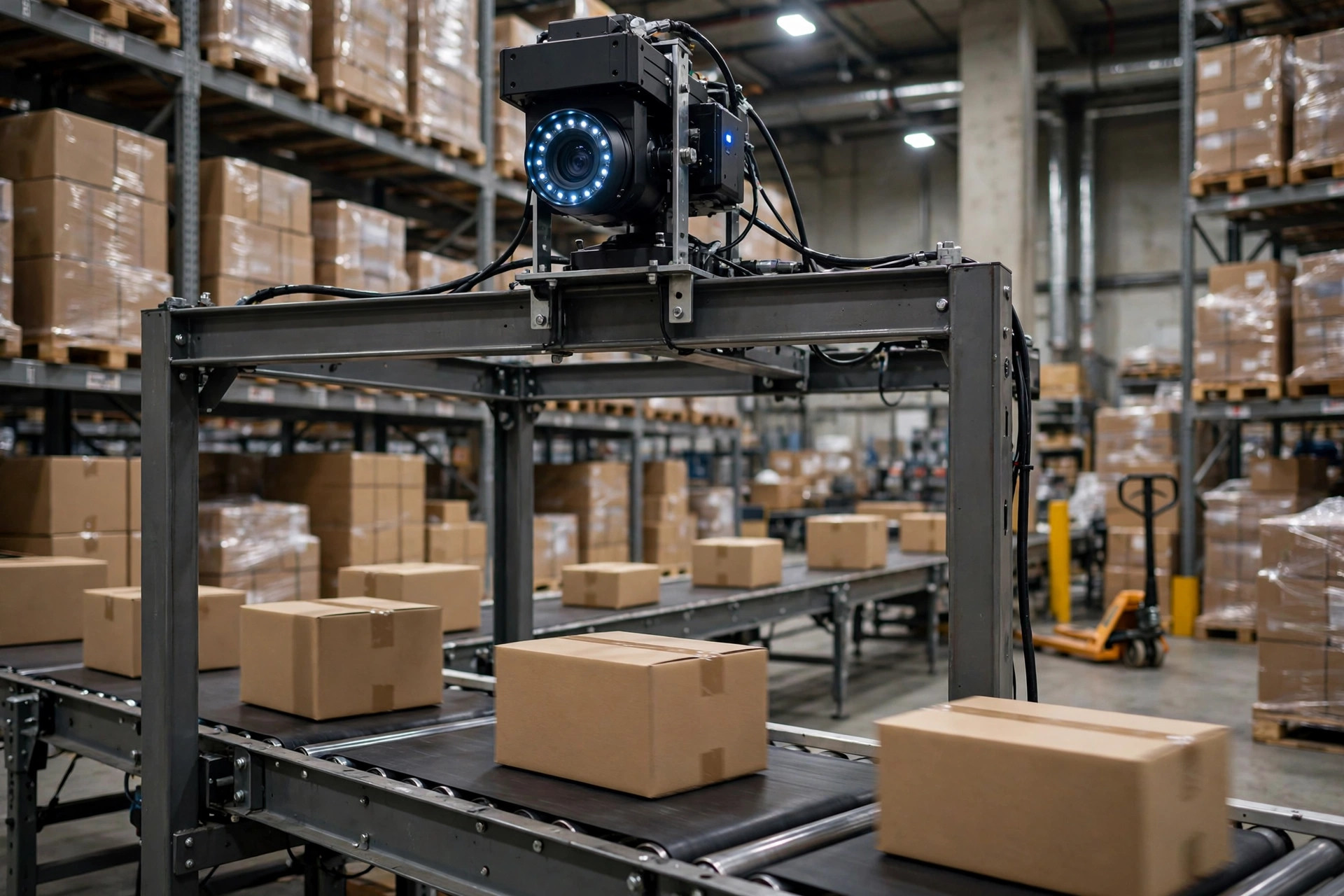
Now the edge side. NVIDIA priced the Jetson Orin Nano Super developer kit at $249 in early 2025, delivering 67 TOPS at 25 watts. A production vision station is not a developer kit, of course: industrial camera, lens, lighting, an edge compute module, plus installation and commissioning. Across system-integrator quotes I have seen, a complete station typically lands in the $2,500 to $3,500 range — an indicative figure, not a quote. After that one-time spend, the marginal cost per image is electricity and depreciation, which rounds to zero.
Take a mid-size sortation line producing 30,000 images a day — one photo per parcel, 900,000 a month — and the comparison looks like this:
| Cloud inference | Edge inference | |
|---|---|---|
| Cost per image | ~$0.001 | ~$0.00008 (hardware amortized over 36 months) |
| Monthly spend | ~$900 | ~$70 (depreciation plus power plus basic maintenance) |
| Upfront investment | Near zero | ~$3,000 one-time |
| Inference latency | Hundreds of milliseconds, network round trip | Milliseconds, processed locally |
| Data compliance | Images leave the network | Data stays on premises |
At this volume the cloud costs more than 10x the edge, and the hardware pays for itself in three to four months. Now flip the scenario to a bulk-goods warehouse shooting 500 images a day: the cloud bill is $15 a month, and a $3,000 edge investment takes 200 months to break even — the cloud wins outright. There is no universal multiple; the answer lives in daily image volume, with the rough crossover sitting around 3,000 to 5,000 images a day.
The counterintuitive part: the per-inference price never decides the bill
This is where most buyers stop calculating, and where the real money hides. In the deployments I have tracked, three off-balance-sheet items decide total cost of ownership, and none of them is the inference unit price.
The first is the false-positive rate. Large cloud models are generally more accurate; a small edge model that misfires 1 to 2 percentage points more often turns into several hundred extra manual reviews a day at 30,000 images. One review position's labor cost can consume the entire inference-cost saving within months. Money saved on compute reappears on the payroll; the ledger just changes pages.
The second is model iteration. When the business changes — new packaging, a new label format, new SKUs — the cloud side is usually a parameter tweak or a vendor model upgrade. The edge side means re-collecting data, labeling, retraining, and pushing the model over the air to every device on the floor. Almost nobody writes that engineering cost into the first budget.
The third, and the real trade-off, is volume certainty. Cloud inference is a pure variable cost, which suits warehouses with volatile volume or use cases still being validated. Edge is a sunk cost, which suits stable, high-volume lines. Deploying edge hardware before volume is certain means paying in advance for business that has not happened yet.
Where this is heading: hybrid routing within two to three years
NVIDIA's central claim with its new edge platform is that small and mid-size models now match last year's largest models in accuracy. Edge-deployable model quality keeps rising while edge hardware price-performance keeps steepening — 67 TOPS for $249 would have been unthinkable two years ago.
That supports a judgment with a timeline: over the next two to three years, the dominant warehouse vision architecture will be hybrid routing. The edge does real-time first-pass screening, catching obvious defects in milliseconds; the cloud handles difficult re-checks and model training, reserving expensive cloud calls for the genuinely hard samples while routine ones are digested locally. Done well, this pushes average per-image cost below one-twentieth of pure cloud. It has one prerequisite: a team that can maintain two pipelines at once — data reflux, model versioning, remote fleet management of edge devices. Without that team, the complexity of a hybrid architecture eats the savings it was supposed to create.
So the question was never really "how many times more expensive is the cloud than the edge." The two questions that matter are more concrete: how many images worth inspecting does your warehouse produce each day, and what false-positive rate can you tolerate. Write those two numbers down and the answer appears on its own. As for whether a $249 box can replace a $900 monthly bill — it can, but the savings will resurface elsewhere in the labor and engineering budgets. Ledgers do not lie; they just turn the page.
By Dr. Chen, Supply Chain Researcher