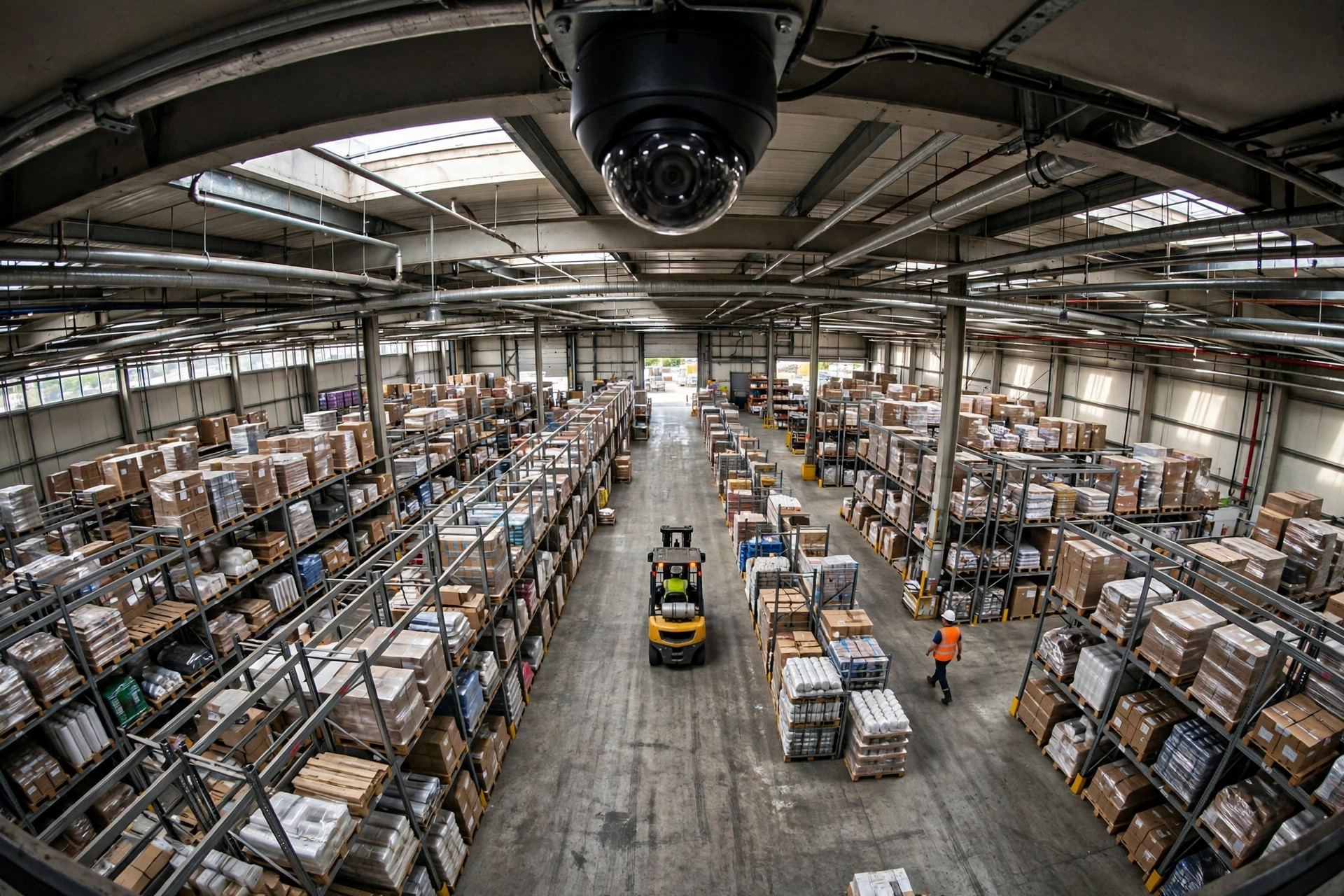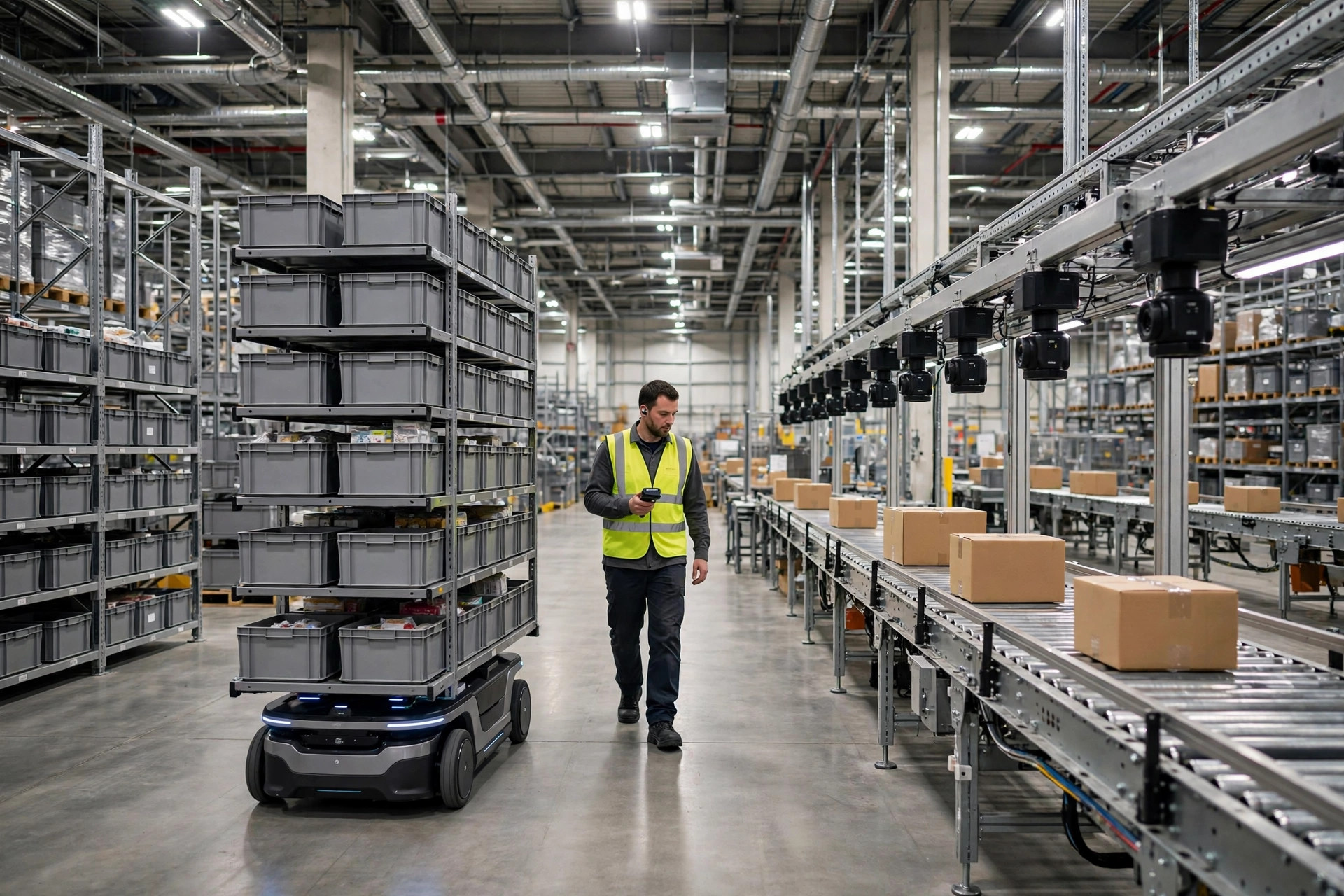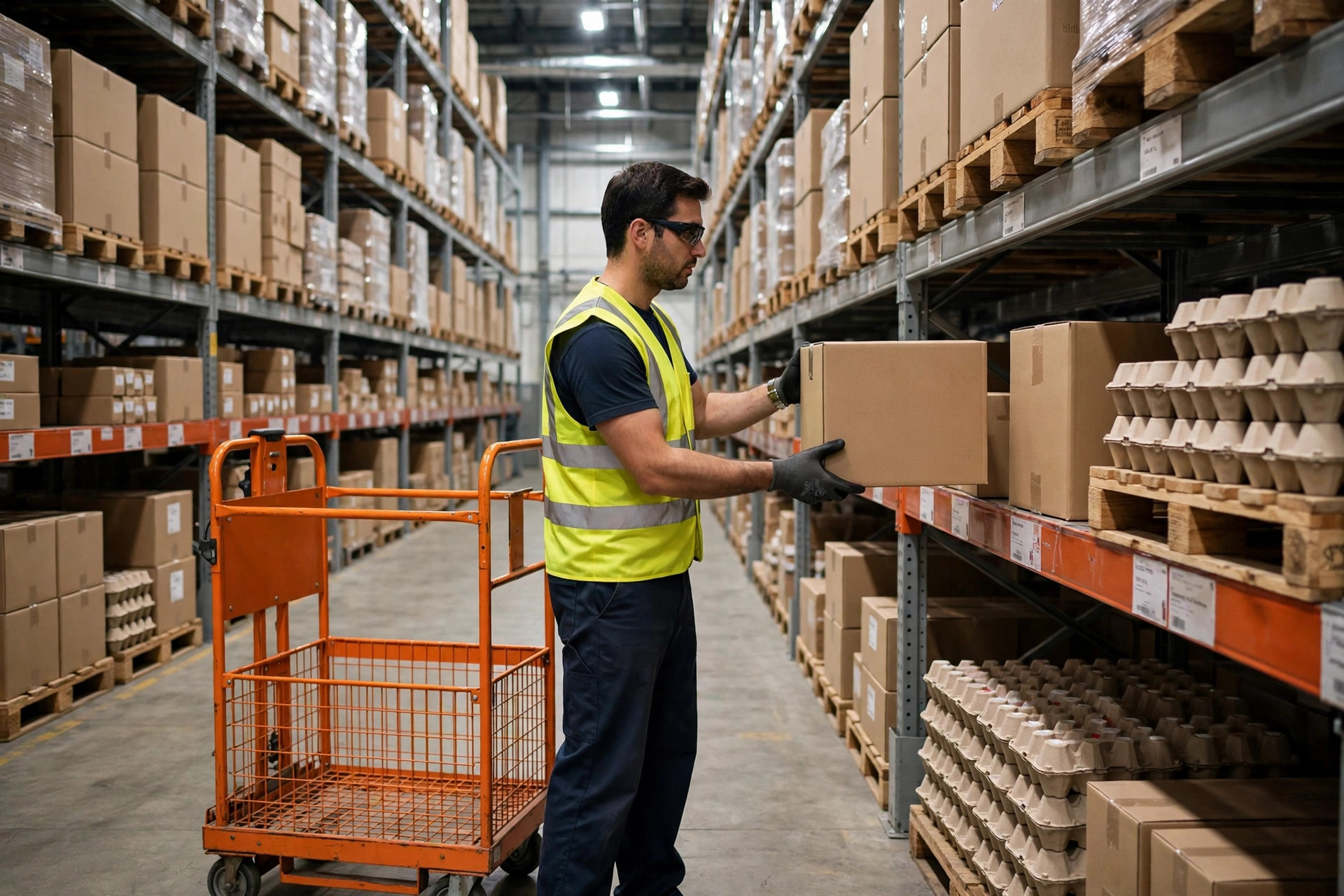
Most warehouses today present a curious anachronism: slotting plans are still rebuilt once a year, while the order mix they serve changes by the week. How AI slotting optimization works, at its core, is not a story about a cleverer algorithm. It is the shift from slotting as an annual event to a continuous data feed — the pick path is less "computed" than fed by three distinct data streams.
The Annual Re-Slot Is Losing the Race
In the fall of 2023, I visited a third-party logistics facility of roughly 80,000 square feet in California's Inland Empire. Its slotting practice was entirely typical: once a year, in Q1, the operations manager ran an ABC analysis in a spreadsheet, shuffled A-class SKUs closer to the pack stations, and that was the plan for twelve months.
The problem was a mismatch of rhythms: a consumer-goods client taken on that year saw several promotional SKUs multiply pick velocity within weeks, while their slots still sat in far aisles assigned back in January. The pick supervisor told me that during peak season, the extra distance his team walked daily was more than anyone wanted to calculate. By the time the next annual ABC exercise came around, the promotion was long over, and the "high velocity" in the data belonged to last season's demand. Static planning permanently chases a distribution that has already moved on.
This was not an outlier. Across the facilities I have studied, one or two re-slots per year remains the norm, while e-commerce order composition shifts weekly, sometimes daily. When planning cadence and the rate of change differ by an order of magnitude, the misalignment is paid for in footsteps on the warehouse floor.
What AI Slotting Optimization Actually Consumes: Three Data Streams
Strip the technology down and there is nothing mystical about it: the model depends on three data streams of very different character. Understand these three, and you understand most of how it works.
The first is order and velocity data, which answers "what moves fast, and when." Not just total SKU throughput, but pick frequency at weekly, daily, and wave granularity, plus seasonal curves and ramp-ups. Many warehouses have this data but only use its average — the value lives in the distribution. A SKU with middling annual velocity that spikes every November deserves a very different slot strategy from one that moves evenly all year.
The second is SKU affinity data, which answers "what gets picked together." An order co-occurrence matrix reveals that phone cases and charging cables, or coffee beans and paper filters, belong in adjacent slots. This is the classic blind spot of rule-based slotting: ABC scores each SKU in isolation and cannot see order-level combinations. In early 2024 I examined a Midwestern e-commerce fulfillment center whose WMS slotting module had pulled the several hundred highest-velocity SKUs to the front — reasonable on its face, underwhelming in results. The post-mortem showed that SKUs frequently ordered together had been scattered to opposite ends of the building, forcing extra trips to complete a single order.
The third is physical and constraint data, which answers "what is allowed to go where." Slot dimensions, load capacity, aisle widths, golden-zone heights, temperature requirements, hazmat segregation, narrow-aisle equipment limits — hard constraints no model can negotiate with. However fast a SKU moves, if its carton does not fit the flow rack up front, or it requires refrigeration, it will never occupy the "optimal" slot. This data is often in no system at all — it lives in veteran supervisors' heads, which is exactly where the data-quality problem below does its worst damage.
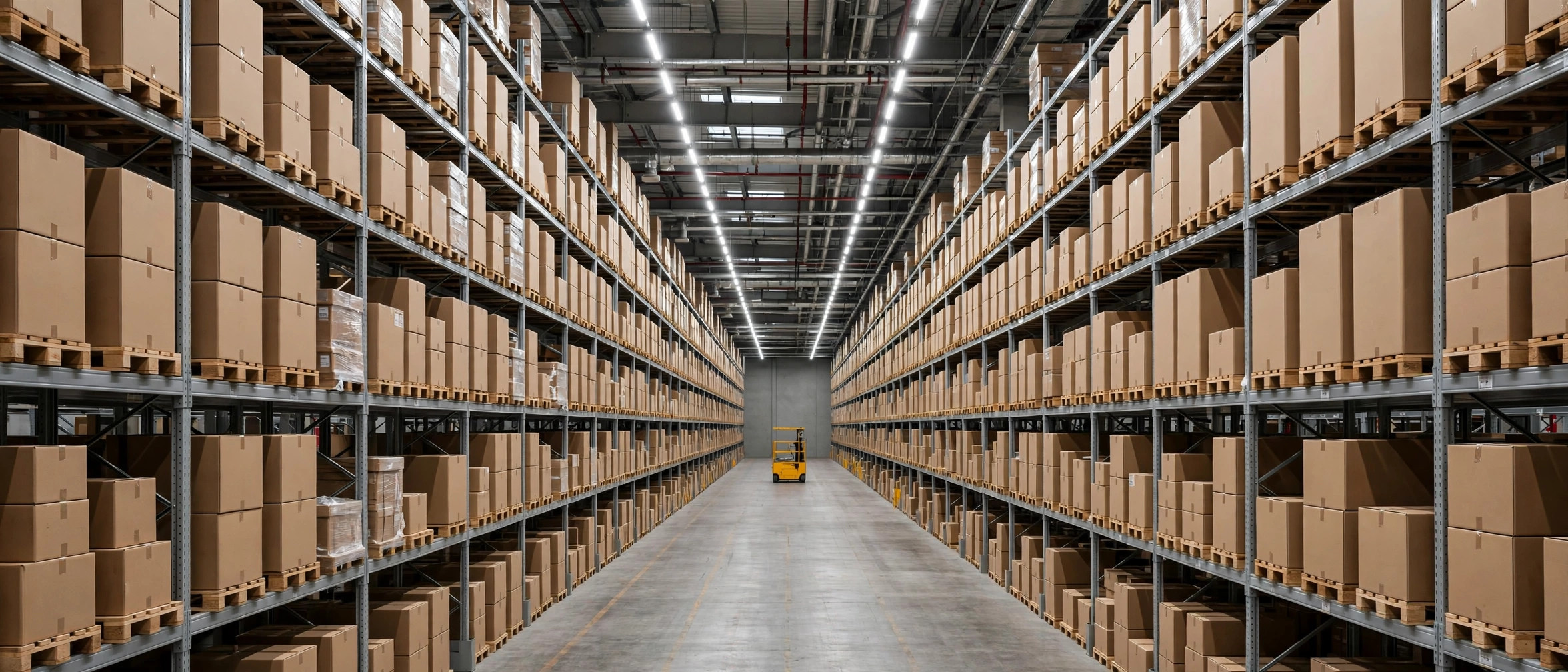
| Data stream | Question it answers | What goes wrong without it |
|---|---|---|
| Order & velocity data | What moves fast, and when | Slotting chases last season forever |
| SKU affinity data | What gets picked together | Fast SKUs sit in isolation; combined orders travel extra |
| Physical & constraint data | What is allowed to go where | Recommendations are unexecutable, or create safety and compliance risk |
Why Rule Engines Hit a Ceiling
Once the three streams are clear, the limits of rule engines explain themselves. A rule engine is essentially threshold-triggered — "if a SKU's velocity exceeds X for two weeks, move it N slots forward" — with three structural limitations.
First, it is reactive. A threshold fires only after a change has happened and persisted; by then, demand may already be moving to its next phase. Rules chase the distribution instead of anticipating it.
Second, it is single-dimensional. ABC rankings look at one metric at a time and cannot weigh multi-objective trade-offs — "high velocity but bulky," "strong affinity but needs cold storage." Real slotting is multi-objective optimization; single-dimension rules deliver only local optima.
Third, it is a static snapshot. Rules describe a past window; a trained model learns the distribution itself — seasonal drift, new-product ramp curves, promotional decay. Having seen enough examples of "what change looks like," it can recommend at the first sign of a shift instead of waiting for a threshold to break.
The Counterintuitive Bottleneck in AI Slotting Optimization: Data Quality, Not the Algorithm
This is the most counterintuitive conclusion from years of observation: the first bottleneck in adoption is never how smart the algorithm is. It is whether the warehouse's data deserves it.
The logic is straightforward: a model can only optimize the warehouse it can see. If slot dimensions in the location master are wrong, capacities were never entered, and system codes do not match the physical aisles, the "optimal slot" may not hold the SKU — or may not exist. The smarter the algorithm, the more confidently wrong its recommendations, and the faster frontline trust collapses.
I have seen the cautionary version. One facility invested substantially in an AI slotting module and saw little after three months. The review found that more than a fifth of the slot-dimension fields in its location master had been filled in casually at setup and never verified. The "golden slots" computed on that data were visibly unusable on the floor. Two months of location-master cleanup later, the recommendations became useful — work with nothing to do with AI and everything to do with basic data governance.
The sober judgment: before adopting, a warehouse should answer three questions. If it cannot, the algorithm conversation should wait.
First, is the location master accurate? Cycle-count a sample of locations and check whether the system's dimensions, capacities, and types match physical reality. If you cannot say confidently how big a slot is, every recommendation is built on sand.
Second, is the pick-transaction data clean? Can every pick record be traced to a SKU, location, and timestamp? Are returns, exceptions, and adjustments handled consistently? Models learn from historical pick behavior; dirty data teaches dirty patterns.
Third, are the constraints in the system? Golden zones, hazmat segregation, equipment limits, temperature zones — the rules in supervisors' heads need to become structured data. If constraints exist only as human experience, the model produces theoretically optimal, practically unexecutable recommendations, and each one spends down frontline trust.
Where This Goes in the Next Two to Three Years
Extend the timeline, and several trends come into focus.
First, slotting moves from project to routine operation. Just as replenishment shifted from monthly planning to automatic triggering, dynamic slot adjustments are becoming a standard WMS function — weekly or daily micro-adjustments, not one annual relocation. The frequency of change leaves static planning no future here.
Second, simulation becomes the standard gate before any move. Relocating slots has real costs — move labor, efficiency dips during transition. The sensible sequence: validate in a digital twin first — travel saved, impact on wave picking — then touch a pallet. Simulate first, execute second, and trial-and-error costs drop sharply.
Third, slotting converges with labor management. Today's recommendations consider the freight and ignore the people, yet pick productivity is a function of both. The next generation will fold in crew skill mix, equipment availability, even new-hire ramp-up — guidance tuned to "this shift, this crew."
A realistic timeline judgment: large 3PLs and major e-commerce operators will make dynamic slotting standard within two to three years, while smaller warehouses remain in the rules-plus-manual era. The dividing line will not be algorithm pricing — algorithms keep getting cheaper. It will be the data foundation: whoever governs location masters and transaction data first captures this wave first.
In the end, this technology never really answers just "where should the freight go." It forces a more fundamental question: is the warehouse in your system the same warehouse on the floor? When slots can be re-optimized weekly, how long before the organization stops revolving around fixed rack numbers and starts revolving around flowing data? The industry should sit with that.
By Dr. Chen, Supply Chain Researcher