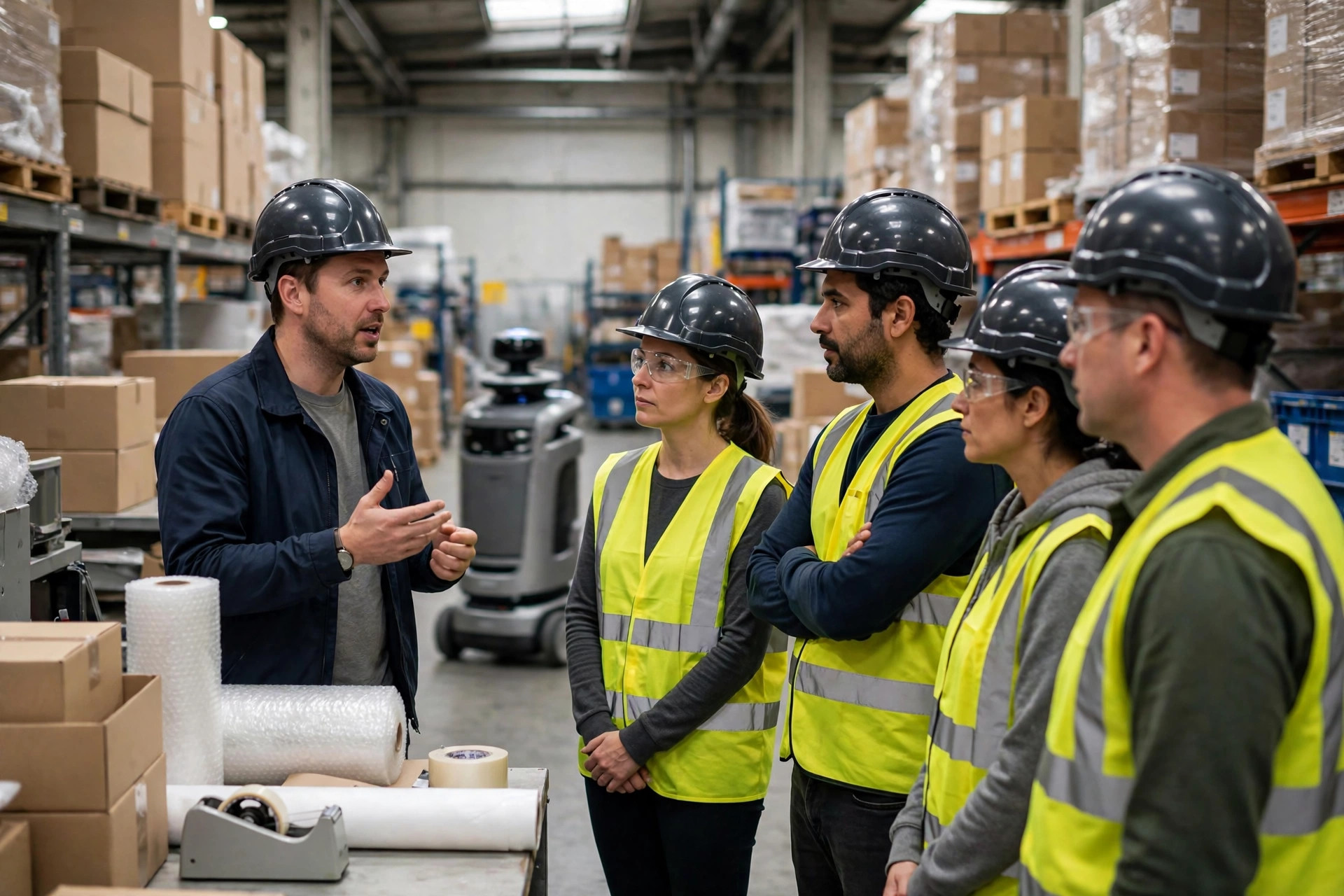
Early in 2024, I noticed something telling on the floor of a third-party logistics provider's automation showroom: the busiest booth wasn't demonstrating any machine at all, but a large screen streaming live pick-accuracy and stockout-alert curves. The sales lead told me the questions buyers ask about warehouse AI had changed — two years earlier, everyone asked "do you have AI"; now they ask "how much money does this save per year." A change in the questions being asked is usually more honest than any industry report.
According to the MHI/Deloitte Annual Industry Report released in March 2025, 28% of supply chain organizations report AI in live use today, with another 54% planning adoption within five years — implying roughly 82% penetration by 2029. The report also notes that AI is already creating measurable value in two areas: inventory management and demand planning. What I find most instructive is how carefully the report separates "in use" from "planned." After the hype fades, those are two different things, and only the first one is worth studying.
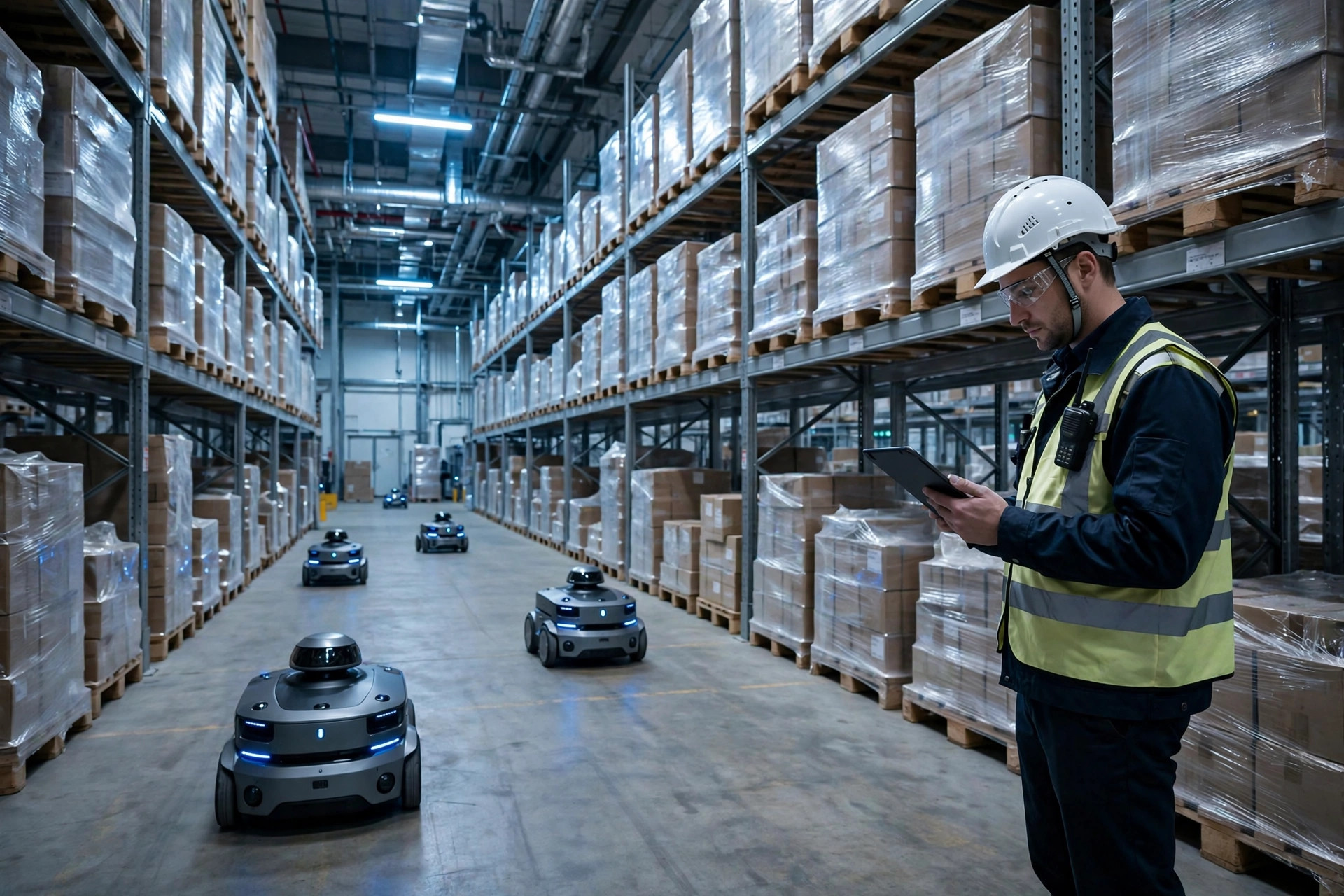
So which AI use cases actually made it from the slide deck into the daily shift schedule over the past two years? Reviewing public case studies and industry research, my answer comes down to three: pre-shipment vision inspection, demand-forecast-driven replenishment, and voice- and vision-assisted picking. They share one trait: none of them is glamorous.
Vision inspection: a second pair of AI eyes before dispatch
The most thoroughly documented public case comes from Amazon. In June 2024, the company disclosed Project P.I. — "private investigator" — a system in which products pass through an imaging tunnel before shipment, where generative AI and computer vision scan each item for damage, wrong color or size, and expired goods. Flagged items are intercepted and reviewed by human associates, who decide whether the item goes to discounted resale, donation, or disposal. Per Amazon's disclosure, the system was already live at multiple North American fulfillment centers, scanning millions of items per day, with expansion to additional sites planned through 2024 (sourced from Amazon's official disclosure, as reported by technology media in June 2024).
Why did vision inspection stick first? The economics are unusually direct: intercepting one defective parcel avoids the full cost chain of a return — reverse logistics, re-inspection, restocking or write-off. A return typically costs several times the original fulfillment, so this math is easy to defend. Just as important, it doesn't change the existing process: the tunnel sits on the conveyor, and items are inspected as they "pass through." No workflow had to be redesigned around the technology.
Its boundaries are equally clear. First, false positives still need human review — the system is positioned as a second pair of eyes, not a replacement, and the human-in-the-loop arrangement is the steady state, not a transition phase. Second, long-tail SKUs have thin image samples, so model performance degrades; bestsellers are recognized far more reliably than items that sell a few dozen units a year. Third, it only solves visible problems — damage, wrong color, expiry. It cannot catch a mispick, which belongs to the picking process upstream.
Demand forecasting: the quietest AI use case
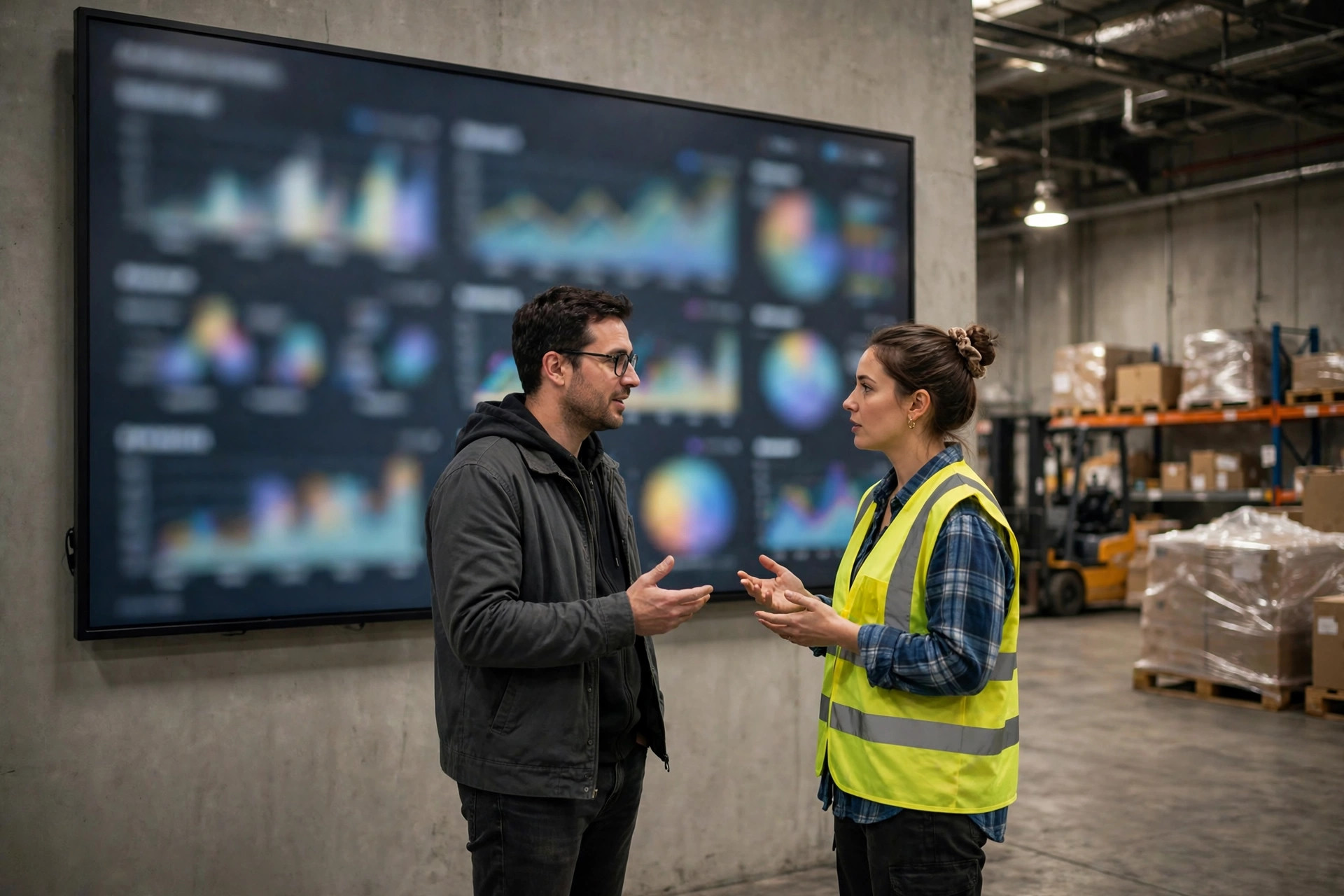
If vision inspection is the visible kind of AI, demand forecasting is the quietest: no new hardware, no flashy demo video, just computation running in the background. It is no coincidence that the MHI/Deloitte report names demand planning among the areas where the technology already delivers value — sales history, inventory records, and replenishment logs already live in the WMS and ERP, giving this use case the strongest data foundation of the three, with no new data-capture chain required.
The mechanism is straightforward: the model outputs SKU-level demand forecasts and suggested safety stock for the coming weeks; planners confirm, and replenishment tasks are generated automatically; before peak season, it flags which SKUs risk stockout and which risk overstock. The hard part was never the algorithm — it is data governance. If lead times are missing from SKU master data, the most accurate forecast in the world still can't land.
The shortcoming is equally structural: it is only good at what has a pattern. Promotions, new products, sudden viral demand — scenarios with no history — leave the model guessing. In other words, forecasting answers the future with the past, while the most expensive warehouse problems tend to come from futures with no past. That ceiling is shared by all predictive AI, and I see no sign of it being broken in the near term.
Voice and vision-assisted picking: an old technology's second act
Voice picking is genuinely old technology — it dates to the 1990s and has been used for decades in North American grocery distribution centers. A new generation of algorithms gave it a second life: noise cancellation that works in loud freezer environments, accent adaptation that lowers the bar for new hires, and natural-language interaction that replaced rigid numeric codes with spoken words. Meanwhile, vision assistance — overlaying pick instructions in the field of view of smart glasses or head-mounted displays — genuinely freed pickers' hands, so their eyes no longer shuttle between the rack and a handheld terminal.
The return on this use case hides in two metrics: mispick-rate reduction and shorter time-to-proficiency for new hires. Both vary enormously across operations, however, and consistently sourced public data is scarce — so I won't quote figures here. Whenever a vendor advertises an efficiency gain in the tens of percent, my advice is to ask two questions first: what is the denominator, and how many warehouses were in the sample?
Three problems remain unsolved: heavy accents combined with high noise are still the hard case; wear comfort and battery life limit penetration in high-intensity continuous operations; and workforce acceptance — some veteran workers feel "watched," and the change-management cost of rollout is routinely underestimated.
One table: the economics of the three AI use cases
| AI use case | Problem solved | Key dependency | Investment level | Payback logic | Scale status | Still unsolved |
|---|---|---|---|---|---|---|
| Pre-shipment vision inspection | Intercepting damage, mispicks caught too late, expired goods | Imaging tunnels, SKU image library | Medium-high (hardware + integration) | Avoiding the full cost chain of returns | Led by large e-commerce and 3PL operators | False positives need human review; long-tail SKUs underperform |
| Demand forecasting for replenishment | Stockouts and overstock | WMS/ERP sales and inventory history | Medium (software + data governance) | Lower stockout losses and carrying costs | Widest penetration; named by the MHI report | Promotions, new products, black-swan events have no history |
| Voice/vision-assisted picking | Pick errors and picker efficiency | Speech models/vision algorithms, wearables | Medium | Lower mispick rates, faster new-hire ramp | Mature in grocery distribution | Noise and accents; comfort and battery life |
One pattern reads clearly from this table: all three payback cases are built on measurability. Returns avoided, stockouts reduced, mispick rates lowered — each can be verified by finance. That is precisely the question most hyped proposals of the past two years could not answer.
Two AI directions that didn't pan out
The first is humanoid robots — the hottest narrative in warehouse automation in 2023–2024. A fact check: Agility Robotics' Digit moved more than 100,000 totes at logistics provider GXO's Georgia distribution center (company-reported figures: roughly 98% task accuracy, over 65,000 cumulative operating hours), and the relationship converted from pilot to a multi-year service agreement in June 2024. That is genuine progress. The other side is equally real: even Amazon, an early Agility investor, has not scaled the current robot generation and is waiting for the next one; and Gartner analysts' read is that on throughput-per-dollar, wheeled bases with articulated arms win — a conclusion they expect to hold through at least 2028. Humanoid robots are not a scam, but they answer an obsession with looking human. Warehouses need throughput, not a face.
The second is the "can chat about anything" general-purpose AI assistant. In 2024, many WMS vendors shipped an AI assistant that would answer any question. But the warehouse floor doesn't need conversation — it needs determinism. "Can this location hold this pallet?" answered wrong costs more than not answering at all. The uncertainty inherent in open-ended large models makes them a poor fit for process-heavy, compliance-sensitive warehouse operations. With the hype gone, the verdict is clear: what survived is narrow AI embedded in a specific process step, not an omniscient general assistant.
The contrarian read: surviving AI doesn't look like AI
Here is the contrarian judgment: the technology forms most celebrated during the 2024–2025 hype — humanoid, conversational, general-purpose — were precisely the first to be falsified in the warehouse. The three use cases that actually stuck aren't selling "intelligence" at all. They're selling determinism.
The underlying trade-off is generality versus process depth. Hype-era technology sold possibility: one model that could talk about any scenario. What survived sells certainty: a single, well-defined, measurable problem, a complete data loop, and a bounded cost of error with human review as the backstop. This is the same logic by which WMS itself spread more than a decade ago — a technology only counts as landed when it becomes part of the process; as long as it remains a capability demonstration, it stays in the product launch.
On the MHI projection of 82% AI penetration by 2029, my position is: direction credible, precision doubtful. The more interesting question sits outside the number. Once vision inspection, demand forecasting, and assisted picking become table stakes, the gap between warehouses will shift from "do you have AI" to "whose data is better" — and data quality is precisely the lesson many warehouses spent the last decade avoiding. The next round of divergence may start not in algorithms, but in location master-data accuracy. After the hype, the homework left for warehouse managers may be harder than it was during the hype.
By Dr. Chen, Supply Chain Researcher