Bottom line: a small warehouse needs no 5S consultant or new software. Three things are enough — floor zones, location labels, and a 10-minute end-of-day reset. Sixty days later, your pickers will spend less than half the time hunting for stock. The warehouses that fail at it never fail on method. The boss gives up first. I've seen this failure three times: a loud kickoff, nobody minding the store by week three, back to chaos in two months.
Why 5S Isn't Spring Cleaning
5S stands for Sort, Set in order, Shine, Standardize, Sustain. Most small-warehouse owners hear "5S" and picture a big weekend cleanup. Three days of clean, then back to normal on day four.
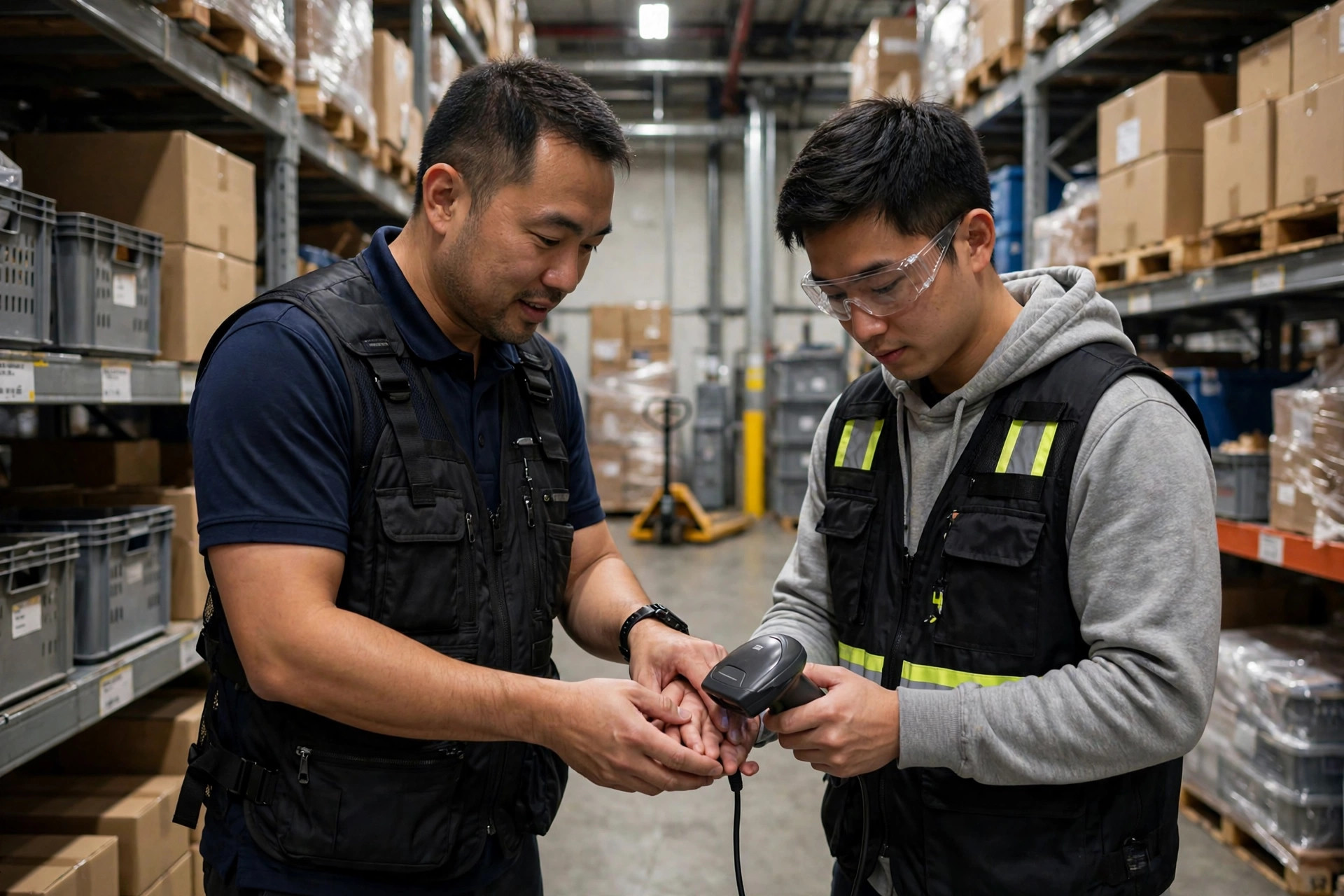
Fall 2023, I was implementing WMS at a 65,000-square-foot auto-parts e-commerce warehouse. The owner had spent three grand on a three-day 5S training. Red tags all over the walls — very impressive. Two months later I went back: the red tags were still there, the "pending disposition" boxes under them collecting dust, and nobody could tell me who owned the follow-up. I counted — more than forty tags, not a single one resolved. The owner had handed follow-up to the office admin, who'd never set foot in the warehouse.
The rule of red-tagging is simple: every tag gets a disposition within 48 hours. Nobody enforced it, so the tags became wallpaper. 5S isn't hygiene — it's order. Where does the stock go, where do the tools go, where does the broken stuff go? Every spot has an answer, and everyone knows it. A spotless floor means nothing if pickers still dig through three pallets to find one SKU.
The Math: What 60 Days of 5S Actually Buys
Early 2024, a small 3PL in eastern China — about 100,000 square feet, 800 orders a day — asked me to sort out their floor. Before touching anything, I timed 20 pick lines: average 3 minutes 40 seconds to find one line, worst case 11 minutes. No location labels anywhere; everything ran on veteran pickers' memory.
We did just the three things — floor zones, location labels, the daily 10-minute reset. Sixty days later, same measurement:
| Metric | Before 5S | 60 days after |
|---|---|---|
| Avg. time to find one pick line | ~3.5 min | ~1.3 min |
| Mis-ships per month | 17 | 6 |
| Forklift aisles | Routinely blocked by staged freight | Clear end to end |
Itemized, so any owner can sanity-check it:
| Spend item | Cost |
|---|---|
| Floor paint and floor tape | ~$550 |
| Label printer plus a year's supplies | ~$200 |
| Rack-level labels, laminated and waterproof | ~$280 |
| Total | Under $1,100 |
What it saves is daily picker labor: 30 pickers, 40 minutes of search time saved per person per day — that's 600 labor hours a month. The investment paid for itself in about two months, and everything after that is pure gain. Unlisted returns matter too: faster new-hire ramp-up, and customer site visits that stop being embarrassing. You can't put those in a spreadsheet, but every owner knows what they're worth.
Small-Warehouse 5S: The Four-Step Playbook (Start This Weekend)
Step 1: Zone the floor (half a day)
- Print a floor plan. Hand-drawn on a big sheet is fine.
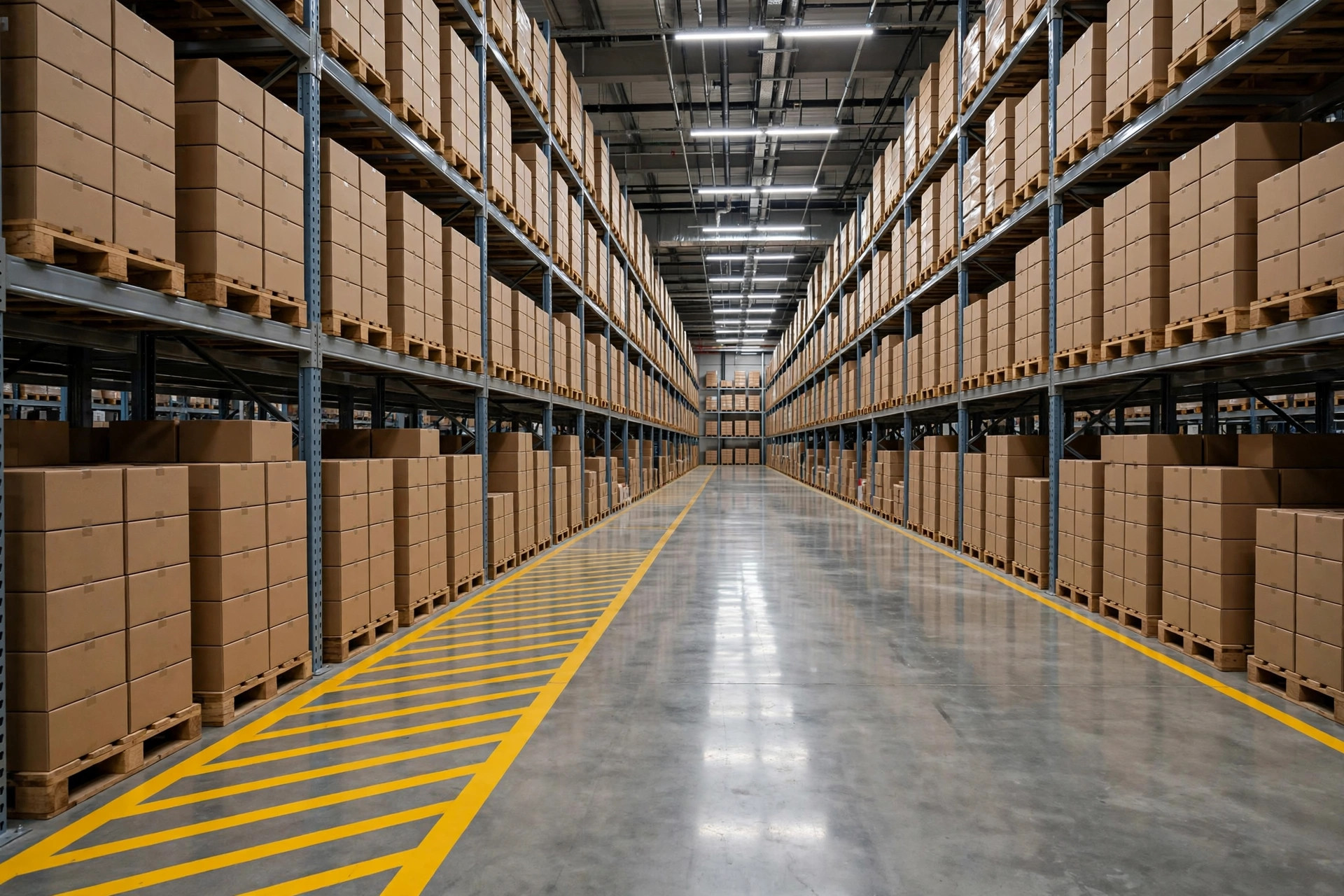
- Tape out four zones with yellow floor tape: inbound staging, picking, quarantine for exceptions, packing and shipping. Laminated sign at each zone entrance, lettering big enough to read from 10 feet away.
- Forklift aisles get solid yellow lines; pedestrian walkways get dashed white lines. Forklift aisles no narrower than 11.5 feet, walkways no narrower than 4 feet. After marking, have a driver run the route: if he says he can turn without clipping, it passes.
- The quarantine zone is the linchpin. Damaged goods, pending returns, orphan stock — everything homeless goes there. Nothing stages in aisles or at rack ends. Ever.
Step 2: Code and label every location (one day)
- Keep the code dumb-simple: zone, aisle, level, bay — for example, INB-03-2-05 for inbound staging, aisle 3, level 2, bay 5. No clever alphanumeric schemes your crew can't memorize.
- One label per location, all at eye level (about 4.5 to 5 feet). Crooked labels get redone on the spot.
- Test immediately: call out 10 random codes; the crew must walk to each within 30 seconds. Fail, and you re-label and re-learn.
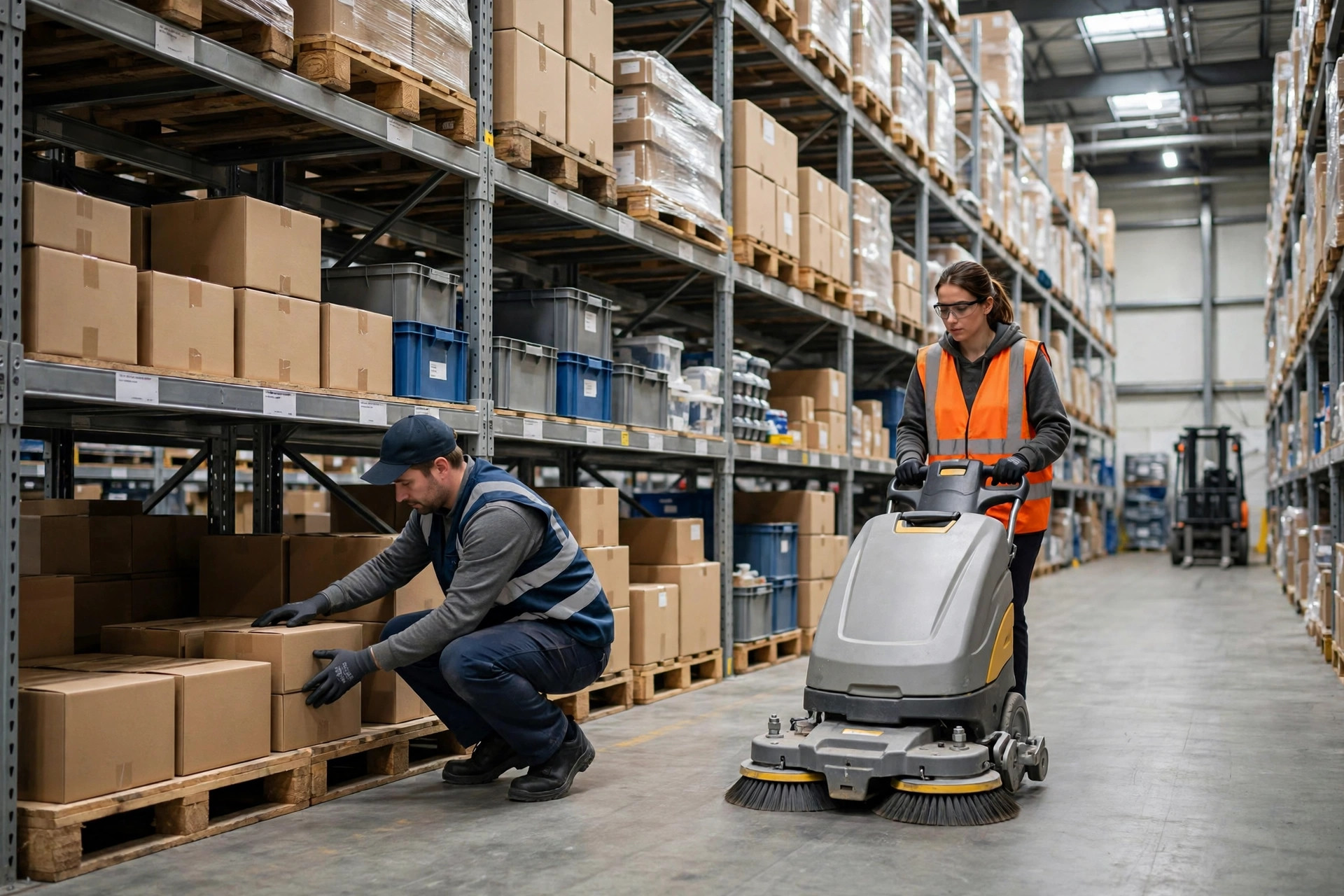
Step 3: The daily 10-minute reset (starts on day one)
- Ten minutes before clock-out, everyone stops: tools back in place, pallets back in place, loose cartons back in place, trash out.
- The shift lead photographs three spots — main aisle, inbound, quarantine — and posts them in the group chat. The photos ARE the checklist; no forms.
- Whoever's zone isn't reset gets named at the next morning huddle. No fines. Three callouts, and the shift lead buys bubble tea — face works better than fines.
Step 4: The weekly 30-minute hold (anti-backslide)
- Every Friday before clock-out, the shift lead walks the floor against the zone map, looking for creep: staged freight where it shouldn't be, pallets over the lines, fallen labels.
- Three or fewer findings: fix on the spot. More than three: Monday's huddle does a root-cause review.
- Change the photo angles every month, or people will only tidy the spots the camera sees.
- Make it lesson one of onboarding: the new hire walks the zones with the shift lead, learns the codes, and can reset their own area on day one. Warehouses where it actually works get new hires productive in three days; without it, new people still ask "where does this go?" after three months.
- Last Friday of the month, one hour on three numbers: late-search picks, mis-ships, aisle blockages. Numbers trending down means the system is alive. Trending up means the daily reset stopped — go check.
Where It Goes Wrong (I've Seen Each of These Three Times)
- Red tags with no owner. Every tag needs a named owner and a 48-hour deadline. Decide who removes tags before you hang a single one.
- Labels too small or too high. The test never changes: can a floor worker read it from 10 feet away and find the location in 30 seconds?
- A big kickoff, then no daily reset. 5S always dies the same way: "we're too busy." But peak season is exactly when a blocked aisle costs you real money — every detour a forklift takes is cash out the door.
- The boss stages his own stuff in the aisle. The moment the owner's samples land in the walkway, the crew learns the rules are for other people.
- Outsourcing 5S to the cleaning crew. Cleaners can sweep floors; they can't decide which zone a pallet belongs in. 5S is floor management, not a janitorial contract — the shift lead owns it, period.
One Counterintuitive Call
Small warehouses should NOT copy the big-company 5S playbook — the dedicated committee, the monthly audits, the score rankings. The more formal it gets, the faster it dies.
Big companies have full-time teams to push 5S. You don't. So face the trade-off honestly: your resources cover exactly one habit, and it has to be the daily 10-minute reset. Zoning and labeling are one-time investments; the reset is a daily action. Order isn't something you organize once — it grows out of resetting every single day.
| Big-company 5S system | Small-warehouse playbook | |
|---|---|---|
| Driven by | Dedicated 5S committee, monthly audits | Shift lead, 10 minutes a day |
| Inspection | Scores, rankings, red/yellow cards posted | Three phone photos in the group chat |
| Investment | $15,000 and up, consulting included | Under $1,100 in materials |
| How it dies | Audits stop, everything rebounds | Resets stop, everything rebounds |
| How it lives | System inertia | The owner glances at three photos a day |
One minute a day on three photos beats any audit. You look, the shift lead doesn't dare stop. You stop, and by day three nobody's taking photos.
Under $1,100, ten minutes a day, search time cut in half, mis-ships down by two-thirds. Any small-warehouse owner can do this math. The ones who can't aren't failing the math — they're failing the follow-through.
Something you can use tomorrow: tonight before clock-out, take two shift leads and spend 20 minutes clearing staged freight out of inbound and the aisles. First thing tomorrow morning, check whether the aisles are clear. A warehouse with clear aisles is never far off track. Once those 20 minutes show results, talk about zoning, labeling, and the daily reset — one step at a time, no rush.
By Lin Xiao, WMS Implementation Consultant