We are a small warehouse, and we cannot afford to burn money on fancy toys. That was my first reaction when I first heard about voice picking.
It was last summer. A friend who sells warehouse equipment came to visit our little 3,000-square-metre warehouse. He watched our pickers carrying paper lists in one hand and a barcode scanner in the other, walking, reading, scanning, and putting things down again. He said, why are you still using paper? With voice picking you wear a headset, the system tells you where to go and how many to take, and you just pick. I thought, here we go again, another big-company toy. We have a dozen people. The big-company playbook does not work for us.
Then he showed me a few numbers, and I stopped laughing. That is how this guide to voice picking came about: ears instead of eyes, and the honest maths on how much faster it is and how many fewer mistakes it makes.
Voice Picking Starts with Accuracy: Ears Beat Eyes
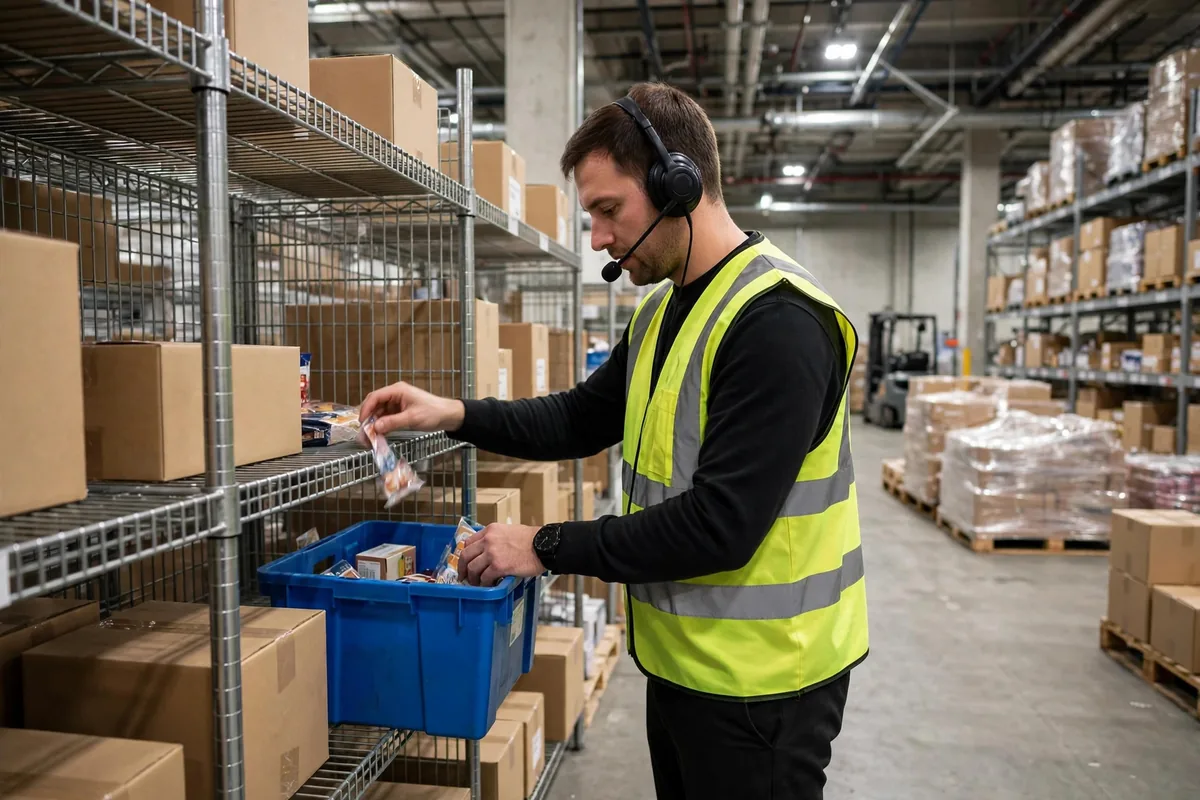
Voice picking is a simple idea: free your eyes from paper lists and screens. The system tells you by voice which location to go to and how many items to take. You pick them up, confirm by voice, and your hands stay free for the actual picking. No more putting things down to scan, no more squinting at a list.
Accuracy is where voice picking makes its strongest case. Public figures from vendors such as Dematic and Honeywell put voice picking accuracy at 99.8–99.99%, with an error rate of roughly 0.2–2 errors per thousand picks. Compare that with pick-to-light, which runs at roughly 3–5 errors per thousand picks. Pick a thousand items with voice and you might get two wrong at most. Pick the same thousand with lights and you might get five wrong. That gap looks small until you count what one wrong pick costs in reshipping, returns and customer service time.
A friend runs a small cosmetics warehouse, where the wrong shade was his top complaint. After switching to voice, the system read the location, quantity and shade aloud and the picker confirmed it back, so a wrong shade surfaced on the spot. Within a month complaints dropped, and he no longer stayed late reshipping wrong orders.
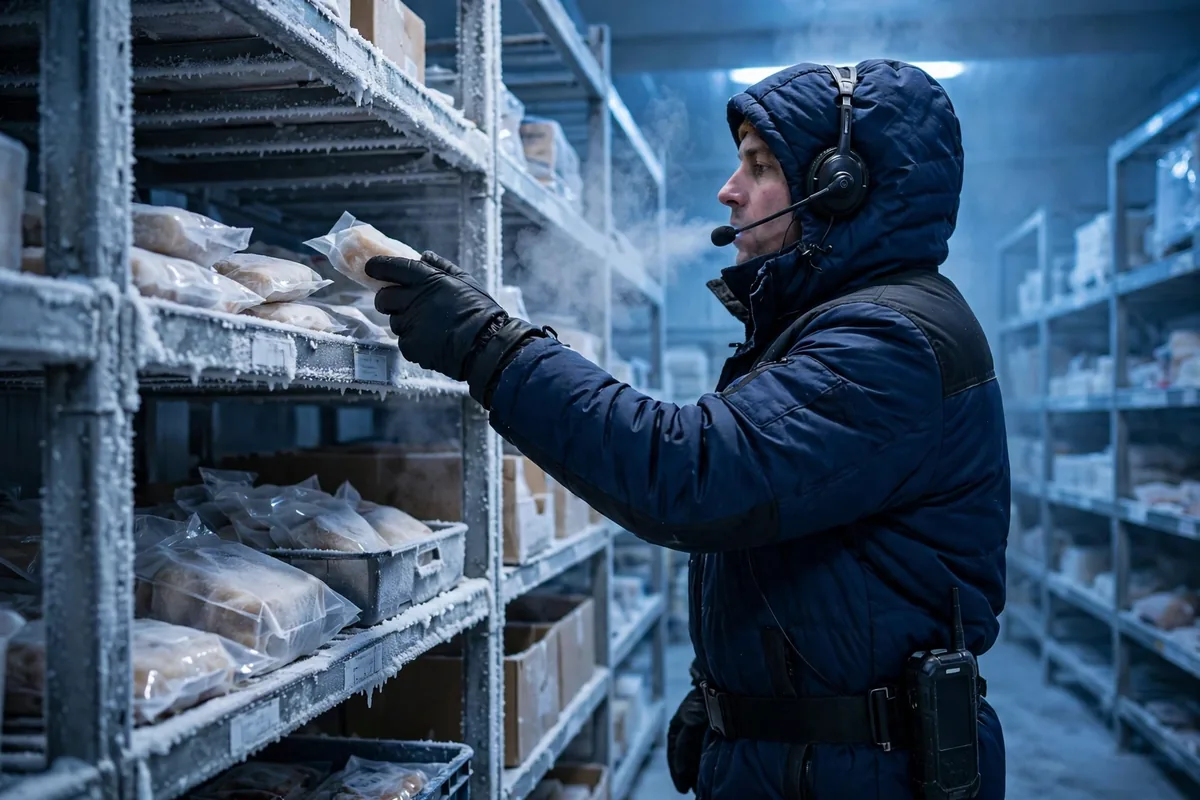
Cold storage is the classic use case, and I completely buy it. In a freezer warehouse you wear thick gloves, screens fog up, paper lists get damp, and scanners freeze. A headset giving instructions while both hands stay free is simply the most practical way to work. Some jobs do not trust eyes and fingers. They trust ears.
How Much Faster Is Voice Picking? Split the Two Kinds of "Faster"
When people talk about speed, they often quote one number and hide the rest. Split it into two kinds of faster. As a technology upgrade on its own, the voice system lifts productivity by roughly 5–10%. Combined with process optimisation, whole-order picking can rise by 25–35%, and piece picking by more than 45%. See the difference? Buying headsets alone does not make you much faster. Sorting out pick paths, slotting, and wave planning at the same time is where the real speed comes from.
Gartner has a figure worth remembering too: voice is 40–50% more productive than paper lists and barcode data capture. That sounds dramatic, but it compares voice against the old paper-and-barcode method, not against an already optimised pick-to-light setup. Use it as a reference, not as a promise.
Let me show you the maths with a worked example — this is a hypothetical illustration, not our warehouse's real data, just to show the scale. Suppose one picker does 800 picks a day. At a pick-to-light error level of 4 errors per thousand, that is a little over 3 mistakes a day. With voice at 1 error per thousand, it is under 1 mistake a day. Over a month, that is fifty or sixty fewer mistakes. If each mistake costs half an hour of reshipping and customer service time, that is twenty to thirty hours saved a month. That is roughly where the money for the voice system comes from — not from picking a bit faster, but from stopping the expensive rework.
| Comparison | Paper / barcode capture | Voice picking |
|---|---|---|
| Accuracy (public figures) | Lower than the voice system | 99.8–99.99% |
| Error rate | Higher than voice | About 0.2–2 per 1,000 picks |
| Productivity vs paper / barcode | Baseline | 40–50% higher (Gartner) |
| Hands during picking | Often busy with paper and scanner | Free to pick |
| New starter onboarding | Longer training | Training time can fall by more than 50% |
That last row matters more to small warehouses than any vendor brochure admits. Our biggest fear before a sales peak is hiring new pickers who still cannot pick reliably after three days of training. Voice walks them through step by step: listen, pick, confirm. Training time can be cut by more than 50%. A new starter can be useful on day one, and the system corrects mistakes on the spot instead of a senior picker shadowing them all day. You cannot see that benefit on a spreadsheet, but during peak season it can save the week.
The Counterintuitive Part: Voice Picking Is Not for Every Job
Here is the counterintuitive part: if the voice system is so good, why does every warehouse not use it? Because it is not universal.
Full-pallet handling is a good example. When the job is moving whole pallets and most of the time is spent walking and driving, there are not many picks to speed up, so voice saves little. Warehouses with a huge variety of products and locations that change constantly also face higher maintenance costs, because the voice prompts and vocabulary need constant updating, and a small team may not have the time for that.
Scale is a real question too. Honeywell voice is used in 60 countries, by more than 1 million workers, in 35 languages. That is big-company scale. For a warehouse with a dozen people, the question is return on investment: if your daily pick volume is modest and your error rate is already low, the money saved may not cover the equipment and maintenance. Sorting out your paper process and labelling your locations properly might pay back faster. The big-company story does not automatically fit a small warehouse.
My cosmetics friend learned the other half of this lesson the hard way. At first they only bought headsets and software and changed nothing else. Speed rose by less than ten percent, and the owner nearly sent the equipment back. Then they re-slotted the warehouse, moving bestsellers closest to the packing bench, and whole-order picking jumped by about thirty percent. Same headsets, same software. The process changed, and the result changed with it. The voice calculation cannot count the equipment alone. It has to count the process work too.
Small Warehouses Have Their Own Way: Pilot First, Then Decide
For other small warehouses like ours, I have three practical suggestions.
Pilot one scenario first. Do not roll it out across the whole warehouse at once. Pick the product category with the most picking errors, or the shift where new starters struggle most, and try it for a month. During the pilot, watch two numbers only: how much the error rate fell, and how much picking speed rose. If both look good, expand. If only one looks good, ask whether the problem is the process or the equipment.
Then do your own maths. Do not copy the vendor's marketing numbers. Use your own pick volume, error rate, and reshipping cost. A small warehouse doing only a few hundred picks a day with barely any errors a month may not find the voice system the best investment right now. Spending the money on slotting and process first might pay back sooner.
Finally, a word to anyone still on paper lists: paper is not unusable, but its hidden costs are easy to ignore. You think you saved money on equipment, but you are paying every day in wrong picks and new-starter training. Whether voice is worth it is not answered in a vendor brochure. It is answered in your own error log and your own overtime sheet.
We are a small warehouse, and we cannot afford to burn money. But we can afford even less to keep making mistakes and working overtime every day. Do the maths properly first, and only then spend. That is how a small warehouse survives.
By Xiao Ma, Small Warehouse Owner