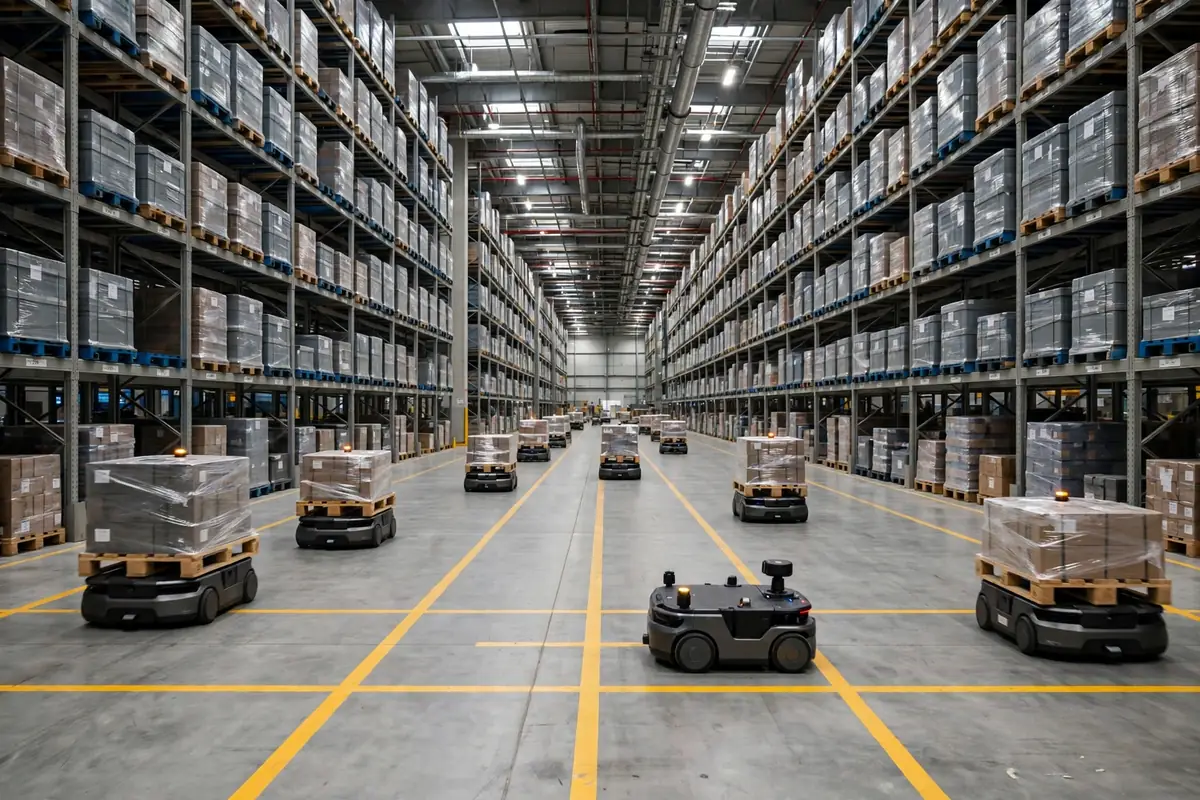
In the fall of 2024 I walked into a 3PL warehouse outside Ontario on an integration job. The manager pointed at the framed floor plan on the wall: drawn five years ago by a consultant, fast movers in Zone A, slow movers in Zone B, untouched since. I asked one question: do your peak-season best sellers still live in Zone A? He went quiet. The best sellers had turned over three times. The slots had not moved once. That is the state of most warehouses I visit — and it is exactly the problem AI warehouse layout optimization is built to solve.
What AI Warehouse Layout Optimization Actually Calculates
Let me be clear about one thing first: this is not software that draws a prettier floor plan. It does three jobs. It eats data — historical order lines, the velocity of every SKU, which SKUs keep getting ordered together, each SKU's size and weight, and the racking's load limits and beam heights. Then it places stock with heuristic algorithms. Think of it like a navigation app calculating a route, except instead of one route it is deciding where thousands of SKUs should each live. Genetic algorithms, simulated annealing — the names sound intimidating, but the work is plain: try combinations, score them, try again, until it finds the arrangement with the shortest total travel. And it checks the answer in simulation, running tens of thousands of orders through the proposed layout to see how far pickers actually walk and where aisles jam up, then adjusts.
This is worth money because walking is brutally expensive. A widely cited figure from Georgia Tech's warehousing textbook puts travel at roughly 55% of picking time. More than half a picker's shift is spent walking, not picking. Slot the fast movers well and the walking shrinks — the math is not complicated. Research on ABC class-based storage has reported picking route and time cuts of up to about 45% (Le-Duc, 2005), and that number comes from the academic literature, not a vendor brochure.
Then there is the dynamic part. ABC classification is not a one-time job: this month's A-class best seller can be dead stock next month. What the AI does is re-run the ABC math every month, sometimes every week, on fresh velocity data, and move slots along with demand. A human team could do it in theory. In practice, nobody re-slots an 8,000-SKU warehouse by hand every month — the roster would collapse first.
Where the Hand-Drawn Map Goes Wrong
The failure modes of experience-based layouts, as I have seen them, come down to three. Slots are fixed and demand is not. That 3PL in Ontario is the textbook case: Zone A was set five years ago and now holds stock that stopped selling seasons ago, while the real best sellers sit at the far end of the farthest aisle. Then there is the co-occurrence blind spot: two SKUs may each sell slowly, but if eight out of ten orders contain both of them, an experience-based layout puts them at opposite ends of the building and the picker crosses the warehouse on every order. An algorithm spots instantly that they are joined at the hip and slots them side by side. And people count distance and forget time.
That third one is the most overlooked, and the most counterintuitive: cut travel distance and order cycle time does not fall by the same proportion. In a published simulation built on a public dataset, optimized routing cut travel distance by 54% — but average order processing time fell only 6.6%, because the hands-on picking, the searching, the confirming, did not get one minute shorter. Distance is the biggest slice of the cost, not the whole cost. If a vendor tells you travel down by half means output doubled, ask for the simulation report. If the numbers do not line up, it is sales talk.
When AI Layout Optimization Pays — and When It Does Not
My dividing line for AI warehouse layout optimization is simple: more than a thousand SKUs, volatile velocity, two or more seasonal changeovers a year — worth a conversation. Three to five hundred SKUs and a layout that has not moved in a year — do not touch it. Putting this system in a 300-SKU warehouse is like fitting a GPS to a bicycle. The GPS is not bad. You just do not need it.
Before the numbers, a disclosure: the table below is a hypothetical example. I picked the figures from ranges reported in published research, not from any single warehouse's measured results. Industry analyses generally put the travel-distance reduction from intelligent slotting at 15% to 30%; I used 20%, the middle of that range.
| Item | Experience-based layout | After AI optimization (hypothetical) |
|---|---|---|
| Walking per picker per shift | 8 km | 6.4 km |
| Travel share of picking time | ~55% | ~44% |
| Total distance saved per day, 20 pickers | — | 32 km |
| Labor hours saved per day | — | ~17.6 hours, roughly 2.2 headcount |
How the labor math works: in an 8-hour shift, travel at roughly 55% is about 4.4 hours. Cut that by 20% and each picker saves 0.88 hours per shift; twenty pickers save 17.6 hours a day. The whole calculation rests on one condition: your order-line data is clean and your velocity numbers are real. Garbage data in, expensive garbage slots out.
There is also a hidden bill: dynamic re-slotting means physically moving stock. One big re-slot before peak season costs moving hours and carries a mispick risk, and both belong in the calculation. The more often you re-slot, the finer the math has to be. Re-slot too eagerly and the warehouse gets messier, not cleaner — not a paradox, just the moving cost eating the savings.
Do Not Copy the Output Blind
The first step after the algorithm hands you a plan is always a human check against hard constraints. Fire lanes cannot be blocked. Overweight stock cannot go up high. A forklift cannot turn where a column grid gets in the way. Areas outside sprinkler coverage cannot hold high-stacked goods. The algorithm may not know these constraints, and even if it does, it may not weight them properly. I have seen a warehouse copy an optimized plan straight into production and put heavy goods on the top beams — the rework cost more than the optimization ever saved.
The maintenance traps come in three flavors. Dirty data: missing order lines and wrong slot records nobody fixes, so the algorithm drifts further off every cycle. Runaway re-slotting frequency: one big move before peak season is enough; weekly small moves leave pickers hunting for stock that moved yesterday. And do not confuse layout optimization with a digital twin. A digital twin is a live mirror of the whole warehouse, built for simulation and monitoring; layout optimization solves one problem — where each SKU lives — and it is far lighter and far cheaper. The two are not in the same price range or the same project timeline. When a vendor sells you layout optimization dressed up as a digital twin, most of the time it is a price markup wearing a fancier name.
So here is my usual rule: is the money worth it? Look at one number — how much the average travel distance per order fell after optimization, multiplied by your real labor cost. Down more than 20% and the hours come back, it is worth it. Down only a few points and your slotting was never that bad; keep the money for something else. One thing you can do tomorrow, and it costs nothing: export three months of order lines and run an ABC classification. Once you see that, you will know whether your warehouse needs AI warehouse layout optimization — or just a fresh look at the map.
By Da Liu, Automation Engineer