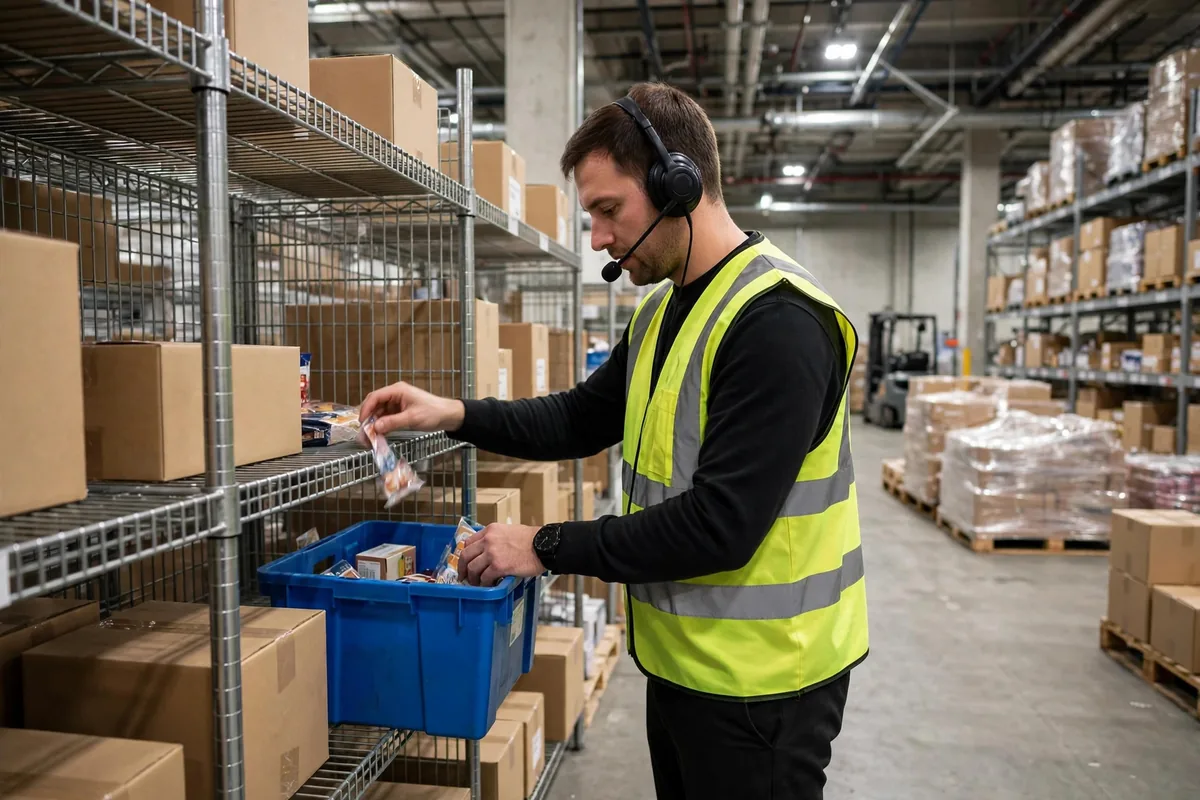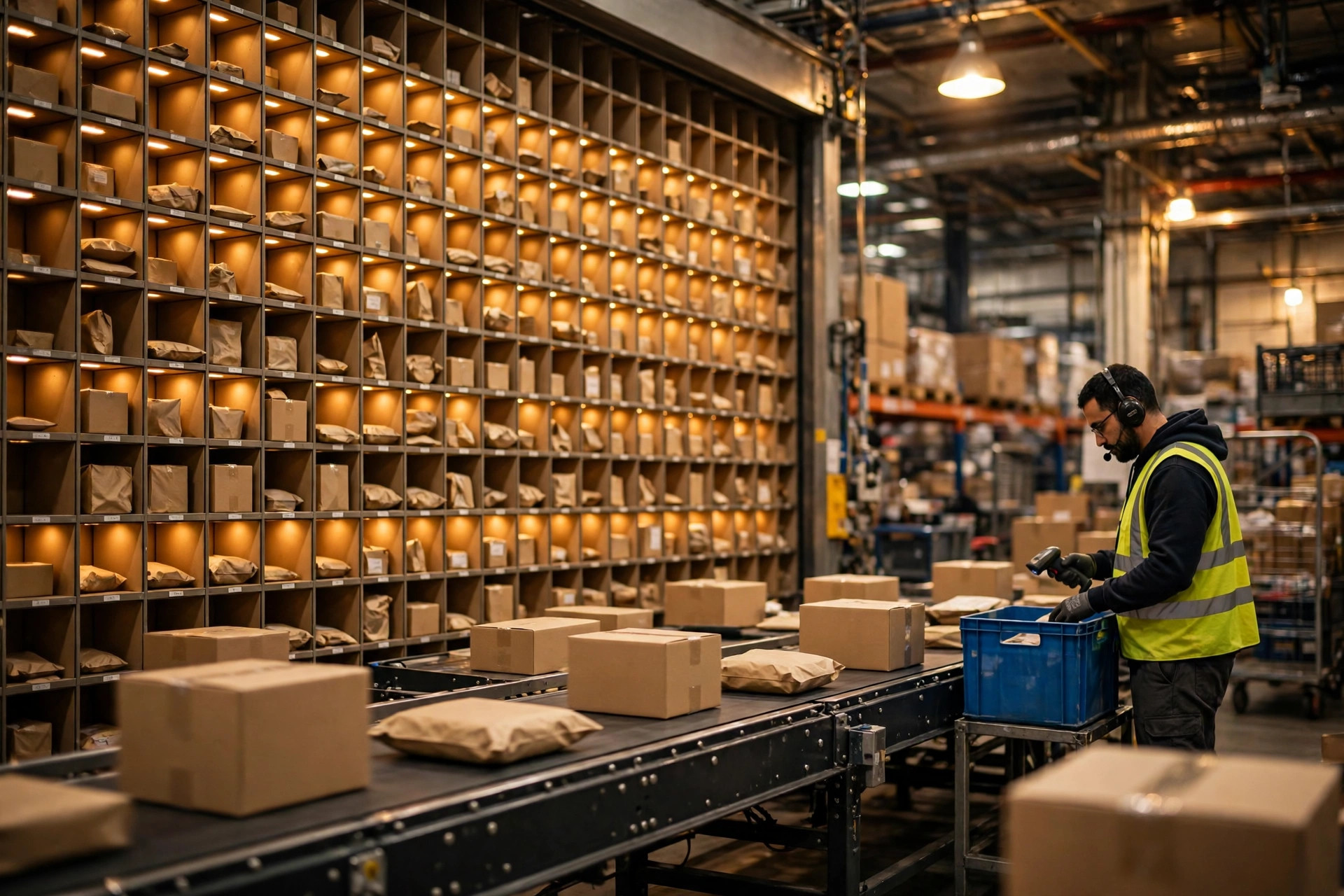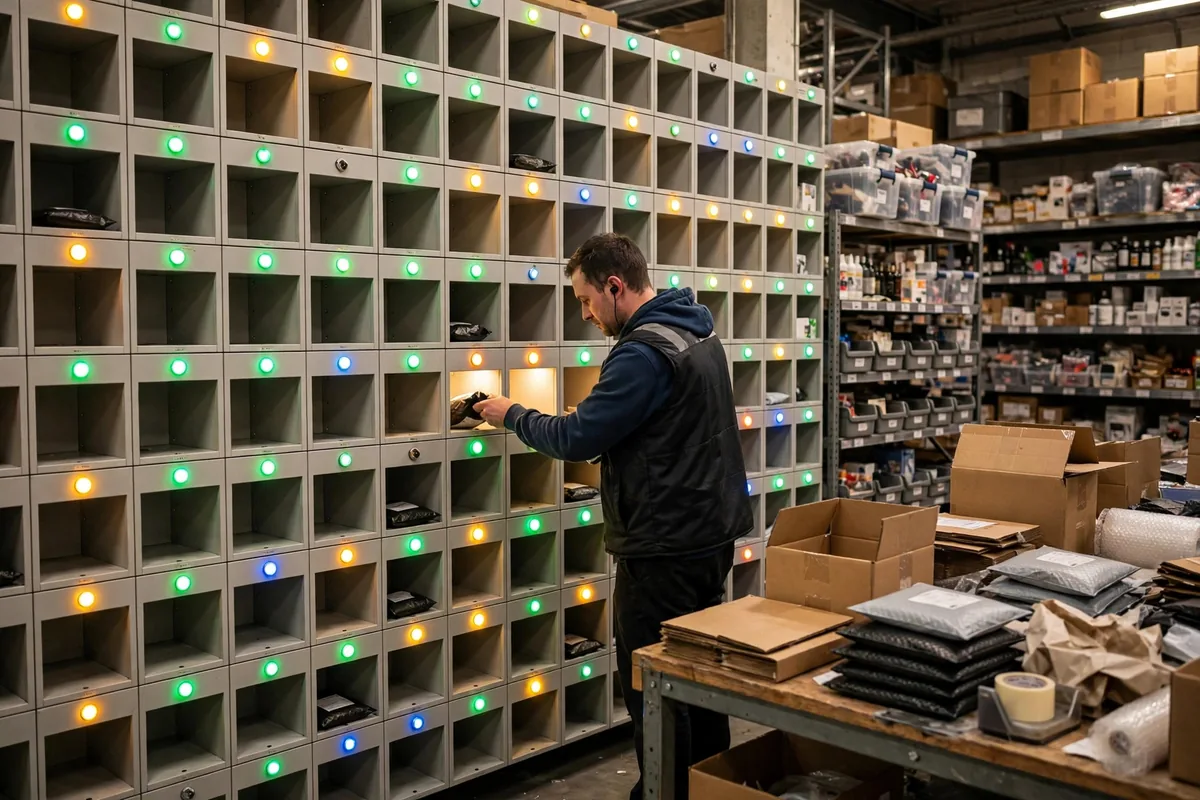
Voice picking is now standard equipment in many large distribution centers. The vendor brochures all quote accuracy above 99.9%. According to Dematic's published figures, however, the real-world error rate for voice picking runs at 0.2 to 2 errors per 1,000 picks — 99.8% to 99.98%. The number itself is not bad. What deserves attention is the distribution behind it: voice picking misrecognition does not happen evenly. It concentrates in three places — accent, noise, and the confirmation mechanism itself.
Voice picking misrecognition: start with the data
Establish the baseline first. A study published in the Journal of Organizational Behavior Management (Berger and Ludwig, 2007) followed 132 selectors at a foodservice distributor in the southeastern United States: after voice-assisted selecting with immediate feedback was introduced, errors fell from 2.44 per 1,000 cases picked to 0.94 — a reduction of more than 60%. A vendor-published case study tells a similar story from the other side: after TaylorMade adopted voice picking, its picking team shrank from 20–25 people to 14–16, while throughput rose from 41 transactions per hour to 184. Both sets of numbers confirm that the value of voice picking is real — but its accuracy is never a standalone figure. It is a function of a set of conditions.
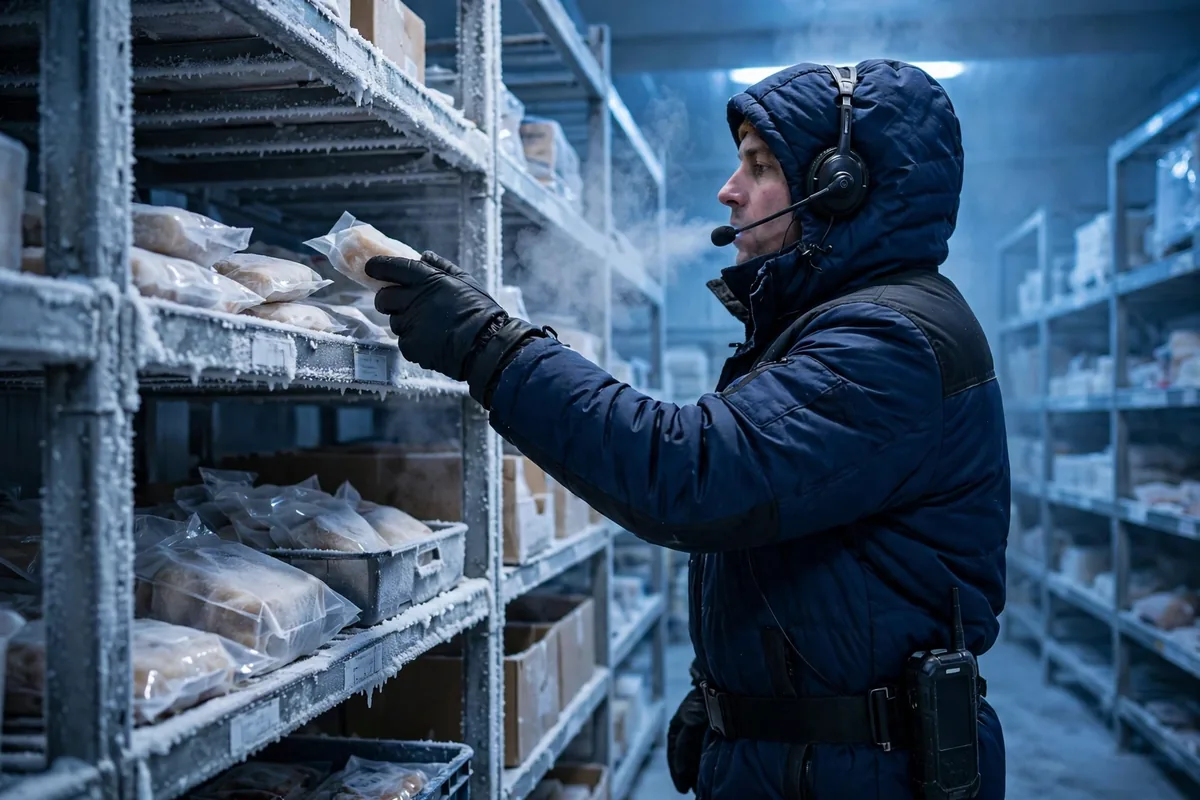
Noise is the first condition. Speech intelligibility begins to degrade noticeably once ambient noise passes 65–70 dB(A), while a typical distribution center routinely exceeds 85 dB(A). Industry reporting on high-noise industrial environments suggests recognition accuracy can fall from above 95% to below 60%. The range is that wide because "noise" is not a single variable: the steady drone of a conveyor and the transient spike of a forklift starting up damage recognition in completely different ways.
Noise is not the only culprit
Steady background noise is, paradoxically, the easier problem. Modern industrial headsets handle stable-frequency noise reasonably well with noise-cancellation algorithms. The hard part is the transient: the shriek of a hydraulic lift, the roar of a forklift ignition, the clang of metal racking — sounds that arrive suddenly, spread across a wide spectrum, and are gone before the algorithm can model them. Then there is reverberation: in a high-bay warehouse, sound bounces off hard surfaces and the boundaries between phonemes blur, so the system hears not a clean string of syllables but speech wrapped in echo. Warehouse acoustics are rarely the first item on an acceptance checklist, yet they set the floor for how voice picking performs in real conditions.
There is also a variable that seldom makes it into the evaluation at all: the headset itself. A picker wears it for eight hours; sweat, slippage, and a loosening headband all pull the microphone away from its optimal position, and recognition degrades with it. That is an ergonomics problem, not a technology problem — but it ends up on the same "misrecognition" ledger. Evaluating voice picking on lab recognition rates alone is like evaluating a car on its advertised fuel economy.
Accent: the voice the model has never heard
If noise is an environmental variable, accent is a human one. Speech recognition models are trained overwhelmingly on standard pronunciation, while the picking workforce in an American warehouse is often multilingual and multi-accented: native Spanish speakers, immigrants from Southeast Asia, native English speakers with regional accents — the same sentence comes out with different vowels and different intonation. Early voice picking systems were speaker-dependent: each worker read a vocabulary list so the system could build a personal voice profile, stored on a server and downloaded to the worker's terminal at the start of each shift. That approach works, but it has a cost: misrecognition peaks in a new hire's first two weeks, which is precisely when turnover is highest.
The same trap exists in other languages. In English, "fifteen" and "fifty" are the classic pair; in Chinese, the numbers three, four, seven and ten blur together at speed. The underlying issue is identical: if the confirmation vocabulary contains near-homophones, the probability of misrecognition is amplified systematically. This is not workers "speaking incorrectly." It is a vocabulary list designed without checking for minimal pairs.
The check-digit paradox: when the safeguard becomes the hole
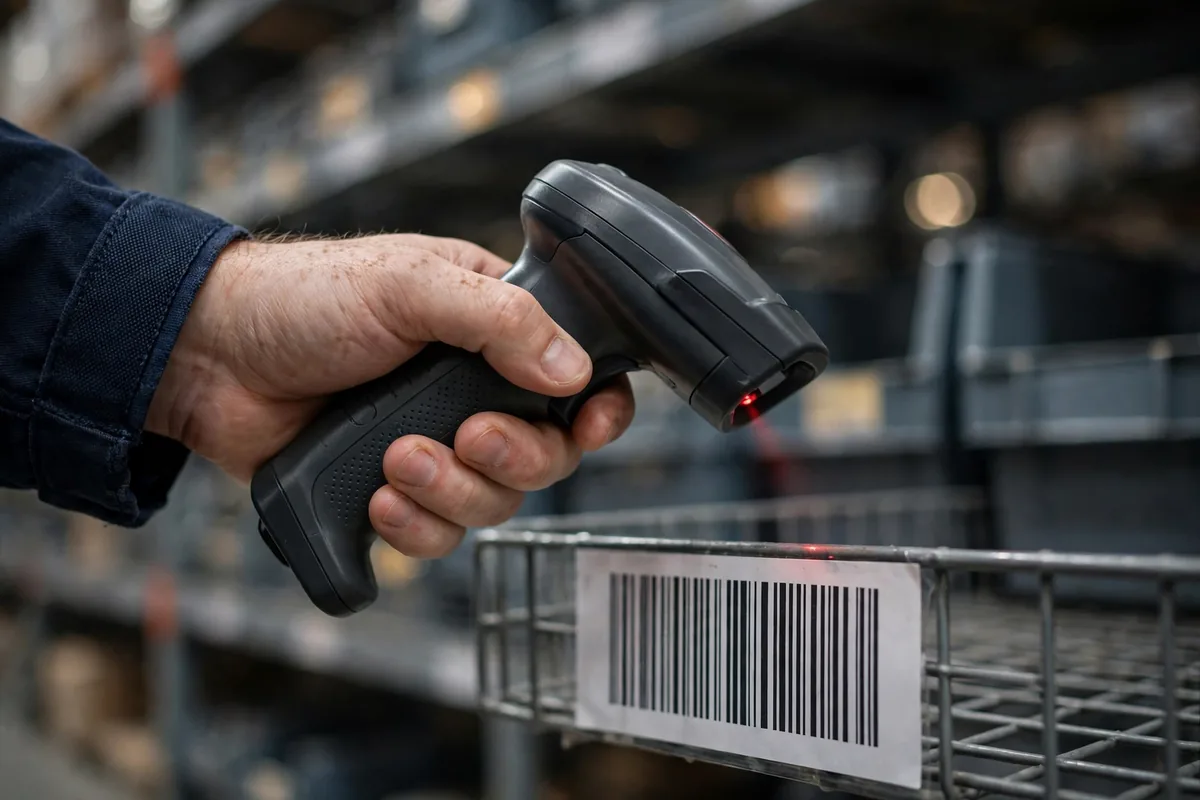
The core error-proofing mechanism in voice picking is the check digit. The system announces a location, the worker reads aloud the check digit posted on the racking — usually the last three digits of the barcode — and only after the system verifies it does it announce the pick quantity. The mechanism looks airtight, but it has a counterintuitive hole: the most dangerous misrecognition is not the system mishearing. It is the system hearing correctly.
A veteran picker who has worked the same zone for months has the check digits memorized. Before even reaching the location, the number is already out of their mouth, the system verifies it, everything is green — and the wrong item gets picked. The industry calls this "check digit memorization," and there is even a patent (EP3038030A1) proposing dynamic check digits — a different code for every interaction — precisely to stop workers from passing verification from memory. A safeguard that fails in the hands of experienced workers is worth noting: the error curve for voice picking does not fall monotonically. Novices are protected by the system; veterans can bypass the verification and push errors back up.
The countermeasures are not mysterious. Dynamic check digits, rotating check codes, an extra scan confirmation for high-value items — all of them are already deployed somewhere. What they share is a shift of responsibility from "worker discipline" to "process enforcement." Any verification step that depends on workers voluntarily complying will be bypassed under peak-season pressure. That is not a problem of human nature. It is a problem of process design.
My trend judgment is this: over the next three to five years, the reduction in voice picking misrecognition will come mostly from process design, not from waiting for the next generation of algorithms. Dynamic check digits, speaker-adaptive profiles, and voice-plus-vision double confirmation are all process-level fixes — cheap, and fast to show results. Algorithms will keep improving, of course, but in the warehouse setting, each additional percentage point of algorithmic accuracy costs far more than a process improvement that delivers the same gain.
One open question remains. When voice picking accuracy has already reached 99.9% and beyond, who should pay for the remaining 0.1% — the system, the process, or the people? There is no standard answer, but it determines where the next round of investment goes: into a better recognition engine, or back into check-digit procedures and vocabulary design. My judgment is the latter. Time will give its own answer.
By Dr. Chen, Supply Chain Researcher