We have a client in Shenzhen selling small home appliances. In 2024 he was pushing 40,000 orders a month on Shopee Vietnam and decided to stop paying a 3PL and run his own warehouse — "one month of fulfillment fees would cover half a warehouse lease in Binh Duong," the boss declared. He is exactly the kind of person I keep meeting these days: a Chinese cross-border seller trying to figure out the Vietnam overseas warehouse question.
Six months later he came back to me. His first sentence: "Susan, I'd rather go back to being the client. Your business is not for me."
I'll tell you why — and I'll show you the math, because in this business the math is where nine out of ten sellers go wrong.
Vietnam Overseas Warehouse Math: Build vs. Lease vs. 3PL
Nobody knows how deep the water is in warehouse pricing better than the vendor side. Say you're setting up a 3,000 sqm facility near Ho Chi Minh City — Binh Duong or Dong Nai, close to the ports, convenient for e-commerce flows — shipping 30,000 to 40,000 orders a month. Here's the three-year total cost, laid out honestly:
| Cost item | Build (land + construction) | Lease and self-operate | Third-party overseas warehouse |
|---|---|---|---|
| Rent / depreciation | Huge upfront, amortized to roughly USD 3–4/sqm/month | Ready-built warehouses in southern Vietnam averaged about USD 4.9–5/sqm/month in Q1 2026 (CBRE) | Zero rent, per-order fees |
| Labor | You hire everyone: one supervisor plus 20 operators, all on you | Same as build | Zero |
| Equipment | Racking, forklifts, packing lines — several hundred thousand USD upfront | Same, slightly smaller scale | Zero |
| Compliance | Company registration, fire inspection, tax filing — all yours | Fire and tax obligations don't disappear just because you lease | Zero, the provider absorbs it |
| Flexibility | Worst — you pay for empty space in the low season | Leases typically run 3–5 years; early termination penalties hurt | Best — scale up or down with order volume |
Our Shenzhen client picked the middle column. When he did the math he only looked at rent: 3,000 sqm at USD 5 is USD 15,000 a month — "half of what the 3PL charges!" What he missed were three line items. First, fire inspection in Vietnam: a warehouse can't open until it passes, and the local agent he hired dragged it out for four months while rent kept running. Second, he hired 20 workers and turnover ran at roughly double what he was used to in Shenzhen — the people he trained before peak season were all gone after it. Third, tax: Vietnam's standard corporate income tax rate is 20% in 2026, and the books have to survive scrutiny. The "flexible" accounting he ran back home doesn't fly with the Vietnamese tax authority, so he ended up paying a local accounting firm on top.
All in, his "self-operate and save" plan cost nearly 40% more over three years than staying with a 3PL. And that doesn't count the half year of his own time he burned.
Vietnam Overseas Warehouse Costs: Rent Is Never the Expensive Part
After signing hundreds of warehouse contracts, here is the counterintuitive thing I most want the client-side bosses to hear: in Vietnam, the most expensive part of a warehouse is never the rent — it's the compliance and localization management costs you never put in the spreadsheet.
Rent is public. CBRE publishes it every quarter; anyone can look it up. Compliance is the hidden ledger: foreign investors can't buy land outright in Vietnam — you take land-use rights and lease inside an industrial park, with contracts running decades. Fire approval, environmental permits, labor compliance — every one of them has local quirks, and if you don't know the right people, the time cost alone will bleed you dry. We on the vendor side have kept local teams for over a decade and know exactly which door to knock on. That's why a 3PL's per-order pricing looks expensive but is really the provider absorbing all that hidden cost for you.
Then there's localization. Workers are easy to hire in Vietnam, but managing them is nothing like managing in China: weaker overtime culture, more public holidays, and labor disputes get handled in a very local way. Another client of ours, an apparel seller from Hangzhou, leased a 2,000 sqm warehouse in Bac Ninh in early 2025 and sent over three Chinese supervisors. Two of them quit within six months — not because the business failed, but because they couldn't stand staying. He eventually gave up the lease, came back to our 3PL warehouse, and his order volume actually grew — because he finally had time to work on product selection and traffic.
So my verdict is blunt: under 50,000 orders a month, don't touch self-operation. At 50,000–100,000, leasing and self-operating is negotiable — but get your compliance team in place first. Only above 100,000 orders a month, with a plan to stay in Vietnam for five-plus years, should you seriously consider building.
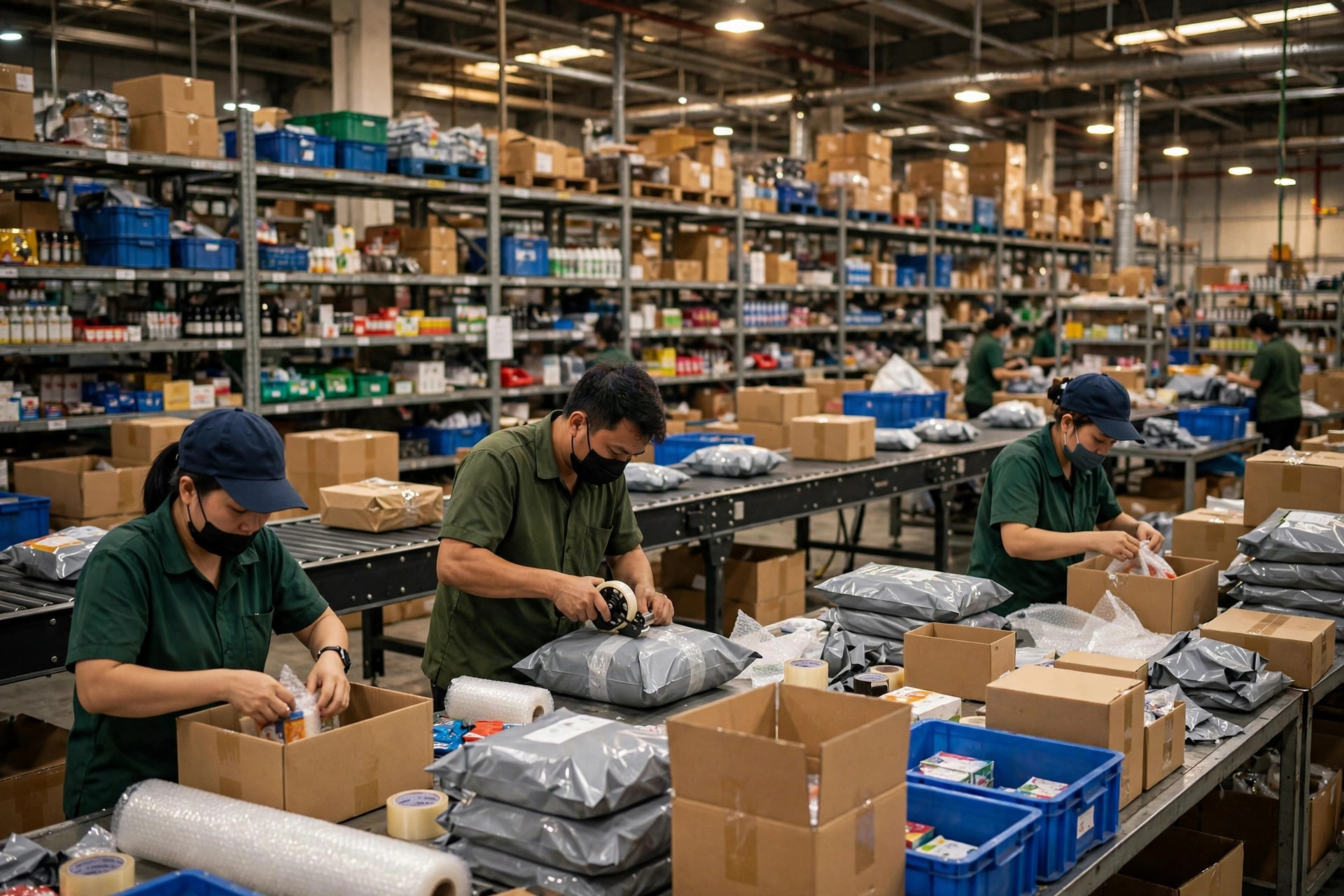
Three Contract Traps That Specifically Catch Chinese Sellers
Trap one: lease term and escalation. Standard industrial park leases in Vietnam start at five years, and annual escalations of 5%–8% are common. When you sign, you think "in five years I'll be huge." When you want to move in year three, the early-termination penalty wipes out everything you saved in years one and two. Cap the escalation in writing, and spell out the early-exit terms — "to be negotiated by both parties" means nothing.
Trap two: fire inspection and handover condition. Shell-condition handover is the norm in Vietnam, and if the contract doesn't say who owns fire approval, it defaults to you. The worst case I've seen: a seller leased a warehouse for four months, never passed fire inspection, shipped zero orders, and paid every cent of rent.
Trap three: customs and tax liability. Many sellers take "customs clearance included" for granted — until goods get held, the 3PL says "I only handle inside the warehouse," and the broker says "I only file the declaration." Remember: whoever promises clearance must put clearance timelines and exception liability in the contract, or it's an empty sentence. Vietnam's tax and customs rules change fast — always go by the latest local policies before you sign, not last year's experience.
Next Time You Negotiate, Ask These Three Questions
Question one: "If fire inspection fails, from which date does my rent-free period start?" — this one filters out half the unreliable landlords and agents.
Question two: "Exactly how many months' rent is the early-termination penalty, and which clause is it in?" — don't trust verbal promises. In Vietnam, what's not written doesn't count.
Question three: "If my volume doubles, which line items on your quote go up?" — a 3PL quote has three separate lines: storage, handling, consumables. Find out which one rises first in peak season, so you don't go pale when the November invoice arrives.
Vietnam is worth doing — Shopee, Lazada, and TikTok Shop are fighting it out there and the traffic dividend is real. But build vs. lease was never a math problem about "which is cheaper." It's a question of how long you plan to stay in Vietnam and how much hidden cost you can absorb. If you can't do that math, you're welcome to come back to being the client — we on the vendor side don't have much, except contracts signed by the hundred and every pitfall already stepped in on your behalf.
By Susan, 3PL Sales Director