
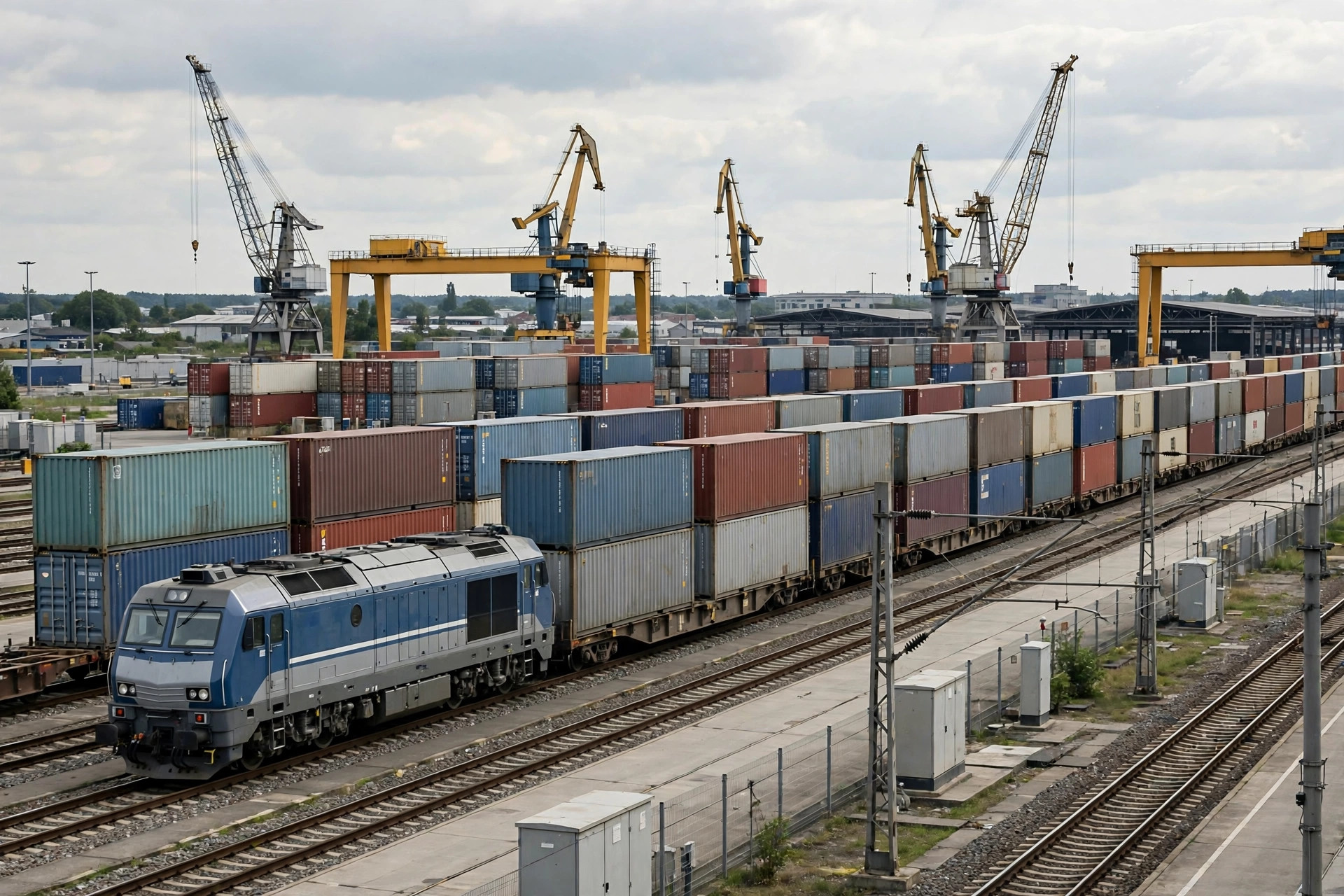
Start with the math. One shipment from inland China to Europe: 15–20 days by China-Europe rail, 30–40 days by ocean. Rail freight costs substantially more — exact rates swing with season and route, so get the latest quote from the rail operator before you plan anything. The half-month saved: is it worth the premium?
That is the question a rail consolidation warehouse answers every single day. It does three things: consolidates cargo from multiple sellers into one container, gets the box into the rail yard before the cutoff, and keeps three ledgers straight — freight cost, transit time, and inventory carrying cost. Of the three, the math comes first.
Consolidation Warehouse Location: Next to the Yard, or Next to the Cargo?
Two schools of thought. Build the consolidation warehouse right beside the rail terminal, so cargo rolls straight into the yard. Or build it at the cargo source, consolidate there, and trunk the sealed box to the terminal. The cost structures are completely different:
| Cost item | Warehouse beside the yard | Warehouse at the cargo source |
|---|---|---|
| Warehouse rent | High — logistics real estate near terminals is never cheap | Lower — warehouses in manufacturing clusters are easy to find |
| Drayage / trunking | Short drayage, but yard gate queues eat hours | One drop-trailer trunk move, transit time is fixed |
| Cutoff tolerance | High — arriving an hour or two late can still make it | Low — the trunk transit eats your buffer |
| Best for | Fragmented, time-sensitive, scattered cargo | Concentrated, plannable cargo with lead time |
There is no standard answer, only arithmetic. If your cargo sits in Yiwu bound for Warsaw, the yard-side warehouse costs more in rent but removes trunking uncertainty. If your cargo is made in Chongqing and the terminal is across town, a source-side warehouse is a free drayage. Every yuan saved on location comes from knowing your own cargo geography, not from measuring straight lines on a map.
LCL in Practice: One Wrong Shipping Mark Spoils the Whole Box
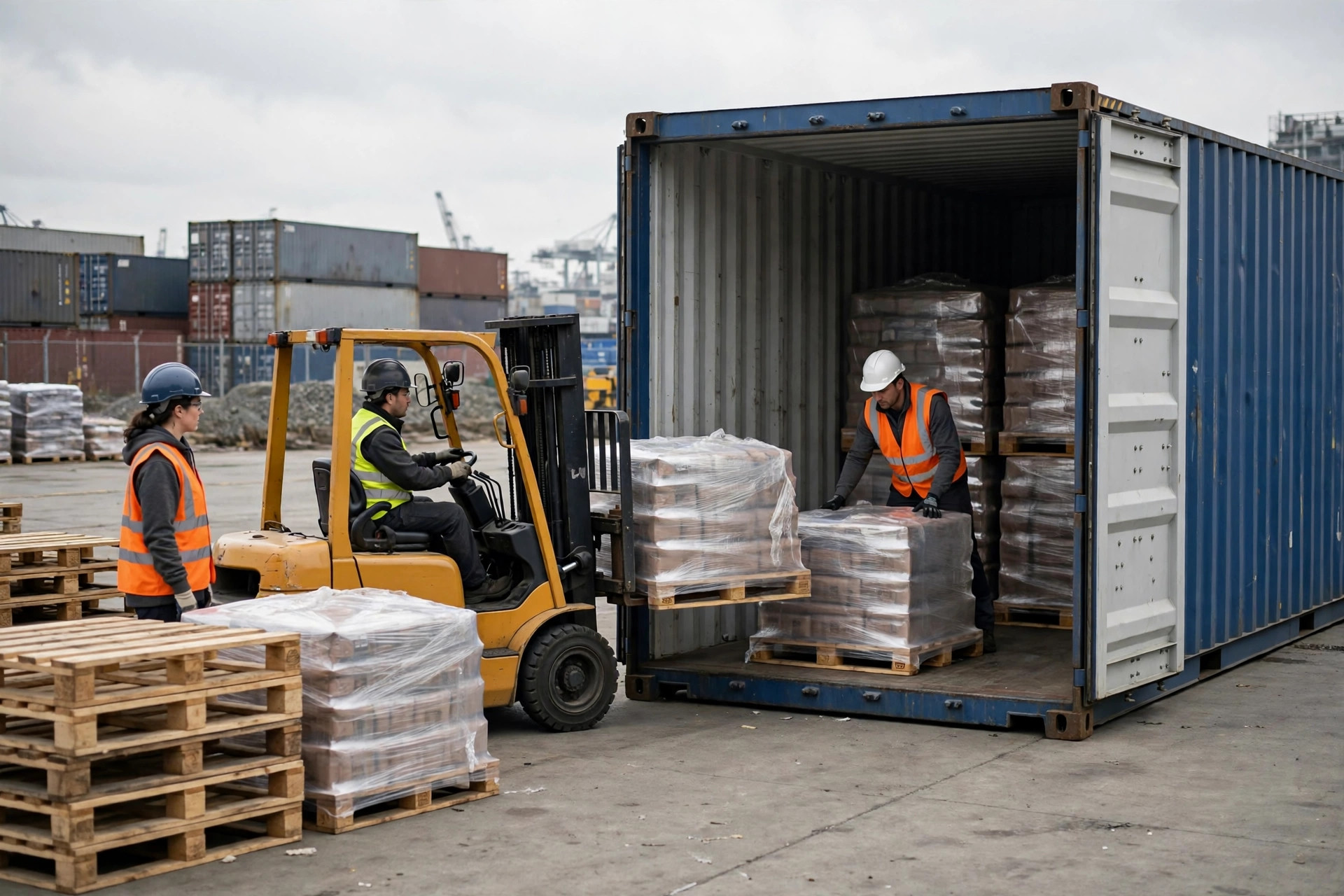
September 2024. A Yiwu seller shipping Christmas lights — peak season for him. That lot was 18 CBM. A 40-foot container holds 60+ CBM, so booking his own box meant a load factor under 30%. He would have paid full freight for 70% empty air. Money down the drain.
He used a consolidation warehouse instead. It packed his 18 CBM of lights together with two other sellers' home goods and hardware into one 40-footer, and the three split the freight by actual cubic meters. His per-CBM cost dropped immediately.
But LCL doesn't buy you cheap — it buys you discipline. Three sellers' shipping marks and packing lists must match one-to-one. The warehouse photographs every lot at loading; seal number, container number, and packing list get triple-checked. Why? Because at the destination, when customs opens the box for inspection and nobody can tell whose carton is whose, the whole container gets held — and all three sellers bleed time together. One wrong mark wipes out every yuan saved on freight, and then some.
LCL carries a hidden ledger entry: waiting. Filling a box takes time — 3 to 5 days is normal. Those 3 to 5 days may be the most uncertain stretch in the entire chain, less predictable than the 18 days on the rails. So when you pick a consolidation warehouse, don't just compare the LCL rate — ask for its average box-fill cycle. A warehouse that fills boxes slowly is expensive at any price. Your cargo sitting in its shed for five extra days costs you carrying cost and delivery risk. That's money too.
Yard Cutoffs: The Train Doesn't Wait Two Hours
Yard cutoff times are deadlines, not suggestions. March 2025: a Chongqing auto-parts exporter had a shipment tied to a German customer's production line. One day late meant a line stoppage, with penalties accruing daily. The yard cutoff was noon the day before departure. The factory loaded late; his cargo reached the yard at 2 PM — two hours past cutoff. That week's train was gone. The next one left in 6 days.
He did the math on the spot: 6 days waiting plus 18 days in transit meant certain breach. Air freight cost several times the rail rate, but it saved the order and the customer. He chose air. Was that money wasted? Yes — but it was cheaper than the breach.
The lesson is one sentence: set your "latest arrival at warehouse" half a day before the cutoff. That half day costs nothing, and it absorbs traffic jams and factory delays. Half a consolidation warehouse's value is in LCL; the other half is in guarding that deadline for you. Forty kilometers from the yard, one hour stuck in traffic — that hour appears on no quotation, but it is written into your cost.
The Transit-Time Ledger: What the Premium Buys You Per Day
Now the full accounting. Rail versus ocean for the same shipment is never just about freight:
| Item | China-Europe rail | Ocean |
|---|---|---|
| Transit time | 15–20 days | 30–40 days |
| Freight level | High (check the rail operator's latest quote) | Low |
| In-transit inventory carrying cost | Cargo value × annual capital cost × ~18/365 | Cargo value × annual capital cost × ~35/365 |
| Replenishment response | Nearly twice as fast — safety stock can shrink | Slow — safety stock must run thick |
See it? The freight gap is on the books; the carrying-cost gap is off the books. Take $500,000 of cargo at an 8% annual cost of capital. Rail cuts about 17 days off transit, so the carrying cost saved = $500,000 × 8% × 17/365 ≈ $1,860. That $1,860 is genuinely saved — it just never appears on a freight quote.
One decision rule, and only one:
If (rail premium) < (carrying cost saved) + (breach / stockout risk avoided), rail is the right money.
Plug in your own three numbers: cargo value, cost of capital, and how much more this shipment costs by rail than by ocean. Positive — take the train. Negative — take the ship. Don't ask your gut. Ask the formula.
Counterintuitive: The Higher the Cargo Value, the Better Rail Looks
Most people's instinct is "rail is expensive, ocean is cheap." Half wrong. For low-value, bulky, time-insensitive cargo, rail is indeed expensive. But for high-value cargo, the carrying cost recovered from 17 fewer days in transit can cover the freight premium. Expensive and cheap are never decided on the freight quote — they're decided on the total ledger.
Second counterintuitive point: the warehouse closest to the yard isn't necessarily the cheapest. Rents near terminals run high, gate queues run long, and the "nearby" drayage may cost more all-in than it looks. Consolidating at the source and trunking straight to the yard can cost less overall, with cutoff risk managed by that half-day buffer. Proximity is psychological comfort. Low cost is real money.
Three Levers That Actually Save Money
- The load-factor lever. LCL lifts your load factor from 60% to 90%, and unit freight drops by roughly a third. That is the consolidation warehouse's most honest value — no negotiation needed, just physics.
- The cutoff lever. Arrive half a day before the deadline. Zero cost, and it dodges the 6–7 day wait for the next train. Highest ROI move in the entire chain.
- The cargo-value lever. Run the formula before every shipment. High-value cargo goes by rail, low-value by ocean, mixed as the math dictates. Betting everything on one mode isn't logistics — it's gambling.
A Calculable Conclusion
Next time someone asks "is the China-Europe train worth it," don't answer with a feeling. Fill in three numbers: your cargo value, your cost of capital, and the rail-over-ocean premium for this shipment. Run the formula. Above zero — rail. Below zero — ocean. And a consolidation warehouse isn't judged by its rate sheet either, but by whether it helps you win on all three ledgers. In logistics, the real bill was never on the quotation. It's in the formula.
By Lao Zhou, Logistics Cost Analyst


