Start with the ledger. In Vietnam cashew export warehousing, the most expensive line on the books is usually not rent. It is mold. Vietnam is a processing hub, not just an origin: it imports raw nuts, clears plant quarantine, holds them in dry storage, and feeds them to processing lines. Warehousing looks like a quiet middle step in that chain. In practice, it is where money quietly leaks. A few days in a damp warehouse can cost a lot more than the rent saved — it costs the lot its grade and its price.
Most people start by asking the rent per square meter. I start with a different question: can this warehouse hold raw nuts through the rainy season? If that question has no convincing answer, a cheap rent is meaningless.
Vietnam Cashew Export Warehousing Starts With the Full Ledger
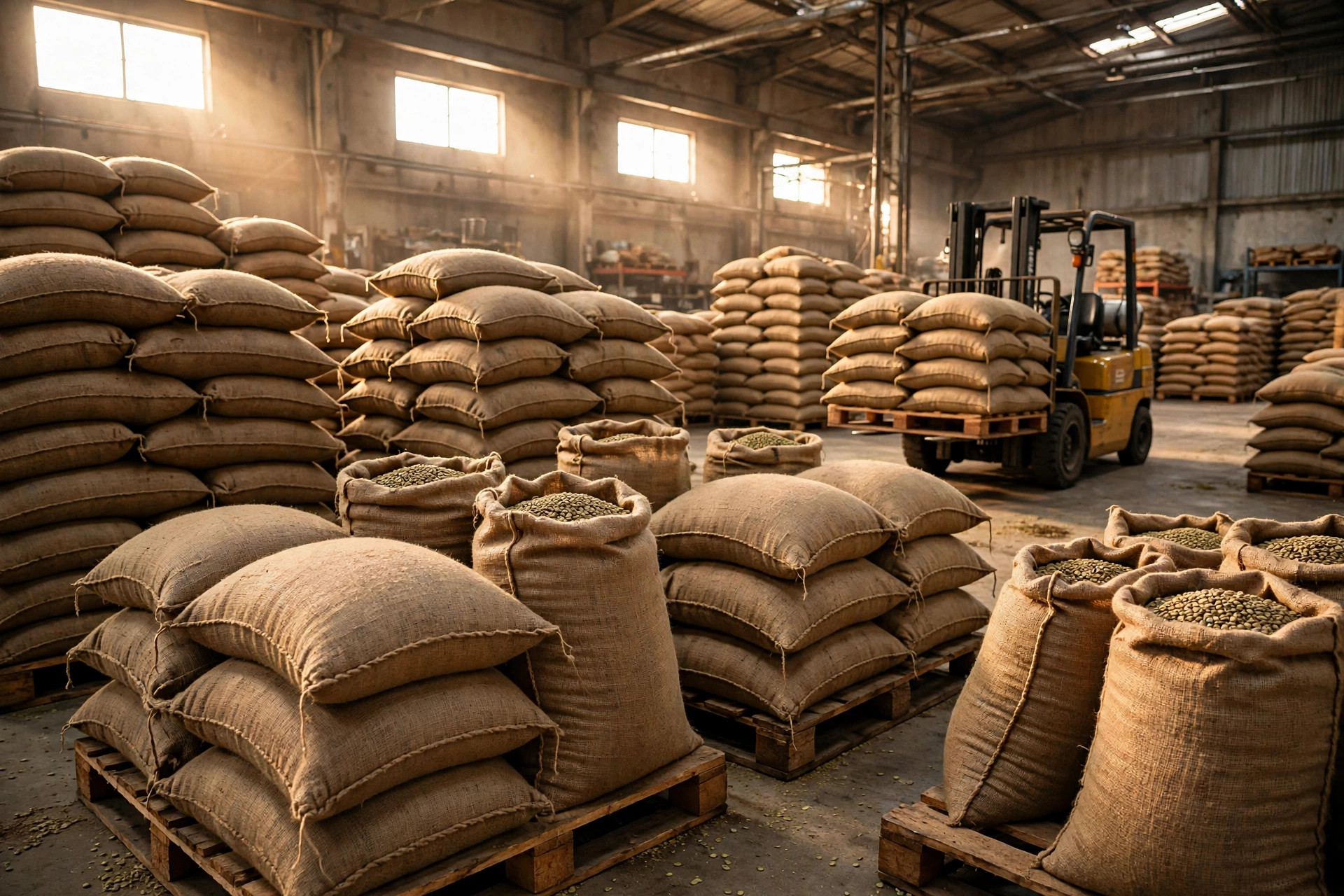
What a hub warehouse handles is not finished product. It is raw nuts, packed in 80kg jute or woven bags, arriving at the port, clearing quarantine, sitting in dry storage, and leaving on the processing plant's schedule. The warehouse does not earn its keep on a storage fee spread. It earns it by delivering raw material to the processing line in the best possible condition.
So the true cost of holding one lot is: unloading and short-haul after port arrival, warehouse space occupied while quarantine is pending, moisture-control investment in dry storage, sampling and aflatoxin testing, grading, re-bagging, and shrinkage, plus the cost of a processing line waiting when outbound delivery slips. Leave any one of these lines out and the books look healthy until the month-end count exposes the hole.
| Cost item | Where the money goes | Cost of cutting it wrong |
|---|---|---|
| Port arrival and quarantine wait | Unloading, short-haul, space held while quarantine clears | Goods stuck at the port or in open yards, rained on |
| Dry storage and moisture control | Ventilation, raised pallets, stack management, moisture protection | Stuffy stacks go moldy, whole lots downgraded |
| Sampling and testing | Lot-by-lot sampling, aflatoxin testing | Untested lots mixed together, one bad lot drags down the whole store |
| Grading and re-bagging | Sorting by grade, re-bagging broken sacks, shrinkage | Whole and broken kernels mixed, re-sorting labor at outbound |
| Outbound coordination | Dispatch by processing schedule, by batch | Processing line idles, or the wrong batch ships |
The moisture-control row is the one to watch: small spending there prevents large losses.
Three Gates After Arrival: Quarantine, Inspection, and Separation
The first gate is plant quarantine. Raw nuts clear quarantine after arrival, and until clearance comes through, the goods must stay in their designated area. They cannot go straight to the processing plant. The hub warehouse's job during that wait is unglamorous but decisive: no open-air exposure to rain, no mixing with other goods, paperwork matching batches exactly. A wait that looks idle is actually when errors creep in — every extra day in the wrong place adds risk.
The second gate is inspection. When a container is opened, each lot gets sampled: torn bags, damp patches at the bottom of sacks, any musty smell or insect damage. This step cannot be rushed by checking only the surface. One rainy-season Monday morning, a hub warehouse next to a southern processing park received a lot of imported raw nuts. The bags looked fine on top. The warehouse keeper took the extra step of feeling the bottom of a few lower bags and found several damp at the base. He pulled a few dozen bags aside on the spot, spread them to air for a day, and marked them separately. When that lot was processed, those marked bags did show light mold — but because they had never been mixed into the main stacks, the loss stayed small. Had they been stacked with everything else, mold would have spread bag to bag through contact, and the whole stack would have been downgraded. Half a day of extra inspection saved the lot's grade.
The third gate is separation by lot. Incoming nuts should never be stacked in arrival order as one big pile. Stack by source lot, arrival date, and inspection result. The payoff shows up at outbound: the plant's batch can be pointed to at once, and if a batch later fails a test, isolation and traceability are already in place.
Vietnam Cashew Export Warehousing and the Moisture Ledger: A Dry Store Is a Profit Center
Moisture and mold prevention is the lifeblood of a hub warehouse: once damp sets in, mold follows, and serious mold can fail aflatoxin testing. A lot that fails may be downgraded or unable to ship as planned — a loss dwarfing any rent saving.
Here is the counterintuitive judgment: the cheapest warehouse is often the most expensive one. A poorly ventilated, low-lying store that turns damp in the rainy season can quote the lowest rent and still produce the highest cost per lot once mold losses are counted. A dry, well-ventilated, strictly managed store looks pricier on rent, but it protects the whole-kernel rate and the test pass rate. A dry store is not a cost center; in a cashew hub warehouse, it is a profit center, literally.
Moisture control itself is not mysterious: keep goods off the floor on pallets, leave ventilation gaps between stacks, never stack tight against walls, check roofs and wall bases for seepage in the rainy season, and turn over bottom bags for inspection on a schedule. What matters is the system, not the equipment: who patrols the warehouse daily, what happens when damp is found, and where the action is recorded. Those rules belong on the wall, assigned to named people — not kept in one person's head.
Here is a second cautionary case. A trading firm once mixed raw nuts from different origins into a single stack, to save stack positions. One lot had picked up dampness in transit, and once mixed, mold spread through the stack, hurting the whole stack's processing yield. Worse, because the lots were mixed, nobody could trace which lot the problem came from, so testing and re-sorting labor multiplied. The stack positions saved were not worth the rework wages. Separate stacking looks fussy. It is actually the cheapest insurance a hub warehouse can buy.
At this point the moisture budget can be calculated rather than guessed: if a lot goes moldy, the loss is roughly the value of the downgraded or unshippable portion. As long as moisture control, mold prevention, and testing together cost less than that expected loss, the spending is justified. Every warehouse's figures differ, but the formula is the same — use your own expected mold loss as the denominator, and work the prevention budget backward from it.
The Handover Ledger: Never Make the Processing Line Wait for Your Warehouse
The last ledger is handover. Raw-nut storage does not end at outbound dispatch. It ends when the processing line starts running smoothly. The plant dispatches on a production schedule, so the warehouse must ship by batch, by grade, and on time. Ship the wrong batch, or leave the needed batch still waiting on quarantine, and the line stops. The cost of a stopped line never appears on the warehouse invoice, but it will appear in the next price negotiation.
Grading belongs in this ledger too. Whole kernels are graded W180, W210, W240, and W320, with smaller numbers meaning larger kernels. Broken kernels come as WS, LP, SP, SS, and other forms. Whatever grade the plant needs, the warehouse must be able to ship it. Broken kernels are not waste — they are a different price line. Some buyers specifically want broken kernels for baking and food-ingredient use. Treating broken kernels as scrap, or shipping whole and broken mixed together, is throwing money away. The cleaner the grading, the smoother the plant's scheduling — and the stronger the warehouse's negotiating position.
Before finished goods ship, there is one more step: vacuum packaging. Processed kernels are vacuum-packed so they hold their condition into the export leg. Where a hub warehouse also holds finished goods, the same disciplines apply: moisture protection, no crushing, no odor transfer, finished stacks apart from raw-nut stacks, markings followed to outbound.
Now add up the whole account. A hub warehouse's profit does not come from how high or low its rent is. It comes from three things: mold losses kept down, tests passed the first time, and handovers that never stall the processing line. Get those three right and a slightly higher rent is still profitable. Get them wrong and the cheapest rent is still a loss. In Vietnam cashew export warehousing, do not start by negotiating rent. Start with one question: can this warehouse deliver raw nuts to the processing line clean and dry? If the answer is yes, the business adds up.
By Lao Zhou, Logistics Cost Analyst