Sri Lanka cinnamon export warehouse storage is, at its core, an aroma-preservation business rather than a space-rental business. What the buyer is really paying for is invisible: the fragrance locked inside a rolled quill. If that fragrance fades, even the finest grade will not command a fine-grade price; if it survives the journey, an ordinary grade can still deliver a steady, defensible shipment. Warehousing, in this trade, is therefore not a passive holding stage but a long chain of judgments. Grade the lot wrong, miss the moisture, or consolidate it with the wrong cargo, and the loss will be collected all at once, at the moment the buyer opens the cartons.
The starting point is botanical identity, and it matters more than most newcomers expect. Ceylon cinnamon is Cinnamomum verum, a different species from the cassia bark that dominates much of the mass market. The distinction is commercially load-bearing because it connects directly to the European Union's PGI geographical indication protection: only product meeting the origin and variety conditions can trade under the Ceylon cinnamon name. For a warehouse, the operational consequence is immediate. Lot identity must be protected from the moment goods arrive. Shipments from different growing areas or different suppliers, however similar they may look, must be stacked separately and recorded separately. Once lots are mixed on the floor, no document written afterwards can unmix them. Origin premium is not a label stuck onto a carton; it is something grown out of zoning and record-keeping inside the warehouse.
Grading and Moisture: The First Gate of Cinnamon Export Warehousing
On a March morning, a consolidation warehouse near Galle was receiving a fresh delivery of quills. The workers did not start by weighing. They started by spreading the quills out and grading them: rolling a quill between the fingers to feel how tightly it was wound, bringing it close to check whether the aroma was clean and bright, holding it to the light to see whether the colour was even. The thinnest, most complete, most tightly rolled quills went to the Alba grade, the next tier to C5, and the coarser quills to C4, each grade on its own pallet with its own tag. The order of operations is worth noting. Grading happens before weighing and packing, because once grades are mixed inside a sealed carton, no paperwork can rescue them, and grade integrity is precisely the first thing a buyer checks on arrival.
Moisture comes next. Sri Lanka has the SLS 81 moisture specification, but in practice the buyer's specification governs, and different buyers draw the line in different places. The warehouse approach is sampling rather than guesswork, and certainly not a squeeze-and-hope test: sampled quills are measured, and a lot that tests over the limit goes back for further drying rather than being sealed on a gamble. The logic chain here is complete. Excess moisture is not merely a number on a report. Damp goods sealed in moisture-proof packaging for weeks at sea face a multiplied risk of mould and caking, problems that cost a few days of drying in the warehouse but an entire claim at the destination port. Much of warehousing's value lies in exactly this ability to intercept a problem at the cheap stage of the chain.
Moisture-Proof Consolidation: Packing Before the Container
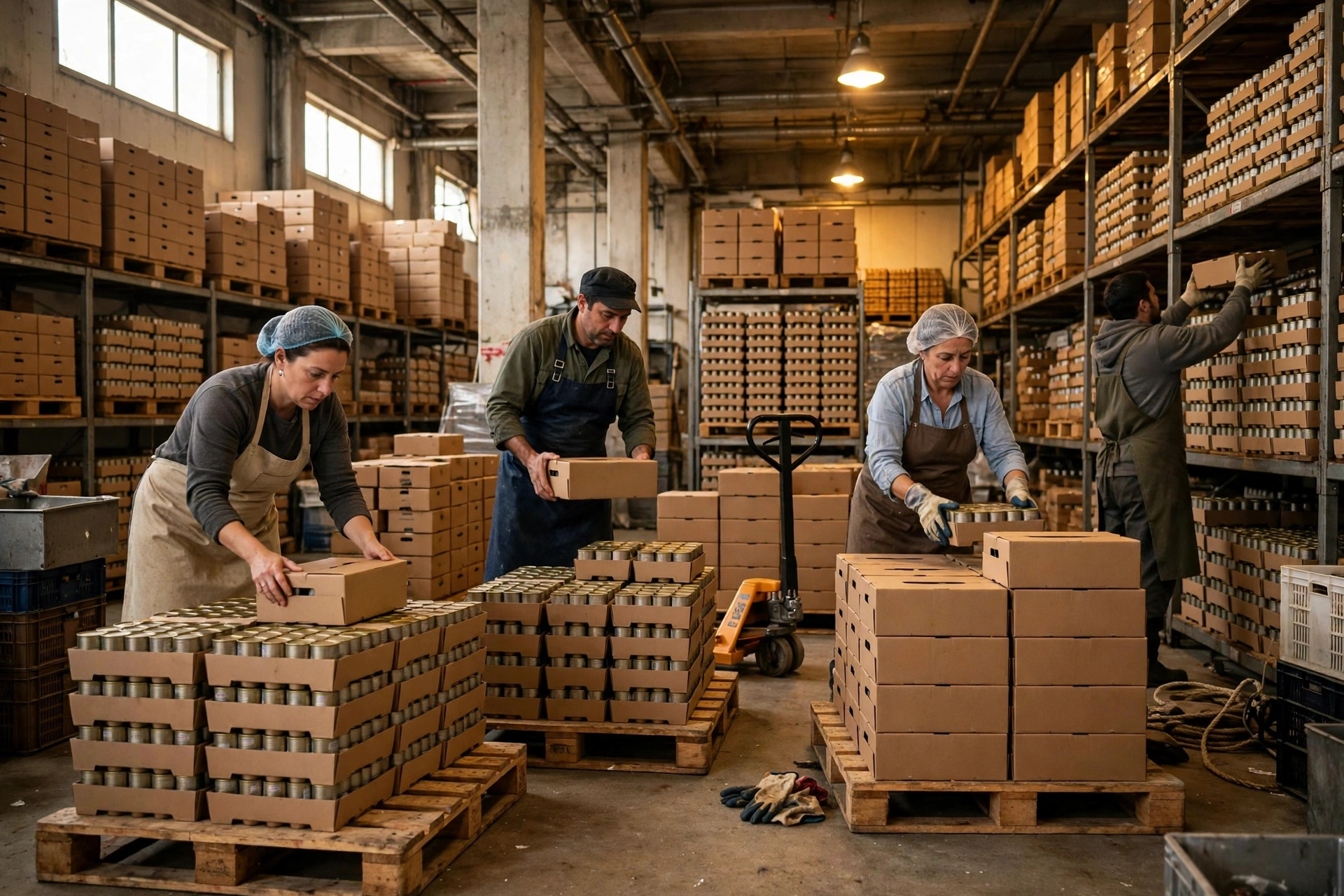
At the stuffing stage, a second structural feature of this trade comes into view: many shippers do not have enough volume to fill a container alone, so less-than-container-load consolidation is the norm. An export warehouse near Colombo illustrates the working method. Before consolidation, each shipper's goods receive separate moisture-proof treatment: an inner moisture-barrier bag, desiccant inside the carton, pallets raised off the floor, and physical separation between different shippers' goods inside the container rather than a hurried mixed load. During the rainy season, the crew pays extra attention. A pallet that has just been rained on does not go into the container, and condensation on the container walls is wiped dry before stuffing begins, because moisture protection is decided less by how expensive the materials are than by whether water vapour was allowed any opening during that half hour of loading.
The trade-offs can be summarised in a simple decision framework:
| Decision | Conservative approach | Aggressive approach | Where the risk sits |
|---|---|---|---|
| Moisture-proof packing | Barrier bag plus desiccant, sealed in batches | Plain cartons, relying on container desiccant alone | Damp transit, aroma loss across the whole lot |
| Consolidation partners | Only cargo with no conflicting odour | Fill every gap, whatever the cargo | Aroma transfer, either way, contaminating the cinnamon |
| Stuffing timing | Stuff only when rain has stopped and the container is dry | Rush stuffing to meet a sailing, rain or not | Moisture sealed inside, creating its own mould conditions |
The judgment behind the table is that warehouse cost cannot be counted in materials and labour alone; the probability of a destination claim must be priced in as well. This is where Sri Lanka cinnamon export warehouse storage earns its keep: barrier bags and desiccant cost very little, while a claim costs the whole shipment's reputation, and in a spice trade that lives on repeat buyers, reputation is precisely the asset that is hardest to rebuild.
Quills Versus Powder: A Counterintuitive Judgment
This brings us to a counterintuitive judgment that deserves to be stated plainly: grinding cinnamon into powder is not always the more profitable option. Intuition suggests powder wins everywhere, since it packs densely, fills a container efficiently, and is convenient for the end user. But the fragrance of a spice lives inside intact cellular structure, and grinding multiplies the surface from which aroma escapes. Powder therefore has a markedly shorter shelf life than whole quills, and its aroma fades much faster. A buyer receiving whole quills can still judge grade by appearance, roll, and aroma; a buyer receiving powder can only trust a laboratory report. That information asymmetry itself depresses the price. Quills sell visible quality, while powder sells trusted testing, and trust is the more expensive thing to produce.
A second counterintuitive point hides inside drying itself. Many assume that drier is always better, and that drying to the extreme settles the matter once and for all. Over-drying, however, can strip away part of the volatile aromatic compounds, leaving a quill that is technically dry but disappointingly faint in aroma. Moisture control is therefore not a race toward the lowest possible number but the defence of a window: low enough to suppress mould, high enough to keep the fragrance. Sealing follows the same logic. Sealing quills before they are properly dry is equivalent to tucking mould into bed; the moisture-proof packaging becomes the accomplice rather than the protection. The hardest skill in this kind of warehousing is precisely this refusal to go to extremes.
The Pattern and the Outlook for Ceylon Cinnamon Storage
Pulling back to the wider pattern, warehousing for Ceylon cinnamon is shifting from a mere storage point into a quality-control node between origin and buyer. Geographical indication protection is making origin identity more valuable, and buyers are asking for finer lot-level records. A warehouse that can only answer where the goods are will soon fall short; it will also need to answer what grade they are, what their moisture reading was, whose cargo they were consolidated with, and when the bags were sealed. This shift is hardest on small warehouses, because grading, testing, and record-keeping all demand labour and process, and those are exactly what a small warehouse lacks. One plausible answer is for consolidation warehouses to offer quality control as a shared service, with several small shippers using the same grading and testing routine, sharing the cost and sharing the reputation. That answer, however, raises a fresh question: under a shared routine, who bears responsibility when something goes wrong.
The other end of the trend is the changing structure of demand. The balance between quills and powder, the order mix across grades, and the way consolidation is organised will all move as buyer markets change, and a warehouse that staffs and stocks purely on last year's experience will be caught out when the change arrives. The question worth sitting with is whether, as origin premium comes to depend more and more on verifiable lot records, Sri Lanka cinnamon export warehouse storage will end up moving from cost centre to value centre, and at which link in the chain the operators who still treat warehousing as mere stacking will quietly be left behind. There is no standard answer, but the answer will decide what the next round of competition's ticket of admission looks like.
By Dr. Chen, Supply Chain Researcher