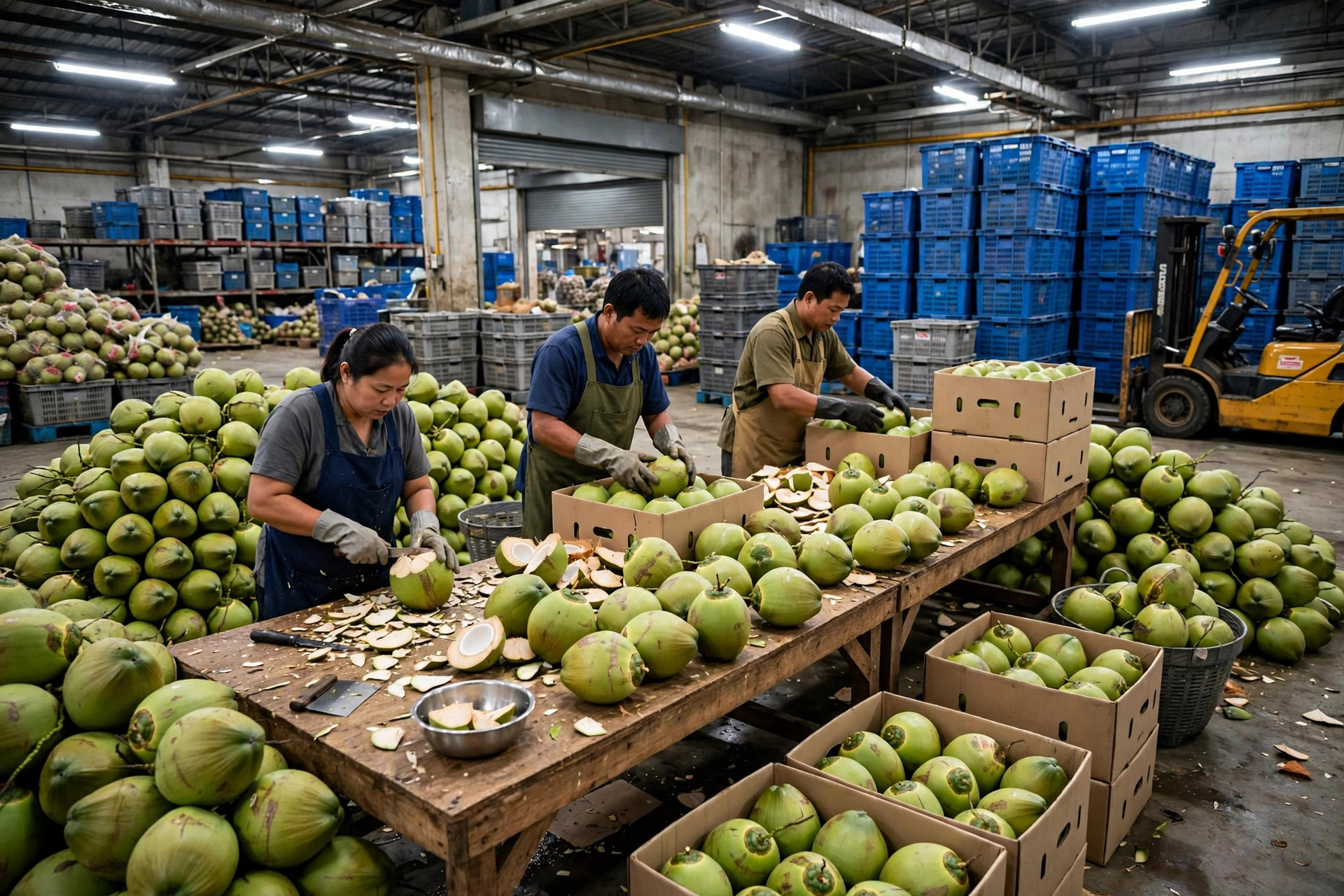
We have a client, a beverage chain back home, that decided last year to try Thailand coconut export warehouse storage for the first time, sourcing young coconuts straight from Thailand. The logic sounded airtight: Thai young coconuts are cheap, juicy, and popular, so ship them in, crack them open in store, and watch the margin. Then the first container arrived, the doors opened, and part of the load had blackened husks and sour-smelling water. Nothing that could go on a menu. The client's first instinct was to blame the ocean leg. I asked them to hold off and pull the processing plant's dispatch log instead. The problem was on land: after trimming, the coconuts had sat in an ambient workshop for two days before entering cold storage. The two weeks at sea were fine. The two days on shore ruined the shipment.
That is the most common trap in this trade. Everyone watches the ocean leg, but the deal is usually settled inside the processing plant. A young coconut is not a durable good. The countdown starts the moment it is trimmed. In this business, every number on the quotation is negotiable, but what actually protects your margin is the handoff — trimming, cold storage, container loading, each step locked tight against the next. Let one joint go slack and whatever you saved upstream comes back at the destination port with interest.
Where the Money Actually Goes in Thailand Coconut Export Warehouse Storage
Start by breaking one container down. Around Ratchaburi, processing plants take young coconuts in, trim them — cutting away the outer husk, shaping each nut into a neat round form — and pack them nine to a carton. That step looks like a labor charge. It is really the first freshness gate. The cleaner the trim, the closer the coconut is to running "naked": its natural protection is gone, and every step after that has to be covered by the cold chain. A careless trimmer who cuts too deep or nicks the shell is opening the door for bacteria, and no cold room can undo that.
Second is cold storage. Trimmed coconuts must go straight into a 2–4°C cold room, a range that stretches young coconut storage to 60–90 days. Note the word "can," not "guaranteed" — late entry or temperature swings shave days off that window fast. Cold storage is billed by the day, so some shippers push plants to trim and load early to save a few days of storage fees. The result is that the fruit sits longer in the destination warehouse instead. You have not saved the storage fee; you have moved it to another country and added a voyage of risk on top.
Third is the container itself. A 40-foot reefer holds roughly 2,150 cartons, and at nine coconuts per carton, that is nearly twenty thousand nuts in one steel box. Once the doors close, the deal is locked: in-transit temperature, ventilation, and discharge coordination at arrival all had to be agreed before loading. You cannot open a reefer mid-voyage to check the goods. Problems discovered at arrival mean returns, discounts, or claims, each one costing several rounds of paperwork more than it would have at the plant.
| Cost item | Weight | Note |
|---|---|---|
| Trimming and packing | Major | Labor plus packaging; trim quality sets shelf life |
| 2–4°C cold storage | Medium | Billed daily; longer storage, higher cost |
| Reefer freight and insurance | Major | Fixed per container; fill it to spread the cost |
| GAP and HACCP certification and documents | Small but make-or-break | Without them, some markets are closed entirely |
| Shrinkage allowance | Flexible | The looser the handoffs, the bigger the allowance |
There is also a negotiation lesson hiding in this table. Shippers love to haggle the unit price, but trimming fees and cold storage fees are the worst places to cut — trim skill and temperature stability decide whether the arrival is good stock or discounted stock, and every cent squeezed there comes back doubled as shrinkage. What you can negotiate is handoff efficiency and document lead time: agree that inspection happens once on loading day, or that certification papers travel with the advance shipping notice. Those cost no money, only attention, and they take most of the surprise cost out of a container. I keep telling clients to haggle the process first; once the process is tight, the price usually follows.
2–4°C Is Not "Colder Is Better" — the Real Variable Is the Handoff
Here is the counterintuitive part. Plenty of people assume a colder room is a safer room, and want the coconuts practically frozen. Wrong. Young coconuts suffer chilling injury below freezing: the flesh turns astringent and the water tastes off. The 2–4°C band is the fruit's comfort zone, and a degree either way matters. What actually determines shelf life is not the number on the thermostat but three handoff points: how fast trimmed fruit gets into the cold room, how much the room temperature swings, and whether cartons sit at ambient temperature waiting for a truck before loading. Lose one of the three and the 60–90-day window starts shrinking.
My advice to clients is never "find the coldest warehouse." It is "find the tightest plant" — ideally a site where the trimming line and the cold room share the same yard, so a trimmed carton rolls a few steps into storage. Those plants quote a little higher, and they are worth it. The cheap plant is usually the one where trimming and cold storage are a truck ride apart, with cartons waiting at ambient temperature for loading, queuing, and forklifts. The storage fee you saved gets repaid in shrinkage.
We had one client who went the other direction and insisted on setting the reefer to 0°C, convinced colder meant safer, no matter what we said. The container arrived, the fruit tasted flat and astringent, and the whole load had to be sold at a discount. He later summed it up himself: a young coconut is not frozen meat, and over-chilling costs just as much as overheating. Before a temperature number goes into a contract, ask one question: is this number what the coconut needs, or what makes a human feel safe?
The Three Sentences Clients Love to Leave Vague in a Thailand Coconut Export Warehouse Storage Contract
We have a client, a European importer, who negotiated a thorough contract and missed exactly one sentence: whether certification documents travel with the goods or follow by mail. The GAP and HACCP papers arrived days late, the container sat plugged in at the port waiting for customs clearance, and power charges plus demurrage burned through the shipment's margin day by day. The client later joked with me: "Susan, do your salespeople plant surprises in contracts on purpose?" I told him the surprise was not planted by us. It was planted by the question nobody asked.
So for young coconuts, I now insist both sides write three sentences down in plain language. First, "cold storage": without a temperature range and a permitted swing, the clause says nothing. It must state 2–4°C, how much fluctuation is allowed, and who pays when the range is breached. Second, "pre-loading inspection": without naming who inspects, what they check, and what happens to a failed lot, it is decoration. Write in carton sampling, opening nuts to taste the water, and whether a failed lot means rejection or a price cut. The cheapest inspection I have seen is also the simplest: on loading day, buyer and seller stand together at the container door, pull a few cartons at random, and open them on the spot. Ten minutes of tasting beats weeks of arguing at the destination. Third, "documents with goods": GAP and HACCP certificates and origin papers — do they travel in the container or follow separately, and who pays port charges if they arrive late? On the quotation, documents are a tiny line item, but they are the only thing that can freeze an entire container in place.
Next time you're negotiating a contract, ask these three questions: first, how soon after trimming does the fruit enter cold storage? Second, who pays if the room drifts outside 2–4°C? Third, if the certification papers arrive late, whose account covers the port bill? Get straight answers to those three, and half the pitfalls in Thailand coconut export warehouse storage are already behind you. The other half is execution — and execution, happily, is exactly what gets easier the more precisely the contract is written.
By Susan, 3PL Sales Director