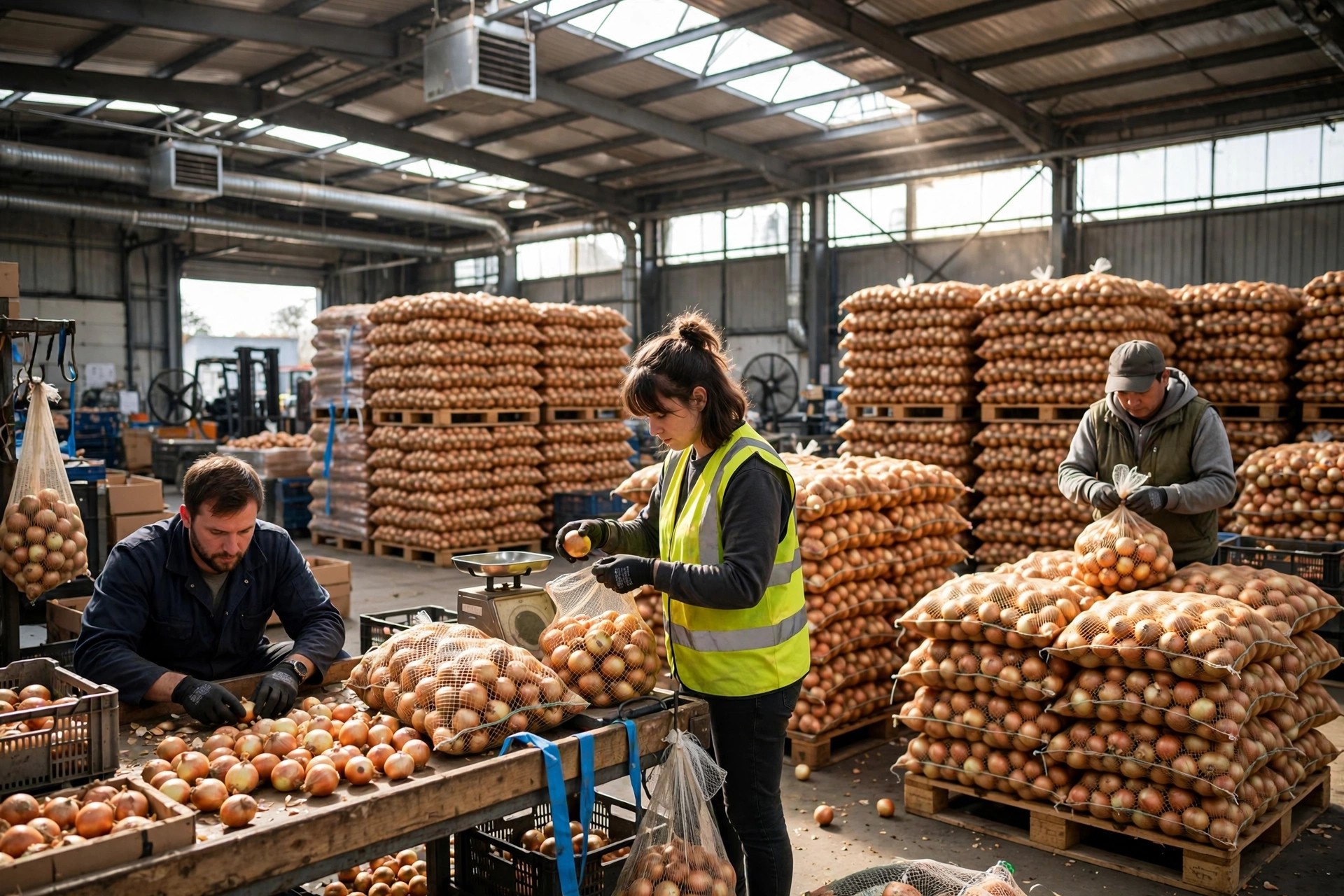
Conclusion first: Egypt onion export warehousing is not really about cold storage. It is about whether the onions were cured dry enough, whether air can actually move through the stack, and whether grading matches the buyer's size bands exactly. If any one of those three slips, a smooth booking, clean paperwork, and a fast sailing will not save the shipment. Buyers judge the cargo when the doors open, not when the container leaves the yard.
The conclusion: three accounts to settle first
The first account is time. Egypt's spring harvest runs from March to June, yet ventilated storage is expected to keep supplying buyers through December. That means for months the onions are not travelling; they are sleeping in your warehouse. How well they sleep decides whether the December containers still command a good price.
The second account is loss. Sprouting, mould, skin damage, and weight loss all come straight out of cargo value. Worse, much of that loss is invisible at loading time and only shows up at destination. The third account is specification. Buyers do not want generally good onions. They want a size band, a pack type, and documents that all line up. Get the size band wrong and the whole container can be renegotiated.
I have seen this pitfall three times, and it always starts the same way: someone compresses curing to meet a loading date. One spring harvest season, at a curing yard near the Nile Delta, workers bagged onions before they were fully cured so a container could be stuffed on schedule. The outside of the bags felt dry, but the centres were still damp. After a few extra days waiting at port, the buyer opened the container to a musty smell and downgraded several loads. The variety was not the problem. Curing was.
Why onions fear sprouting and mould in Egypt onion export warehousing
Onions are contradictory cargo. They need to be dry, but not over-dried. They need air, but not a harsh draught on the skin. Freshly harvested onions still have tender skins and necks that have not tightened. Moisture is still moving out. Stack them straight into a sealed store and heat and humidity get trapped in the heart of the pile. That is exactly where mould likes to start.
Over-curing is just as costly. Skins crack, bulbs lose weight, and appearance drops a grade. So field curing of around twenty days should be treated as a rhythm, not a calendar rule. The real test is condition: necks tight, skins dry and papery, bulbs firm without stickiness. Exact timing is subject to buyer specification, because buyers do not all ask for the same dryness and skin finish. Writing curing as a fixed number of days without checking the crop is one of the most common mistakes in a new export store.
Here is the counterintuitive point: a ventilated store is not about being as cool as possible, nor about the biggest fan. Onions fear stuffiness more than they fear warmth. Steady, gentle airflow that carries damp heat out of the stack beats intermittent blasts of air. Strong direct draughts dry the outer layers and crack skins. In short, you are managing airflow paths, not a temperature number. Whether the stack leaves air channels matters more than the fan rating on the wall.
Egypt onion export warehousing in steps: a field-to-container checklist
Step one: cure in separate, labelled batches. Keep onions from the same harvest day together, and never mix plots or harvest dates in one pile. Each pile gets a card: harvest date, plot reference, curing start date, and the person who checked it. Inspect necks and skins daily during curing. Cover and move piles promptly in rain; do not wait until the rain stops. Ship fully cured piles first, and quarantine under-cured piles in their own zone. Never blend them just to fill a container.
Step two: grade hard to the buyer's size bands. Common bands are 40–60 mm, 50–70 mm, and 60–80 mm, subject to buyer specification. After setting the grader, run a small trial batch, measure the real size distribution, and only then start full production. Finer grading is not automatically better. Extra grades that the buyer never asked for only add handling and breakage. Stack each grade separately, with a label showing the size band, harvest batch, and curing zone.
Step three: pack to the grade and the buyer. Ten-kilo and twenty-five-kilo mesh bags suit many retail and wholesale buyers, while 1,200-kilo bulk bags suit high-volume buyers. Mesh bags breathe, which is their advantage — and their risk. If one mouldy bulb goes into a bag, dampness spreads inside it. So hand-check again before bagging: soft bulbs, broken skins, and mould spots all come out. After bagging, rest the bags in a ventilated area for half a day and confirm the bag surface has not gone damp again before moving them into storage.
Step four: draw the stacking plan before any pallets enter the store. Leave air channels between stacks, leave inspection gaps by the walls, keep pallets off the floor and off the walls, and cap stack height so the bottom layer is not crushed. Place early-harvest stock where it can be shipped first, and later stock behind it, so first-in-first-out happens naturally. Walk the store daily: smell the air, feel stack warmth, look at skins, and check that newly arrived pallets have not blocked an air channel. Write the walk on the location card, not just in someone's head.
Step five: run a pre-loading review before the container doors close. Check that the size band matches the order, that the pack type matches, that batch labels are complete, that the commodity code on the documents is HS 070310, and that GlobalGAP paperwork is in date. One wrong code can trigger an extra inspection at port. When loading mesh bags, do not press them tight against the container wall; leave a little room for air. Before closing the doors, smell and look once more.
| Decision | Common shortcut | What I recommend |
|---|---|---|
| Grading | Eyeball the sizes | Grade hard to buyer bands, trial batch first |
| Packing | One bag type for everything | Mesh bags for breathable specs, bulk bags only for volume buyers |
| Stacking | Fill every wall gap | Air channels, inspection gaps, stacking plan first |
| Shipping order | Ship whatever is handy | First in, first out, early harvest in the easy-access bays |
Common failures: the night-before-go-live checklist
Here is a second scene I keep coming back to. At one ventilated store, the owner proudly showed me a brand-new fan with impressive airflow figures. I walked the air channels and found that several newly arrived pallets had been placed squarely across the main channel. Air simply went around the sides, and the stacks in the middle got almost nothing. I have seen this pitfall three times, and the cause is never that the equipment was too weak. It is that nobody looked at the stacking plan when the new stock arrived.
So run the night-before-go-live checklist and tick every item before loading: curing cards complete, with no under-cured batch mixed in; grading labels matching the ordered size bands; bags free of damage, with mouldy bulbs removed; air channels open and inspection records unbroken; commodity code, GlobalGAP documents, and batch numbers all matching. If any item cannot be ticked, stop and fix it. Do not load with an open question.
One item is easy to overlook: traceability must run backwards to the curing zone. If a buyer complains about mould in one bag, you should be able to say within half a day when it was harvested, where it was cured, which grader it passed through, and which container it shipped in. If you cannot say that, you may end up compensating a whole batch. If you can, you only deal with the affected bags. Location cards, curing cards, and grading records must reconcile, so run a backward trace exercise on one container every week. Paperwork that looks boring on a quiet day is the document that saves money on a bad day.
The final lesson is patience. Harvest season rewards speed, but speed belongs in curing and grading rhythm, not in stuffing unprepared cargo into a container. Get the warehouse step right and you can talk price with confidence in December. Get it sloppy and even an excellent harvest will quietly leak away, one damp bag at a time.
By Lin Xiao, WMS Implementation Consultant