Vietnam black pepper export warehouse logistics cost one client a decade of trust. He had been exporting spices for over a decade when last year he bought a batch of black pepper in Vietnam — two full containers' worth, good money on the table, and a textbook case of the warehouse weeks going wrong. The cargo reached the buyer's warehouse in the United States, the inspectors opened it up, and the moisture was over the limit with a whiff of mold in the air. The buyer docked the final payment and pushed the next season's order back three months. When the client called me, his voice was hoarse. He kept saying the pepper looked fine in the Vietnam warehouse, so how did it go bad on the ship? I told him the problem was never the ship. It was the weeks in the warehouse that nobody was watching, and that is Vietnam black pepper export warehouse logistics in one story: the money is made or lost long before loading.
Vietnam is the world's largest black pepper exporter. In 2025 it shipped 247,482 tonnes of pepper and earned a record $1.66 billion, with black pepper averaging $6,607 a tonne. The United States takes more than a fifth of it, making it the biggest single buyer. Big volume and high prices mean one thing: buyers inspect hard and forgive little. Whatever you save on warehousing, you pay back at the destination port, with interest, on a claim form.
Vietnam Black Pepper Export Warehouse Logistics Starts With Moisture
The moisture red line for export black pepper is 12%. Both the US Department of Agriculture purchasing description and the ISO standard cap black pepper moisture at 12%, and above that line mold gets a foothold. Guidance from the American Spice Trade Association adds the reason: below a water activity of 0.75, most fungi will not grow in spice.
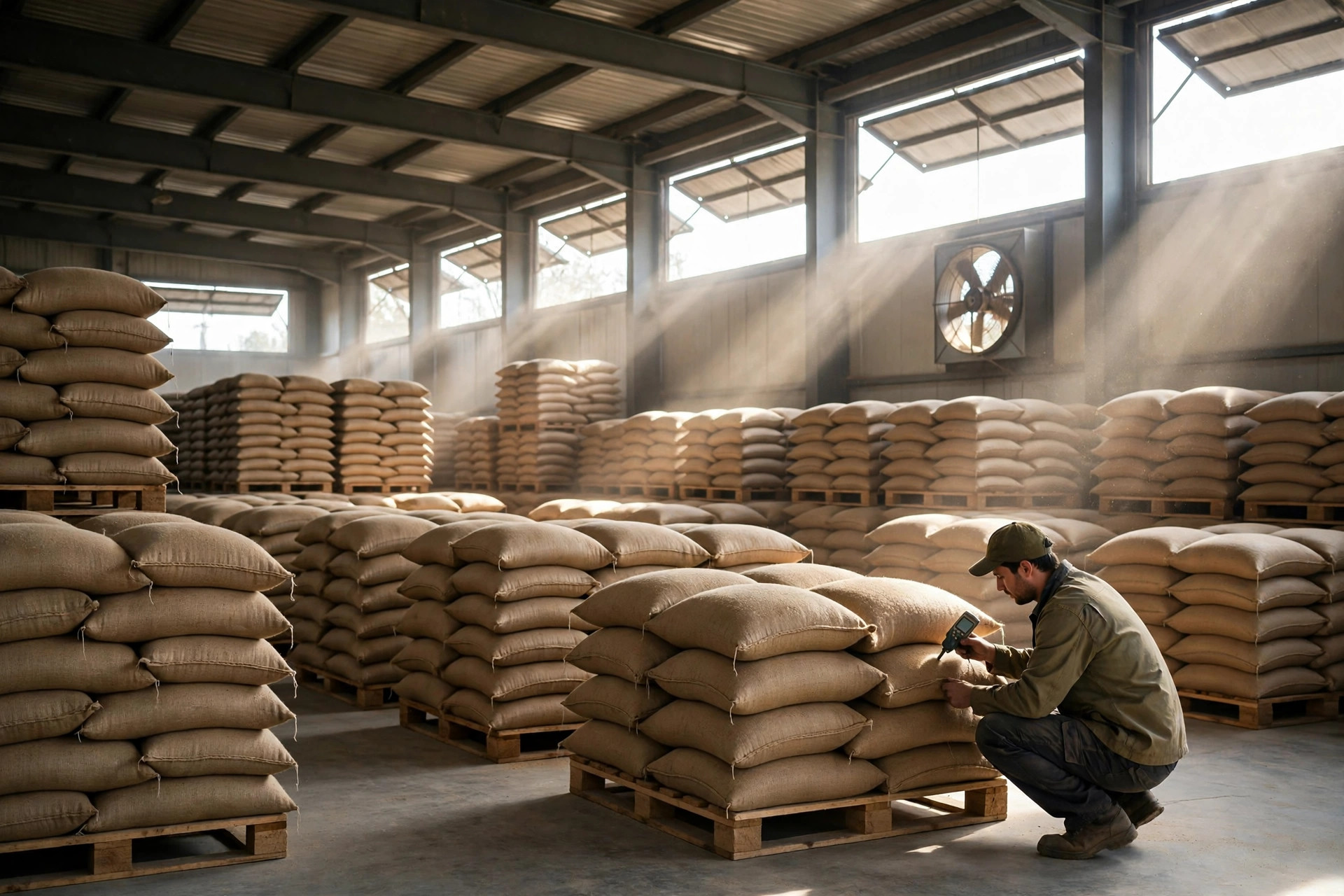
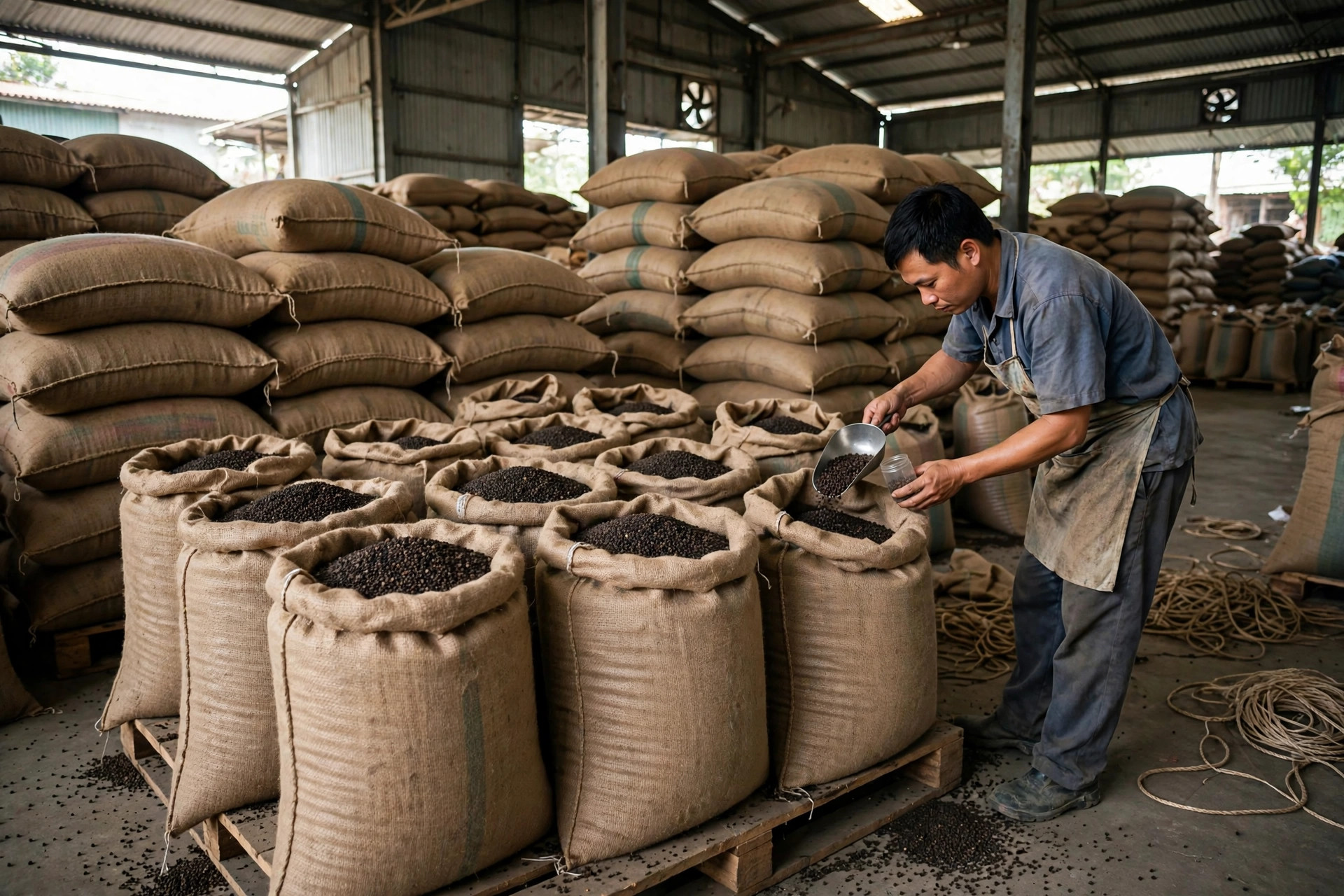
My client's cargo failed on intake testing. The delivery arrived in the rainy season, the pepper had sat in a truck all the way from the growing region, dry on the surface and damp inside. The warehouse took the easy route and tested one handful scooped from the top of a bag. It read 11.5%, so they let the batch through. The true moisture of the lot was close to 13%, and by the time it reached the United States, mold spots had already appeared. When we went back over it, the lesson was one sentence long: intake testing has to sample by layer — top, middle and bottom of the bag — and rainy-season deliveries get double the sampling rate.
Let me put the moisture math on the table, because this is where warehouse managers either earn their fee or lose their client. Take a hypothetical example: a 25-tonne lot of black pepper at $6,607 a tonne is worth roughly $165,000. A full-lot moisture test with extra sampling and labor costs under $300. Damp-proof pallets, keeping stock 15 centimeters off the floor and running a dehumidifier through the rainy season costs a few hundred dollars a month in power and consumables. Now flip it around: a container docked 5% for excess moisture costs more than $8,000, before you count the lost customer. Anybody can do that math, yet every year somebody still skips the test. Check the liner too: a torn moisture-proof liner is an open mouth in the rainy season, and any batch with under 95% intact liners goes back for repacking, no discussion. Suppliers grumbled at first. After two rejections, their delivery quality steadied up on its own.
Flavor Cross-Contamination and Consolidation in Vietnam Black Pepper Export Warehouse Logistics
The second enemy of pepper is smell. Black pepper absorbs odors far better than most people think. Store it in the same zone as coffee beans, tea or chili powder and within two weeks it starts carrying the neighbor's scent. The buyer opens a bag, catches something off, and the whole lot drops a grade, even when the lab numbers still pass.
We had a client renting space in a shared warehouse near the port of Ho Chi Minh City, chosen because it was close to the terminal and the rent was cheap. His pepper shared a zone with another tenant's dried chili, separated by nothing but a wire mesh fence. Three months later the buyer reported a chili note in the pepper. The lab results were still inside spec, but the aroma had changed, and the client had to sell at a discount. After that I made it a rule for every spice client: pepper gets its own zone with a solid wall and its own ventilation, not a wire fence. The rent you save sharing a zone with strong-smelling cargo will never cover one discounted lot.
Consolidation is the third trap, and the most underestimated. In Vietnam black pepper export warehouse logistics, consolidation is where small shippers lose money they never budgeted for. A container of black pepper typically loads 18 to 26 tonnes depending on the bag type and stacking, and small shippers who cannot fill a container on their own share one. Sharing is fine. Sharing with the wrong cargo is not. Pepper consolidated with white pepper is no problem, it is still pepper. Pepper consolidated with cinnamon or star anise is a different story: the aromas cross over, and when the buyer complains, nobody can prove whose cargo caused it. Worse, if your consolidation partner's cargo is over the moisture limit, dampness travels inside a sealed container, and your compliant cargo arrives guilty by association.
Before any consolidation, I have clients sign a short consolidation agreement with three clauses. Each party exchanges its moisture test report before loading. Cargo is stacked in separate zones inside the container, pepper on its own side with a moisture-proof divider between. And if the destination inspection fails, liability is split according to the pre-shipment test reports, so the party with a clean report does not carry the blame. It reads like paperwork. When a claim lands, it is the only evidence you have.
Here is a counterintuitive point: drier is not always better. Plenty of people think pepper should be dried as far down as possible, below 9% if they can manage it. Over-dried pepper loses its aromatic compounds faster, and since pepper sells by weight, you are drying your own money away. Twelve percent is the ceiling, not the target. The good lots sit steady around 11%. The warehouse's job is not to dry the cargo to the bone, it is to lock moisture into a narrow band so the cargo leaves the way it arrived. If you cannot do that, your temperature and humidity logs are just paper.
One more habit worth building in: retest before loading. Pepper stored for three or four weeks changes moisture, and in the rainy season it changes fast. One client's lot tested 11.2% at intake, sat for five weeks untouched, and retested at 12.4% the day before loading. Because we retested, the lot was dried and reloaded, the sailing slipped two days, and the whole container was saved. My rule is a retest within 48 hours of loading, and the retest report travels with the bill of lading so the buyer can see it any time they ask. A sailing can wait two days. Moldy cargo cannot wait at all.
Three Questions to Ask Before You Sign the Warehouse Contract
In this business, the profit hides in the details, and so does the risk. The numbers on a warehouse quotation are only half the story; the other half sits in the clauses. Every time I sit in on a warehouse contract negotiation, I ask the client to ask three questions first.
First, moisture: what standard does intake testing follow, what is the sampling rate, do rainy-season deliveries get extra testing, and who pays for rework and repacking when a lot fails? If the warehouse cannot answer, or just says "we follow the standard," do not sign. Second, the storage zone: does the pepper get its own zone with a solid wall, who is responsible for ventilation and dehumidifiers, and what happens when the power goes out? Third, consolidation: who chooses the consolidation partner, can you see their test report before loading, and how is liability split if flavor or moisture problems show up at destination?
Ask those three questions and you will know the warehouse's real standard within ten minutes. A warehouse that answers clearly is worth paying more for. A warehouse that answers vaguely is a claim waiting to happen, whatever the rent. Vietnam black pepper export warehouse logistics comes down to one question in the end: are you willing to pay for certainty? Every day the cargo sits in the warehouse, it is quietly deciding the price it will fetch at the destination. Guard the warehouse, and the rest of the journey takes care of itself.
By Susan, 3PL Sales Director