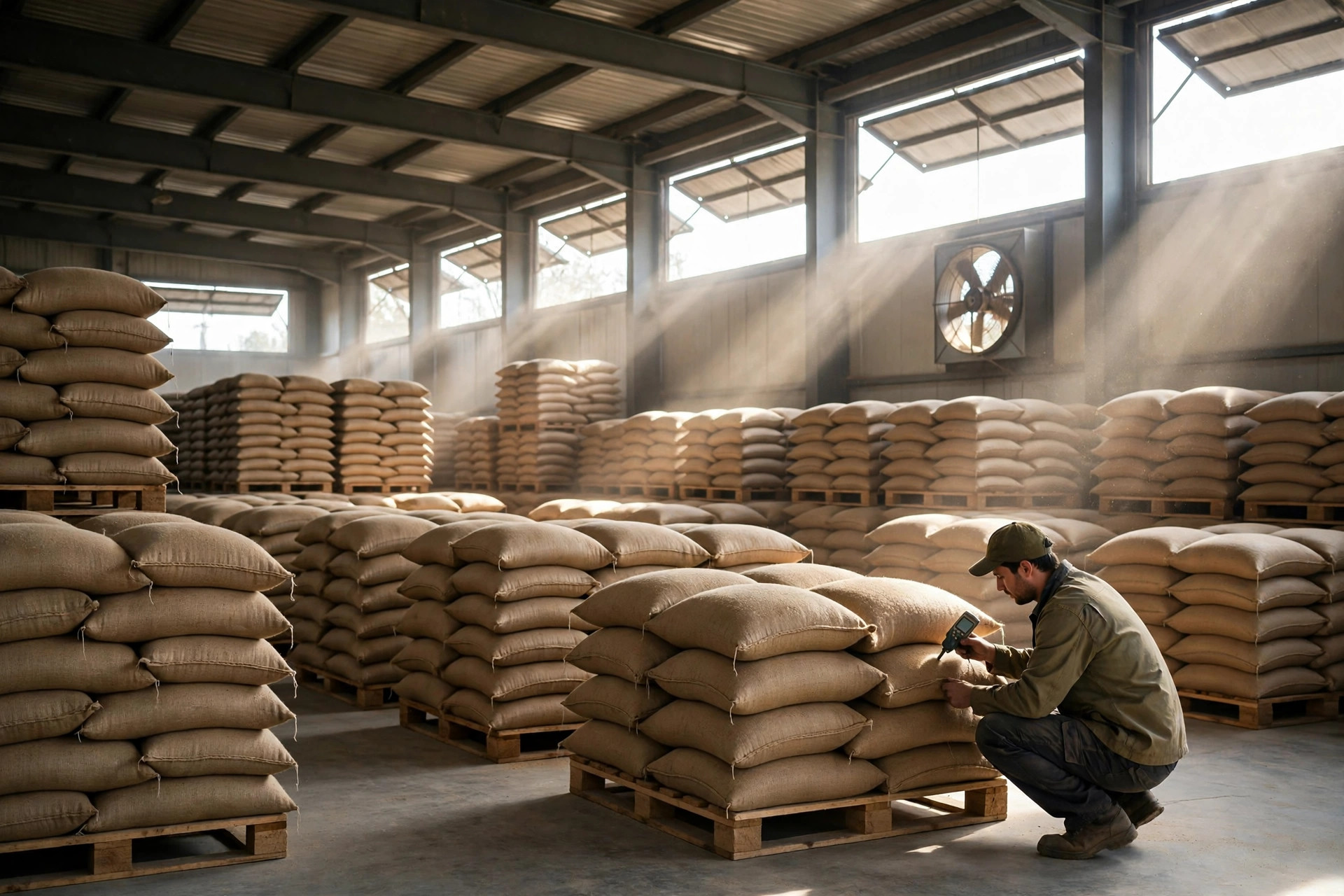
Grain warehouse storage comes down to three daily battles: moisture, pests, and dust. If any one of them slips, the loss does not send you a warning first. It just eats your margin.
Let me complain about the situation first, because this is where most sellers go wrong. People haggle for hours over a purchase price, then treat warehouse routines as if goods look after themselves. The stock goes into the warehouse, the door closes, and nobody checks it for three months. Then a customer complains that the rice smells musty or that there are tiny bugs in the flour, and suddenly everyone is surprised.
I have sold grain and cooking-oil products online for five years. Most of my stock sits in partner warehouses, not in my own hands. After a few painful lessons, I made one rule for myself: partner warehouse or my own small stockroom, someone has to walk my checklist every single week. The checklist is short. It is just three things. Here is how I actually do it.
Moisture: The First Gate in Grain Warehouse Storage
Here is the mistake that taught me the most. In July last year, a batch of 500 cartons of rice arrived at a partner warehouse in Dongguan. To save time, the warehouse stacked them three layers high, right against the wall. It looked tidy. I did not think twice about it. Two weeks later, during a walk-through, the cartons on the wall side felt soft at the bottom. We opened one up, and the outer rice bags had already gone damp.
I counted the damage myself: 37 cartons on the two wall-side rows were affected. Thirty-seven cartons does not sound huge, but returns, repacking, reshipping, and bad reviews cost far more than the value of those 37 cartons. Since then, the first line on my moisture checklist has been simple: stacks never touch the wall, never sit directly on the floor, and never press against the ceiling.
What do I actually do now? It sounds basic, but it works. Every stack keeps a clear gap from the wall, sits on a pallet, and never goes straight onto concrete. Vents and fans are not decoration. Every morning I check the weather before anyone touches a window: if it is humid outside or raining, we do not open up to "air the place out." On a dry morning we ventilate, and we close up again in the afternoon.
Counterintuitively, more ventilation is not always better. Opening windows on a rainy day is basically inviting damp air into your grain warehouse storage. The rule that works is "ventilate by the weather," not "ventilate every day." I keep two handheld moisture meters in the warehouse and test samples every week. My own red line is personal, not a quoted standard: if readings climb two weeks in a row, we check stacks and ventilation first.
Moisture is the worst thing to judge by feel. A bag can feel fine to your hand while the readings are already moving in the wrong direction. Test fixed spots every time: a wall-side stack, a stack near the door, and one in the middle. If you only test the driest stacks in the center, you are fooling yourself.
Pests: Inspection Beats Spraying
On pests, my position is clear: inspection first, isolation second, chemicals last.
In November 2024, a batch of flour taught me this the hard way. It was not a massive infestation. A customer found a few small insects in one bag. When we traced it back, there were already insect traces in pallet gaps and warehouse corners, but nobody had been lifting pallets or clearing corners regularly. A small problem had been left alone until it became a return.
Now my weekly inspection covers three spots. First, pallet gaps and corners. Second, damaged packaging. Third, slow-moving stacks that have not been touched for a while. If we find insect traces, we move fast: isolate the suspect stock in a separate area, take photos for the record, and notify the warehouse team. Isolation is the step you cannot skip. Pests spread while you are "waiting to see." Waiting is how a small issue becomes a big one.
I also agree the response flow with the partner warehouse in advance: who finds it, who isolates it, who gets notified, and when we recheck. It goes on the written checklist, not in a verbal promise. Damaged bags get replaced or resealed the same day, not later. Slow-moving stock gets turned over regularly, because a stack that never moves is an insect's favorite quiet home.
Fumigation gets one sentence from me: it is a job for a licensed professional team, and if your daily routine is solid, you will rarely need it. Do not try it yourself.
One more thing most people do not believe: a clean warehouse prevents pests better than a sprayed warehouse. Spraying kills one wave. Good hygiene cuts off the food source. Spilled grain and scattered flour left on the floor are basically a free canteen for pests.
Dust: The Daily Job Everyone Skips
Dust is the easiest gate to ignore, because it does not look as dramatic as damp stock.
In a grain warehouse, dust mostly comes from two places: spilled grain and flour during handling, and shelves and fan blades that nobody has cleaned for months. My rule is simple: clean up on the same day the work happens, not tomorrow. That sounds easy, and it is the first job to get dropped when peak season gets busy.
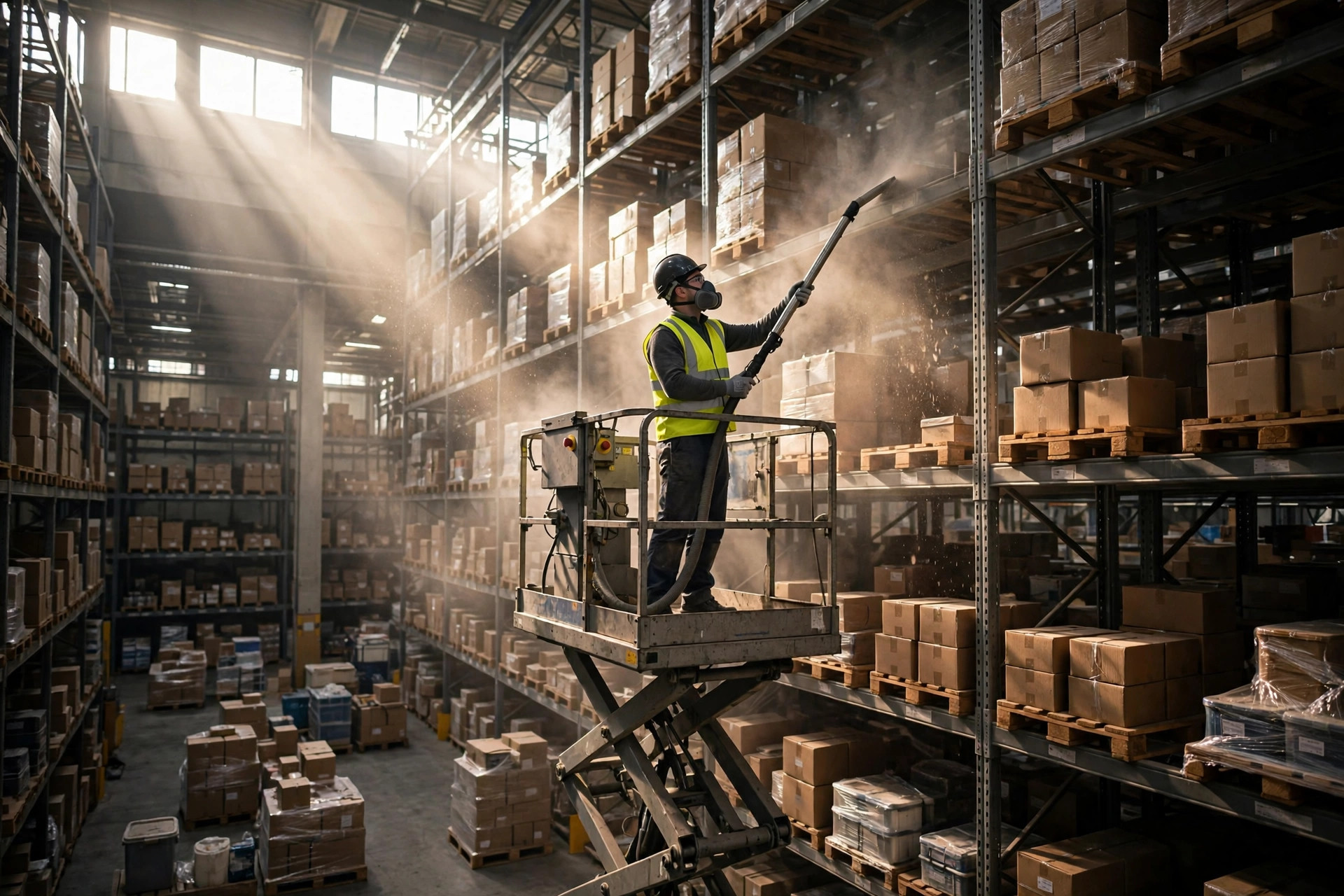
One trick I have actually tested: clean on two levels. Level one is the floor and the area around the stacks, swept after daily work. Level two is the high places and fans, wiped on a fixed day every week. If you only sweep the floor and ignore the high dust, it will fall right back onto your goods. And do not attack dust with a big dry broom, which just throws it into the air. A damp mop and a vacuum do the job properly.
Dust is not only a cleanliness issue. It is also a safety-awareness issue. Built-up dust, poor ventilation, and loose control of open flames are a dangerous combination. My warehouse has a non-negotiable rule: no smoking inside, no open flames, and any hot work must be reported in advance.
There is also a hygiene angle to daily handling. People and tools coming in and out carry dirt in on their shoes, and torn packaging leaves fragments everywhere. A cleaning kit and a bin by the door look trivial, but they save you a much bigger cleanup later.
Doing the Math: What Daily Grain Warehouse Storage Really Costs
A lot of sellers think weekly inspections, cleaning, and moisture checks are a cost. Let me show you my own math, and you can judge for yourself.
| Task | How I do it | Rough monthly cost |
|---|---|---|
| Weekly inspection and moisture testing | One person, half a day | Half a day of labor |
| Ventilation and stack layout | Open and close by the weather, pallets under every stack | Almost nothing |
| Two-level cleaning | Floor daily, high places weekly | One to two labor hours |
| One damp-stock return | Handling 37 cartons, reshipping, bad reviews | Far more than the three rows above combined |
I am not giving you exact cents, because labor rates and product values differ from warehouse to warehouse. But the conclusion holds: daily routines cost small, predictable money. One incident costs big, unexpected money. And that table does not even price in what bad reviews do to a store over time.
My calculation is simple. Spread the monthly inspection and cleaning labor across every carton, and it is almost nothing per carton. Spread one loss across the same cartons, and the difference jumps out immediately. Once you see both sides, you know where the money should go.
Pitfall Checklist: Four Lines to Take Away
First, stacks stay off the wall and off the floor, and ventilation follows the weather, not your mood. Second, pest control means weekly inspection and an isolation routine, not waiting for a customer to find the problem. Third, dust control has two levels: the floor and the high places both count. Fourth, measure moisture with a meter, not with your hand.
There is no shortcut in grain warehouse storage, and no piece of equipment fixes it once and for all. You walk the checklist every week, and you deal with problems on the day you find them. It protects your stock, reviews, and profit.
This one I have actually tested: the shorter the checklist, the more likely people actually follow it. Hold these three gates first, and then talk about optimization and upgrades.
By Ah K, E-commerce Seller (5 yrs)