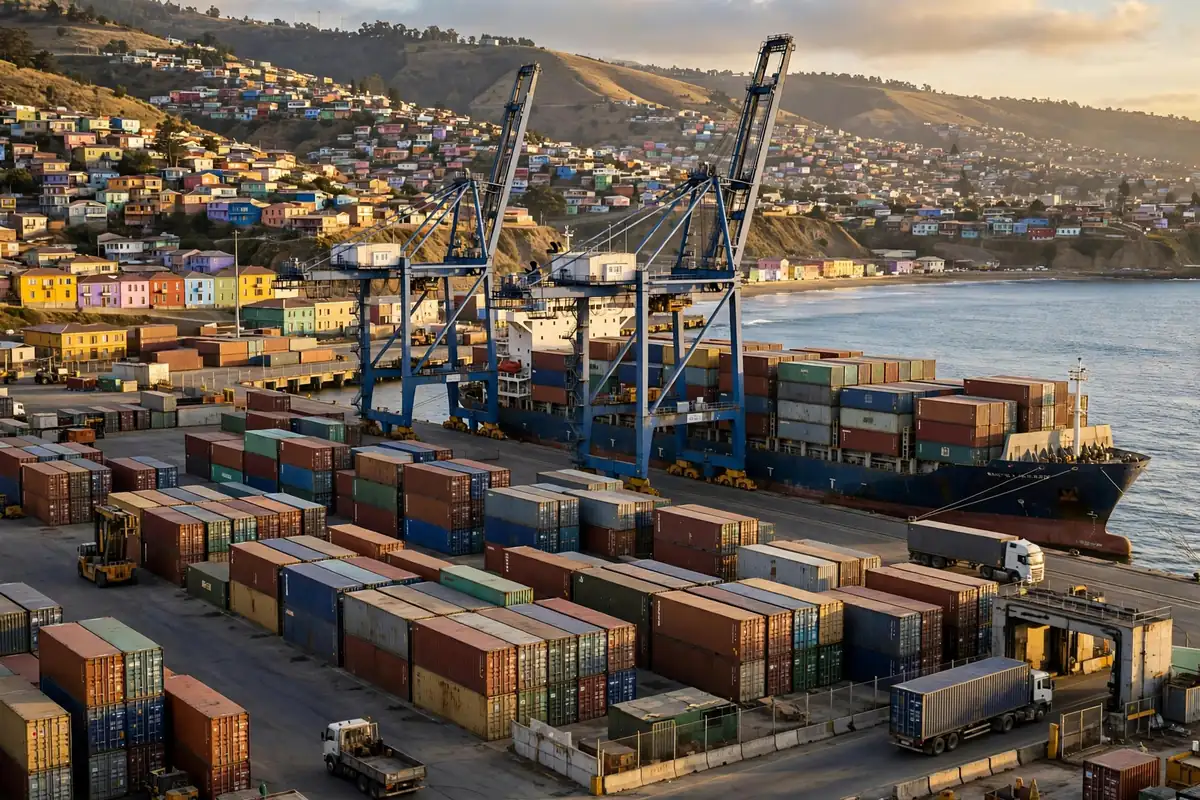
Let me tell you something about Valparaiso port warehouse distribution: you cannot run this old port the way you run a new one. Years ago, on a hot afternoon, I was hauling a forty-foot container out of Santiago, bound for the port of Valparaiso. A little over a hundred kilometers, I figured. Two hours, easy, in time for the evening cut-off. Then I hit the old city. The hills are steep, the streets are narrow, and swinging a forty-footer around a corner takes two lanes while the cars behind you lean on their horns. By the time I crawled to the terminal gate, a dozen trucks were queued ahead of me. I missed the cut-off by half an hour. The box sat in the yard overnight and only made the ship the next morning. The shipper lost a day, and I lost half a day of driving for nothing. Fifteen years behind the wheel, and that is the lesson this port taught me: an old port keeps its own books.
Valparaiso is Chile's old port, about 115 kilometers northwest of Santiago, one of the sea gates for a metropolitan region of around seven million people. But it is not San Antonio, its neighbor down the coast. San Antonio has taken the bigger share of the container business in recent years, with more ships and more berths. Valparaiso is smaller, older, and prouder. Fewer ships call, the cut-off windows are tighter, and the whole dance between the port and the warehouse has to follow the old port's rules.
Three Hurdles in Valparaiso Port Warehousing
The first hurdle is the road. Santiago to Valparaiso is about 115 kilometers, which sounds like nothing. But the last stretch into the old city is the part that eats your day. The town climbs the hills, the grades are steep, the turns are tight, and a forty-foot container needs room the streets simply do not have. Add fog, or rush hour, and a two-hour drive stretches past three. I learned to stop planning by the map. On this lane, you add half a day of slack after the driving time. You think you are racing the clock. Really, you are wrestling with an old city's streets.
The second hurdle is the sailing schedule. Fewer ships call at Valparaiso than at San Antonio, and the cut-off windows are narrow. Fewer sailings means fewer choices. Miss one ship and the next one might be days away. I have seen shippers pick Valparaiso because it looks closer to Santiago, only to find the sailing they wanted was full, and their box sat in the yard waiting. A yard is not a free parking lot. One extra day there, then another, and whatever you saved on freight is gone.
The third hurdle is the gap between the port and the warehouse. Plenty of shippers keep their warehouse in Santiago. The box comes off the ship at Valparaiso, sits in the port yard, gets trucked back to Santiago to be stripped and sorted, and then the empty has to go all the way back to the port. That is three truck trips for one shipment, and the clock is bleeding the whole time. A few years back I hauled an import load for a shipper whose warehouse sat on the far eastern edge of Santiago, picked because the rent was cheap. We waited about four hours at the gate just to pick the box up, stripped it past midnight, and the empty had to go back first thing the next morning. Two round trips, a whole day of a driver's time gone. Over the month, the rent he saved was real, but the extra trucking, the yard time, and the orders that slipped because sorting ran late added up to more than he saved. He told me later he wished he had taken a small warehouse near the port, even at a higher rent, so the freight could be stripped the same day it landed.
That is what this is really about. Port warehouse distribution is not a contest over who sits closest to the gate. It is about who has the fewest steps in between. An old port punishes extra steps: one more lift, one more queue, one more day in the yard, and the math changes.
Port Warehouse Distribution: Where Should the Warehouse Sit?
After all these years on the road, I boil it down to three ways of doing it:
| Your situation | Where the warehouse goes | Why |
|---|---|---|
| Regular small lots, tight sailing dates | A warehouse near the port, in and out fast | The box is stripped and sorted the day it lands, no yard time, and a narrow cut-off stops being scary |
| Big volume, sorting for Santiago and the rest of the country | A warehouse in Santiago | Consolidate first, then send full trucks out on the main roads, instead of dribbling freight out of the port one load at a time |
| Tight sailing, no good ship out of Valparaiso | Look at San Antonio first | About 100 kilometers from Santiago with more ships and steadier space, so a few dozen extra kilometers on the road buys you a sailing you can count on |
The table looks simple, but there is real money behind it. Run the numbers on one box, roughly speaking. Strip it at a port-side warehouse: one truck trip, one lift, and the freight goes straight out. Run it through a Santiago warehouse: a pick-up trip, a drive back, a strip, and an empty return. Two trips, two lifts. The port-side rent may run higher on paper. But add the extra trip, the driver's extra half day, and roughly a day of yard time, and that higher rent pays for itself. Flip it around, though, and the Santiago warehouse wins when the volume is big enough that full trucks and consolidated sorting beat the port-side premium. So do not ask which warehouse is cheaper. Ask which way your freight actually moves.
Here is the part that surprises people: the warehouse nearest the port is not always the cheapest option. Cheap rent with three truck trips is not cheap. What saves money is the shortest time a box spends sitting at the port and the fewest trips a truck has to make. Shippers who stare at the rent per square meter and ignore the rest are doing small math and losing big money.
Dealing With the Port and the Warehouse: A Few Honest Rules
First, never plan against the cut-off time the shipping line gives you. In an old port, take that time and pull it back half a day. A truck waiting half a day costs a little fuel. A box sitting in the yard an extra day costs you the whole rhythm of the shipment. These days, before I even roll out toward Valparaiso, I ask one question: how is the queue at the gate today? That question is worth more than any navigation app.
Second, do not move the truck until the paperwork is complete. A box that reaches the gate with one document missing either waits at the gate or goes back, and an old port does not have spare windows for fixing papers on the spot. Shippers and warehouses alike, check the documents once before the freight leaves. Ten minutes there saves half a day.
Third, agree on a receiving window with the warehouse before you send the truck. I have lost count of the times a driver arrived and nobody was there to receive him, two or three hours burned at the gate. The warehouse should not blame the driver for bad timing when no window was ever given. Set a window and both sides save the trouble.
Fourth, do not bet everything on one port. Valparaiso and San Antonio are both roughly a hundred kilometers from Santiago, and their sailings, space, and queues shift against each other all the time. When a big sailing matters, check both before you commit. Do not wait until your box is sitting in the yard to remember there is another port down the coast.
In the end, Valparaiso is a fine port once you learn its temper. It does not mind you being slow. It minds you being in a rush without a plan. After all these years, I still believe the old saying: better the truck waits than the freight. A truck waiting costs a little diesel. Freight waiting costs you the whole shipment.
By Shifu Zhao, Trucking Veteran (15 yrs)