Vaccine cold chain storage requirements are stricter than food cold chain for one reason: a broken temperature chain does not just spoil a shipment, it voids a vaccination schedule.
A vaccine travels from the factory floor through a production warehouse, a regional distribution center, and a clinic refrigerator before it reaches an arm. Any break in temperature along that chain can leave it ineffective. Vaccine cold chain storage requirements get treated as a separate discipline because they rest on a distinction food cold chain does not share: food cold chain protects taste and shelf life, while vaccine cold chain protects immune response, and a loss of immune response is invisible. A failed dose looks exactly like a good one. That is the central difficulty: the failure gives no immediate feedback, and by the time it is discovered, the doses have already been administered.
Why vaccine cold chain storage is harder than food cold chain
According to the CDC Vaccine Storage and Handling Toolkit, refrigerated vaccines should be stored between 2°C and 8°C (36°F and 46°F), with the thermostat at mid-range, targeting about 5°C. A six-degree band sounds forgiving, but it is a hard boundary on both sides. Below 2°C, adjuvanted vaccines can lose potency permanently from freezing. Above 8°C, heat exposure accelerates component breakdown, and the damage accumulates, so repeated brief excursions add up to a real loss. The CDC also recommends purpose-built or pharmaceutical-grade standalone units as the preferred storage equipment, prohibits dormitory-style units, and discourages household combination units, not because of capacity but because of temperature stability.
Set against ordinary food cold chain, the differences come into focus:
| Dimension | Vaccine storage | Ordinary food cold chain |
|---|---|---|
| Temperature band | 2-8°C, hard boundary, freezing can mean disposal | Varies by product, brief excursions usually mean quality loss |
| Consequence of excursion | Loss of immune response, invisible, hard to catch after the fact | Spoilage usually shows sensory signals, can be caught by inspection |
| Traceability granularity | Lot number, expiry, administration record chain, down to the lot | Often batch or date level, wider recall scope accepted |
| Excursion disposition | Quarantine, label do-not-use, manufacturer written guidance decides | Warehouse usually judges and disposes under its own standard |
| Equipment expectation | Purpose-built or pharmaceutical-grade standalone units, continuous monitoring | Commercial cold storage, comparatively lighter monitoring |
In August 2023, a community clinic in the American Midwest ran into a classic version of this problem. A thunderstorm cut power to the block on a Friday afternoon, and the clinic's backup generator did not automatically pick up the vaccine refrigerator. When staff arrived Monday morning, the unit read 11°C, and the refrigerated vaccines had spent the weekend above 8°C. The doses were labeled do-not-use, isolated, and the clinic contacted the manufacturers lot by lot, acting only after written opinions arrived. The decision rested not with the clinic or the warehouse, but with the manufacturer and the immunization program. Here, the warehouse's job is to preserve the evidence and the product and wait for a judgment it does not get to make.
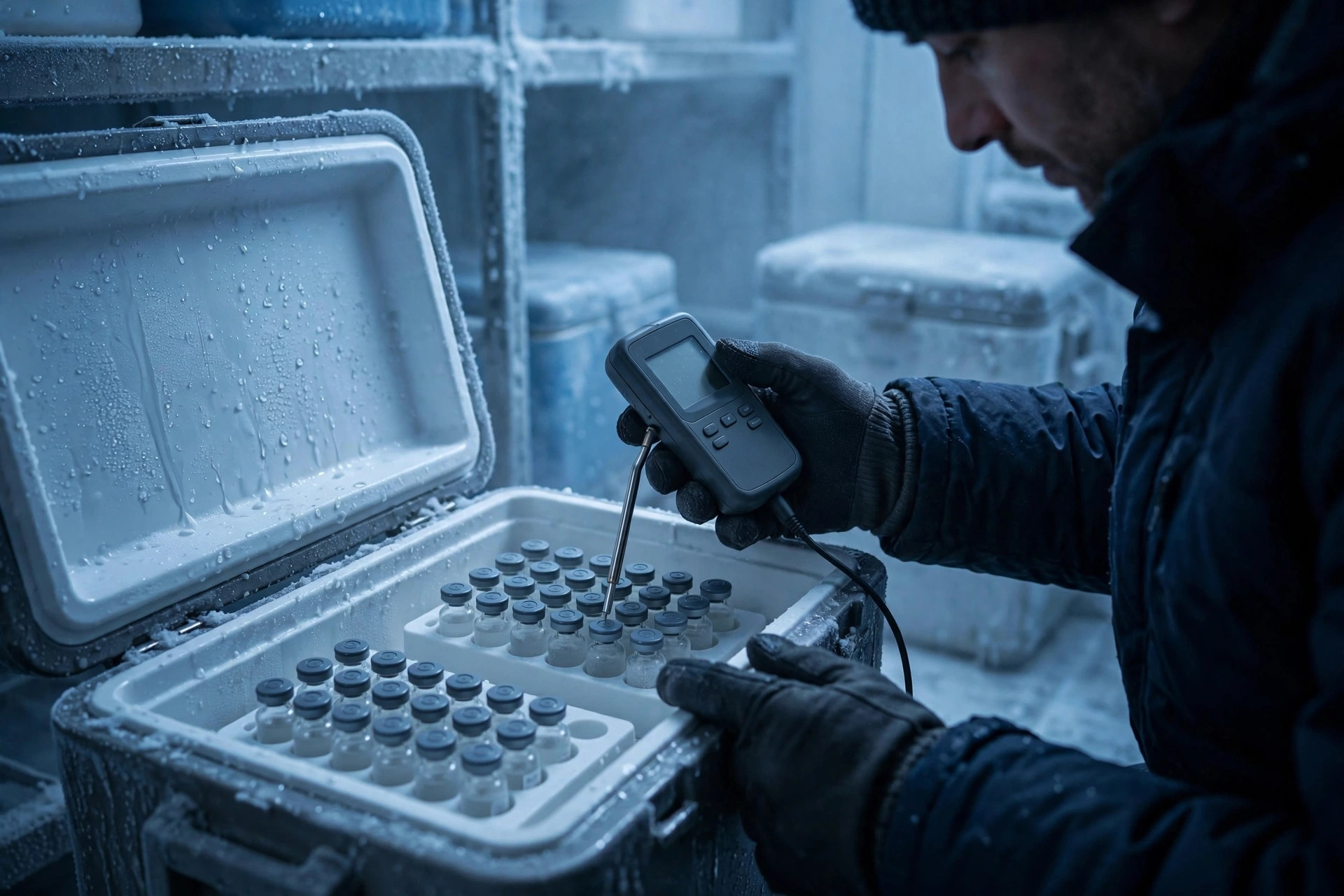
A normal reading on the data logger does not mean the vaccine is fine
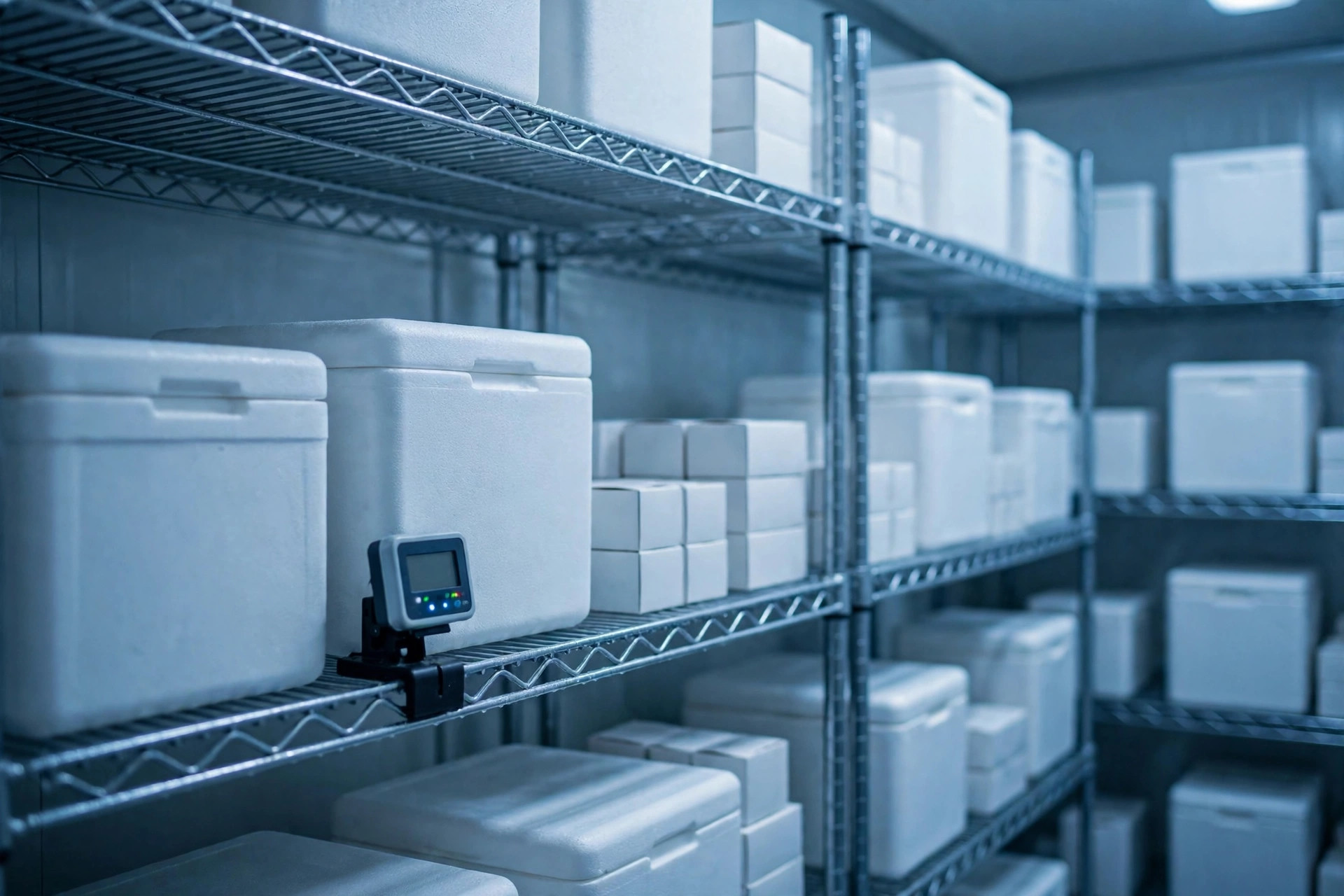
CDC guidance calls for continuous monitoring with a digital data logger (DDL), preferably with a probe buffered in glycol or glass beads so the reading tracks the vaccine itself rather than the air. A buffered probe smooths out transient swings in air temperature, which makes the reading closer to the vaccine's real temperature, but it also means the reading lags the air. When the refrigerator door opens repeatedly, air temperature can spike and recover within minutes while the buffered probe shows only a gentle ripple. A normal reading does not mean the vaccine is fine. It means the temperature at the probe's location, averaged over the recent period, stayed in range.
Probe placement is the second blind spot. A probe near the air outlet reads cold, one near the door reads warm, and one in the center of a fully loaded shelf reads the most stable, which is exactly where temperature is least likely to break range. Thermal mass varies too: a fully loaded refrigerator carries its own buffer in the product itself, while a half-loaded unit warms faster on the same exposure. In early winter 2024, a regional distribution center learned this the hard way. Its cold room DDL showed 4-6°C all year, a compliance record, yet the row of vaccine cases nearest the door was blasted with room-temperature air every time the door opened during peak outbound hours. The problem surfaced during an inventory spot check, not through the alarm system. Afterward, the probe moved from the air outlet to the rack closest to the door, and the door-side row became a staging zone rather than long-term storage. No equipment was replaced. What changed was probe placement and slotting logic.
The trade-off has no clean resolution. Put the sensor at the worst-case location and alarms fire more often, which trains staff to treat alarms as noise. Put it at the most stable location and the record looks clean while the most vulnerable cases sit outside the monitored zone. The arrangement that holds up best is two probes, one at a representative slot and one at the worst-case slot, with separate thresholds, worst-case alarms routed to human review rather than automatic silencing. The purpose of temperature monitoring is not a beautiful compliance curve. It is to answer one question: how warm is the most vulnerable case right now.
Traceability: if the lot numbers do not line up, the recall goes wide
Vaccine warehousing demands traceability a full order above ordinary goods. Every incoming lot needs its lot number, expiry, quantity, and storage location recorded. Outbound picks follow earliest-expiry-first-out, and beyond-use dates get flagged separately when they apply. At administration, the lot number enters the immunization record, completing the chain from manufacturer to patient. A break at any link multiplies the cost of a recall: if the system shows only that some cases arrived in a given month, but not which cases went to which clinic, the recall scope defaults to the worst case, and healthy doses get destroyed with the suspect ones.
Temperature records, in other words, are not just compliance paperwork. They are the vaccine's proof of survival after an excursion. A logger that lost power, data never downloaded, a probe whose calibration lapsed: small lapses in ordinary times become the gaps that decide a lot's fate.
Vaccine cold chain power failure: hold temperature first, assign blame later
Power outages and equipment failures are the most common emergency scenarios in vaccine warehousing, and the most revealing test of a facility's preparation. The CDC's logic: the emergency plan must be written before the event, not improvised during it. At minimum, it needs four things: a backup storage unit or a signed agreement with an alternate site, a backup data logger, a start-up procedure for the generator or backup power, and a contact list everyone can find, covering equipment service, manufacturers, and the immunization program. A plan that has never been drilled differs from no plan only on paper.
Once an excursion has occurred, the response sequence is a decision framework, and the order matters:
- On discovering an excursion, isolate the affected vaccine, label it do-not-use, and do not discard it or remove it from the storage unit, unless the unit itself can no longer hold temperature.
- Record the start and end of the excursion, the highest and lowest temperatures, and the affected lot numbers and quantities.
- Stabilize temperature: if the unit still works, adjust the thermostat slightly and keep watching; if it has failed, activate the emergency plan and move the vaccine to a backup unit with confirmed in-range temperature, with a data logger traveling with it.
- Contact the manufacturer or immunization program with the complete temperature data and wait for a written disposition.
- Execute use or disposal per the written guidance, and archive the full record.
The most counterintuitive step is the first: do not discard. The ordinary warehouse instinct is to throw away what went bad. Vaccine warehousing does the opposite. Until the manufacturer weighs in, out-of-range vaccine is evidence, not trash. Discarding it destroys the basis for judgment and turns a possibly recoverable loss into a certain one. Freezing is the exception inside the exception: once a freeze-sensitive adjuvanted liquid vaccine has frozen, the damage is irreversible and the disposition follows the freeze event specifically. For product-specific details, the CDC and WHO guidance in force at the time and the manufacturer's instructions govern.
The direction of the next few years is not hard to forecast: continuous monitoring will spread, alarms will arrive sooner, temperature data will merge with inventory systems, and excursion judgments will come faster. But technology solves knowing, not doing. As temperature data gets more complete, the line of responsibility may shift from whether a record exists to whether someone acted when the first alarm sounded. That is a question every vaccine warehouse operator will have to answer for themselves.
By Dr. Chen, Supply Chain Researcher