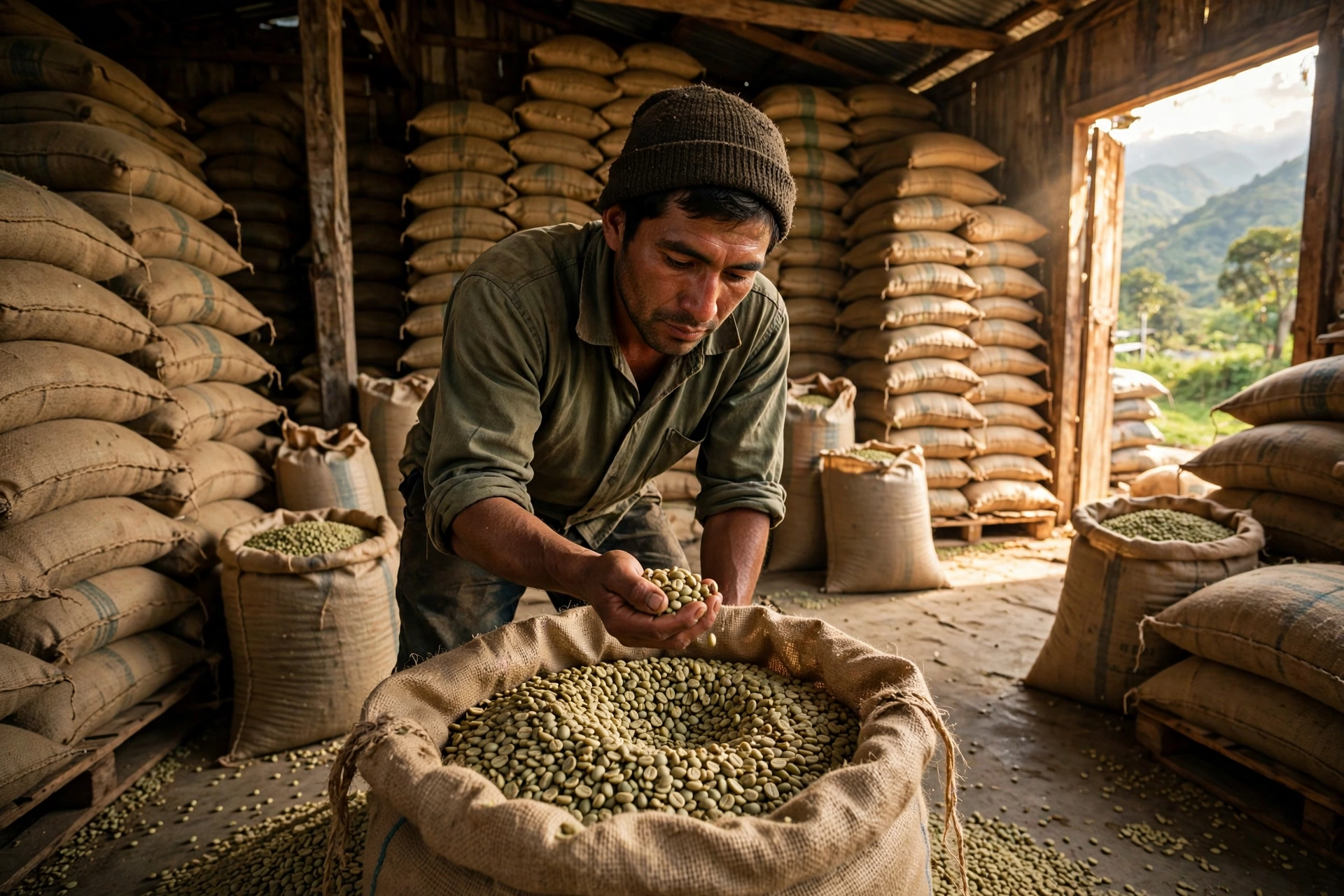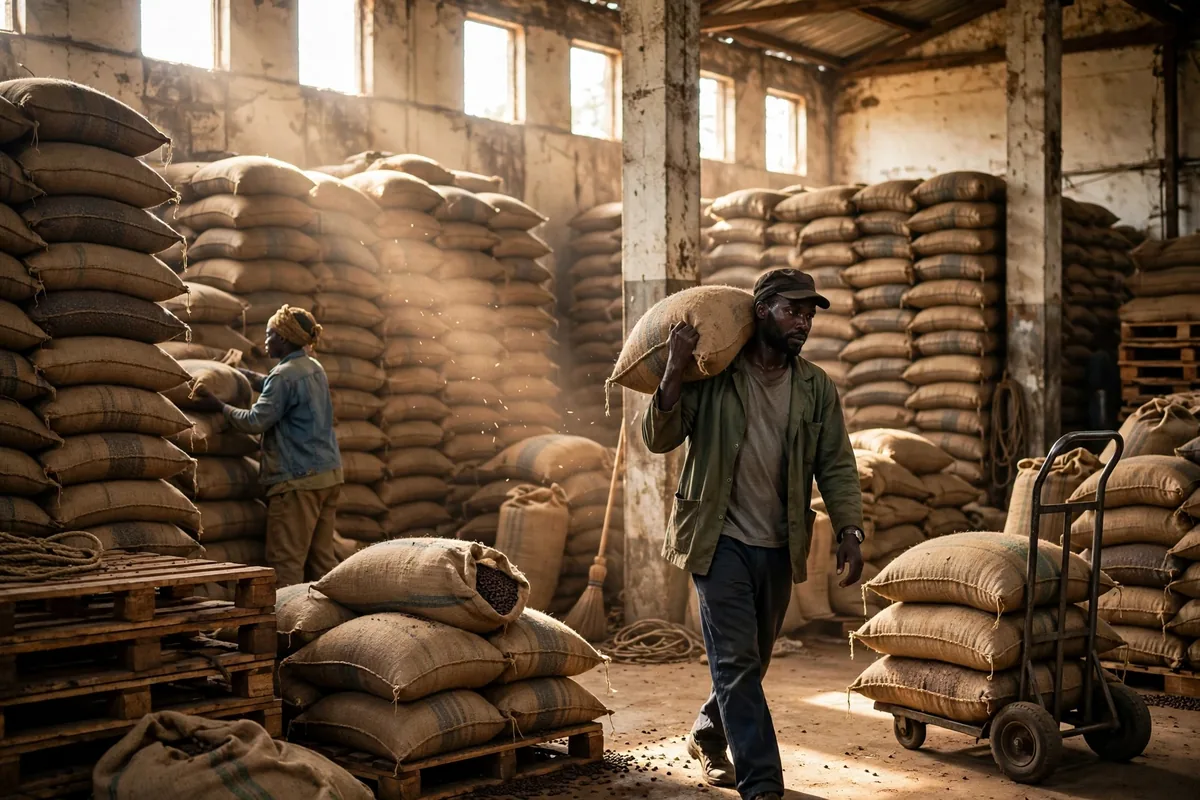
In August 2025, outside Kampala, a truck was being loaded with its fortieth 60-kilo sack of Uganda coffee while the driver watched storm clouds gather over the hills. According to the Uganda Coffee Development Authority (UCDA) monthly report, in the twelve months to August 2025 Uganda exported 7.93 million bags of coffee — 60 kilos per bag — worth USD 2.24 billion, with export value up 58.7% year on year. The numbers look strong. What the warehouse manager was thinking about was something else entirely: whether this load would get onto the road to Mombasa before the rain arrived.
For a landlocked country, coffee does not simply leave the country. Every bag passes through inland warehousing, grading and stuffing, then travels more than a thousand kilometres by road to the Kenyan port of Mombasa, or south to Dar es Salaam in Tanzania. If the warehousing maths does not work, the whole export maths falls apart. That is the story of Uganda coffee export warehouse logistics in one sentence.
Uganda Coffee: The Structure Behind 7.93 Million Bags
UCDA figures put calendar-year 2025 exports at 8.7 million bags worth USD 2.5 billion. On the production side, Robusta accounts for roughly 80% to 85% of output, with Arabica making up the rest, and Uganda is Africa's largest exporter of Robusta. The word largest deserves unpacking. Robusta trades at a lower price than Arabica, so a large export volume does not translate into an equally large export value — and the 58.7% jump in value in 2025 owed more to rising world coffee prices than to a surge in volume. In other words, price did more of the work than quantity.
The warehousing consequence is concrete. Robusta tolerates rough handling and long storage; Arabica does not. In the same warehouse the two beans need different moisture standards, different stack heights and different rotation speeds. Plenty of small warehouses mix them to save effort, only to be downgraded at inspection in the destination port — and what is lost is not freight, but the price premium on the whole container. Keeping the two apart, in separate stacks with separate records, is the cheapest quality insurance available.
Uganda Coffee: Two Corridors to the Sea
Uganda's coffee reaches the sea mainly by two routes. The Northern Corridor runs from Kampala through the Kenyan border to Mombasa, roughly 1,200 kilometres by road. The Central Corridor heads south through Tanzania to Dar es Salaam. Most exporters default to the Northern Corridor because Mombasa offers denser sailings and more liner options: about three to four weeks to Mediterranean ports in Europe, and about four to five weeks to Northern Europe.
But the default is not always the optimum. During the 2024 rainy season, a mid-sized exporter — an illustrative scenario — had its cargo stuck in a four-day queue at the Northern Corridor border crossing with a sailing about to be missed, and rerouted half its containers via the Central Corridor. The per-container road cost was higher, but the sailing was saved. The decision framework is simple: watch three variables — sailing schedules, road transit time, and port congestion. When any one of them deteriorates past a threshold, switch corridors rather than defending a single route out of habit.
A cost sketch for one 20-foot container, Kampala to Mombasa (illustrative scenario; road rates move with fuel prices and the season, so treat these as planning figures, not quotations):
| Cost item | Illustrative figure |
|---|---|
| Inland warehousing and grading | USD 150–250 |
| Road haulage, Kampala to Mombasa | about USD 1,200 |
| Port handling and documentation | USD 200–350 |
| Ocean freight to Europe | varies by carrier quotation |
The ratio is what deserves attention. Road haulage of about USD 1,200 per 20-foot container commonly sits in the same order of magnitude as the ocean freight itself. An exporter in a landlocked country pays its trucking company roughly what it pays its shipping line. That is the counterintuitive heart of Uganda coffee export warehouse logistics: the sea leg is not the expensive part — the land leg is.
Three Tests Inside the Warehouse: Moisture, Grading and Time
The first test in Uganda coffee export warehouse logistics is moisture. Uganda's highland growing areas see wide swings between day and night temperatures, and the industry practice is to hold green coffee moisture in the 10% to 12% range — above it, mould; below it, weight loss. Warehouse floors need a damp-proof layer, sacks are stacked clear of the floor and walls, and inspection rounds increase in the rainy season. None of this is new. The hard part is doing it every single time, because most mould claims, traced back to their origin, come down to one rainy night's negligence.
The second test is grading. Export coffee is graded by bean size and defect rate, and each grade carries a different price. Grading belongs in the up-country warehouse, not at the port. Reworking grades at the port costs double: warehousing fees and demurrage at the same time. The third test is time. Harvests are concentrated, so warehouse throughput peaks sharply. A workable rhythm is to clear space two weeks before harvest, rotate stock first-in-first-out through the season, and ship the highest grades before the rains arrive. In coffee warehousing, time management is not an efficiency question; it is a quality question.
Trend Assessment: Warehousing Is Moving from Supporting Role to Deciding Variable
Three trends are worth tracking. First, whether the high export-value growth can last depends on world prices rather than domestic output; when prices fall, the cost pressure on the warehousing link will rise immediately. Second, the pace of infrastructure improvement on the Northern Corridor will decide whether road haulage costs can come down. Third, more buyers now demand traceability, and batch records in Uganda coffee export warehouse logistics will sooner or later move from a nice-to-have to a condition of market access. All three point to the same conclusion: warehousing is no longer a supporting act in the export chain, but a variable that decides what a bag of coffee finally sells for.
How the maths comes out will depend on next harvest's prices, road conditions and sailing schedules. The numbers will change; the logic will not. For a landlocked coffee exporter, the battle is won in the warehouse, not only in the field. That may be the most thought-provoking layer of this story — and the one most worth watching over the next two harvests.
By Dr. Chen, Supply Chain Researcher