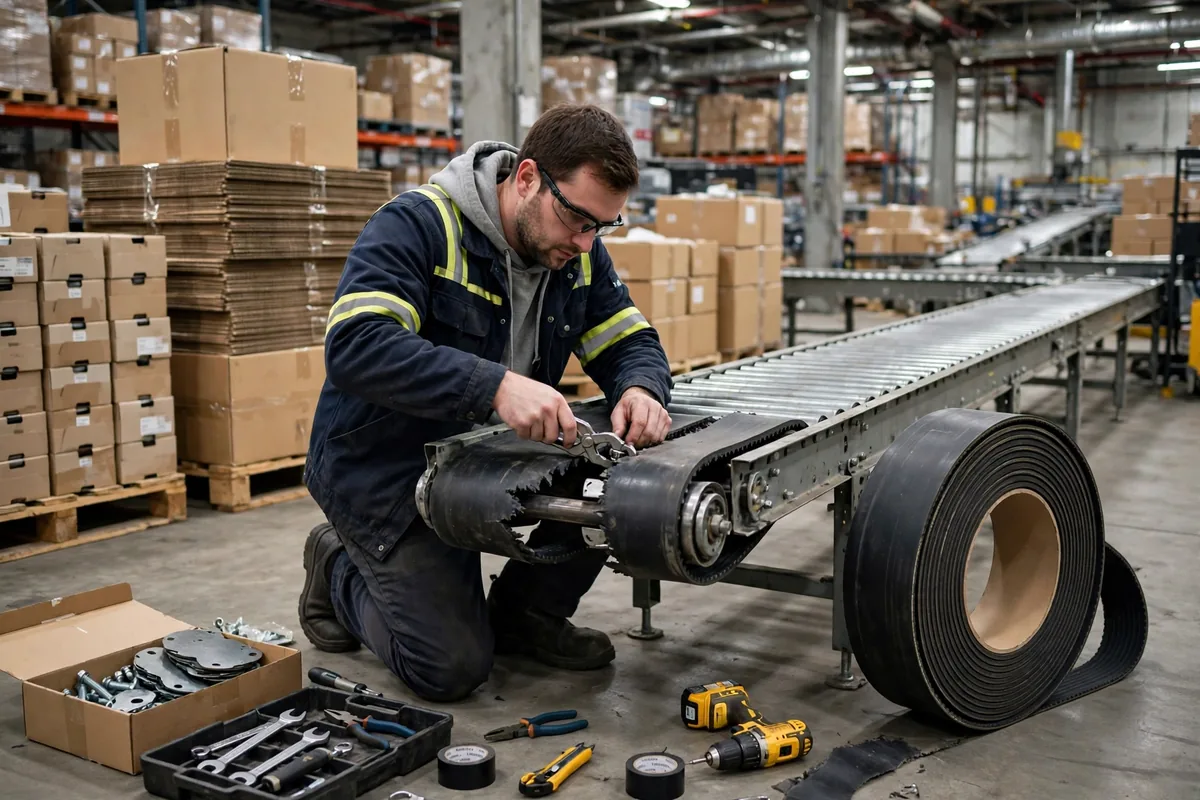
Most conveyor lines do not fail in the middle of the belt. They fail at the splice. When people talk about warehouse conveyor belt repair downtime cost, they usually quote the repair bill and stop there, as if the belt were the expensive part. It is not. The expensive part is the throughput that never happened while the line stood still, the pack stations that waited for cartons, and the wave that had to be rebuilt late in the shift.
Think of the belt like a loop of road. The road surface can be sound for hundreds of metres, but if the one bridge joint in the middle starts to lift, every vehicle has to cross that same weak point, again and again. A splice crosses every pulley and idler on every revolution. It bends, it stretches under tension, it takes the shock of every start under load. That is why splice failure deserves its own playbook, separate from general belt care.
Why the Splice Controls Conveyor Belt Repair Time
An illustrative example makes the point. Imagine an e-commerce warehouse during an evening peak, with a main line feeding packed orders toward dispatch. In this hypothetical case, the splice starts to fray at the edge around mid-shift. The supervisor slows the line, hoping to finish the wave, but each pass over the drive pulley opens the split a little further, until the joint can no longer hold and the line has to stop completely. Nothing exotic happened. No motor burned out, no control system crashed. A joint that had been quietly peeling for days simply reached the point where it could not be ignored.
The mechanics are straightforward. A mechanical splice concentrates load on a row of fasteners that bite into the belt ends. A vulcanized splice spreads load across a bonded area, so it runs smoother, but it depends entirely on how well the bonding was prepared and pressed. Either way, the splice is the only part of the belt that was assembled by hand in the field or in a workshop. The rest of the belt was made under factory conditions. The hand-made joint is where variation lives, and variation is where failures start.
Early warning signs are boring, which is why they get missed. Look for edges lifting, fasteners sitting unevenly, a rhythmic thump or vibration each time the joint passes a pulley, and a split that is measurably longer this week than last week. Any two of those together should move the splice from "watch it" to "plan the replacement." Waiting for a clean break is not a maintenance strategy. It is a scheduling decision to repair the belt at the worst possible time, in the middle of a wave, with everyone watching.
A second illustrative example shows the other failure mode. Imagine a shorter food distribution line where a fastener splice lets go during morning preparation. In this hypothetical case, refitting fasteners is not a long job in itself, but the site holds no spare fasteners and no fitting tool, so the crew loses most of the delay waiting for parts to arrive. The post-mortem blamed belt quality. The real cause was stocking policy: a known wear point had no spare kit beside the line.
Mechanical Fasteners Versus Vulcanized Splice: The Dividing Line
There is no universal winner here, only a dividing line based on tension, run time, and how fast you must recover.
Mechanical fasteners can be fitted on site with relatively light tools, and a practiced crew can usually complete the work within a shorter window, expressed here only as an illustrative comparison rather than a guaranteed time. The joint is less smooth, it can be noisier over pulleys, and the fasteners themselves become a wear item to inspect. Vulcanized splices, by contrast, need a press, heating and cooling time, and a skilled technician. The finished joint is flatter and generally better suited to higher tension and longer, continuously running lines, but a poorly prepared vulcanized joint can fail across its whole width, leaving you worse off than a simple fastener repair.
So the rule I use is this: if the line is a high-tension main line that runs long hours and a splice failure would halt the building, favour vulcanizing and plan it properly. If the line is a lower-tension branch where recovery speed matters more than perfect smoothness, mechanical fasteners are the pragmatic choice, provided the kit actually lives on site. The counter-intuitive point is that the stronger joint is not always the cheaper system. If every minor repair requires waiting for specialist equipment and a specialist crew, warehouse conveyor belt repair downtime cost grows through waiting, not through weakness. Strength you cannot restore quickly is only strength on paper.
Beware one common fake requirement while you are at it. After a splice failure, someone will propose replacing the whole line with a supposedly joint-free solution. Before anyone signs that off, check belt length, pulley diameters, take-up travel, and installation access. Most of the time that proposal uses a capital project to solve a maintenance problem, and the maintenance problem would have been solved by a spare kit and a planned splice replacement.
Counting Warehouse Downtime in Lost Throughput, Not Just Invoices
Here is a simple framework you can run with your own numbers. All figures in the worked example below are illustrative assumptions for calculation only, not industry rates.
Total stoppage cost roughly equals hours stopped multiplied by units not processed per hour multiplied by the margin or delay cost per unit, plus repair labour and materials, plus the overtime and re-planning cost in the following waves.
Take an illustrative example: assume a main line stops for a few hours, assume an hourly throughput figure taken from that site's own recent waves, and assume a modest per-order delay cost that includes rehandling and customer follow-up. Multiply those site-specific assumptions through and, in many such exercises, materials turn out to be the smallest line in the total. Waiting, idle labour downstream, and recovery overtime dominate. Your ratio will differ, so use your own wave data and check the latest official terms for any carrier or service charges you include, rather than borrowing another site's percentages.
That math is also how you decide what spares to hold. A spare belt section, a spare splice kit, and critical drive spares all have a quotable purchase price. The question is how much waiting time each one removes. If a kit on the shelf converts an overnight wait for parts into a same-shift repair, and the line has a realistic chance of needing it in a year, the illustrative payback usually holds up. If the line runs a few hours a week and a half-day stop changes nothing for dispatch, the same kit is just inventory gathering dust. Do not stock by anxiety. Stock by stoppage exposure.
Prevention follows the same logic. A splice inspection does not need software. Walk the line at shift start or end, look at the joint, listen for the thump, photograph the split, and write down its length so next week you have a comparison instead of an opinion. This is like a driver walking around a truck checking tyres before a long run: a few minutes spent looking, in exchange for not dealing with a blowout on the road. After a few months of those records, you can estimate your own splice life pattern and replace joints on a planned basis, during a quiet window, with the right crew and parts already there.
After any splice repair, resist loading the line to full rate immediately. Run it empty and slow for a few revolutions, watch the joint over the pulleys, check tracking and tension travel, then build load gradually. A surprising share of repeat failures happen in the first hour after a repair, when an unseated joint meets a full load.
In the end, warehouse conveyor belt repair downtime cost is not decided by how expensive your belt was. It is decided by whether the splice method matches the tension, whether the kit is on site, and whether someone noticed the split while it was still small. Whether the money was well spent comes down to one number: the total time from stop to restart at the next splice failure, compared with the last one.
By Da Liu, Automation Engineer