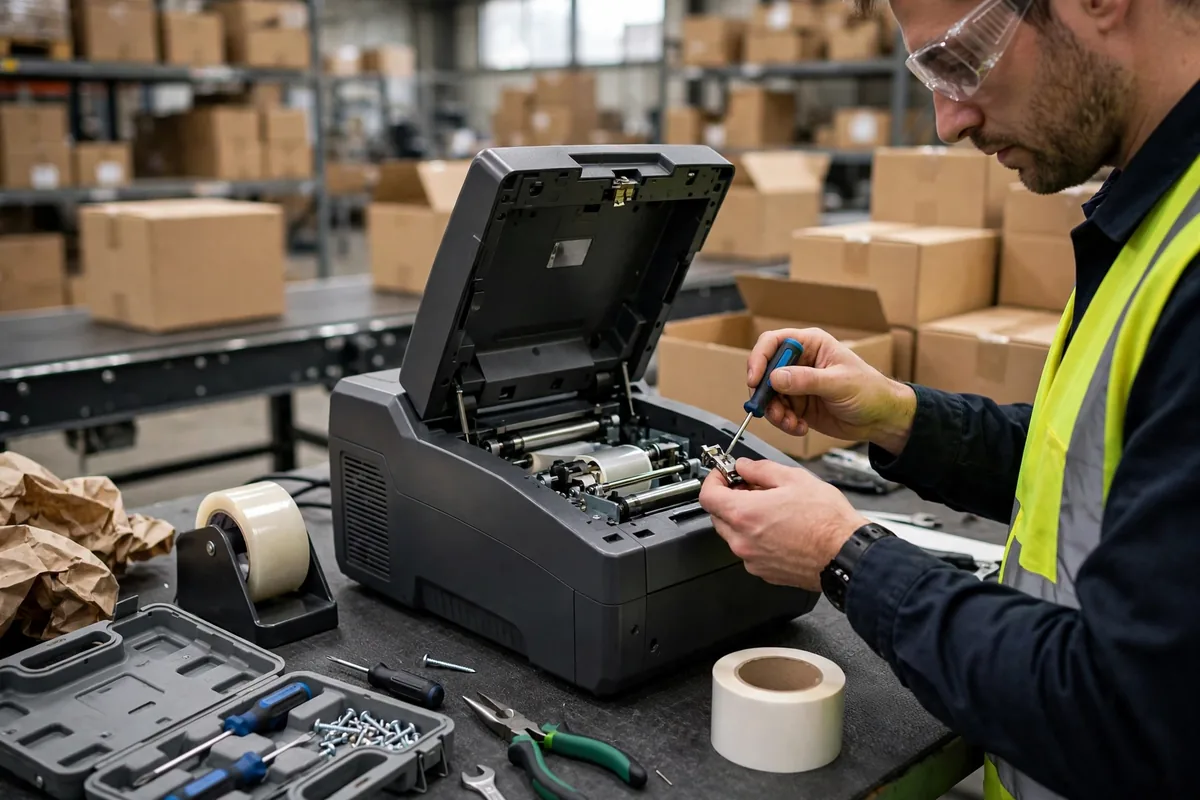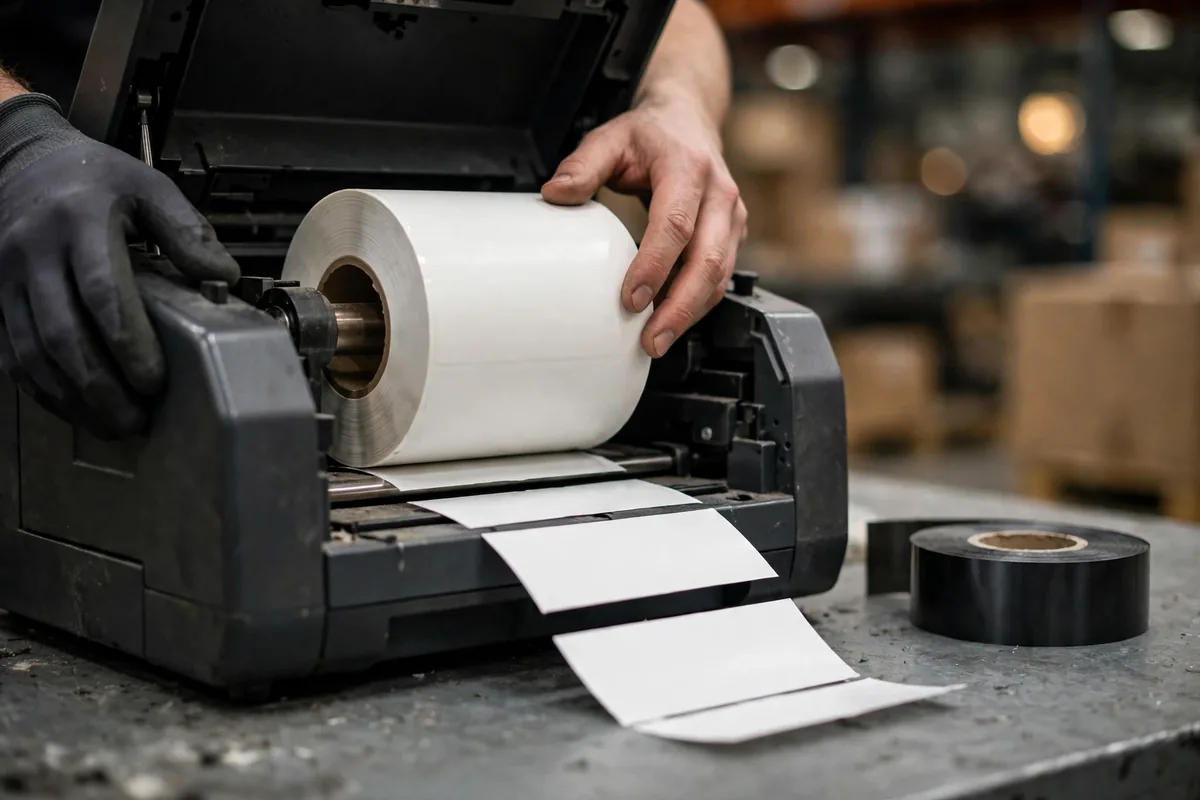
When a thermal transfer ribbon warehouse labels setup starts producing faded barcodes, unscannable codes, or print that rubs off in three days, the printer is usually innocent. I get called in, I look at the ribbon and the label stock, and nine times out of ten the pairing was wrong from day one. Ribbon and face stock are a couple. You select them together, or you pay for the divorce in reprints.
The principle: a thermal transfer ribbon is a tiny hot stamp
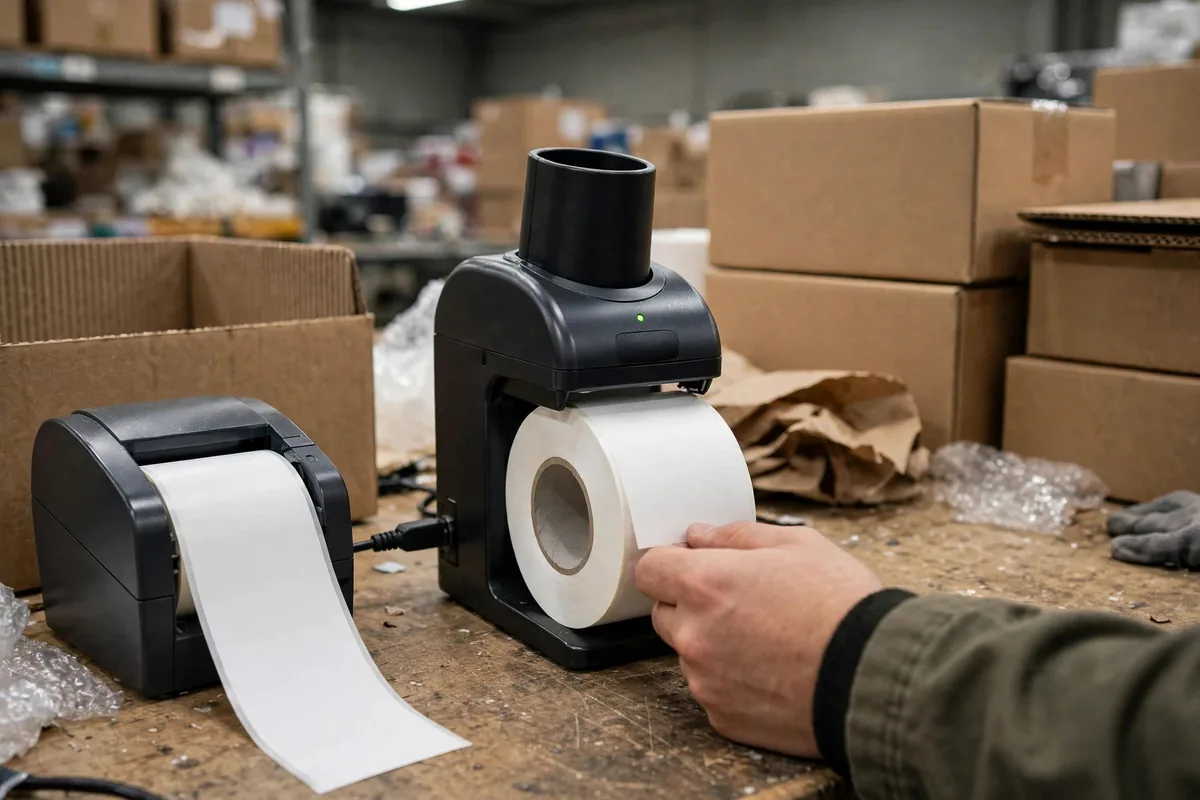
Think of it this way: thermal transfer printing is micro hot-stamping. The printhead has a row of heating elements. Whichever element fires melts the ink layer of the ribbon at that exact spot and presses it onto the label surface. A ribbon has three layers: a back coating that protects the printhead, a film base in the middle, and the ink layer on the front. The ink layer's recipe decides whether your label lives for a week or for years.
Ink layers come in three grades, ranked by resin content. Wax is mostly wax: low melting point, easy transfer, friendly to paper, but the film it forms is soft and a fingernail can scratch it. Wax-resin blends resin into the wax, and both hardness and adhesion step up noticeably. Full resin forms a hard film that shrugs off solvent wipes and outdoor weather, but it is picky about its partner: it only bites properly on synthetic face stocks like PET or PP, and on plain coated paper it actually transfers worse than cheaper ribbons.
Here is the counter-intuitive part: a more expensive ribbon is not a safer ribbon. Resin ribbon on coated paper is like using epoxy on rice paper — the glue is fine, the paper tears first. I watched one warehouse standardize its whole site on resin ribbon, doubling its ribbon spend, and the labels kept failing exactly as before, because nobody had changed the face stock. The first principle of selection is one sentence: decide how long the label must live and what it must survive, work backwards to the face stock, and only then pick the ribbon.
A scenario illustration, with hypothetical numbers: a cold storage operator switched outbound labels from wax to wax-resin after two weeks in the freezer left forklift drivers hand-keying roughly three labels in ten. Rescans dropped sharply after the switch. But what actually convinced them was not the ribbon; it was the math. The minutes lost to hand-keying, spread across their daily outbound volume, cost more than the ribbon price increase. Ribbon selection is never a consumables question. It is a throughput question.
The dividing lines: which ribbon for which warehouse labels
| Ribbon type | Scratch resistance | Solvent / outdoor resistance | Matching face stock | Relative cost (hypothetical) | Typical use |
|---|---|---|---|---|---|
| Wax | Low | Low | Coated paper | 1x | Short-life indoor outbound labels |
| Wax-resin | Medium | Medium | Coated paper, synthetic paper | ~1.5–2x | Cold storage, long-life rack labels |
| Resin | High | High | PET, PP synthetics | ~2.5–4x | Outdoor yards, totes, oily areas |
Three dividing lines fall out of that table. Room temperature, indoors, label life measured in weeks, fast turnover: wax on coated paper, and do not spend a cent more. Labels going into freezers, getting handled and rubbed repeatedly, or sitting on racks for months: wax-resin on a synthetic face stock is the best value band in the building, and most thermal transfer ribbon warehouse labels combinations in real warehouses live right there. Labels going outdoors, onto returnable totes that get washed, or anywhere near oil and solvents: go straight to resin on PET and do not flinch, because the money you save by flinching comes back doubled as rework.
A second scenario illustration, again with hypothetical numbers: an auto-parts warehouse ran wax-resin on PP tote labels. The totes cycled between the production line and the warehouse, and after about three months the label edges lifted and the print rubbed pale. They blamed the adhesive and tried two different glues before finding the real culprit: the wash station used a solvent-based cleaner, and wax-resin cannot survive it. Switching to resin ribbon, with the same wash process, the labels lasted the full tote cycle. The lesson: when you specify a label, do not just ask how long it must last. Ask how much friction it will take and what chemicals it will meet.
The maintenance traps: darkness, speed, and printhead life pull against each other
Darkness — printhead heat — is not a "higher is better" setting. Too low and the transfer is faint. Too high and wax ribbon bleeds, barcode edges fuzz, and scan grades drop faster than the print does; resin ribbon run too hot can wrinkle and print diagonal streaks. Every time you change ribbon grade, you re-find the sweet spot: print test strips at stepped darkness settings on the same label stock, scan every strip, and pick the lowest setting that reads reliably. Lowest reliable darkness also means longest printhead life, and that is a bill most people never calculate.
Speed is the same trade-off. Max out the print speed and the contact time between printhead and ribbon shrinks; the transfer window narrows, and you either compensate with more heat or accept soft edges. My position: label printing is almost never the bottleneck of a warehouse. Saving two seconds per label at top speed and then spending hours on labels that will not scan is pseudo-optimization, and I have no patience for it.
Two more traps. Ribbon width should run slightly wider than the label: a ribbon narrower than the label lets the printhead rub the label edge and exposed adhesive, which is where worn and dead printhead elements come from; far too wide is just money in the bin, so leave a small margin per the printer manual. And dust: warehouses are dusty, a film of dust on the printhead produces perfectly regular white lines in the print, and the first instinct is always to replace the printhead when the real fix is cleaning. Write it into the routine — wipe the printhead with a lint-free cloth at every ribbon change. The cost is nearly zero; the printheads you save are not.
The bill: ribbon savings are small money, rework is big money
A hypothetical worked example: a site prints five thousand outbound labels a day. The per-roll price gap between wax and wax-resin, spread across each label, usually comes out to fractions of a cent. One label that will not scan costs an operator a hand-key, a recheck, and a reprint-and-relabel — tens of seconds each time, before you count mis-ship risk. Cutting the problem-label rate by an order of magnitude saves enough labor and error cost to pay the ribbon upgrade for years. The reverse also holds: if your labels are printed today and torn off today, wax is genuinely enough, and forcing resin is a donation to your ribbon supplier.
So do not ask me which ribbon is best. Ask how long your label has to live, how much rubbing it will take, and what it will touch. Answer those three questions and the thermal transfer ribbon warehouse labels decision reduces to reading a table. Whether the money was well spent comes down to one number: out of every thousand labels, how many make a human stop and deal with them. Get that number down, and the ribbon paid for itself.
By Da Liu, Automation Engineer