Let me start with the unglamorous truth: warehouse voice directed putaway is not magic, and it will not fix a messy warehouse. It simply moves putaway instructions from a screen to your ears. In 2024 I walked a regional fast-moving consumer goods warehouse in East China where putaway workers pushed pallet jacks through narrow aisles all day. Every pallet meant the same broken rhythm: stop, pull out the RF gun, scan, stare at the screen, confirm, move on. The supervisor summed it up well — hands busy, feet busy, brain constantly interrupted by a screen. After voice went live, the peak speed barely changed. What disappeared was the stop-start friction. That distinction matters, and it is where most buying decisions go wrong.
How warehouse voice directed putaway actually works
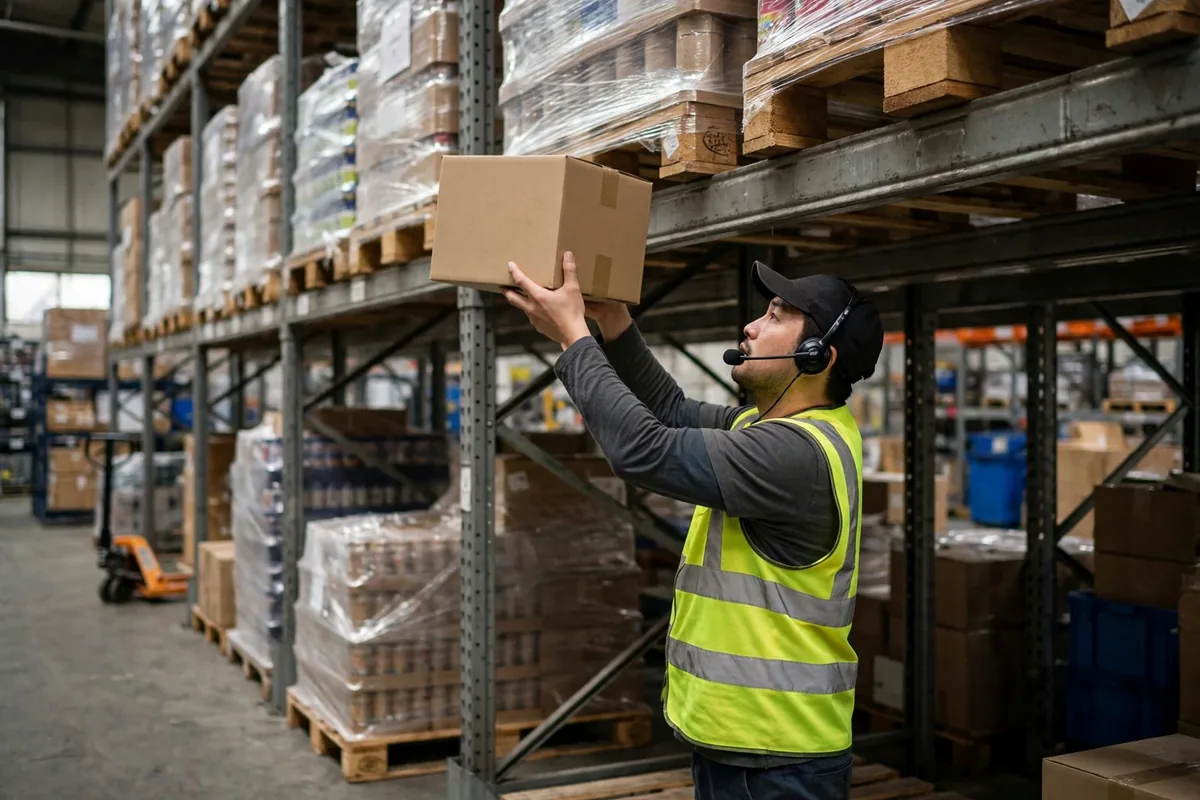
Think of it as the WMS giving each worker a supervisor who only talks. The flow is simple. A worker puts on a headset, logs in, and completes a short voice enrollment, reading numbers and letters so the system learns his accent and pace. Skip this step or rush it, and you will pay for it all week. The system then speaks the task: which staging lane to go to, which pallet to take, and which storage location to fill. At the location, the worker does not scan a screen. He reads out the check digits printed on the location label. If the digits match, the system allows the putaway. He confirms completion by voice, and the next task arrives instantly.
The detail vendors gloss over is the vocabulary. A serious voice system recognizes a deliberately tiny word set: digits, confirm, repeat, exception, and location check codes. Maybe a few dozen words in total. That is a feature, not a limitation. It is like calling numbers across a noisy shop floor — short, predictable words survive forklift reverse alarms and fan noise; free-form conversation does not. Any vendor who brags that workers can "say anything" is selling you a recognition problem.
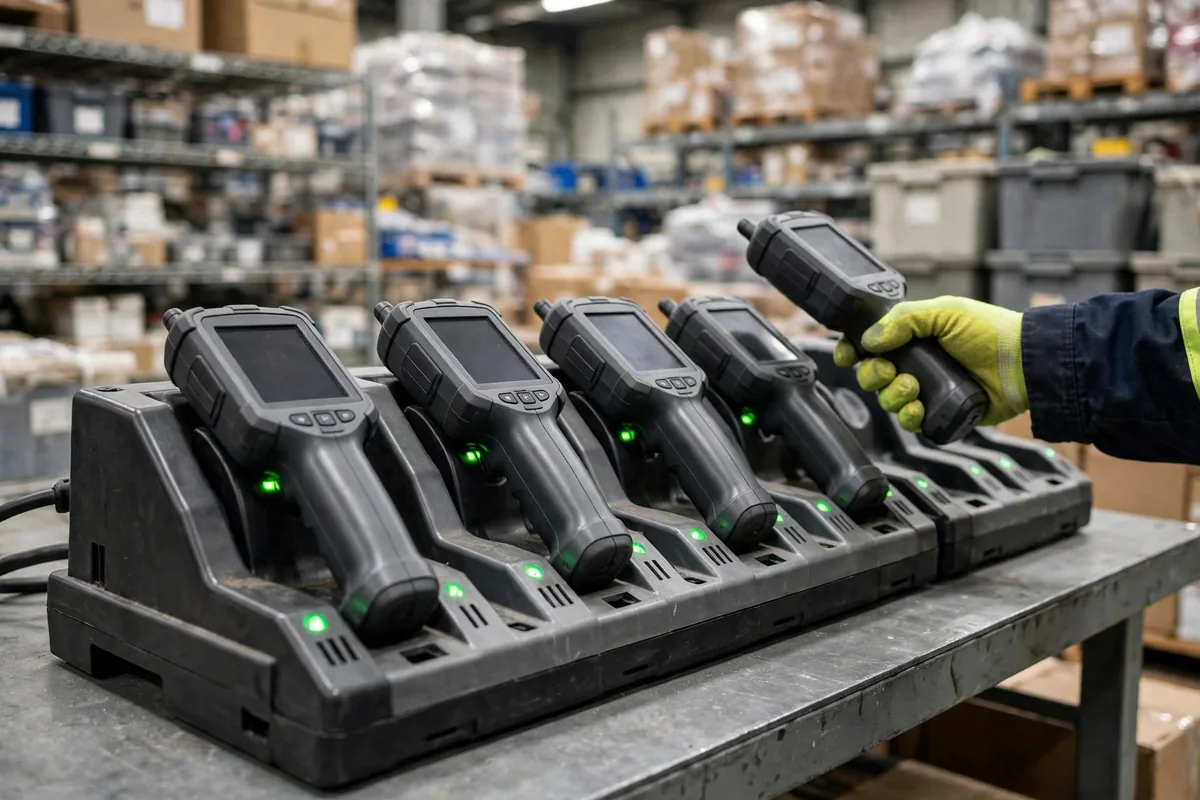
Hardware is boring and decisive: an industrial headset, a wearable voice terminal, and wireless coverage that actually reaches the back of high-bay aisles. In 2023, at a cold-storage site in northern China, metal racking and low temperatures exposed a network designed on office assumptions. Deep in the aisles the voice lagged, workers repeated commands two or three times, and by day two headsets were back in the cabinet. Two extra access points and roaming adjustments fixed it. Voice lives or dies on latency. Once workers have to repeat themselves, trust is gone and no feature list brings it back.
Exception handling deserves the same attention. What happens when a pallet is damaged, a location is full, or a label will not read? In a good design, the worker speaks an exception code, the system asks one or two follow-up questions, and a photo task or manual handling task is created automatically. In a bad design, every exception means a walk back to a desk terminal. Eight trips a day to the office will hand back every minute voice saved you.
Voice putaway versus RF guns and PTL: the dividing lines
The worst selection logic I see is: voice is faster, so voice everywhere. These three tools have completely different temperaments.
An RF gun wins on information density. One screen can show item name, specification, lot, and expiry date. Any putaway decision that needs eyes — separating lots, flagging short-dated stock, checking serial numbers on high-value goods — is safer with a gun and a scan. Its cost is obvious: hands and eyes are occupied, so workers constantly pick the device up and put it down while handling cartons and pallets.
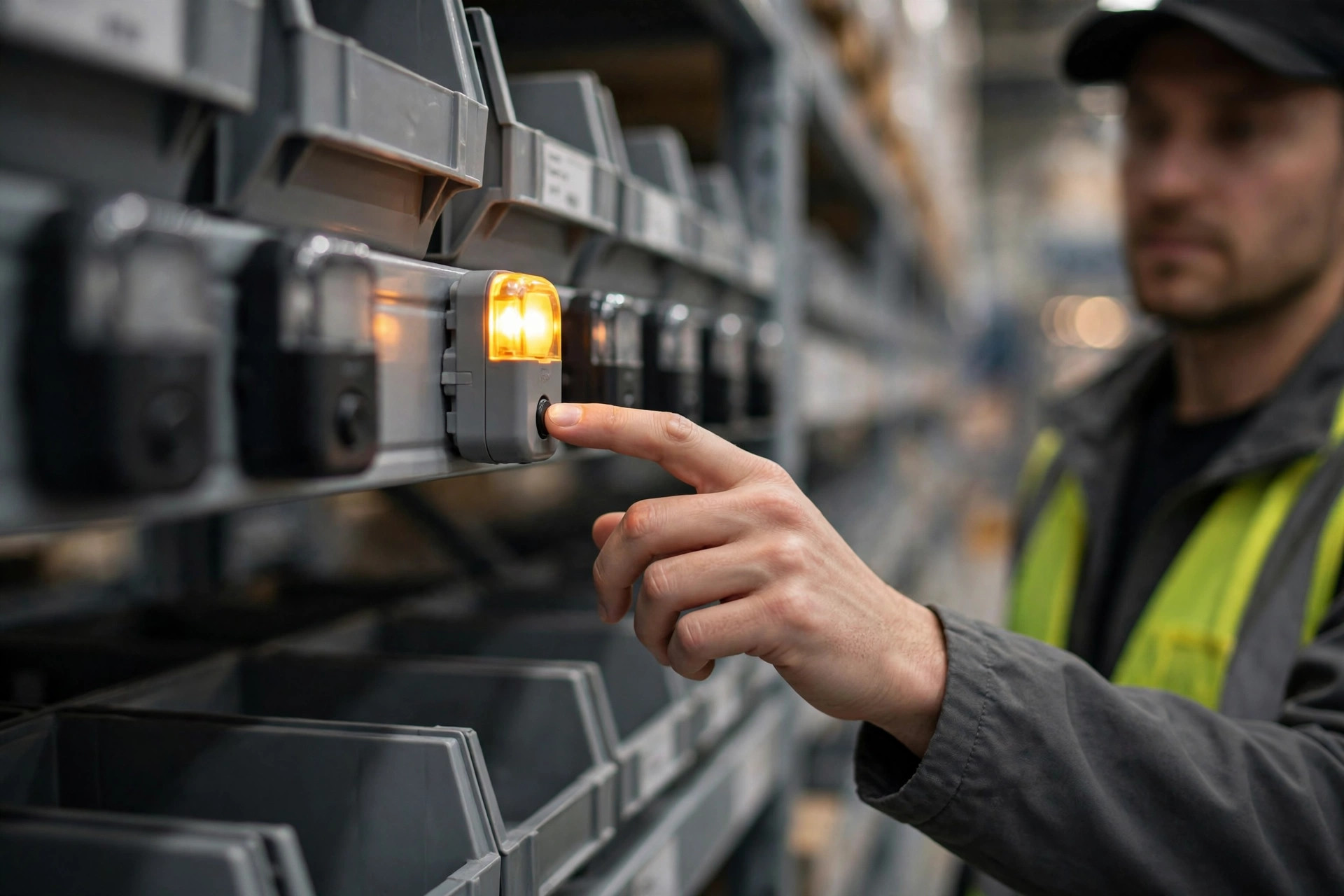
PTL, or pick-to-light, wins at fixed points. Lights tell hands exactly where to go, which suits split-case putaway and sortation walls where positions never move. But lights mean wiring and hardware on every location. If your layout changes twice a year, every change becomes a small construction project, and the flexibility you lose is a real cost.
Voice wins when hands are busy, feet are moving, and the information is simple: full-pallet putaway, full-case replenishment, bulky items where the worker must watch the load and the route. Ears are free in exactly those moments. The reverse is equally true. Split-case work with mixed lots and expiry checks exceeds what a voice prompt can carry, and forcing it there manufactures errors.
That, in one sentence, is where warehouse voice directed putaway earns its keep — and where it does not. A rough decision frame I use on site:
| Dimension | RF gun fits better | Voice fits better | PTL fits better |
|---|---|---|---|
| Work pattern | Mobile, information-heavy | Mobile, hands occupied | Fixed points, high repetition |
| Information per task | Lot, expiry, serials visible | Location plus quantity is enough | Location plus quantity, light-guided |
| Layout change frequency | Any | Any | Low; stable layout only |
| Typical work | Mixed-lot and high-value putaway | Full-pallet putaway, bulky replenishment | Sortation and split-case putaway |
Mature warehouses mix all three: voice in the pallet area, PTL at split-case, RF guns for high-value stock. A single tool forced across the whole building usually reflects a sales quota, not an operational need.
Accuracy, training cost, and an honest ROI calculation
First, accuracy. Voice putaway prevents location errors through check digits: arrive at the wrong location, read its digits, and the system blocks you on the spot. That kills the most common putaway mistake, which is rarely malicious — it is a tired worker one aisle too far, reading the wrong row. But here is the counterintuitive point vendors avoid: check digits cannot catch the wrong product. If two similar pallets sit in staging and one carries the wrong label, the worker can put the wrong goods in the right location and every check passes. Voice solves location errors. Product errors belong to receiving inspection and label discipline. Confusing the two is how projects get oversold.
Second, training — and this is where voice often pays back more than in raw speed. An RF gun means menus, scan sequences, and screen logic for a new hire to memorize. Voice feeds one instruction at a time; the worker follows and confirms. At that East China site in 2024, the supervisor told me seasonal temps previously shadowed a trainer for two days before working alone; with voice, they did enrollment and practice in the morning and handled slow work under the system that same afternoon. I will not promise every site matches that, and workers with strong regional accents may need longer enrollment — a few may never reach reliable recognition and should keep an RF gun as a fallback. But the direction is real: training shifts from teaching software to teaching work discipline.
Now the money, as a clearly labelled hypothetical example — these figures are illustrative magnitudes, not any vendor's quote. Assume a warehouse putting away 800 pallets a day with 10 putaway workers. Suppose headsets and terminals per worker, per-user software licensing, wireless upgrades, and implementation training total the equivalent of about $25,000 in year one, with licensing and maintenance of about $7,000 a year after that. On the benefit side, assume reduced stop-start friction lets the same volume run with one fewer worker, or one fewer seasonal temp in peak, worth roughly $11,700 a year at a fully loaded $975 a month, plus about $2,800 a year saved in searching and recounting after location errors. Total benefit: roughly $14,500 a year. Against year-one cost, payback lands somewhere in the second year. Not exciting — but honest. And if your site puts away only 100 to 200 pallets a day, cannot reduce headcount, and already has few location errors, the fixed cost never spreads thin enough. Small warehouses should skip it. That is not a hedge; that is my recommendation.
One maintenance warning to close. Headsets are consumables. Cables get yanked, microphones collect sweat and drops, and failure rates run higher than RF guns. Stock spares at roughly 20 to 30 percent of your deployed count, and plan battery swaps into the shift, because voice terminals drain far faster in continuous use than in standby. A fleet dying at 3 p.m. will teach you this lesson at maximum volume.
Do one thing before you call any vendor: shadow a putaway worker for a full shift and count how many times he stops to look at a screen or raise a gun, and for how many seconds each time. Multiply it out across your team and your calendar. That number is the ceiling of what voice can win back for you. Whether the money is worth it comes down to that one number.
By Da Liu, Automation Engineer