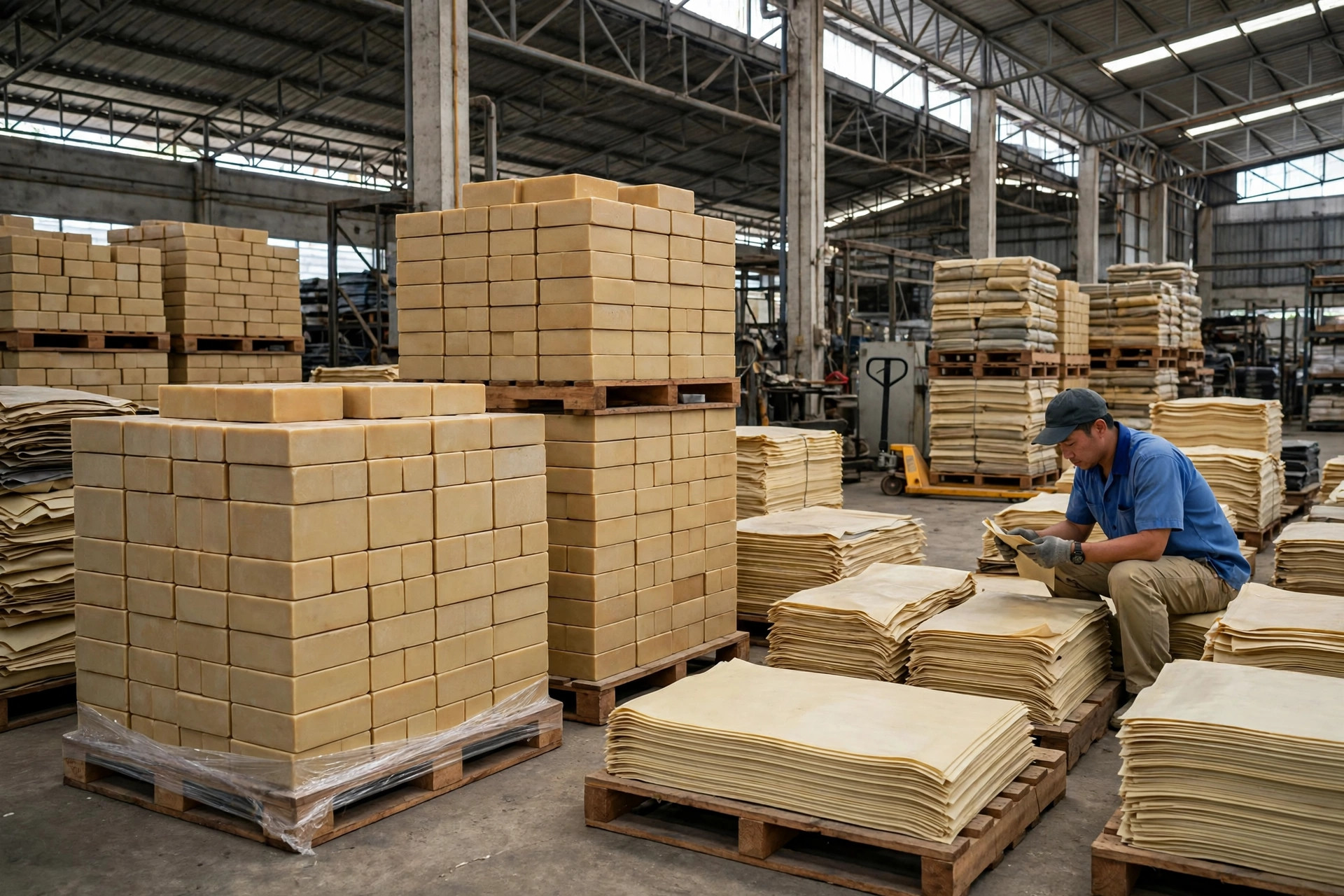
Let me give you the conclusion first: in Thailand rubber export warehouse logistics, the warehouse is not a cost centre. It is part of your pricing power. The same lot of STR20 can arrive at the destination port at full contract value, or it can arrive with a quality claim attached, and the difference is usually not the rubber itself. It is the few weeks the rubber spent sitting in a warehouse. Thailand produced about 4.8 million tonnes of natural rubber in 2024, more than 30 percent of world output, making it the world's largest producer and exporter, with export value near 5 billion US dollars. Around 90 percent of that rubber comes from smallholders. Plantations are scattered, processors are scattered, and the warehouse is the one choke point nobody gets to skip.
I have seen too many people treat rubber like any other bulk commodity. A few years ago I walked through a trader's warehouse in Southeast Asia and watched a stack of ribbed smoked sheet being opened. From the outside it looked perfect. Inside, the middle layers had fused into one solid block. You could not pull the sheets apart. The buyer rejected the lot on the spot, and the shipment was sold at a discount. The loss on that one container would have paid half a year of warehouse rent. There are two sides to this. On one side, natural rubber is sticky by nature: it loves to fuse, it hates heat, it hates damp. On the other side, warehouse managers keep betting that a neat stack and a tarp are enough. Rubber does not accept that bet.
From Plantation to Factory: The First Test in Thailand Rubber Export Warehouse Logistics
Thailand rubber export warehouse logistics starts at the plantation, not at the port. Tappers work before dawn, the latex is collected in the morning, and by the afternoon it reaches a nearby cooperative or primary processing point, where it becomes smoked sheet or cup lump, and later, at the factory, pressed into STR20 blocks. The danger in this stretch is time. Latex left standing starts to coagulate on its own. Cup lump left in an open yard through one more rainstorm picks up water and dirt. Factories pay on dry rubber content and impurity levels, so every shortcut taken at the plantation end comes back doubled on the factory's deduction slip.
So the first rule for anyone running a rubber warehouse is to make inbound inspection non-negotiable. Every truck gets checked for moisture and foreign matter before it is unloaded. Smoked sheet gets sampled for colour consistency and smell: any hint of mould, and that lot is quarantined. Blocks get cut open to check for air pockets and trapped debris. Rejected lots are stored separately and never mixed into a good stack. I have seen this mistake too many times: good rubber and bad rubber stacked together, and the moisture and mould from the bad lot spread through the whole stack. When the claim comes, the entire lot is yours. This step costs labour. Skipping it means gambling your payment on luck.
Anti-Sticking and Moisture Control in Thailand Rubber Export Warehouse Logistics
Anti-sticking and moisture control are the two most expensive lines in a rubber warehouse budget, and the two you can least afford to cut. Sticking first. STR20 blocks leave the factory wrapped in polyethylene film. Stacks need air gaps, they must not touch the walls, and in hot weather the blocks need separator paper or film between layers. Some managers skip the paper to save time and space. Then one rainy season passes, the whole stack fuses into a single block, and the crew has to cut it apart with knives. The buyer opens the container, sees the condition, and downgrades the lot. The paper costs almost nothing per container. A downgrade costs thousands of dollars.
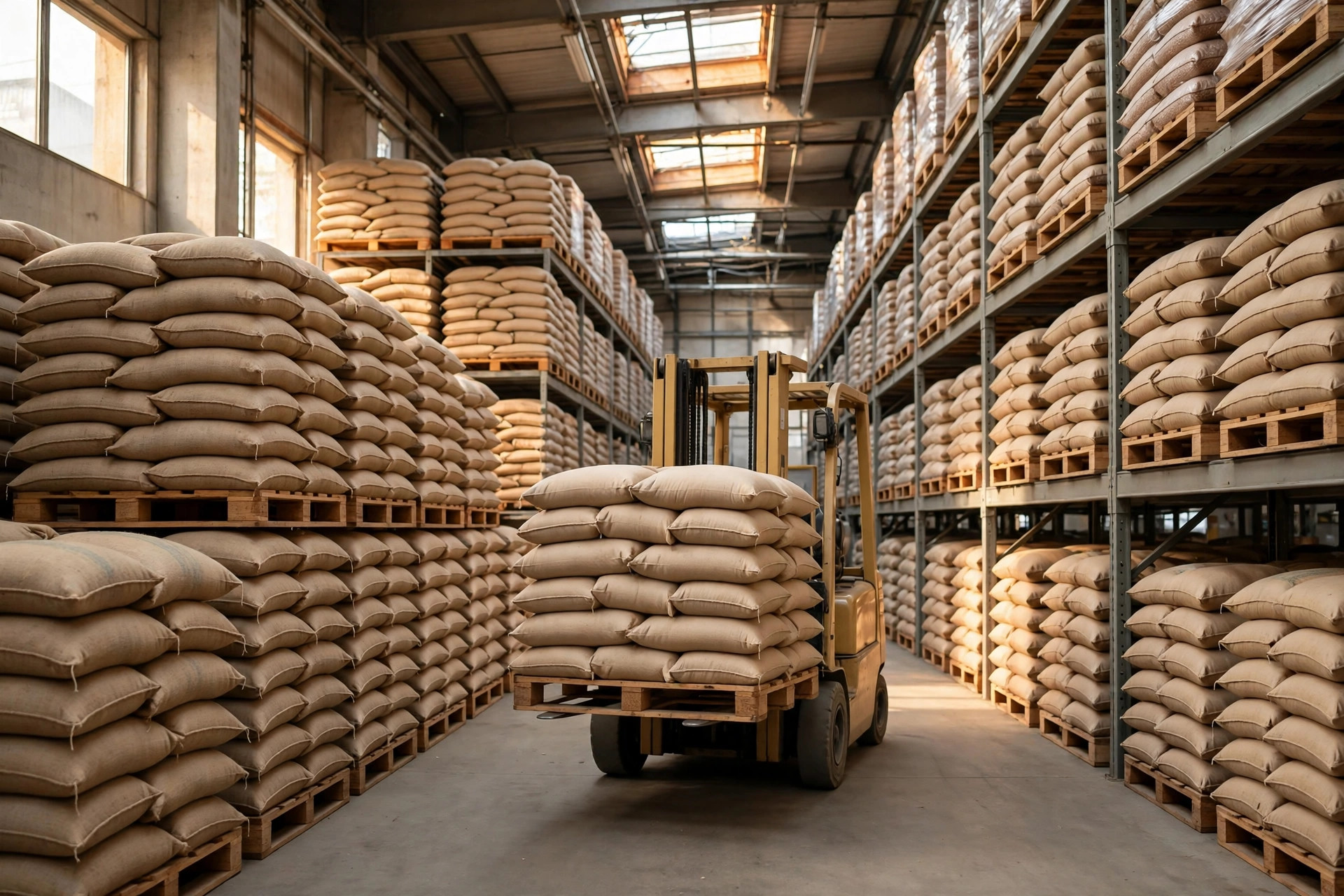
Mould is worse. Thailand's rainy season keeps humidity high for months, and RSS3 smoked sheet, dried by wood smoke, is quick to take moisture back. The warehouse floor must be damp-proofed, pallets raised at least ten centimetres off the ground, moisture barriers under every stack, and temperature and humidity checked at least twice a day during the rainy season. My rule is that gauges do not belong only at the door. The door is well ventilated and the numbers always look fine there. The dead corners between stacks are where mould actually grows. Keep an inspection route, open a sample box every week, feel the sheets for tackiness, look for mould spots. One mouldy pack means the whole stack gets isolated. Wait until the spots spread and the shipment will fail inspection outright.
Then there is the rule people forget: rubber must never share space with anything strong-smelling. Tyre makers are sensitive to odour, and rubber that has absorbed a chemical smell can be rejected just the same. Keeping zones separate is not fussiness. It is written into the contract.
There is also a timing calculation to make during the rainy season. Tapping slows when it rains, prices move, and vessel schedules tighten. A warehouse cannot sit on too much stock and tie up cash, but it also cannot hold rubber through a whole rainy season waiting for a ship. My practice is to schedule inbound deliveries backwards from the sailing date: once the vessel is fixed, let the volume come in; while the sailing is uncertain, I would rather have the factory ship a few days late than let blocks sit in storage through the wettest weeks. Storage cost buys schedule certainty, and the more certain the schedule, the shorter the rubber sits, and the smaller the sticking and mould risk. Once you see it that way, the warehouse stops being a cost centre and starts being the tool that locks in your price.
Consolidation: Two Sides of the Same Coin
Consolidation is where Thailand rubber export warehouse logistics tests your arithmetic. A full container load is simple. A consolidated container saves freight, but all the risk lands on the consolidator. Put plainly, consolidation is not about sharing a box. It is about sharing responsibility: whose cargo arrives first, whose goes at the bottom, whose cannot take weight. Get the loading order wrong and the best case is deformation. The worst case is a claim nobody can untangle.
My rule is to split containers by grade and destination. Dense STR20 blocks can take weight and go at the bottom. RSS smoked sheet is crush-sensitive and moisture-sensitive, so it goes on top, with an inspection aisle left near the doors. Different buyers in one box get dividers and marks that leave no doubt, and the loading list records the exact position and piece count of every consignment, with photographs kept on file. At Laem Chabang or Songkhla, when customs opens the box for inspection, those photographs are your hardest evidence. Without them, every damage dispute comes down to who argues loudest.
Here is a worked example, labelled as hypothetical: one 20-foot container loaded with 24 tonnes of STR20 (hypothetical example), at 2.50 US dollars per kilogram (hypothetical example), carries about 60,000 dollars of cargo. Consolidation might save a third of the freight, a few hundred dollars that you can see. But one moisture-damaged consignment, downgraded and claimed, easily costs several thousand dollars that you cannot see coming. Consolidation saves visible freight and gambles invisible cargo value. Any warehouse manager needs that arithmetic in their head: ship full containers when you can, and when you must consolidate, get the moisture protection and separation right before you talk about saving money.
If the Warehouse Holds, the Price Holds
The final gate is the pre-shipment re-check. Forty-eight hours before loading, sample moisture and appearance once more. Only a passed lot gets sealed. Before sealing, take three photographs: the container number, the seal number, and the full loaded container. Put the seal number in the bill of lading remarks. When the buyer opens the box at destination and the seal does not match, responsibility is settled in minutes. Three photographs cost nothing. At the critical moment they save weeks of argument.
One last piece of advice: do not outsource rubber warehousing and then stop watching. A third-party warehouse is measured on turnover and rent. You are measured on cargo value and claims. The contract should spell out temperature and humidity standards, inspection frequency, and damage liability, and you should walk the floor at least once a month, checking the humidity log stack by stack. In this business, every dollar saved in the warehouse comes back on the claims sheet with interest. Would you rather spend a little now on control, or a lot later on compensation?
By Lao Mi, Supply Chain Veteran (20 yrs)