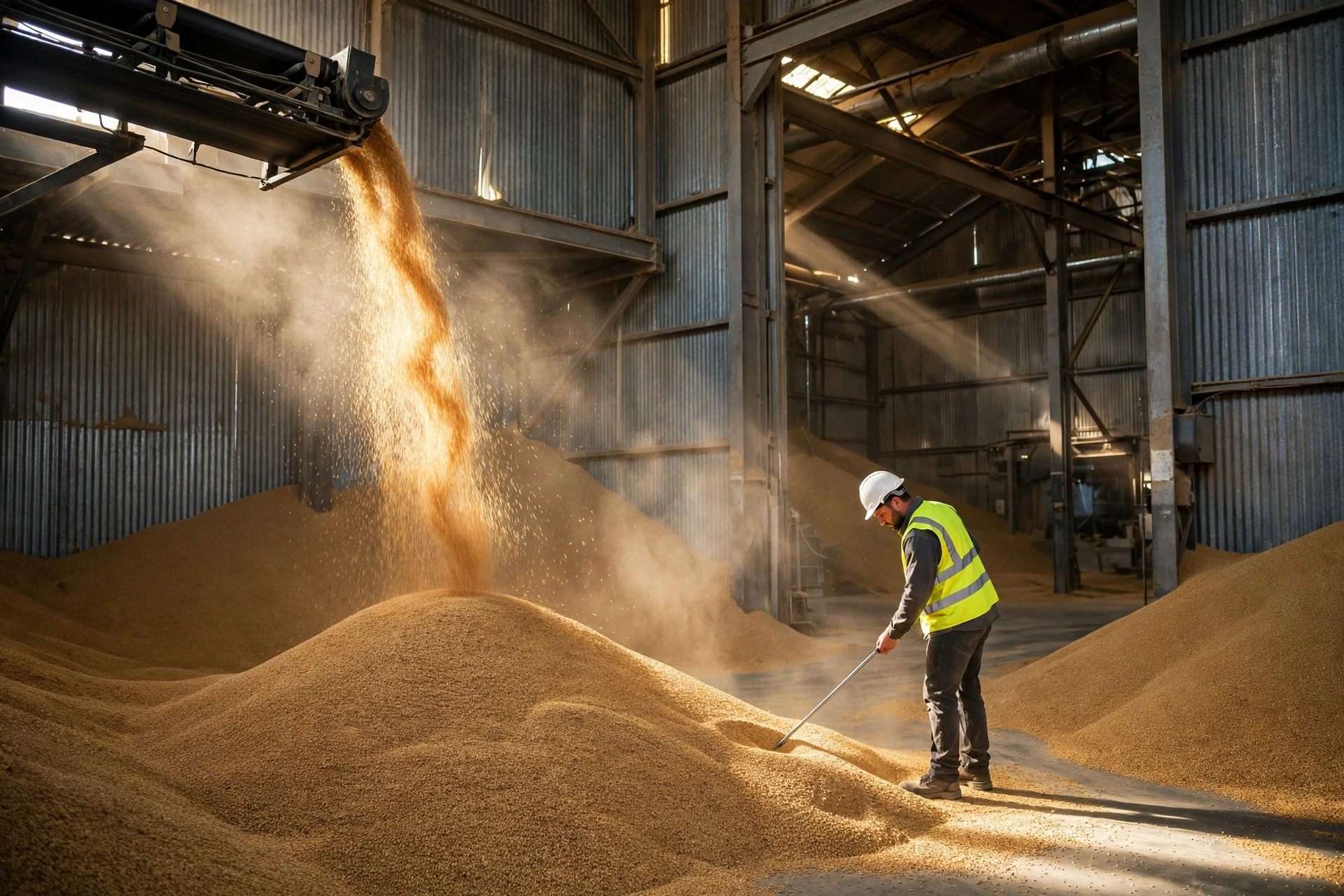
Australia wheat export warehouse storage is not a rent decision, and I will say that up front because it is the mistake I see most often. People shop for the cheapest shed, sign the contract, and only discover the real cost months later, when a load gets downgraded, a fumigation runs late, or a vessel sails without their grain. Storage does not exist to hold wheat. It exists to protect the shipment's quality and its sailing date. Get those two things wrong and whatever you saved on rent comes back several times over.
Australia Wheat Export Warehouse Storage Starts With Three Accounts
I have watched too many exporters ask one question — what is the rent? — and stop there. The honest accounting has three lines, and you need all three before you sign anything.
| Account | What it measures | What happens when it is wrong |
|---|---|---|
| Moisture | Whether grain goes in dry and stays dry | Caking, heating, and a downgraded parcel |
| Pests | How often grain is inspected and whether fumigation can be scheduled in time | A failed port retest and a missed sailing |
| Timing | When grain leaves storage against when the vessel arrives | Grain stuck inland, or a vessel waiting on grain that is not ready |
Moisture is the one people underestimate. Grain can look dry at intake and still go wrong in storage. Inland New South Wales runs hot by day and cool at night, and that swing pushes damp air toward the coldest part of the pile — usually the wall or the surface. The top of the heap can look perfect while the edges are quietly heating. By the time anyone smells trouble, the damage is already priced in.
Here is a judgment that surprises people: the most dangerous grain in a store is often the grain everyone believes has already been dealt with. A fumigation is done, the paperwork is filed, and the team relaxes. But if sealing was imperfect, or temperatures shifted, surviving eggs can build back up over the following weeks. Pest control is not a job you finish once. It is a watch you keep for the whole storage period.
The Season I Learned to Check the Corners
Let me tell you about a season that taught me this the hard way. I was watching over a parcel stored in a flat store inland. Intake samples looked clean, the store's routine checks came back fine, and everyone felt comfortable. Then the corner of the store, hard against the wall where airflow was weakest, started showing insect activity first. The middle of the pile — the easy place to sample — still looked fine. By the time the problem was found, it was no longer one spot. The whole store had to be turned and treated, the labour bill climbed, and the original shipping rhythm nearly fell apart.
The lesson was blunt. Inspection routes that only visit the convenient places are inspection routes designed to miss things. The middle of the pile is the easiest sample to take and the least informative. Corners, doorways, and vents are awkward to reach, and that is exactly where pests settle first. If your sampling plan avoids the awkward places, it is not a sampling plan. It is a comfort blanket.
That season also changed how I read intake results. An average moisture reading can hide a bad pocket. I now want the highest samples, not just the mean, and I want them taken layer by layer. A parcel that averages well but hides a wet pocket is still a parcel with a problem. It is far cheaper to split and handle that pocket at intake than to dig it out of a store weeks later, in front of a port inspector.
Silos or Flat Stores: Every Advantage Has a Price
Ask me whether silos or flat stores are better and I will refuse the question, because it is the wrong question. Every option buys one thing by giving up another.
| Silo | Flat store | |
|---|---|---|
| Advantage | Tight sealing, easier pest and moisture control, fast outloading | Flexible stacking, easy to separate grades and parcels, not tied to one outlet |
| Price | One grade per silo, little room to change your mind | Sealing and ventilation depend entirely on how carefully people manage it |
| Best fit | A single grade, a large parcel, a fixed sailing date | Mixed grades and parcels that need sorting while the season is still moving |
Another season, I watched a team use both types well — and that season is the clearest lesson I have about Australia wheat export warehouse storage. Clean, single-grade grain with a firm vessel date went into silos, because sealing and fast outloading mattered most. Mixed parcels with no vessel fixed yet went into a flat store, because they needed the freedom to split, move, and change direction. That season ran smoothly. I have also seen the reverse mistake: several parcels blended into one silo to save effort, only for port sampling to find the quality did not match the contract. A silo saves management effort and charges you flexibility. A flat store gives you flexibility and charges you management effort. There is no side of that trade that is free.
This is also why intake discipline matters more than storage technology. Wet grain in a silo goes wrong quietly, sealed in. Wet grain in a flat store goes wrong openly, spread across the floor. Different failure, same loss. The fix is the same in both cases: sample properly at intake, act on the worst samples rather than the average, and never bury a known problem in a store hoping the port will not find it. The port always finds it. The only question is whether you find it first.
The Port Leg: You Are Booking Time, Not Space
The last leg, from inland storage to Sydney Port, is where good seasons quietly fall apart. When you book a vessel, you are not really booking hold space. You are booking a window of days, and everything else has to land inside it. Grain must be ready, retested, fumigated, and documented before that window opens. Arriving at the port on sailing day and hoping the road, the testing, and the paperwork all cooperate is not a plan. It is a gamble, and the house usually wins.
I work backwards from the vessel. Fix the sailing date, then set the outloading date, the retest date, and the fumigation date in reverse, with slack built in between. That slack is not waste. It is the margin that lets you survive a failed retest and still make the next sailing. A failed retest with slack is a problem you can solve. A failed retest without slack is a vessel sailing away while your grain sits on the wharf.
The other port trap is split responsibility. The storage team thinks its job ends when grain leaves the gate. The port team thinks the storage team failed when grain is not ready. Export storage has to be managed as one chain, from the silo to the ship's hold, with sampling, retesting, and fumigation responsibilities written down before the season starts — who does each step, and by when. If nobody owns the handover, the handover owns you.
So before the next intake season, ask yourself one question: are you storing this grain for the vessel, or for the rent? In Australia wheat export warehouse storage, the answer will tell you which store to choose, how hard to inspect it, and how much slack to leave before the ship sails.
By Lao Mi, Supply Chain Veteran (20 yrs)