We have a client in the Georgia peach export warehouse storage business, and every peach season he gets squeezed from both sides: the orchards cannot wait, and the overseas buyers inspect every box like it owes them money. When he first came to talk warehousing with us, his first question was not "what is your pallet rate?" It was "can you promise my peaches will look the same when they go onto the reefer as they did when they came off the tree?" That is the right question, because the real cost of peach export is never just the warehouse bill.
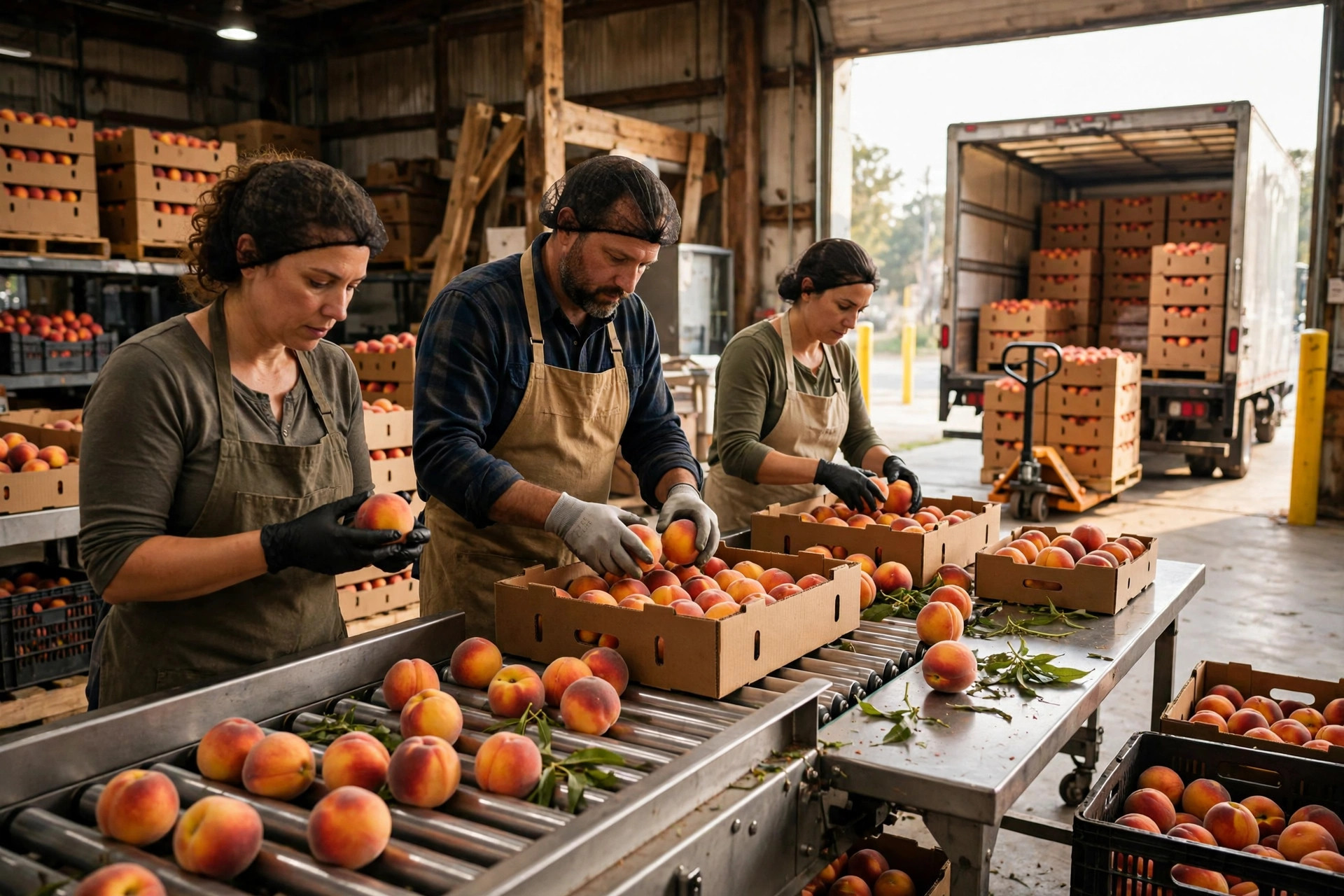
Most of his fruit moves through the packing houses around Fort Valley. The peach season runs roughly May through August, and in the peak weeks the trucks waiting outside the packing houses can stretch from sunrise to sunset. One year, on his first few loads, he tried to save time by hauling freshly picked peaches straight to the packing house gate and joining the queue, figuring that early arrival meant early grading. That day the house was still clearing earlier fruit, so his peaches sat on the truck for most of the afternoon. By the time they reached the grading line, a visible share had gone soft. The graded-out seconds left him short of a full load, and he had to pull replacement fruit from another supplier at short notice, paying extra freight and extra labor. He told me later that what he earned on that load did not even cover the cost of topping it up.
Peak season packing houses are like that. When volume surges, the schedule falls apart: one grower delivers a few extra pallets, and everyone behind him waits; the longer the wait, the more boxes pile up in the shed and the longer the pre-cooling queue gets. Peaches do not wait politely. The longer the line, the more soft fruit, and that bill always lands on the shipper.
What Georgia peach export warehouse storage has to protect
Peaches are picky in a very specific way. First, they go soft: overripe fruit cannot survive a long ocean leg, and a buyer can tell with one squeeze. Second, they bruise: every extra touch, from grading to packing to reloading, adds a bruise. Third, they hate temperature swings — and here is the part most newcomers get wrong. It is not steady warmth that does the most damage; it is going cold and then warm again. Fruit that has just been pre-cooled and then sits in a warm shed for hours will sweat on the surface and soften faster than fruit that was never cooled at all.
Another client of ours tells the opposite story. His volume is small, only a few dozen pallets a season, but he is fussy in the right places. Before grading, his fruit rests in the shade; after grading, the packed boxes never spend the night in the shed — they go straight into pre-cooling. He also struck a deal with the packing house: when his fruit arrives, it gets a grading line of its own instead of waiting behind the big growers. That arrangement looks trivial, but it saves exactly the hours peaches fear most. When his buyers open a few boxes at inspection, firmness and color are consistent, and he has never once received a deduction note. His volume is modest, but his repeat business is the steadiest we have. In export warehousing, buyers do not remember how many loads you shipped; they remember whether you ever made their life difficult.
From packing house to reefer: the warehouse storage sequence
The sequence sounds like common sense, but every step hides a detail. Our rule of thumb is simple: pick, grade and pack, pre-cool as soon as possible, and load straight onto the reefer, with as few hand-offs in between as possible. Reefer trucks commonly run around 34–36°F, but that is only the common range — the buyer's spec governs, so get it in writing in the contract rather than relying on a handshake.
Three approaches are common, and the comparison makes the trade-offs clear:
| Approach | Advantage | Cost | | Load the same day as grading | Fewest hand-offs, fruit at its freshest | Packing house and trucking schedules must line up tightly | | Pre-cool, hold a day or two, then load | Flexible timing, easier to consolidate loads | One more cycle in and out of storage; any break in the cold chain undoes the work | | Stockpile, then ship in peak volume | Big orders, stronger negotiating position | Longest storage time, highest risk of soft fruit and loss |
There is no single right answer, only the answer that fits your sailing schedule and your buyer's inspection rhythm. If the vessel is tight, pay a little more and load the same day. If the schedule is loose, holding a day or two can fill the container and spread the freight cost. In Georgia peach export warehouse storage, the step that most often goes wrong is actually booking the truck: book late, and pre-cooled peaches sit in the warehouse waiting; book early, and the truck waits at the gate while grading is still running, with the driver on the clock either way. Our practice is to send the day's grading volume to the carrier as soon as the packing house opens, so trucks are dispatched to match the volume — better two smaller trips than a full truckload baking at the gate.
The three bills hiding in the quote
A warehousing quote usually shows storage and handling fees, but peach export really has three bills. The first is storage and handling, visible on paper. The second is shrinkage and deductions, invisible until it hurts. The third is the calendar: miss one sailing, and nobody can promise what the next one will cost. Documentation and inspection requirements should also be confirmed early, subject to the buyer's latest spec — never discover a missing paper when the container is already at the port.
There is a fourth bill people forget: coordination. When the packing house, the carrier, and the freight forwarder each tell a different story, and something goes wrong, they point at each other while the shipper pays from both sides. Before signing anything, put all three contacts on one sheet, with each leg of the journey assigned to a named person. In the end, Georgia peach export warehouse storage is not won by whoever has the biggest building; it is won by whoever's hand-offs never drop the ball.
Here is the counterintuitive part: the cheapest warehouse is usually the most expensive one. A few percent saved on storage means nothing if pre-cooling runs late, the fruit gets reloaded one extra time, or the reefer temperature does not match the spec. The soft pallets and the buyer's deduction will eat the savings several times over. A slightly pricier warehouse with a tight process looks like a loss on the quote, but once you count shrinkage and repeat orders, it is the cheaper option. Read a quote sideways, not just the first line.
So next time you negotiate a contract, ask these three questions. First, how long passes between grading and loading onto the reefer, and who guarantees the cold chain never breaks? Second, is the reefer temperature range written into the contract, or is it just a verbal promise? Third, if inspection at destination fails, who bears the loss, and by what deduction standard? Get those three answers in writing, and the peach export warehousing bill is finally being counted where it matters.
By Susan, 3PL Sales Director