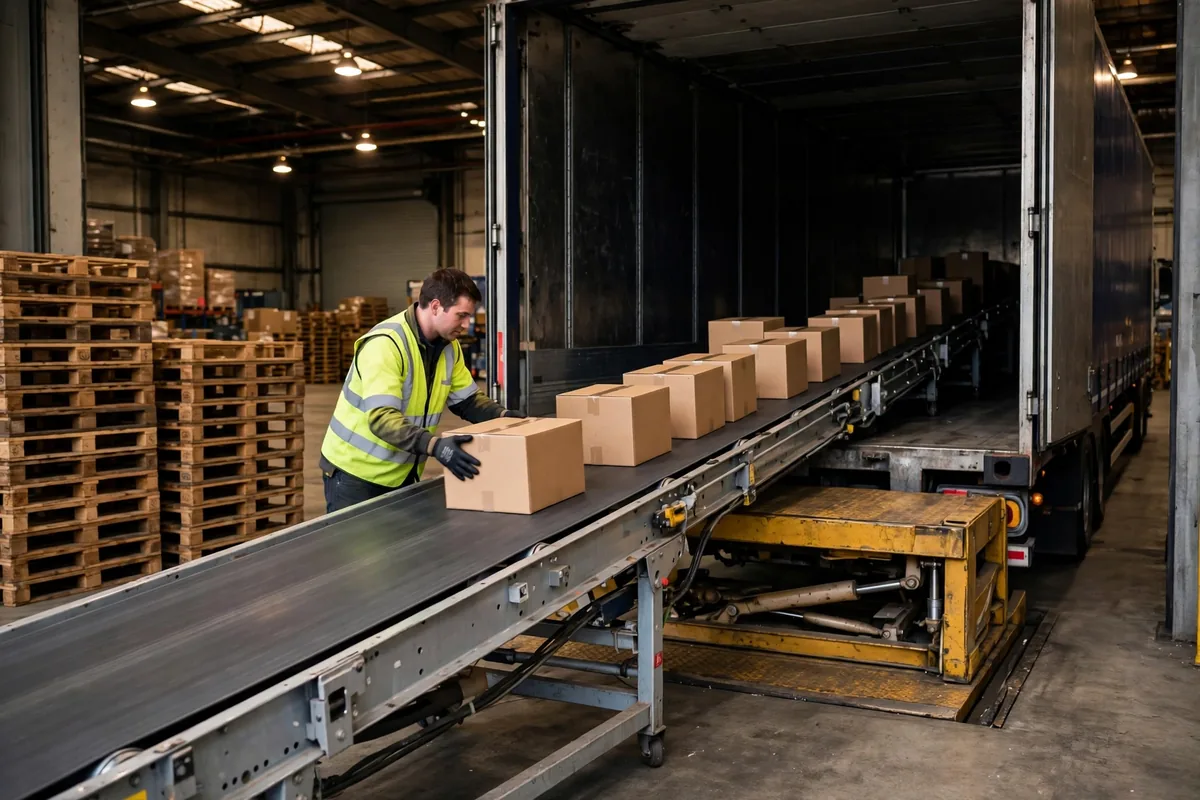
Let me tell you about the first time I watched a telescopic conveyor pull a full trailer apart — a July afternoon a couple of years back, waiting to get unloaded at a 3PL warehouse in Ontario. For the first time in fifteen years on the road, I thought somebody had finally designed dock work with the worker in mind. It was over thirty degrees out. A 53-foot trailer sat at the dock, and the inside of that box was an oven. The old way, two guys climb in there and carry cartons out one by one, bent double, all the way to the back. That day was different. The conveyor stretched itself into the trailer in sections, cartons rode the belt out on their own, and the crew stood on the dock in the shade, catching boxes and stacking pallets with dry shirts on. I have seen too many warehouses treat unloading as "somebody's problem." People are not machines. People get tired, then they get slow, then they make mistakes, and mistakes cost money.
The idea is simple. A telescopic conveyor is a belt conveyor that extends and retracts, its sections sliding inside each other like a telescope. Retracted it is only a few meters long; extended, the big models reach nearly 30 meters, according to manufacturer spec sheets. Belt widths are usually 600 or 800 millimeters. Belt speed is adjustable, typically 15 to 36 meters per minute, and load capacity runs around 50 kilograms per meter on common models — check the manufacturer's latest published specs before you buy, because those numbers vary by model. It runs in both directions, so the same machine loads and unloads. The extension moves slower than the belt, so give it time to reach full length before the crew starts working. What decides whether it works for you is not the spec sheet, though. It is your dock height, your trailer length, and your carton size. Get those three wrong and the most expensive machine on the market will not save you.
What Changes Once a Telescopic Conveyor Reaches Into the Trailer
The biggest change is that nobody has to walk to the back of the trailer anymore. Unloading a full trailer used to mean dozens of trips into a dark, hot box, bent over, carrying weight. Heat exhaustion in summer, slips in winter, thrown-out backs all year — that was normal. With the belt reaching in, the crew works at the trailer door or on the dock, on flat ground, in fresh air. They save their strength, so the pace stays steady instead of falling off a cliff in the last hour. Damage drops too. A tired worker drops cartons; a belt running at a steady speed does not.
But here is the honest part: the machine saves the walking, not the work. Somebody still has to catch the cartons, stack them, and wrap the pallet. Anyone who tells you one belt machine replaces your whole unloading crew is selling you something. I know an auto-parts warehouse that bought two of these and did not cut a single headcount. What they cut was overtime and injury claims, not people. That is not as exciting a story, but it is the true one.
One winter during peak season, a beverage distributor in Riverside left a mark on me. Six trailers a day, all heavy full pallets of drinks. After they put the belt in, unloading one trailer went from over two hours to about an hour and a half. Drivers stopped waiting half the day at the dock, and the warehouse stopped pulling people off the picking lines to rescue the dock. And let me tell you what drivers fear most: waiting. A truck parked at a dock is a truck not earning. Fuel and time burn while nothing moves. Their dispatcher told me the drivers stopped arguing about slow unloading altogether. I believe it, because I have had that argument myself, from the driver's seat.
Four Ways to Load a Truck, Side by Side
There are really four ways to do this job. Put them next to each other and the trade-offs are obvious:
| Method | How it works | Best for | Weak spot |
|---|---|---|---|
| Manual carrying | Workers go inside and carry cartons out | Small volumes, mixed odd-shaped freight | Exhausting, slow, injury-prone, hard to staff at peak |
| Fixed belt conveyor | A set-length belt on the dock; someone still carries inside the trailer | Steady volume, one trailer type | Cannot reach deep into the trailer, so it only does half the job |
| Telescopic conveyor | The belt extends into the trailer and brings freight out | Carton freight, high volume, many trailer types | Takes dock space, needs power and maintenance, cannot handle overweight cartons |
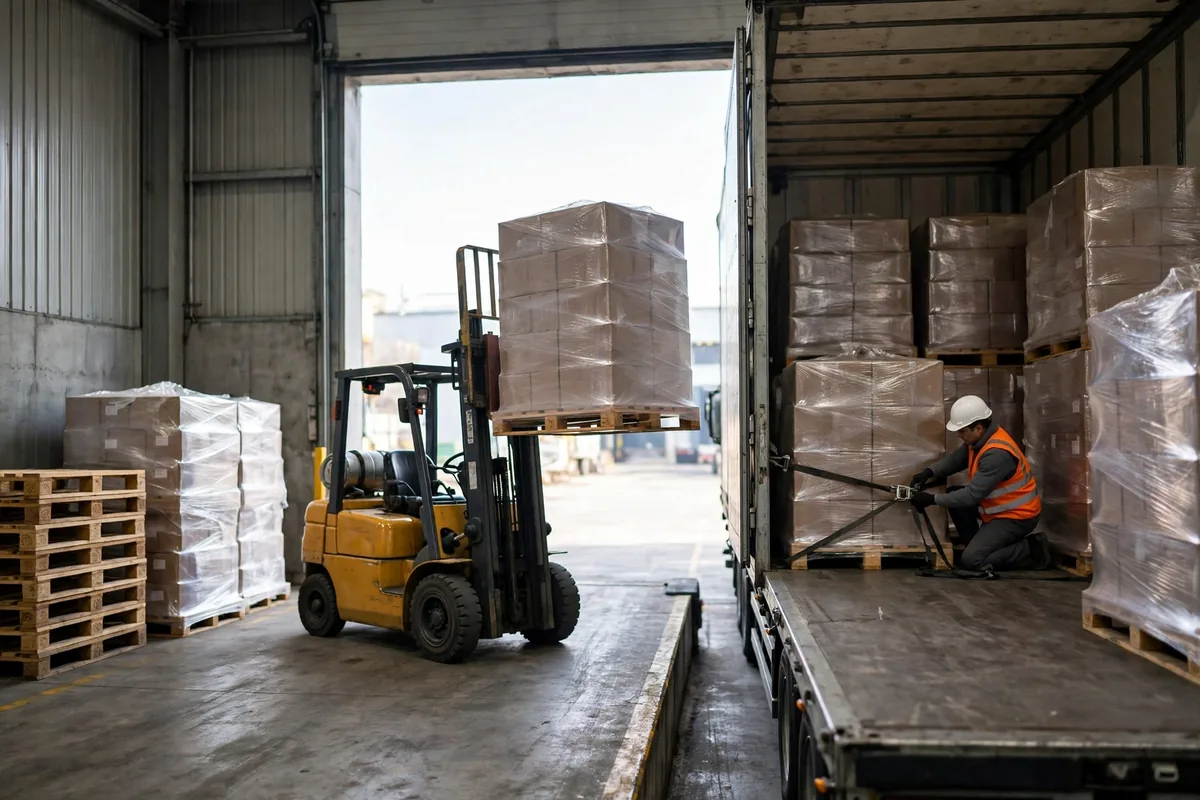
| Forklift and pallets | Whole pallets in and out, fast | Fully palletized freight | Useless for loose cartons and mixed loads, no room to turn inside a trailer |
No method wins everywhere. If everything you ship is palletized, this machine is money wasted. If everything is loose cartons at two or three trailers a day, manual labor will quit on you the moment peak season hits. Picking the wrong method costs more than buying the wrong machine.
Is a Telescopic Conveyor Worth It? Run Three Numbers
Before the math, one thing clear: the figures below are a hypothetical scenario, an illustrative example — not any real warehouse's books. Plug in your own real numbers and the answer is yours.
Say a warehouse unloads two trailers a day, 1,200 cartons each. By hand, four workers take three hours per trailer. With the belt running, three workers finish in two hours. At an assumed labor cost of 20 dollars an hour, the daily saving is (4 × 3 − 3 × 2) × 20 = 120 dollars. Over 22 working days a month, that is 2,640 dollars. Set aside the harder-to-measure stuff — injuries, damage, drivers waiting — and count labor alone. A mid-range machine at an assumed 30,000 dollars pays for itself in about 11 months. Double the volume and payback drops under six months. Halve it, and payback stretches past two years, and the deal stops making sense.
So the test is one sentence: does your dock move enough cartons a day to keep the machine fed? Three more numbers go with it. First, how mixed is your trailer fleet — the more varied the trailers, the more the telescoping is worth, and the less a fixed belt can do. Second, carton weight — if you regularly exceed the per-meter load rating, do not force it; the belt and the motor will both give up early. Third, dock space — the machine takes room even retracted, so a crowded dock needs to make space before it buys anything.
Here is the counterintuitive part: longer is not better. People love buying the model that extends the farthest, thinking they are future-proofing, and then those extra meters get used twice a year while the maintenance bill stays high all year. Buy for the longest trailer you actually run, plus half a meter of slack. And before you buy anything, measure three things: dock height, trailer interior length, and your largest carton. Once you have those, the model picks itself, and no sales pitch can push you into the expensive version.
Fifteen years on the road taught me this: equipment is dead, process is alive. It is a good machine, but it cannot rescue a dock whose process is a mess. My advice is to rent one, or run one machine for three months first. Run it through peak, run it on night shifts, run it on the hardest load you have. After three months you will know exactly how much labor it saved, how much damage it prevented, and how many fewer arguments your drivers had. Then deciding how many to buy, and how long, is easy — because the numbers will be yours.
By Shifu Zhao, Trucking Veteran (15 yrs)