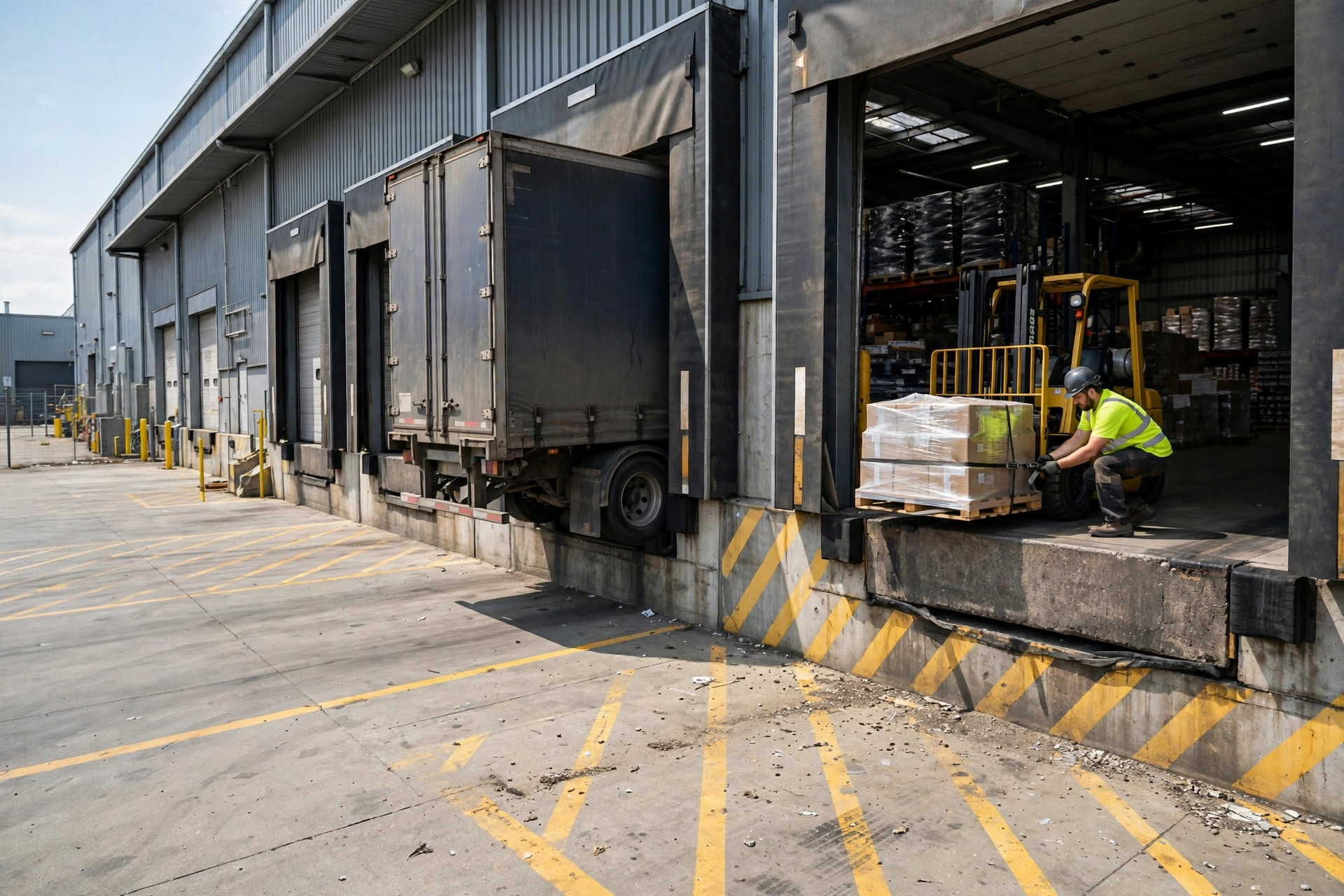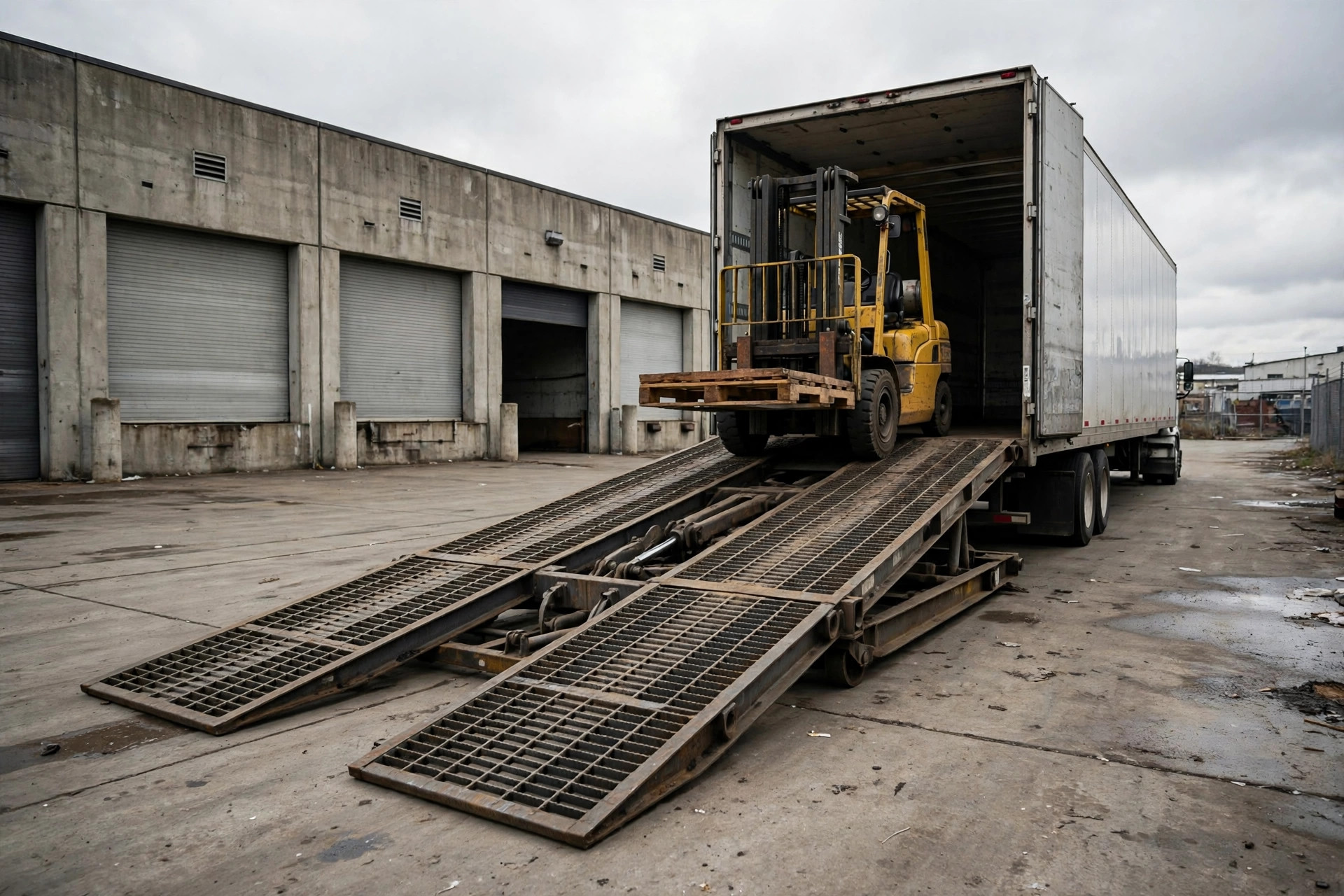
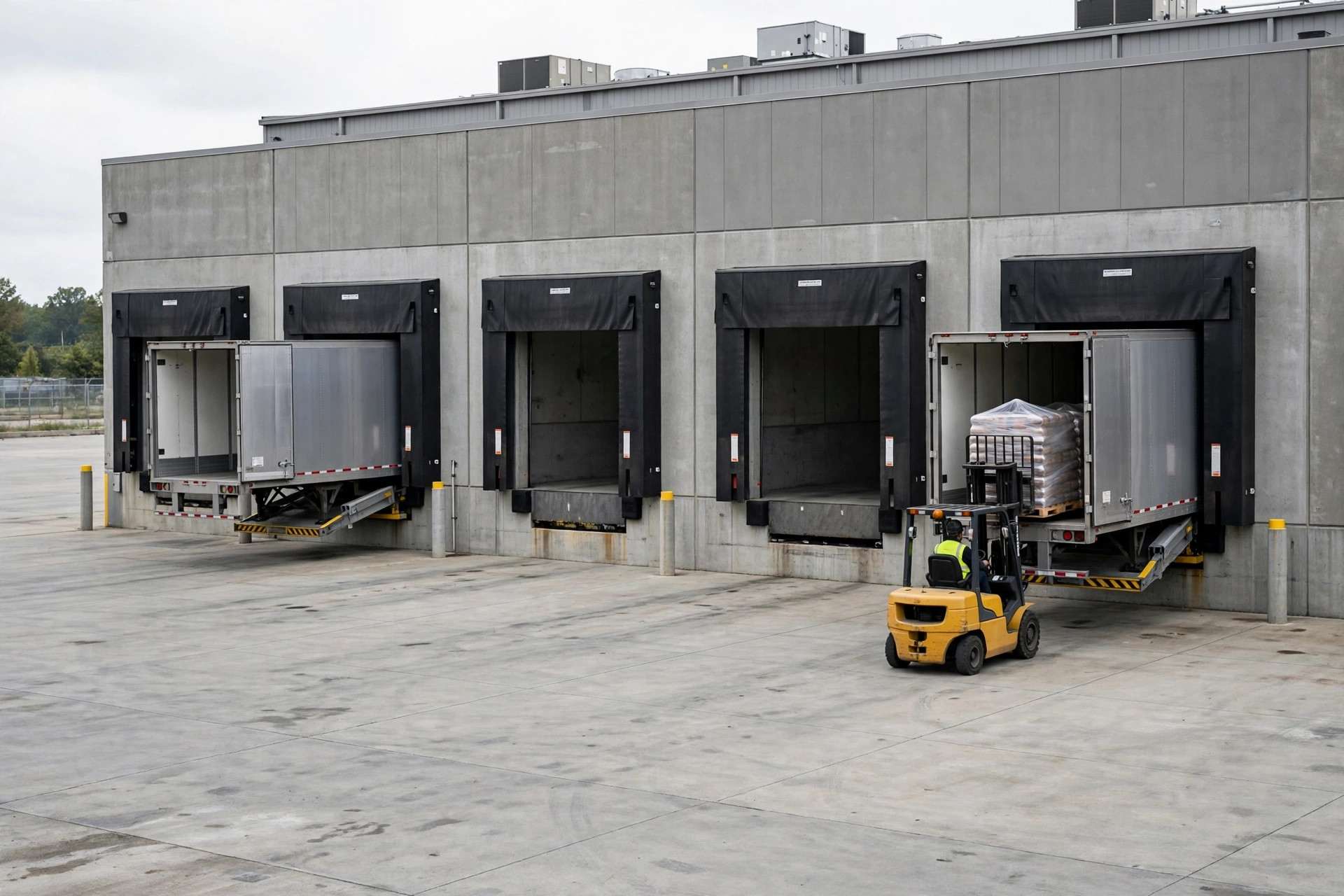
Fall of 2023, I'm sitting in my cab outside a flat warehouse near Fontana, waiting on a load. Calling it a warehouse is generous — it's basically a big box with the floor at parking-lot level, not a single dock door in sight. The dispatcher leans out and says, "Driver, hang tight, the mobile yard ramp's on its way." Ten minutes later a flatbed rolls up hauling thirty-some feet of steel frame, backs it against my trailer, and a forklift starts marching pallets straight up into the box. Let me tell you — in all my years on the road, I've seen plenty of dockless yards, but that day I finally did the math: that steel ramp was doing the job of a twenty-to-thirty-thousand-dollar concrete dock.
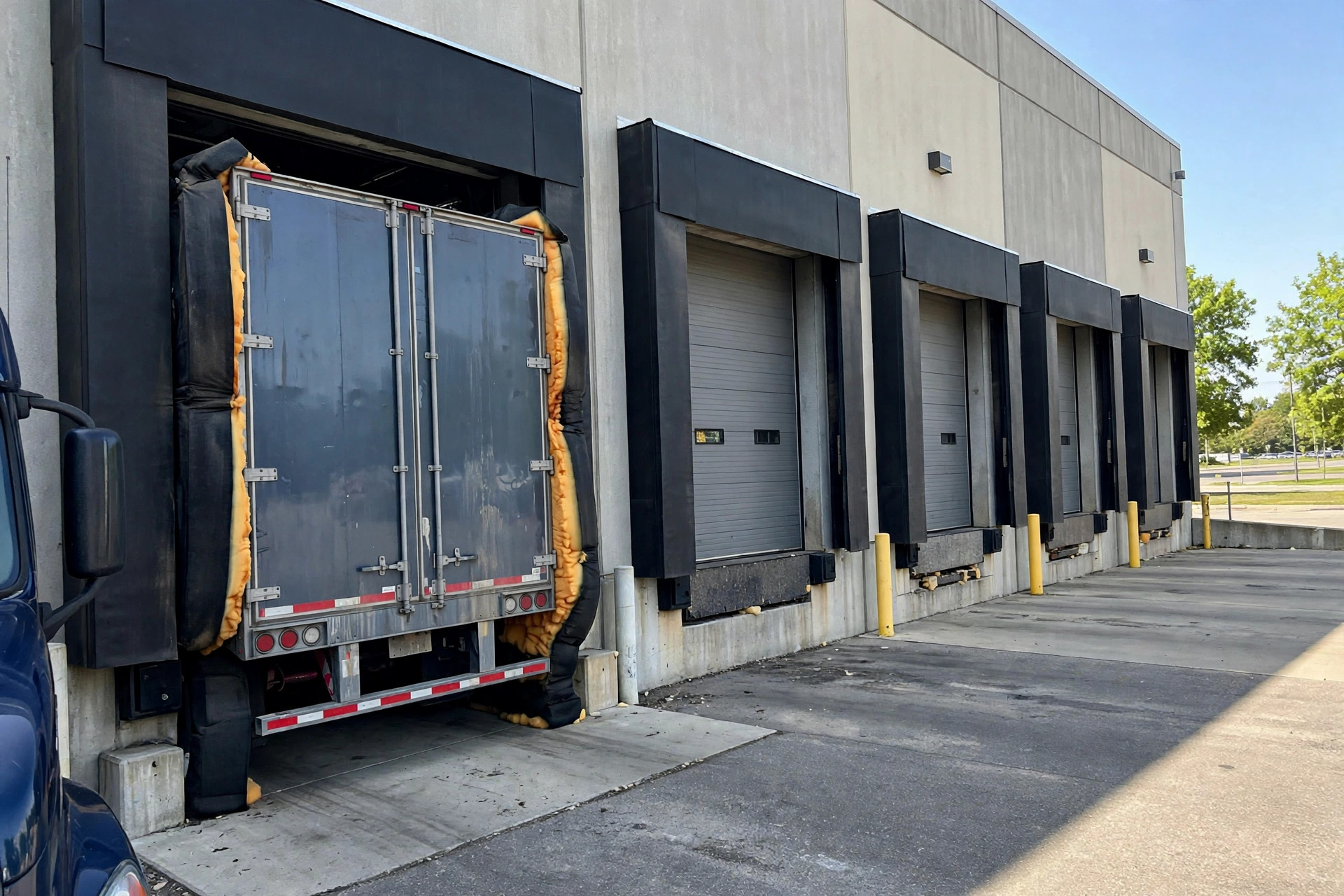
Here's the thing: no dock doors doesn't mean no full truckloads. Plenty of shippers lease cheap ground-level space, or grab temporary overflow space for peak season, and their first thought is "we're screwed on truckloads." You're not. There are two ways to bridge that four-foot gap between the ground and a trailer floor: pour a concrete dock, or get yourself a mobile yard ramp. Today I'm going to walk through both, with the numbers, so nobody burns money they didn't have to.
What a Mobile Yard Ramp Actually Is
Strip away the sales brochures and it's a towable steel ramp. One end sits on the trailer floor, the other on the ground, and the forklift drives straight up into the trailer. Standard lengths run thirty to thirty-six feet, six to eight feet wide, with a serrated steel grating deck that grips even in the rain. Rated capacities run 16,000 to 30,000 pounds — the rule of thumb is the ramp should be rated at least double your forklift's weight plus the load, with margin to spare.
The thirty-six-footers usually have a six-foot level-off section at the top, so the forklift levels out before rolling into the trailer. Height adjusts to match a standard dry van floor, around forty-eight to fifty-two inches. No foundation, no permits, no construction crew — it shows up, the legs go down, and you're loading the same day. Move sites? Tow it away or sell it. Steel holds its value.
The Money: Mobile Yard Ramp vs. Concrete Dock, Side by Side
Forget the pitch decks. Here's how the money actually breaks down.
| Yard ramp (buy new) | Yard ramp (rent) | Concrete dock | |
|---|---|---|---|
| Upfront | $11k–$20k+ | ~$1,000/month | $25k–$45k+ |
| Lead time | Loading the same day it arrives | Same day | Weeks, plus permits |
| You move | Tow it or sell it | Hand it back | You just renovated your landlord's property |
| Upkeep | Touch-up paint, tighten bolts | The rental company's problem | Cracking, settling — expensive and shuts you down |
| Best for | Long-term use, changing sites | Peak season, temporary sites | Your own land, high volume, long horizon |
New steel ramps run eleven to fifteen grand for the standard brands, over twenty for the heavy-duty ones; decent used units go for six to ten. On the concrete side, precast runs around twenty-five thousand, poured-in-place pushes forty-five — and that doesn't count excavation, rebar, and drainage. So for the same four feet of elevation: one option works the day it shows up, the other takes a month; one moves with you, the other stays with the landlord.
The Grade Thing: What the Regs Say vs. What Drivers Know
This is the most important section in this whole piece. Every forklift operator, read it twice.
OSHA's rule is clear: no ramp steeper than one vertical to three horizontal — twenty degrees. That's the hard legal ceiling. But let me tell you, that's the "won't get you fined" line, not the "safe" line. Twenty degrees with a loaded forklift and the driver's knuckles are white. One poorly stacked pallet and you're in trouble.
What do working crews actually use? The equipment makers' guidance: keep it under ten degrees, roughly a ten percent grade. A thirty-foot ramp climbing forty-eight inches of trailer height lands right in that zone — which is exactly why standard ramps come in thirty and thirty-six feet. It's physics, not laziness. Never buy a shorter ramp to save yard space. The space you save won't cover one accident.
Two more red lines, paid for in blood. First: the ground under the ramp has to be hard. Soft ground settles, one end of the ramp drops, and the forklift goes up crooked — nobody can save that. Walk the ground before you set up; if it's dirt, compact it and lay steel plates. Second: freezing rain and heavy storms mean stop. Grating grips fine in rain, but a sheet of ice turns it into a skating rink. No load is worth a life.
Rent or Buy? Three Numbers Decide
Drivers like me don't decide on vibes. Three numbers:
One: trucks per day. One or two a day, busy only in peak season — rent. A thousand a month, three grand for a whole peak season, hand it back clean. Fifteen, twenty trucks a day, every day — buy one. It pays for itself in under a year and everything after is gravy.
Two: how many more years at this site. Leased space with eighteen months left on the contract? Do not pour concrete. I watched a small 3PL in Dallas pour a twenty-five-thousand-dollar concrete ramp, then the landlord jacked the rent the next year. They moved. The ramp stayed. Brutal. Own the land and planning to run it for a decade? Concrete is the one-and-done answer.
Three: whose dirt is it. Rented ground means the mobile ramp is the only choice that doesn't lose money — you can tow it, or sell it. That outdoor-furniture shipper in Fontana back in 2023 leased a ground-level box for three peak months, ran six or seven full truckloads a day off a rented ramp, spent about three grand, and handed it back when the season ended. Clean math. If he'd poured concrete on a gut feeling, that twenty-plus grand would have been a gift to his landlord.
Before You Buy, Look at These
Decided to buy? Don't rush the order. Checking a ramp is like checking a used truck — a few looks tell you everything. First, guardrails on both sides, solid, not wobbly — walk away from anything loose. Second, the legs: hydraulic saves your back, hand-crank saves your wallet. Third, the tires: solid tires take abuse, pneumatics tow easier; rough yard, go solid. Fourth, the lip that meets the trailer floor has to sit flush — a gap means every forklift wheel thumps over it and the load shifts. And ask about warranty and a trial — a seller who won't let you try it is hiding something.
Rain and Ice: The Two Things That Scare Me
Last word on weather. A yard ramp works outdoors, so you watch the sky.
In rainy season the fear isn't the deck slipping — grating handles rain fine. The fear is the ground going soft underneath. Waterlogged dirt is killer number one, like I said. Before a big storm, move the ramp to high, hard ground and throw steel plates under the feet to spread the load. Old-driver basics.
Freezing rain and snow are simpler: stop. Don't gamble. In all my years, the worst one I saw was at a yard in Oklahoma — driver rushing a load, thin ice on the ramp, forklift with a full pallet slid sideways. Pallets everywhere. The man walked away, which was pure luck. My rule since: ice on the ramp, the truck waits. No shipment is bigger than a life.
One more: check the guardrails and wheel chocks before every use. Loose rail, missing chock — don't run it that day. Safety gear looks like overkill right up until the day it's the only thing between you and disaster.
That's the whole story in one line. There's an old saying where I come from: it's not food or clothes that make you poor, it's never doing the math. A dockless site isn't scary. What's scary is signing off without running the numbers. Lay out the three — trucks per day, years at the site, whose land — and the answer writes itself. Next time you see a steel ramp leaning against a trailer on the road, you'll know: that shipper did their homework.
By Shifu Zhao, Trucking Veteran (15 yrs)