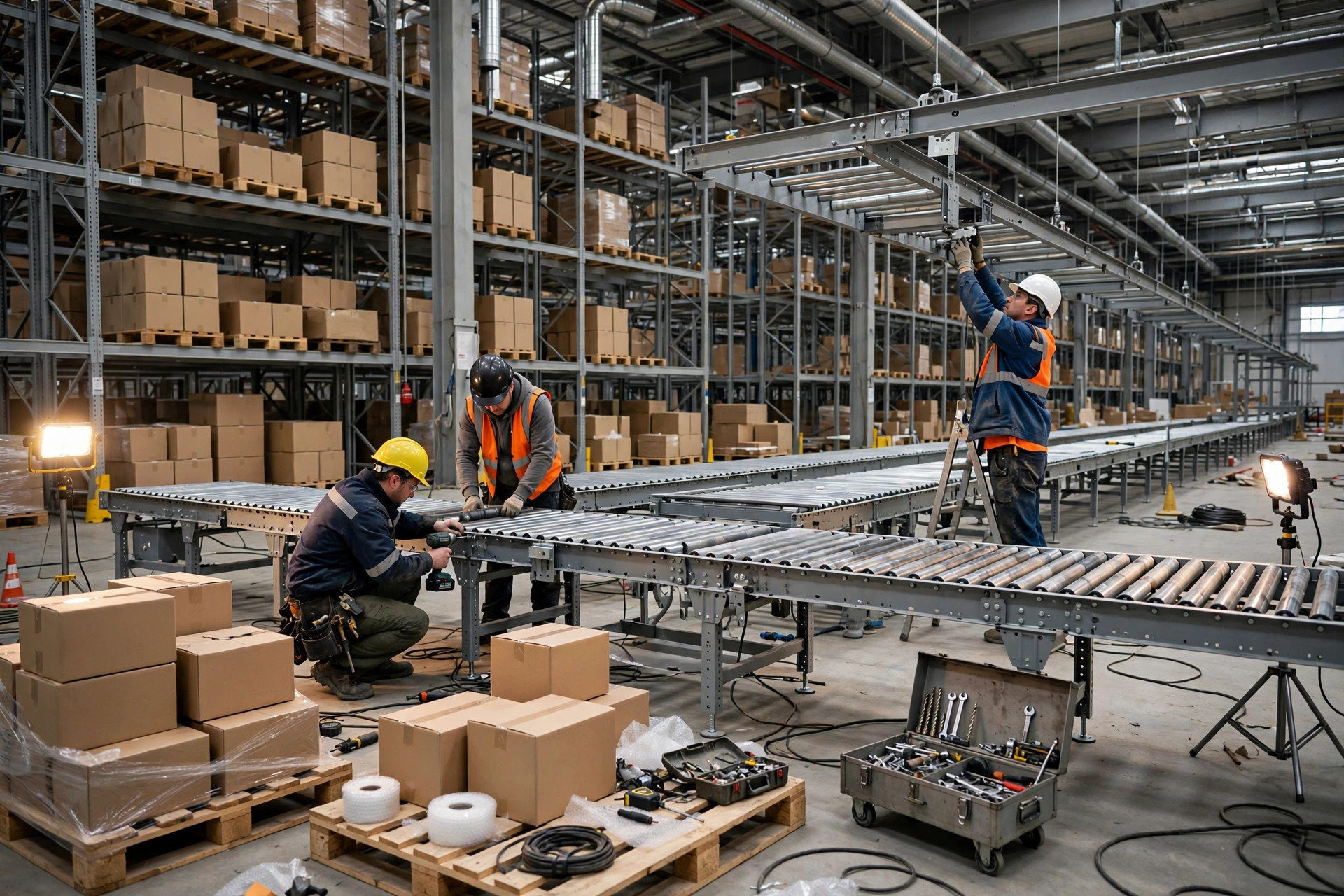
Last year I walked into a transload warehouse in Rancho Cucamonga and watched four guys unload a floor-loaded 40-foot container. Box by box, hand to hand. Nearly four hours before they saw the floor. The owner told me, "After one container, their arms are shot for the next day." I asked how many trailers a day. Six to eight in peak season, he said. That's when I told him his labor math needed a rewrite.
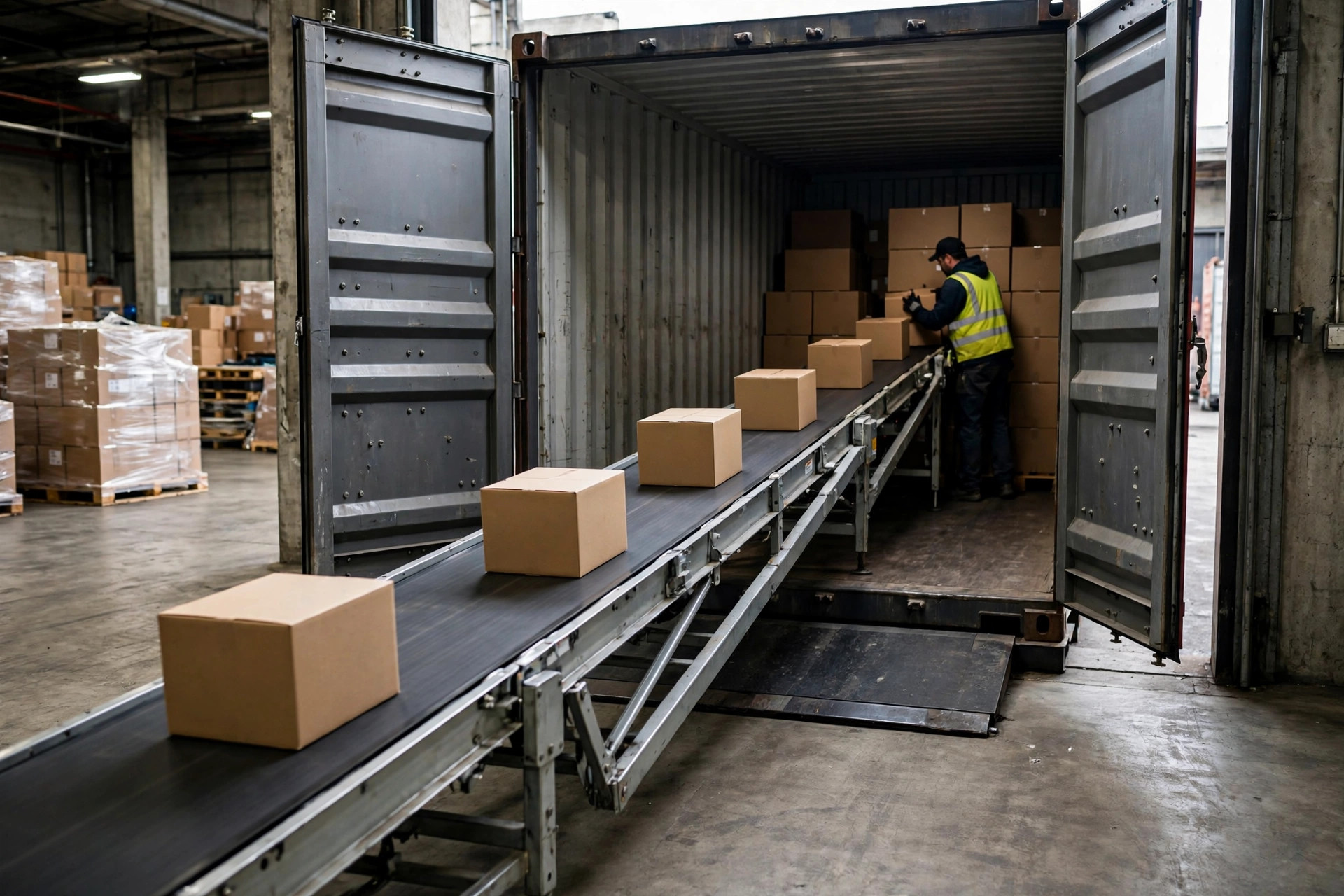
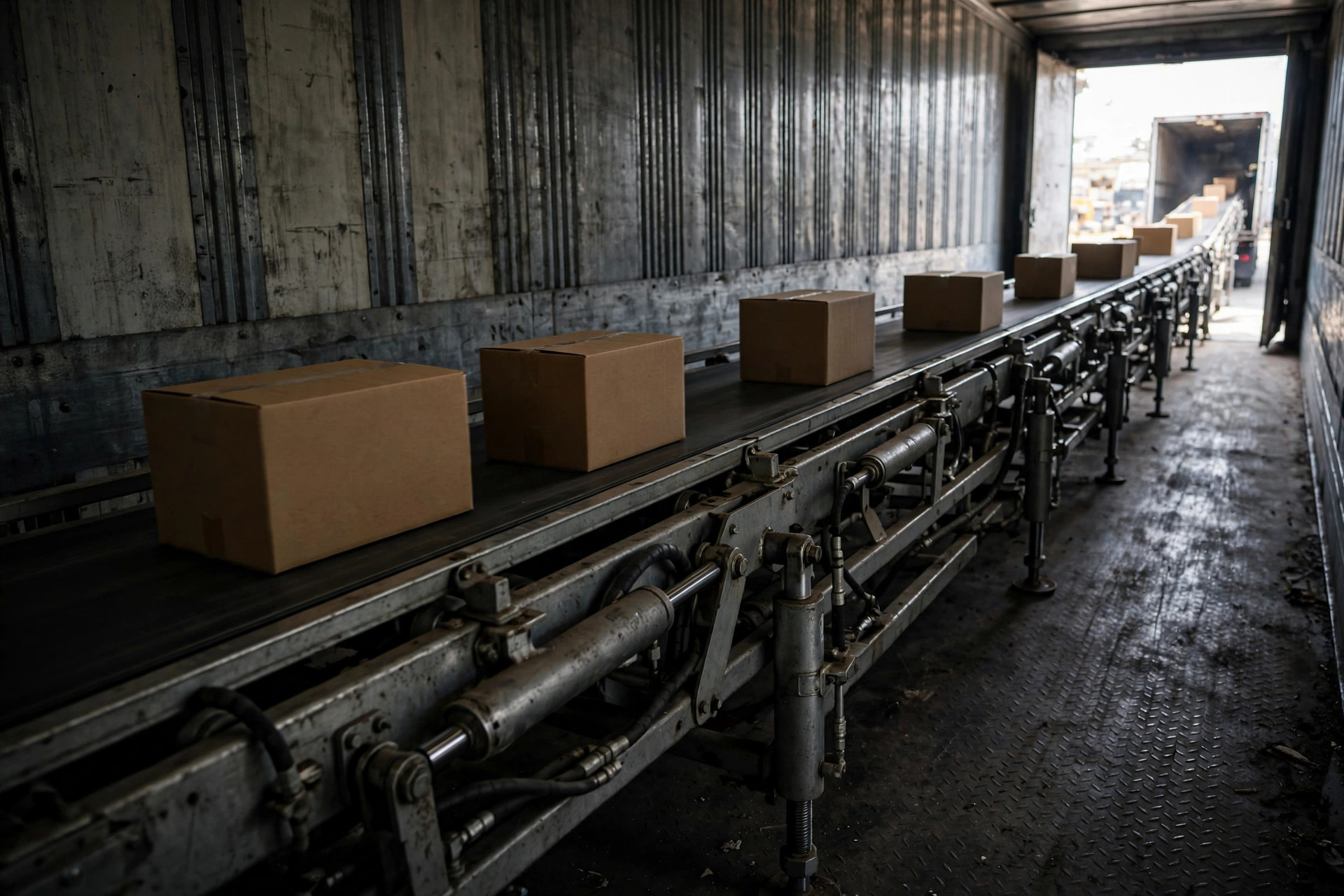
A telescopic belt conveyor is not complicated: a belt conveyor that extends and retracts in sections. The boom reaches deep into the container or trailer, cartons ride the belt out, and people only handle boxes at the two ends. Loading works the same way in reverse. In one sentence — it turns "people walking into the trailer to carry freight" into "freight walking itself out."
Where the money actually goes
A telescopic conveyor long enough to reach into a 40-foot container runs roughly $20,000 to $40,000 in the US, installed (check current manufacturer quotes — the spread between budget and European lines is easily 2x). Installation itself is simple: power, leveling, anchoring, half a day.
Ongoing costs come in three buckets. Electricity: motors run 3 to 7.5 kW, eight hours a day is a rounding error on the power bill. Wear parts: a belt resurfacing once a year, a few hundred to a little over a thousand dollars. The hydraulic telescoping mechanism: seals and hoses age out, budget a few hundred dollars a year amortized. All in, annual maintenance rarely exceeds 5% of the equipment price.
The real comparison is labor. A floor-loaded 40-footer — call it 2,000 cartons — takes 4 people 3.5 to 4 hours by hand. With a telescopic conveyor, 2 people finish in 1 to 1.5 hours. California warehouse floor labor runs $20–25 an hour base; loaded with insurance and benefits, figure $30. Six trailers a day in peak season: the manual approach burns about $2,880 a day (4 people × 4 hours × 6 trailers × $30); the conveyor approach about $900 (2 × 1.5 × 6 × $30). That's nearly $2,000 a day saved. Over a three-month peak, the equipment pays for itself.
Off-peak? Two trailers a day saves $600+ daily. Across 250 working days, that's over $150,000 a year in labor. Against a $30,000 machine, payback lands around five months. I've run this math for three warehouses and it comes out the same every time: if you handle more than 3 floor-loaded trailers a day, buy it without hesitation; under 2 a day, hold off.
Who should buy one — and who shouldn't
Good fits first. Floor-loaded carton operations: e-commerce returns warehouses, transload and deconsolidation sites, import devanning operations. Cartons in the 20–70 lb range — that's the telescopic conveyor's home turf. Congested docks: every hour faster per trailer is an hour of dock turnover recovered, and your yard operation feels it too. Tight labor markets: in the Inland Empire, peak-season temp hiring gets harder every year. Equipment doesn't call in sick and doesn't get injured.
Now the don'ts. Palletized freight operations: full pallets move by forklift, a belt conveyor adds nothing — it would just sit there. Oversized or heavy pieces: anything over ~110 lbs strains both the belt and the people staging it; stick with forklifts or cranes. Sites with hard physical constraints: steep dock grades, no nearby power, low canopies that block the boom from extending straight — fix those first.
One use case people overlook: loading, not just unloading. Most warehouses only think about inbound, but outbound gains are just as real. Reverse the belt into an empty trailer, one person stages cartons inside, no more walking back and forth. I know a 3PL that bought a unit specifically for loading — their peak-season on-time shipment rate jumped two points.
How to run it, and the selection checklist
The equipment only delivers if the process keeps up. The standard two-person flow: trailer spotted and docked, one person wheels the conveyor to the tail, powers up, and extends the boom to the nose; one person inside the trailer feeds cartons from the stack onto the belt; one person on the dock receives and pallets. As each layer clears, retract one boom section and continue. A practiced pair clears a 2,000-carton 40-footer in 70–80 minutes.
Two scheduling details matter. Rotate the person inside the trailer hourly — feeding the belt is the most fatiguing job, and tired people slow down faster than you'd expect while injury risk climbs. And don't max out the belt speed on day one. Find the pair's rhythm first, then dial up 10–20%. The dumbest thing I've seen: belt at full speed, people can't keep up, cartons jam, and you stop the line to unclog it.
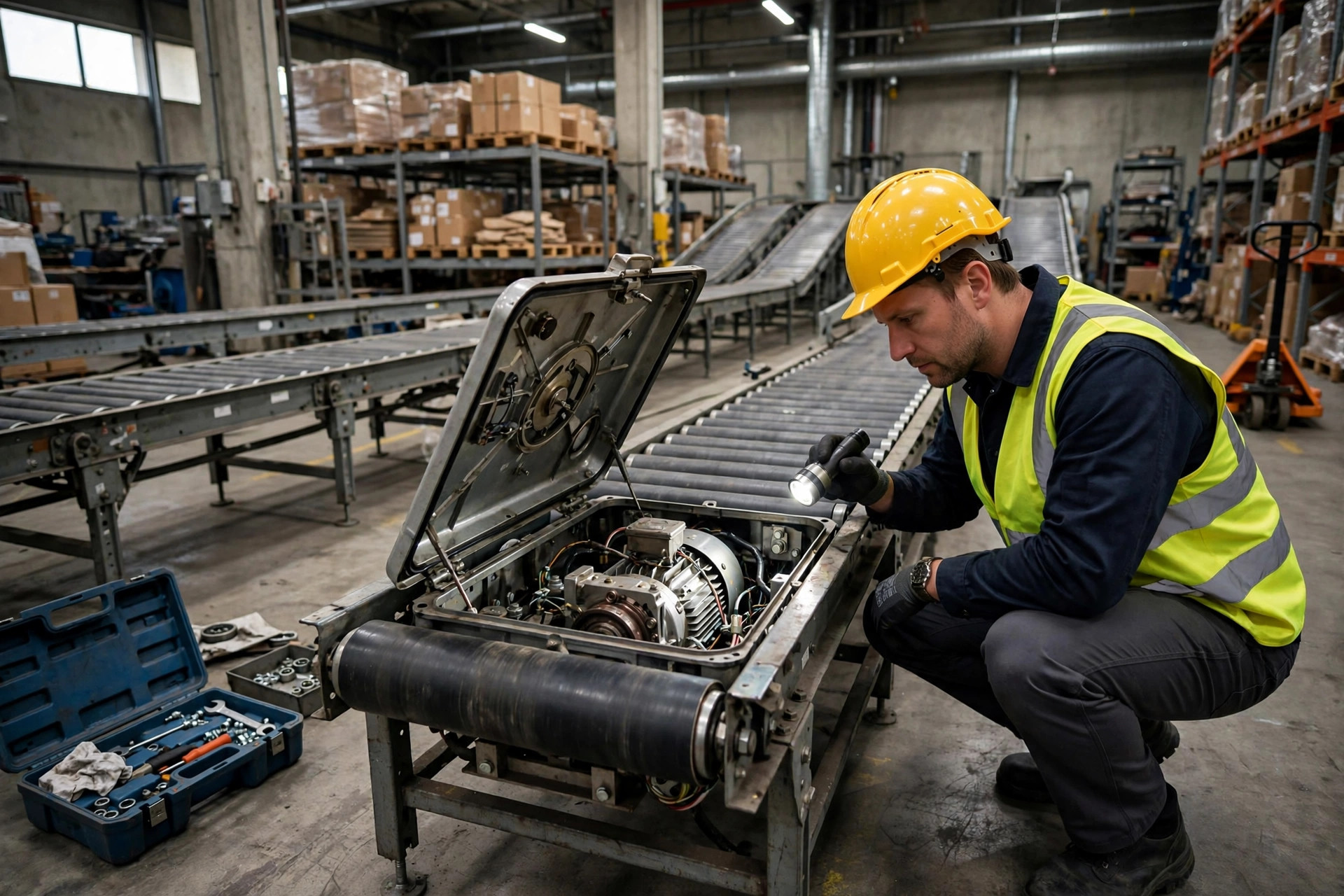
Daily inspection should live on a laminated card zip-tied to the machine: belt tracking, e-stop function, hydraulic oil level before startup; blow out dust under the belt weekly (carton dust jams rollers silently); check telescoping chain tension monthly. Do that and the machine runs 8–10 years.
How does it stack against the alternatives? Pure manual: zero capex, slowest, most injuries — right for 1–2 trailers a day. Fixed belt conveyor: half the price, but it only covers dock-to-sortation; the trailer interior stays manual — right when the dock is far from the sort area. Telescopic: the expensive one, but it eats the most labor-intensive segment — inside the trailer. Above that sit boom conveyors with auto-palletizing, and those only make sense past 20 trailers a day. Mid-size warehouses shouldn't even look; it'll tempt you, and you'll regret the invoice.
Selection comes down to five specs. Length: 40-foot reach for a 40' container, 50-foot for a 53' trailer — buy short and the boom never reaches the nose, which defeats the purpose. Belt width: 24 inches is the universal choice, 32 for big cartons; wider means heavier and harder to move. Capacity: size to your heaviest carton class plus 30% margin. Height adjustment: standard dock height is 4 feet, but older buildings run 3.5 — the boom pitch must adjust. Mobility: casters for shared dock positions, fixed base for a dedicated door.
Three pitfalls, all paid for in real money. First, power location. These machines want 480V three-phase (verify against the nameplate). Plenty of docks only have 120V outlets nearby; running temporary cable is expensive and usually non-compliant. Have an electrician look before you order. Second, floor flatness. A fully extended 40-foot boom magnifies every dip in the dock floor; the boom head wobbles and the hydraulics take the beating. Level the floor first. Third, used units and hydraulics. The used market is 40% cheaper, but the telescoping hydraulic mechanism is the heart of the machine — cycle the boom full-extend to full-retract three times during inspection, listen for noise, watch for smooth travel. Skip this and the repair bill can exceed a new unit. Fourth, don't cheap out on belts. An OEM belt runs $1,000+; a no-name is $600–700 but tracks poorly and slips constantly. Thirty minutes of re-tracking here and there, and the wasted labor eats the savings within a year. On a consumable that runs all day, buy OEM or a major aftermarket brand.
The annual maintenance ledger: belt resurfacing $800–1,200; hydraulic oil and seals $300–500; roller bearings and chains $200–400; plus an electrician visit twice a year. Total: $1,500–2,500 a year. Against $150,000+ in annual labor savings, that's a rounding error.
Here's what I'd do tomorrow if I were you: skip the purchase order for now. Take a stopwatch to the dock for one full day. Log headcount, duration, and carton count per trailer, and compute your true cost per trailer. Multiply by annual trailer volume. That number is what a telescopic conveyor saves you each year. Put it on paper, and the buy-or-not decision makes itself.