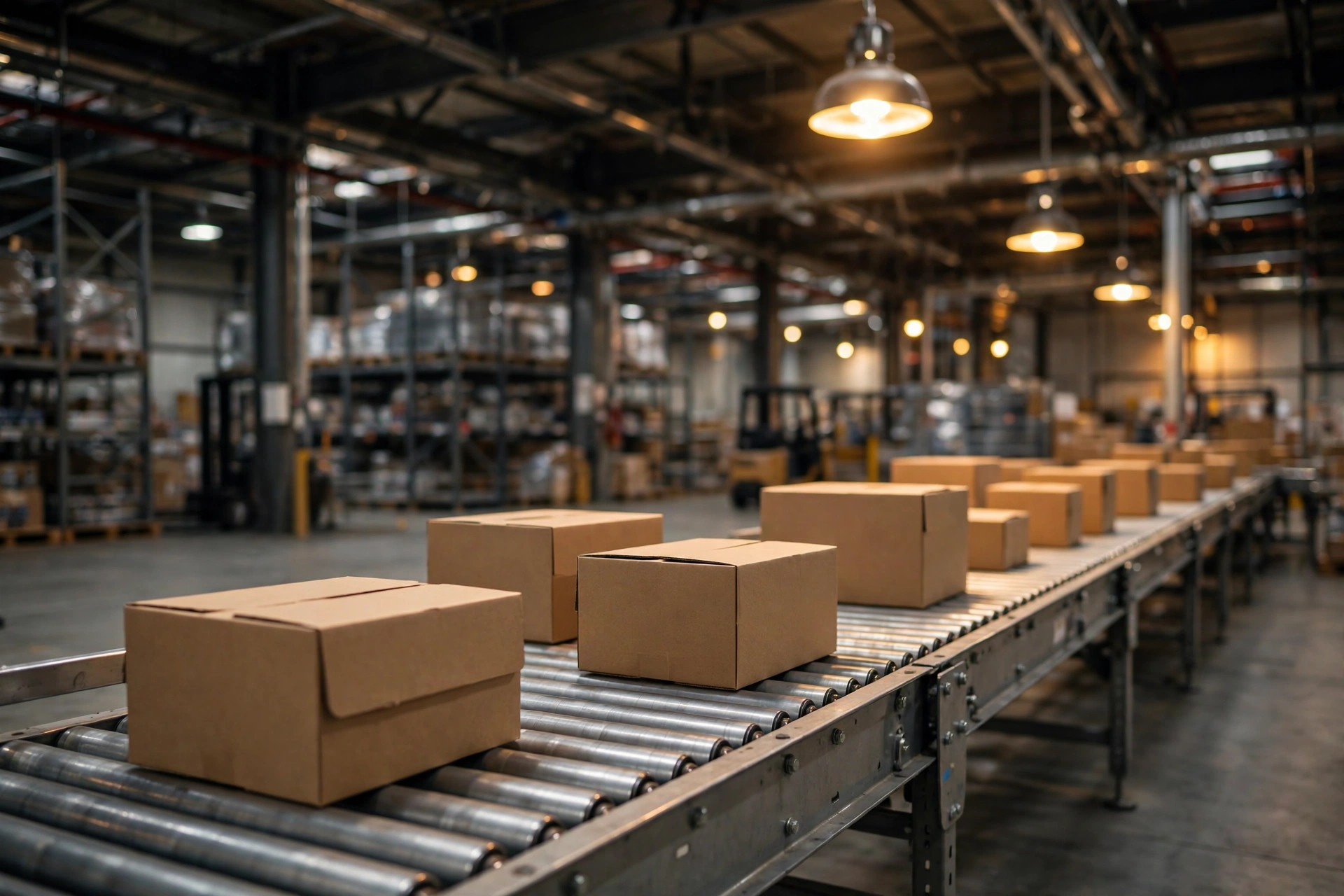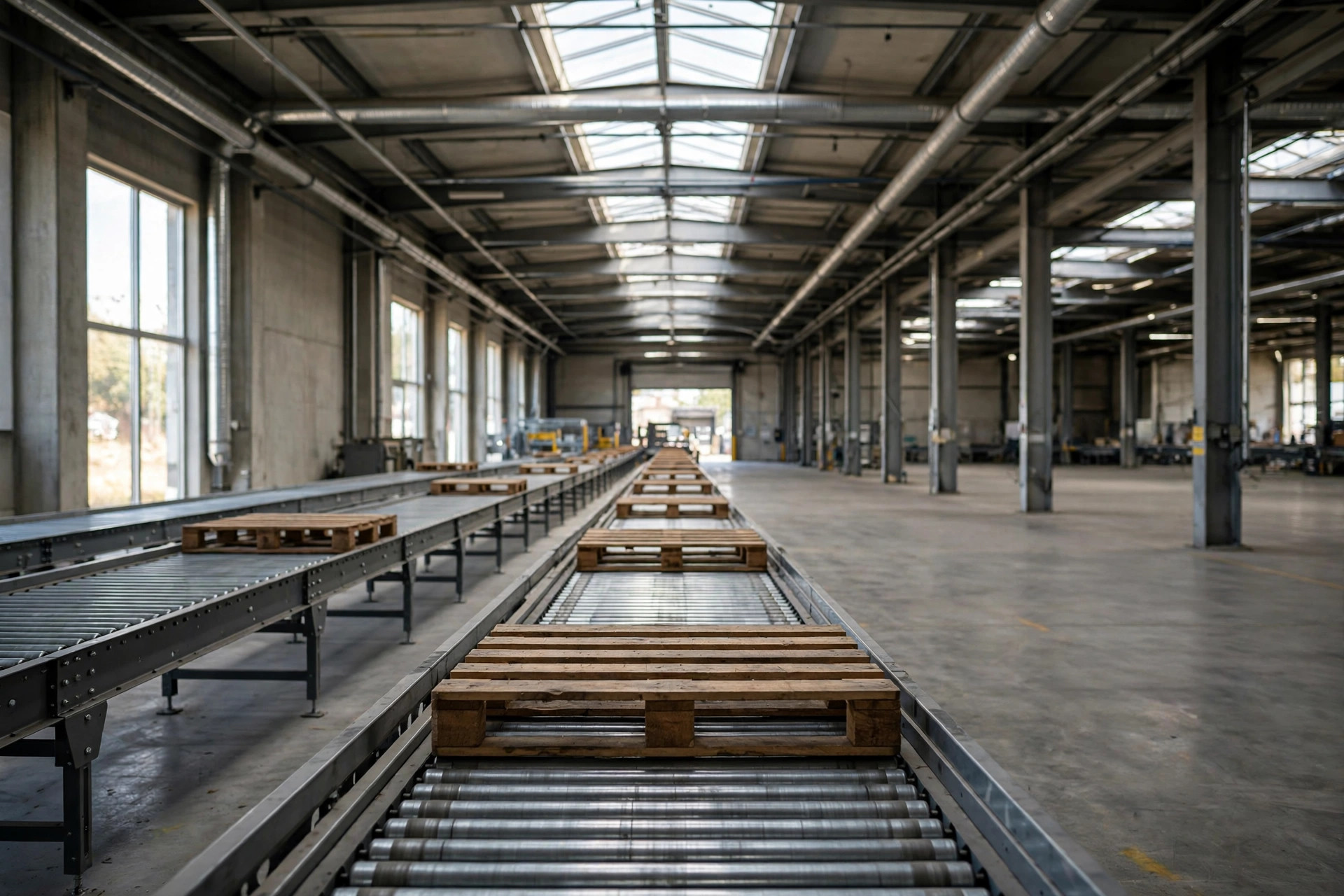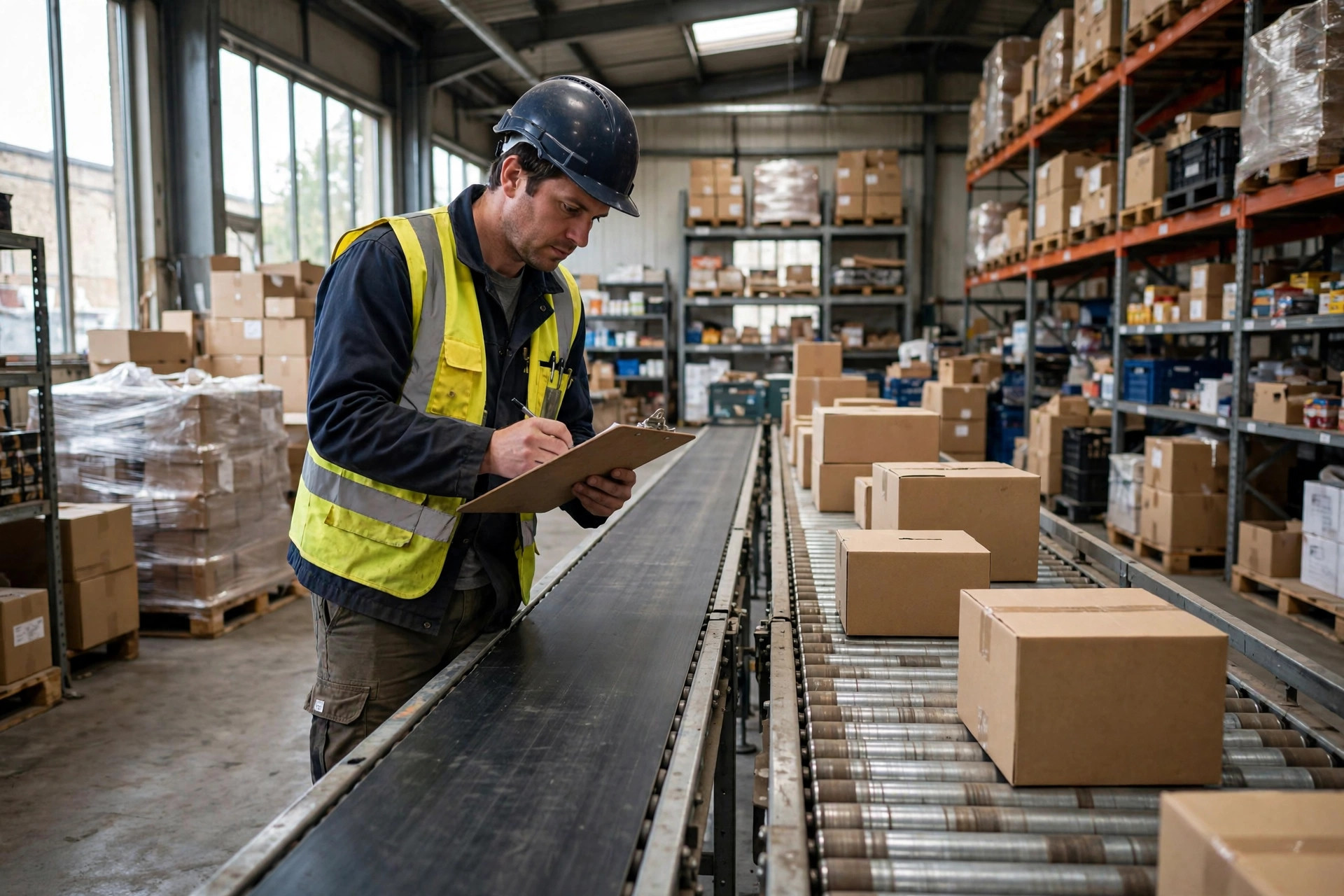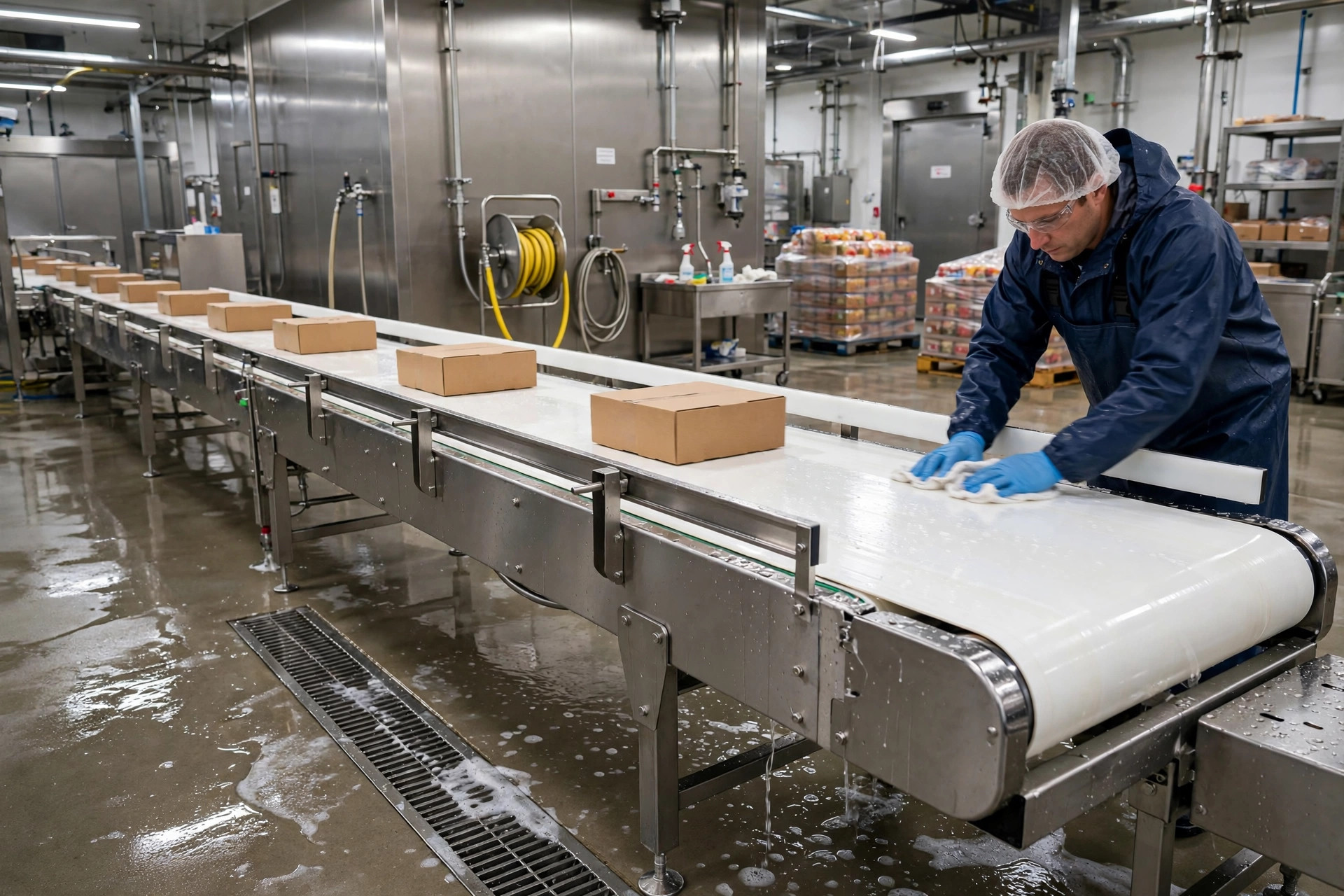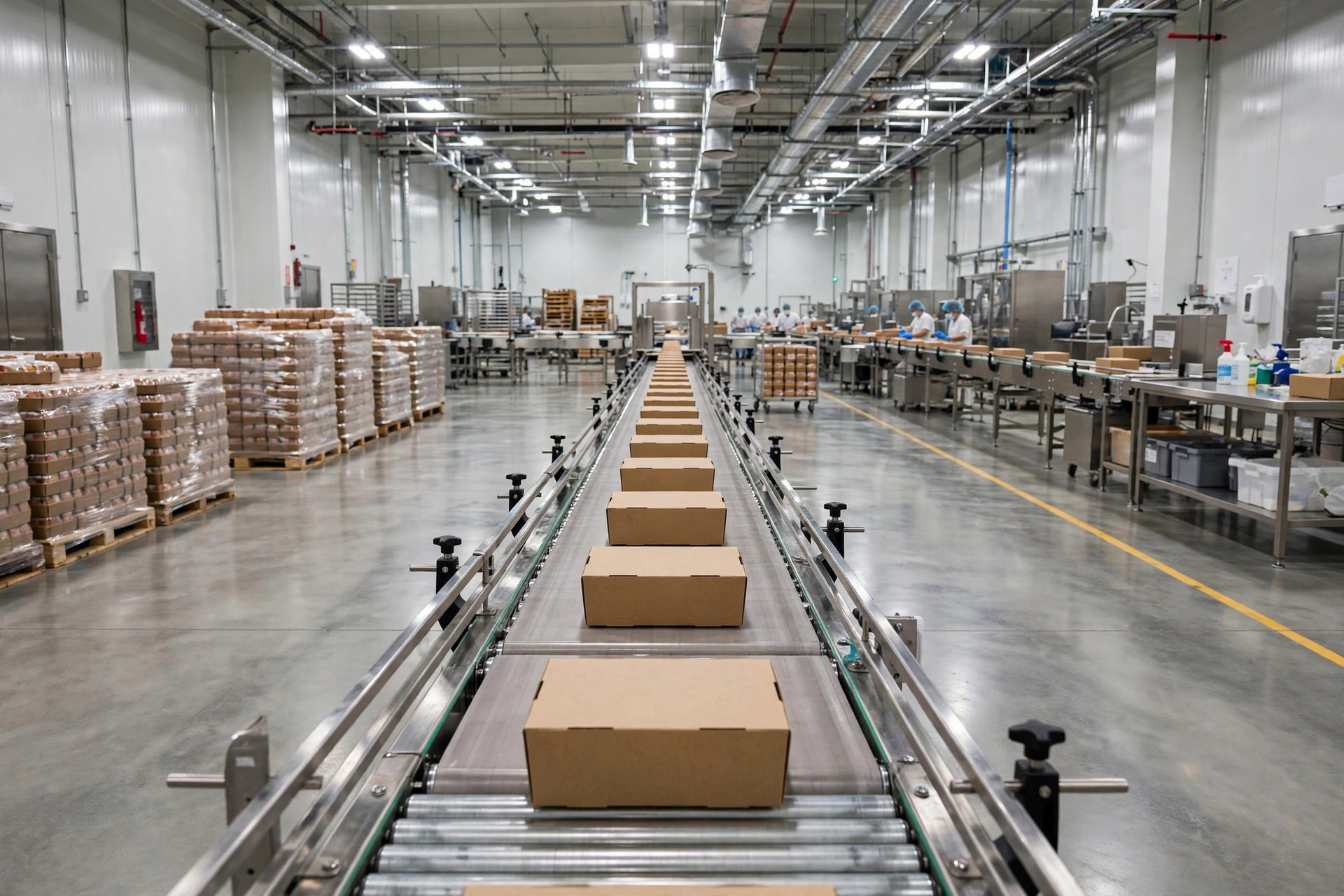
Another Amazon rule change. In Q2 2025 I toured two food 3PLs in San Bernardino and the modular belt conveyor vs flat belt gap hit me the second I walked in.
Miss your FBA replenishment window by a day and you're out of stock for two weeks — and the ad spend to climb back up the rankings costs more than renting a small warehouse. That's why, for the past two years, my first filter when choosing a 3PL for food has not been the rate card. It's the conveyor line.
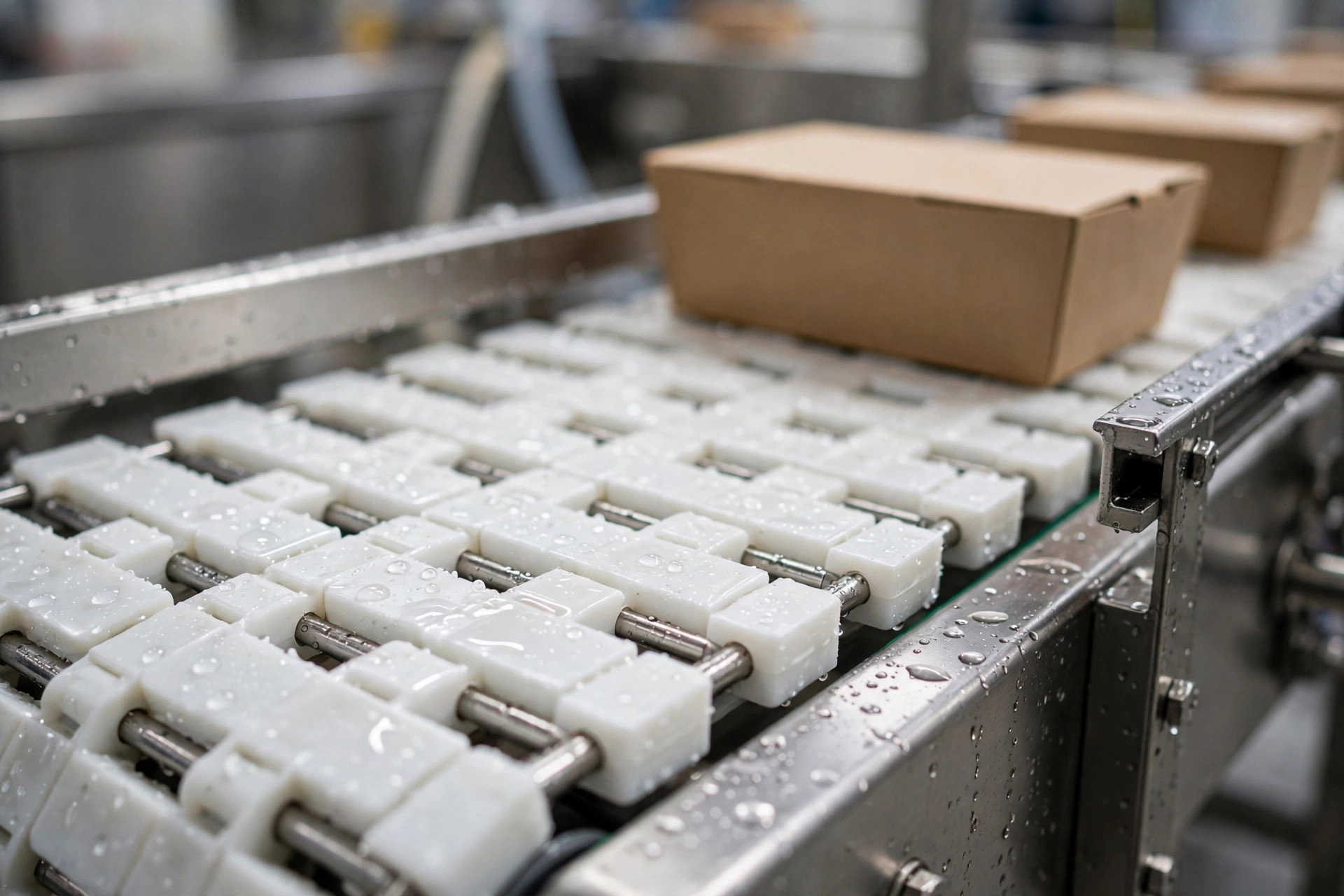
One ran white modular plastic belt, washed down clean, not a trace of residue in the mesh. The other ran old-school flat belts, edges fraying, a black ring of grime around the splice. The owner shrugged: "Doesn't affect shipping." Sure, buddy — if you're shipping screws. I sell food. Belt hygiene is my damage rate and my return rate.
They aren't the same machine — here's the 30-second version
For non-engineers:
- Modular belt: interlocking plastic modules strung together on hinge rods, like LEGO bricks. When a few modules break, you pull the rod and swap just those modules — the rest of the belt stays on the conveyor.
- Flat belt: one continuous rubber or PVC band looped over rollers. When it fails, you either replace the whole belt or vulcanize a splice — both jobs for a specialist.
Most sellers touring a 3PL look at square footage and rack neatness. Wrong call. In a food warehouse, the conveyor is the single piece of equipment that touches every unit you ship. That's where you look.
modular belt conveyor vs flat belt: the three-cost breakdown
1. Washdown
Food-warehouse conveyors get washed — daily, sometimes multiple times a day; FDA and USDA don't negotiate on food-contact surfaces.
The modular belt's open mesh drains water and cleaning agents straight through. The flat belt is a solid sheet — water only wicks off the sides, and the splice and the edges become gunk magnets. That black ring I saw at the flat-belt 3PL? That's years of buildup, and you can't scrub it out of a splice with a brush.
But don't jump to conclusions — there's a catch, below.
2. Maintenance and downtime
In 2023, I worked with a prep center east of Los Angeles doing snack repacking. Their flat belt tore mid-section. Result: a full day of downtime waiting for the vendor's tech to come vulcanize a splice. My shipment missed its FBA window by that one day. Two weeks out of stock, rankings tanked, and my ACoS went from 28% to 41% while I burned ad dollars to climb back.
Ever since, my first warehouse question is: "When the belt breaks, who fixes it, and how fast?"
This is where modular belt shines. Damaged modules get pulled and replaced in-house — the spare parts are a handful of plastic modules, not a service call. A flat-belt failure is measured in days of downtime; a modular-belt failure is measured in hours. That one day was the whole story of modular belt conveyor vs flat belt for me: repair time measured in hours versus days. Sellers shouldn't fear repair bills. We should fear downtime. An out-of-stock week costs an order of magnitude more than any belt repair.
3. Total cost
| Modular belt | Flat belt | |
|---|---|---|
| Upfront purchase | Higher | Lower — the traditional cheap option |
| Washdown labor | Lower — hose it down | Higher — splices and edges need hand detail |
| Repair | Cheap — swap a few modules in-house | Expensive — vulcanizing or full replacement, vendor visit |
| Downtime loss | Small — back up in hours | Big — a day or more per failure |
See it? The premium you pay upfront mostly pays itself back downstream. As any cost analyst will tell you: quoting the purchase price alone is a shell game — total cost of ownership is what counts. With conveyors, the real money is always in the downtime.
The counterintuitive part: modular belts have seams too
Here's the catch.
Modular belts are great, but they have an inherent flaw: hundreds of hinge joints. Visibly clean does not mean microbiologically clean. Sauce and grease work their way into hinge crevices where a pressure washer can't reach — you have to pull modules apart and scrub.
So here's the real insight: if your SKUs are ready-to-eat, or you mix allergens (nuts, dairy, gluten) and change products constantly, be skeptical of modular belt. For high-care zones, the industry standard is a homogeneous belt — one solid sheet of food-grade plastic, no layers, no hinge seams, wipe it down and you're done.
Read between the lines: when vetting a 3PL, a more important question than "which belt do you run?" is "what's your allergen changeover SOP, and can I see the sanitation verification records?" If they can't answer, walk away. If my sauce SKUs and my nut SKUs share a line, the FDA audits the warehouse — but my brand pays for it.
The three questions to ask any 3PL
- When the belt breaks, who fixes it and how fast? Ask to see the spares — spare modules for a modular belt, a spare belt for a flat belt. "We call the vendor" means you're dead in peak season.
- Who washes the belts, and how often? Ask for the washdown log. "We wash when it looks dirty" means it never gets washed.
- How do you switch allergen SKUs? Ask for the SOP and verification records. Hesitation here means your products share a line with allergens and you don't even know it.
My current 3PL — signed in Q2 2025 — actually had a belt failure in peak season. A deformed carton jammed and snapped hinge rods on three modules. Discovered at noon; spare modules swapped in that afternoon; the line ran that evening. No shipment missed, no FBA window lost.
Don't pick a 3PL off the rate card. Walk the floor, look at the conveyors, ask those three questions, then sign. This one I tested myself — it works.
By Ah K, E-commerce Seller (5 yrs)