Last year on an auto-parts distribution project, the owner pointed at the drawings and said: let's just use pneumatic pushers for the diverts, they're the cheapest. I told him to hold on and give me three numbers first: the heaviest single item, the target rate per minute, and whether the cartons are rigid boxes or soft polybags. He paused — those three numbers are the entire admission ticket for diverter selection. If you can't report them, any choice is a gamble.
One boundary first: this is about divert mechanisms on conveyor lines, not sorter machines — cross-belt and sliding-shoe sorters are a different budget conversation. Here it's just the three workhorses that kick items off a main line into a spur.
How the Three Diverter Mechanisms Actually Work
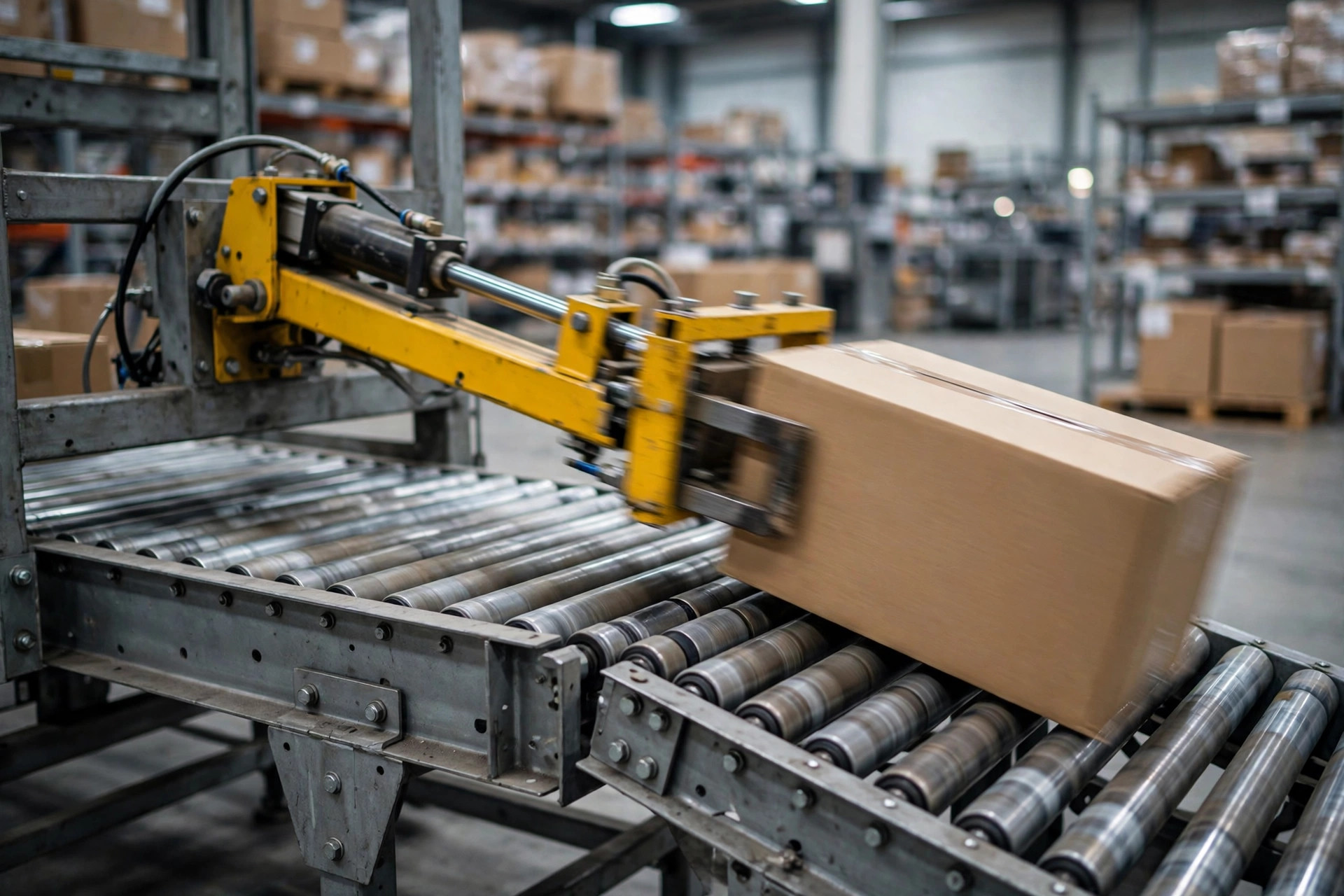
The pneumatic pusher is the bluntest of the three: an air cylinder plus a paddle that smacks the item sideways into the spur. Think of a table-tennis push shot — fast, straight, harsh, and strictly binary: extend, retract. The paddle must reach out, knock the item off, then pull back before the next item passes — the rate ceiling lives in that round trip. Per manufacturer specs, a high-speed pusher tops out around 60 items per minute with single items up to about 34 kg — that's the CASI SortMaster 130 HS class (CASI published specs). Heavy-duty pushers exist, like Fives' PARA-Push: a full divert-and-return in 2 seconds, items up to 54.4 kg, but the rate drops to 30 per minute (Fives spec sheet). Force and speed don't coexist — that's physics, not a tuning problem.
The swivel wheel takes a different approach: a full row of wheels pivots together, usually 30 or 45 degrees, and the item is carried off the line rather than hit off it. Think of a hockey puck nudged by a stick — rolling contact, gentle, and the item never stops. Diverts work in both directions. Per manufacturer samples, swivel-wheel diverters run up to about 6,000 items per hour at line speeds up to 2 m/s, handling items up to roughly 50 kg. Fully electric, no air — its biggest hidden advantage, and you'll see why in the maintenance section.
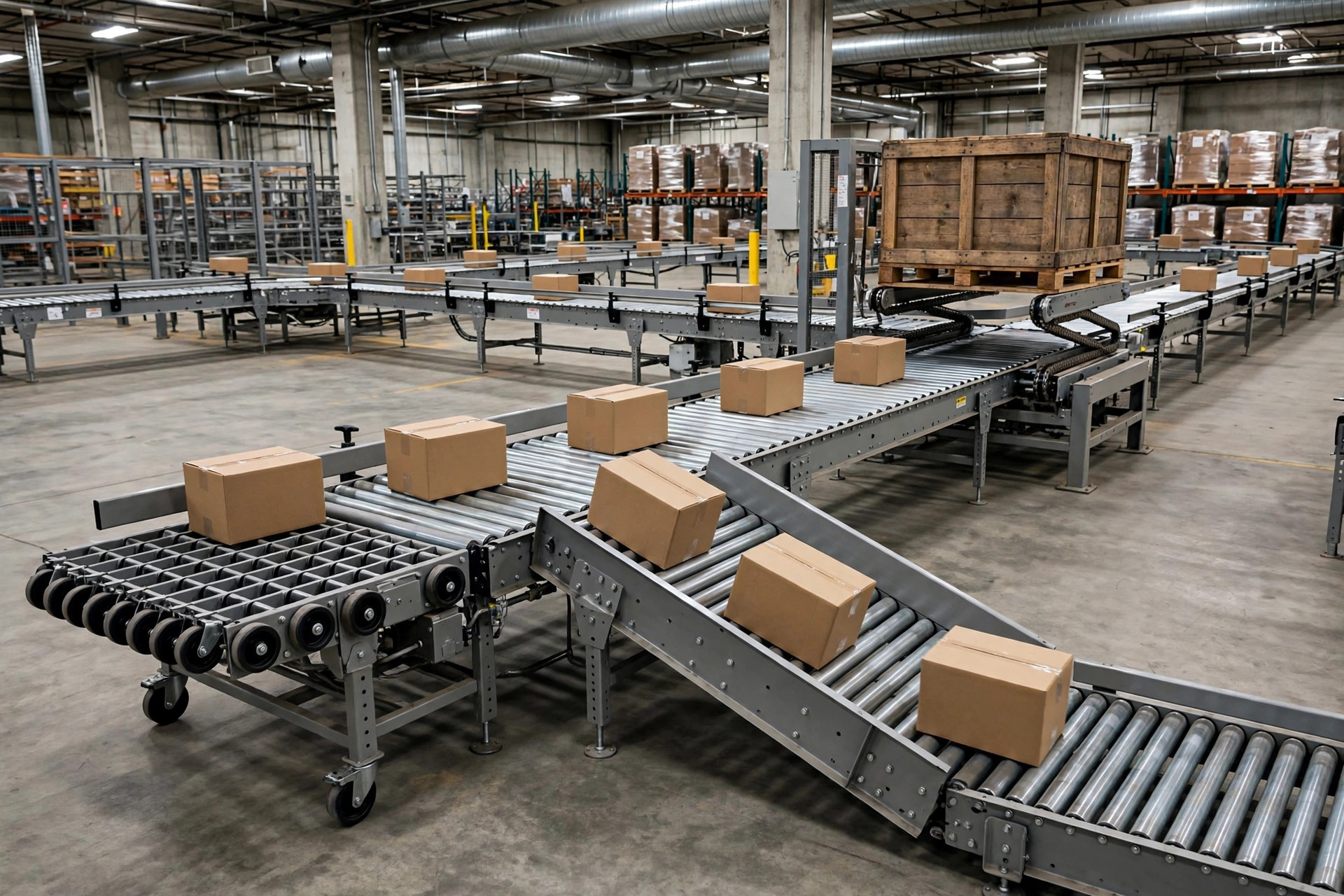
The pop-up transfer does the heavy lifting: the main line is a roller conveyor, and between the rollers hides a row of chains or wheels. On divert, they rise, lift the item off the rollers, and carry it sideways into the spur. Think of an elevator: pick the passenger up first, then deliver them to another street. Slow, but strong. LEWCO's chain transfer spec sheet lists capacity up to about 1,800 kg (4,000 lb) — this is the pallet and heavy-load machine. Most designs lift on air cylinders, so yes, it drinks air.
Diverter Selection: Three Numbers Decide
Mechanisms understood, selection becomes arithmetic. Here's the comparison:
| | Pneumatic pusher | Swivel wheel | Pop-up transfer | | Divert angle | 90°, one direction | 30°/45°, both directions | 90° | | Typical rate | 30–60 items/min | 60–100 items/min | 10–25 items/min | | Item weight | under ~35 kg | under ~50 kg | ~50 kg up to tons | | Air supply | yes (0.5–0.7 MPa) | no (electric) | mostly yes | | Kryptonite | soft packs, light flyers, fragile goods | overweight items, uneven bottoms | low rate — not for rush lines | | Relative cost | low | medium | medium–high |
(Manufacturer-sample and project-measured figures; confirm against vendor specs.)
My five dividing lines:
First, single items over 30 kg — the pusher is out. Don't believe "just upsize the cylinder" — a bigger bore means more paddle inertia, and the rate collapses first.
Second, rates above 60 items per minute — the pusher is out. A heavy-duty pusher can take 54 kg but only at 30 per minute, and at that price you might as well buy the swivel wheel.
Third, soft polybags, irregular shapes, fragile goods — the pusher is out. The paddle delivers impact load; polybags deform, labels wrinkle, and downstream scanning pays for it.
Fourth, pallets, heavy loads, 90-degree transfers into buffer — don't hesitate, pop-up transfer. That's its home field; everything else is a guest appearance.
Fifth, no stable air supply on site, or you don't want to babysit a compressor — pick the electric swivel wheel. The reliability ceiling of a pneumatic mechanism isn't in the mechanism; it's in the compressor room. That line comes back later.
Two counterintuitive calls. First: the cheapest pusher is often the most expensive option in peak season — one hour of stoppage, one damage claim, and the purchase savings are gone. Second: faster isn't always better. Divert rate has to match the downstream process rate. Diverting 120 items per minute into a manual palletizing station that does 20 just builds a very expensive traffic jam in the spur.
And a shot at a pseudo-requirement I hear too often: can we use a pusher to divert pallets? My answer: that's a physics problem, not a budget problem. A pallet plus load starts at a ton; a pusher will only bend its own paddle. There is no "brute force" option in mechanism selection.
In 2023, a cross-border e-commerce 3PL warehouse in eastern China ran about 22,000 parcels a day, over 60% soft polybags. To save budget, the integrator installed six pneumatic pushers across six divert lanes. The paddles creased polybags, wrinkled labels, and scan rates slid; flyers under 0.5 kg got knocked airborne and jammed in the guide rails. Peak-season throughput fell from a designed 45 items per minute to under 30, with manual jam-clearing every day. The next year they retrofitted swivel wheels — the extra money paid back in a single peak season of no stoppages. Lesson: pushers have two natural enemies, the soft and the light. Keep them away from polybag operations.
In 2024, an auto-parts distribution center in southern China moved cartons of 18–45 kg each, with a 90-degree transfer into a manual palletizing zone. A pusher couldn't move 45 kg — friction plus inertia just skews the box; swivel wheels would have grooved and slipped under the weight. They went with pop-up transfers at roughly 15–20 items per minute. Looks slow, but the manual palletizing behind it runs at exactly that pace, so the system balanced — the field version of that "match the rate" point above.
Diverter Maintenance: Air, Wheels, and Dust
Principles and selection set the ceiling; maintenance sets the floor. Each mechanism has its own trap.
Everything about the pusher comes back to air. The FRL unit (filter, regulator, lubricator) is its lifeline; moisture in compressed air is killer number one — in winter, condensate can freeze the directional valve solid. The paddle's rubber face is a consumable; once it's worn smooth, heavy items slip. Slow leaks at air fittings are a chronic bleed on the electricity bill. A pneumatic mechanism means betting your reliability on the compressor: when it stops, pushers and pop-up transfers all lie down. My practice: dual compressors in mutual backup plus a receiver tank, quarterly leak checks on air lines. The farther a use point is from the compressor room, the bigger the pressure drop — read the end-of-line gauge regularly. Lose 0.1 MPa and the pusher's rate and force drop with it; don't wait for the failure to go looking.
The swivel wheel's trap is in the wheels. The pivot wheels wear unevenly on their coating; once lopsided, the divert angle drifts and items start scraping the spur guides. Slack in the timing belt or linkage drifts the angle too. And the worst: stretch-film scraps and metal shavings jammed into the pivot mechanism — one jam, one servo alarm, one stopped line. A flashlight into the pivot gap during rounds beats any report.
The pop-up transfer's trap is the word "wait": the mechanism can't drop until the previous item has fully cleared the transfer zone. Rate equals lift plus lateral move plus lower plus return — every phase is mandatory, and the only way to go faster is shaving each phase. Cylinder seals and lift-guide lubrication are scheduled maintenance; and the most common "false fault" is a photo-eye blinded by dust — a wipe fixes it, but every wipe means stopping the line and crawling in, so don't skip the dust covers to save money.
So, is the money well spent? Watch this one number: cost per diverted unit — the mechanism's five-year total cost of ownership divided by total diverted units over five years. Plug in your project's real quotes, air and power costs, and replacement cycles — the pusher-to-swivel-wheel gap, spread across every item, pays back the first time peak season runs without a stoppage. Selection was never about buying the cheapest — it's about buying the lowest stoppage cost.
By Da Liu, Automation Engineer