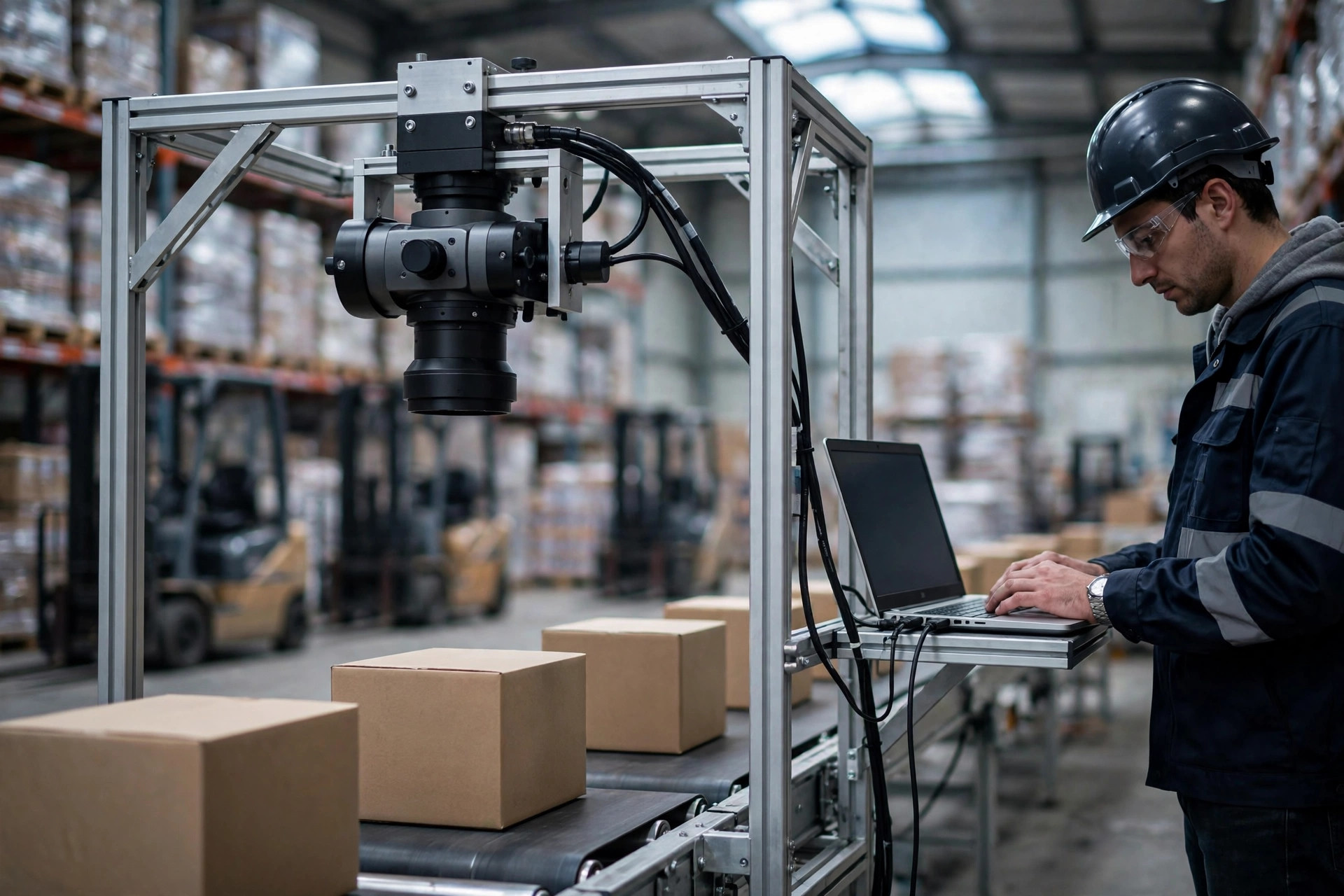
In 2023 I worked with a returns warehouse that wanted a vision system on its audit line to catch damaged cartons. The math was simple: one damaged box shipped to a customer meant a claim plus return freight — enough to pay for several industrial cameras. The project sailed through every review, then stalled on something nobody had planned for. Not the algorithm. Not the camera specs. We couldn't assemble the training data.
After months of waiting, we had a few dozen real photos of damaged boxes. Worse, they were nearly identical: the same crushed corner, the same two conveyors, the same overhead lights. We trained the model anyway. In its first week live, it flagged perfectly good cartons as damaged, and the false alarms piled up until the operators switched the alerts off. That project taught me a rule I still use: on day one of any vision project, ask where the data comes from before you pick a camera.
Why the Defect Refuses to Be Photographed
Start with the uncomfortable truth. Damage, leaks, mislabeled cartons, lifting tape — these are rare events by design in any well-run warehouse. A high-volume audit line moves tens of thousands of units a day while keeping its damage rate in the low fractions of a percent. Collecting a few thousand photos of "damaged" means camping by the conveyor for months, and you can't change seasons, relamp the ceiling, or switch carton vendors mid-collection without shifting your data distribution.
Even when you finally get the photos, labeling is a bottomless pit. Damage has no ground truth: how crushed does a corner have to be before it counts? Does tape lifting two millimeters get a box? Three labelers will annotate the same image three different ways. Then there's the silent killer of real-world capture: scene coverage. Lighting, camera angle, belt speed, carton age — the combinations are endless. Your photos will always describe "this station, last quarter," and the model will feel homesick the moment it goes live.
By the day your real dataset is finally big enough, the project window has usually closed. That's the death loop of warehouse vision: the places that need the model most are exactly the places that can't produce the data.
Three Ways to Manufacture Data
If real defects won't come to you, build them yourself. Three approaches actually work, and each has its own temperament.
The first is 3D simulation rendering. Model a carton in 3D, script the dent depth, tear placement, and stain patterns, then randomize camera position, lighting, and background at will. Every rendered image ships with free annotations — the renderer sees the scene from a god's-eye view, so bounding boxes, segmentation masks, and depth maps come straight out of the scene graph with zero labeling cost. The tooling is mature: BlenderProc, open-sourced by Denninger and colleagues at the German Aerospace Center DLR in 2019 (arXiv:1911.01911), built on the idea that photorealistic rendering shrinks the sim-to-real gap; NVIDIA's Omniverse Replicator, whose stated purpose is generating labeled synthetic data at scale for visual inspection and robotics; and Unity's Perception package, designed specifically to produce synthetic datasets with ground-truth annotations.
The second approach is domain randomization, and its logic runs backward: don't chase realism, chase chaos. The founding paper by Tobin and colleagues in 2017 (arXiv:1703.06907) randomized textures, lighting, and camera positions so aggressively that the real world started to look like just another random variation. Their model localized objects in real scenes to 1.5 centimeters. My field take: conveyor scenes with fixed backgrounds are ideal for this trick, because you don't need the simulation to look real — you need it to look varied.
The third route is generative models. Feed your few dozen real damage photos into a GAN or diffusion model and let it dream up more variants. I'm skeptical of this one. Generative models hallucinate with total confidence, inventing damage patterns that violate physics. A model trained on those fantasies learns fake features and fails in production anyway. My verdict: generative models are fine as an augmentation sidekick — brightness shifts, background swaps — but don't ask them to invent new defect categories from nothing.
Simulation Is Not a Silver Bullet
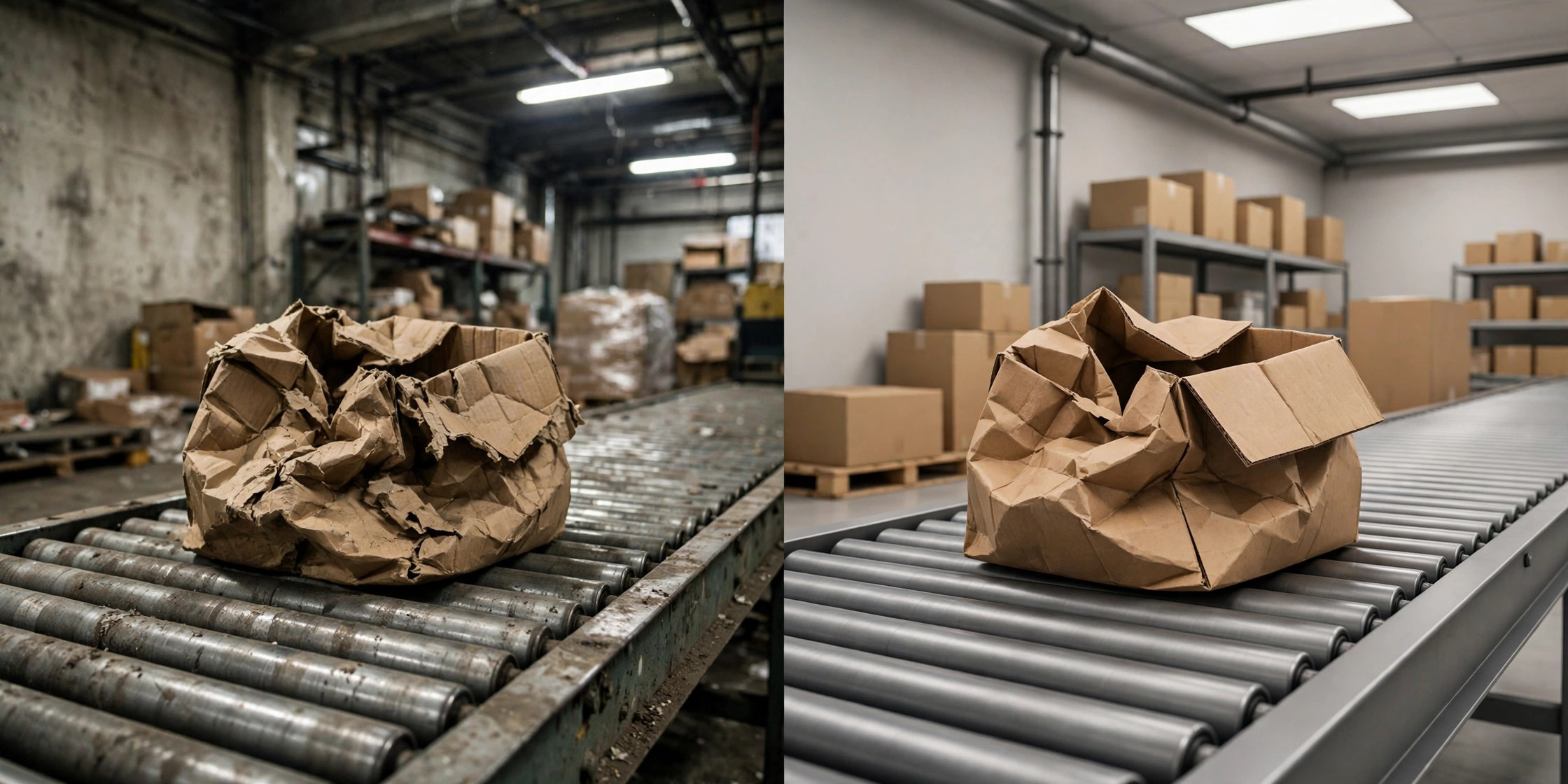
Look at the image above: a real damaged carton photographed in a warehouse, next to its 3D-rendered twin. If your eyes can spot the gap, the model feels it ten times harder.
The sim-to-real gap is real. However convincing the rendered lighting, simulations routinely skip sensor noise, lens distortion, and the motion blur of a belt running at full speed. The sneakier trap: synthetic defects tend to look too clean, too textbook, while real damage is dirty, random, and unreasonable. A decision boundary learned on clean data collapses the moment it meets the mud of the real world.
The fix is one word: hybrid. Train on synthetic data for coverage, so the model has seen enough defect shapes; calibrate on real data, so the decision boundary gets dragged back to reality. After that, close the loop: keep feeding production false positives and misses back into the training set. Synthetic data takes you from zero to one; real data takes you from working to good. Neither replaces the other.
When to Skip Synthetic Data
Synthetic data is powerful, but some jobs are faster with a plain camera.
Skip simulation when the defect is easy to stage. Mislabeled cartons, for example: print a batch of labels, stick them on, and you can shoot hundreds of photos in an afternoon with any angle and lighting you want. The hours a 3D artist spends building the scene would cover three full shooting sessions.
Skip it when nobody on the team speaks the 3D pipeline. Modeling, materials, lighting, render pipeline — each is a craft of its own. Outsourced modeling quotes routinely exceed the cost of shooting plus labeling, and after two or three rounds of revisions the project is dead.
Finally, do the cost math. Real capture is linear cost: one more photo, one more annotation, one more dollar. Simulation is fixed cost: the expensive part is building the scene, and after that each additional image costs almost nothing. The decision rule is clean: the larger the volume you need and the rarer the defect, the more synthetic data wins. Small volume, easy to stage — pick up the camera and shoot.
Your Checklist for Tomorrow Morning
If you're kicking off a warehouse vision project tomorrow, do these in order and don't skip steps:
- Count your samples first. List every defect class you need to detect and count the real photos you hold for each. Any class that can't fill a validation set goes straight into the "must use synthetic data" column.
- Mount the camera first. Install it at the final deployment position and let it run for a week. Bank the real data stream now — it's the capital you'll spend on calibration later.
- Run the tooling first. Get a GPU box, run the BlenderProc official example end to end, and render your first batch of self-annotated images. If you can't get that working, you're not ready to build your own simulation pipeline.
- Run a bake-off first. Train one small model on synthetic-pretrained plus real-finetuned data, and another on real data alone. Compare false-positive and miss rates, and let the numbers decide.
- Talk scale last. If synthetic wins the bake-off, invest in the full simulation scene. If it loses, go back to shooting and don't fight the tooling.
My verdict is blunt: synthetic data is not a silver bullet, but it is the most underrated lever in warehouse vision. Used well, it compresses "waiting for data" from months to weeks. Used badly, it's an expensive toy. What separates the two is never faith in the technology — it's the bake-off sitting on your desk.