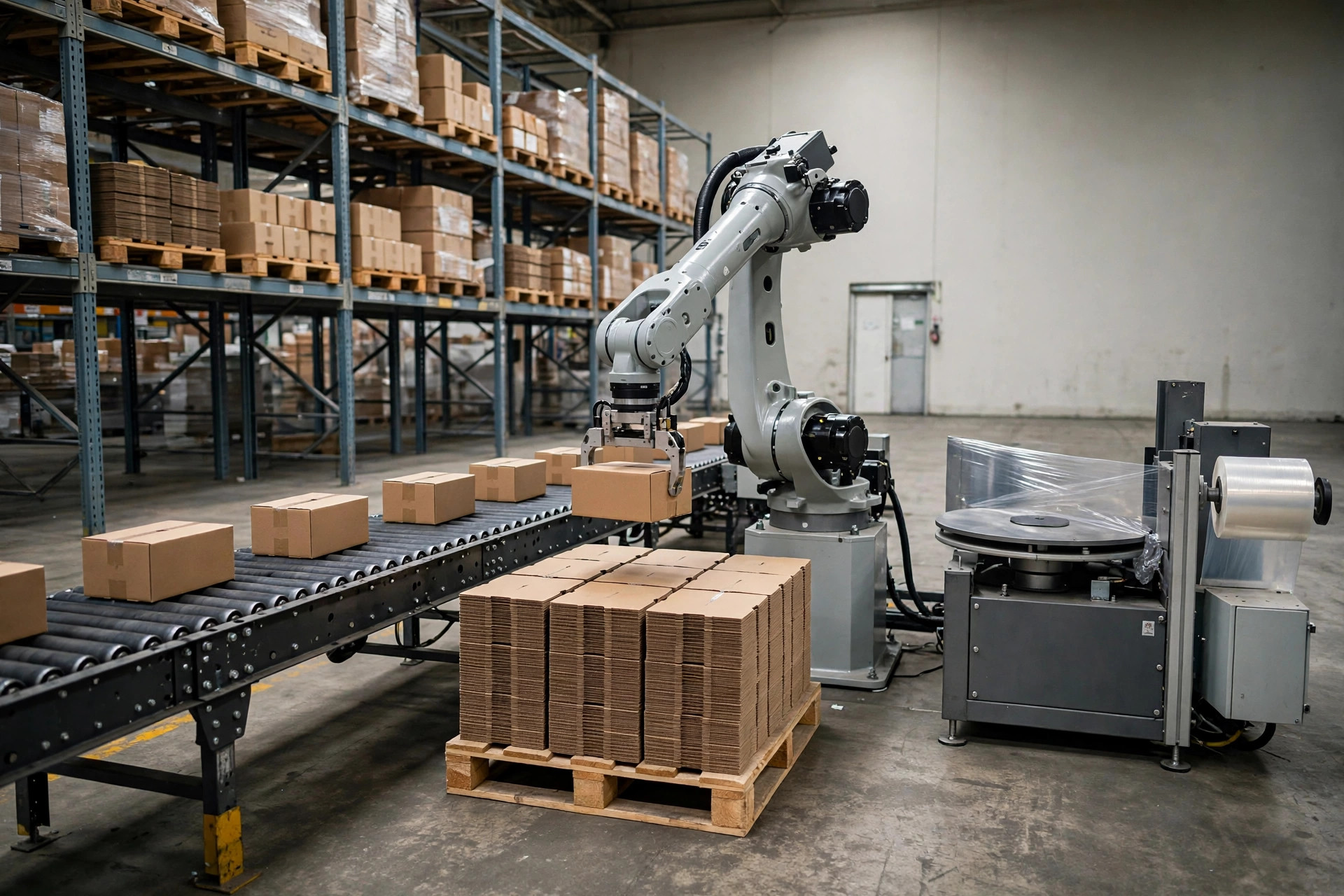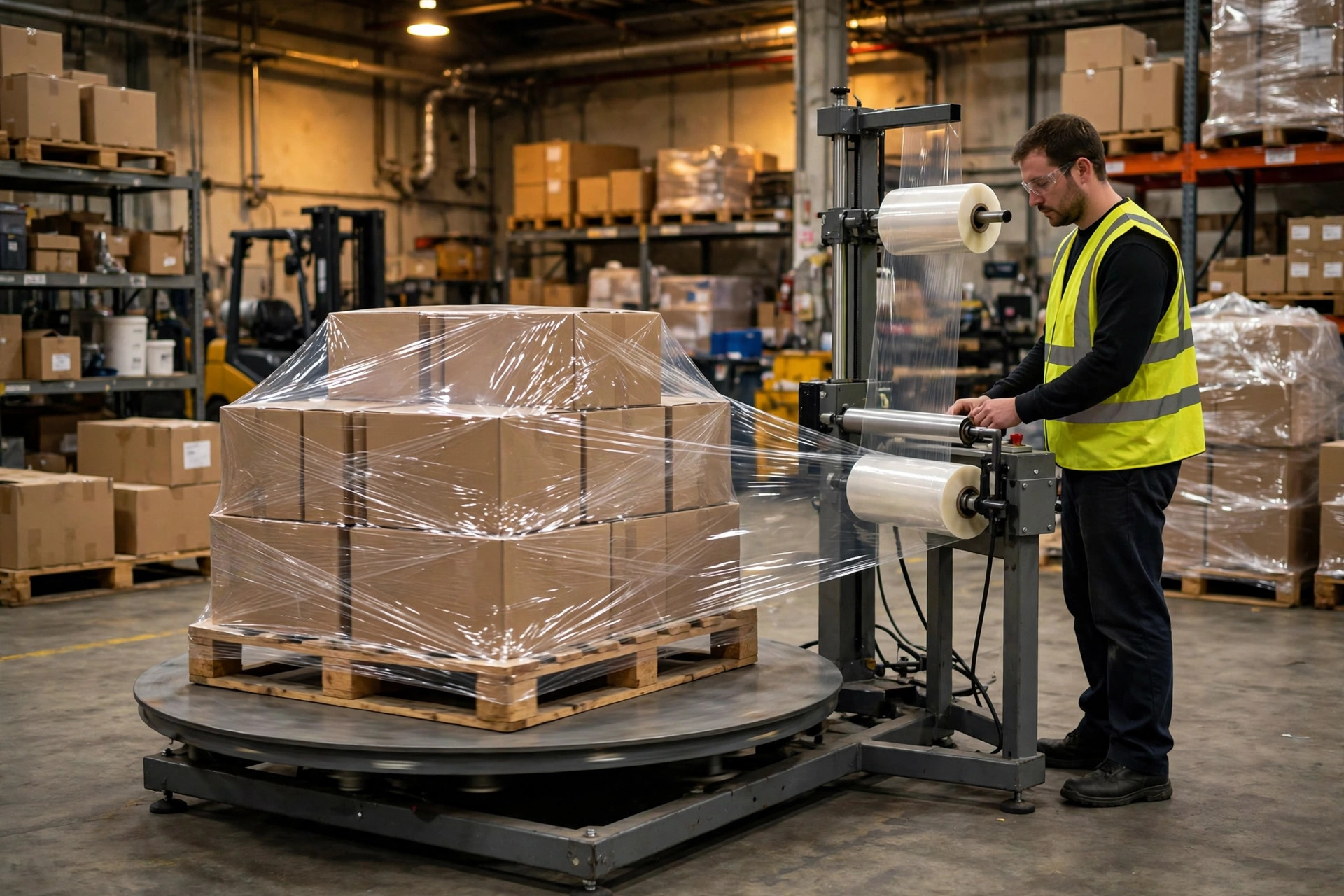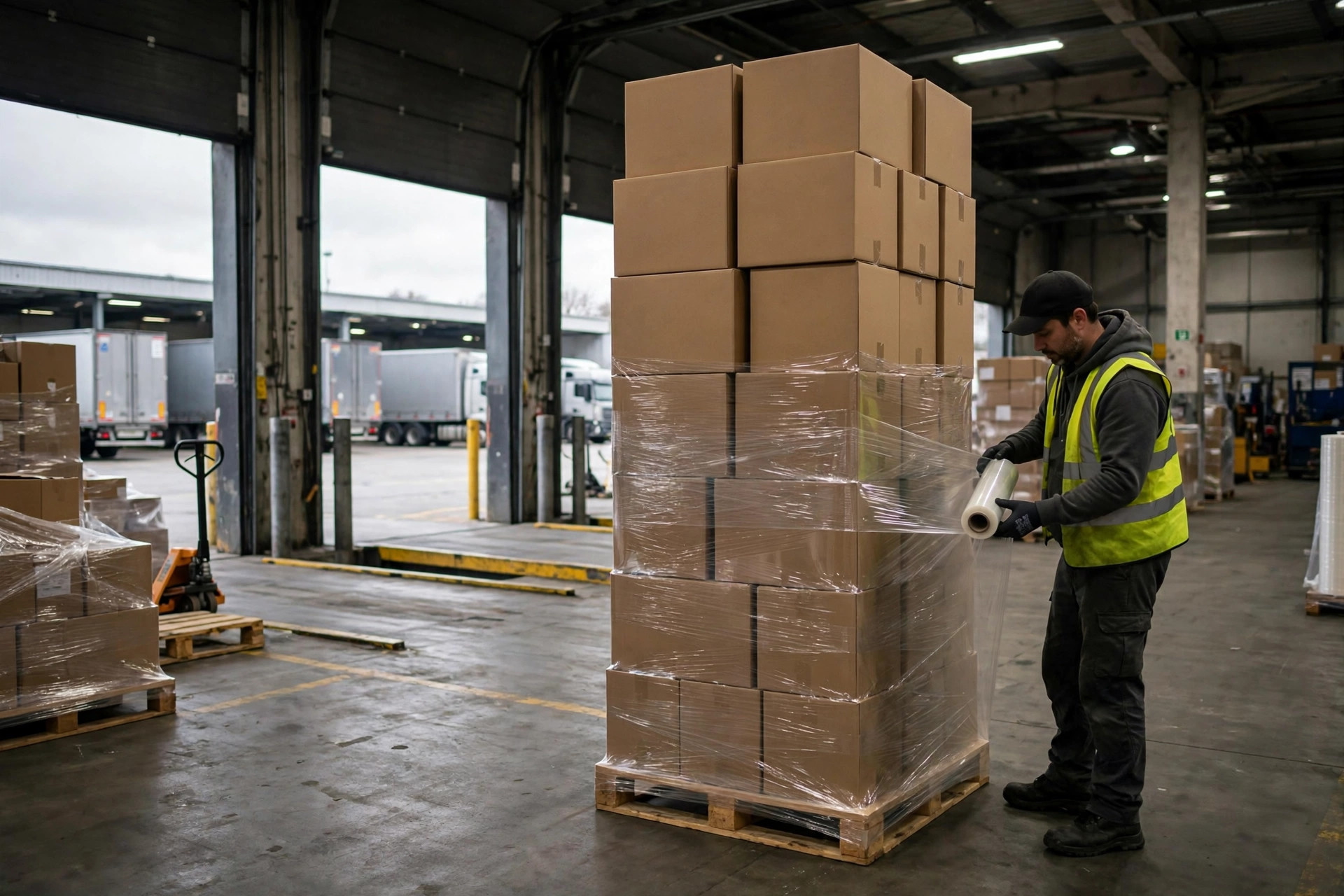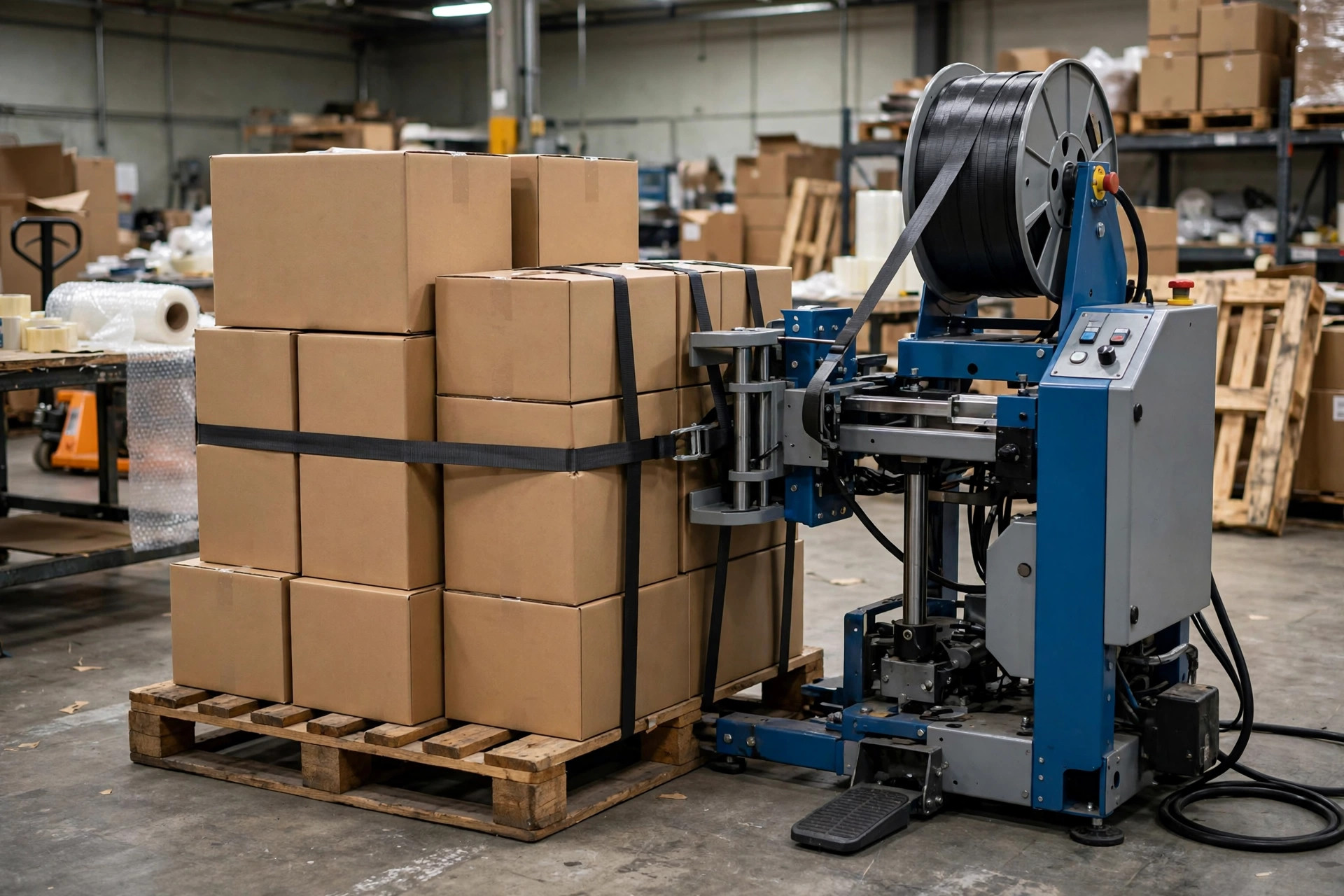
Strapping and stretch wrap solve the same problem with completely different physics. Think of strapping as a seatbelt: a high-tension band cinches the load at a few points, and whether the pallet holds together depends on band tension and placement. Think of stretch wrap as a wetsuit: elastic film hugs the entire load from top to bottom, and the holding force comes from surface pressure and film-on-film cling. Neither approach is better. Each has failure modes the other doesn't.
The most expensive mistake I see is warehouses using one method in a scenario built for the other, then throwing labor, material, and rework at the problem — only to discover at year-end that the money started burning the day they chose wrong.
The Physics: Cinching vs. Hugging
Get the physics right first, because everything downstream follows from it.
Strapping is about break strength and tension. A PET strap has a tiny cross-section; a machine (or a person) pulls it taut, and all the force concentrates on a line. It's like tying down luggage with rope: if the rope stays tight, the boxes don't scatter. The upside is airflow, fast unwrapping, and zero film consumed. The downside is equally obvious: the force is local. If your load is soft — cartons stacked tall, bagged goods, anything with rounded or uneven corners — a tightened strap digs in like a knife. I've seen cartons with grooves carved into them and corners crushed flat.
Stretch wrap spreads the load out. Pre-stretched film — standard on modern automatic wrappers, typically running 150%-250% stretch ratios — gets wound around the pallet in three to five revolutions, and the elastic recovery force grips the whole load evenly. It's a wetsuit, not a rope: pressure over the whole surface, not at points. The film also moonlights as dust and moisture protection, which strapping can't do.
So the first principle: if the load is uniform, heavy, and square-cornered, strapping has the edge; if it's soft, irregular, moisture- or dust-sensitive, stretch wrap is the right answer. Remember that sentence and 90% of selection decisions answer themselves.
The Selection Line: Daily Pallets and Load Shape Decide
Clients always ask: "Da Liu, should our warehouse buy a strapping machine or a stretch wrapper?" I always answer with three questions: how many pallets a day, what shape is the cargo, and how much is each pallet worth?
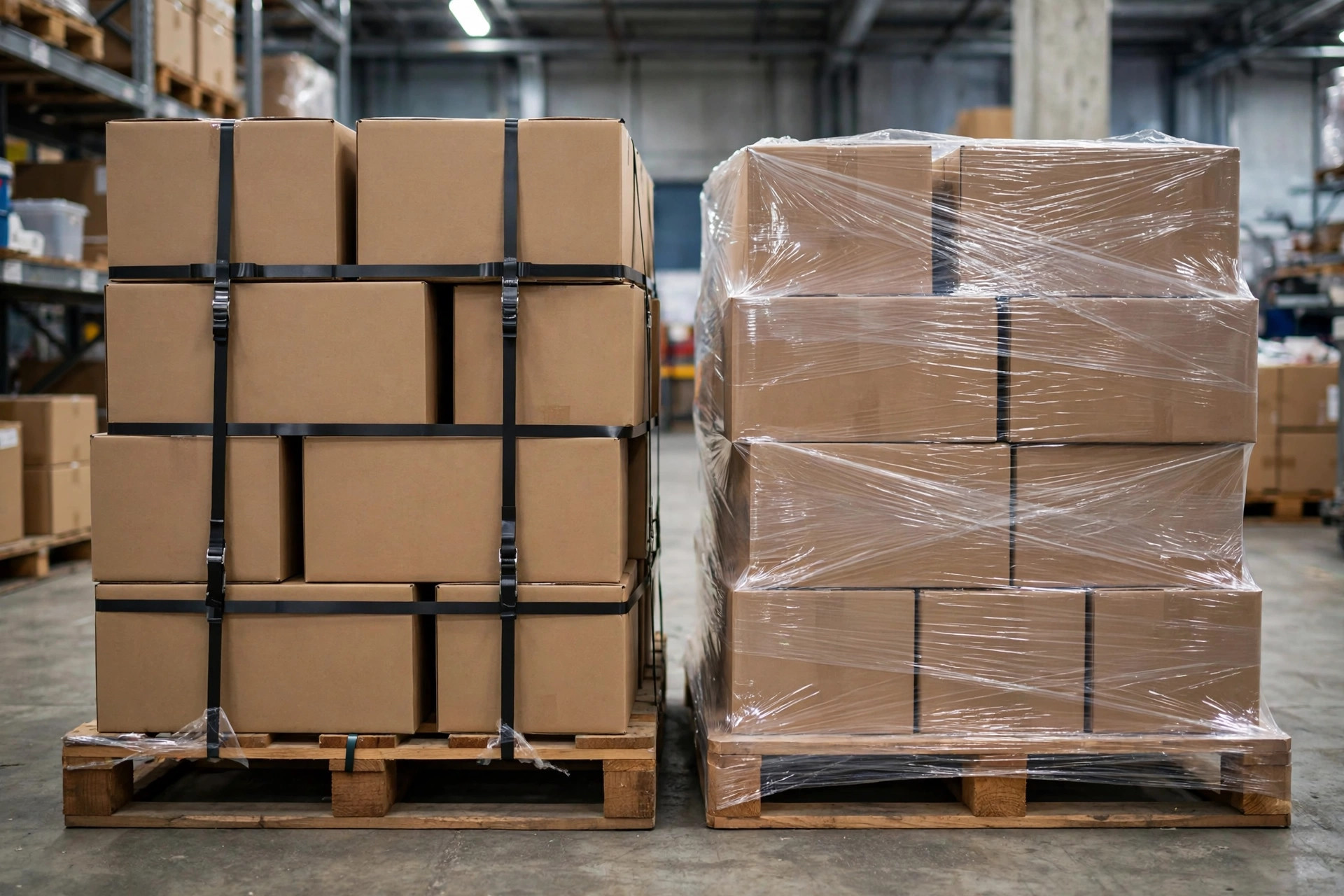
Here's a real one. Late 2024, a 3PL in Ontario, about 80,000 square feet, shipping 60-80 pallets a day of home goods in mixed-size cartons — textiles, storage boxes, nothing uniform. They were hand-strapping everything. Two workers, backs wrecked by end of shift, and when peak season hit, straps went on loose; damage complaints piled up a dozen a month. The owner had already approved budget for a semi-automatic strapping machine. I walked the floor once and called it out directly: this cargo profile is strapping's worst nightmare.
Mixed shapes and soft cartons mean local strap tension crushes corners, and hand-strap tension is pure feel — which disappears entirely under peak-season pressure. The fix was a turntable automatic stretch wrapper. Labor time per pallet dropped from several minutes to just over one, and the complaints went to zero. Wrong direction, and the harder you try, the worse it gets.
The mirror image: a building-materials distributor in Riverside, 2023, shipping uniform pallets of bagged mortar — heavy, perfectly square loads. Their film consumption was nearly double the normal rate: the operator, playing it "safe," had cranked the wrap count to seven or eight revolutions. The extra film was pure anxiety. Switching to a dual-head automatic strapping machine cut consumable cost dramatically, and the loads rode containers without moving an inch. Right tool, and the savings are straight profit.
Compress both cases into a decision table:
| Scenario | Leans strapping | Leans stretch wrap |
|---|---|---|
| Daily volume | 30-200 pallets, steady | Volatile volume, mixed cargo |
| Load shape | Uniform, heavy, square | Soft, irregular, moisture/dust-sensitive |
| Consumable cost | Strap is cheap, usage visible | Film costs more, but pre-stretch controls per-pallet cost |
| Unwrap speed | Cut two straps, done — fast | Must cut film — slower, fine for non-urgent |
| Moisture/dust | None | Built in |
Now the costing framework. Per-pallet securing cost = consumables + labor time + damage allocation. Strapping consumables (PET/PP bands) run a few bands per pallet — cents-level magnitude. Stretch film per pallet typically runs in the tens of cents to just over a dollar, lower with higher pre-stretch. Labor flips the other way: a skilled worker needs 2-3 minutes to hand-strap a pallet; an automatic wrapper does it in 60-90 seconds. Under 20 pallets a day, hand strapping wins on total cost; past a hundred, the machine's amortized labor cost takes over. Damage allocation is the line everyone forgets: one collapsed pallet and a customer claim wipes out months of strap and film savings. Any selection based on equipment price and consumable price alone is doing small-account math.
The Maintenance Trap: Buying the Machine Isn't the End
Second thing worth calling out: most warehouses shop on purchase price and never model the maintenance bill.
The biggest pitfall on stretch wrappers is the pre-stretch rollers. As rollers wear, actual stretch ratio slides from 200% down to 120% or worse. Film gets thicker and thicker, consumable cost creeps up, and operators blame "bad film quality." I tell clients to measure actual film thickness every 6-12 months; when the roller texture is worn smooth, replace them. A roller set pays for itself in months of film savings. Second pitfall: turntable bearings. Heavy pallets, high RPM, starved bearings — the turntable shudders and wraps alternate tight and loose. That kind of hidden damage is nearly impossible to trace back.
Strapping machines fail more narrowly: dust in the strap channel and residue on the heat-seal head. The seal head heat-bonds the strap; once it's gummed up, seal strength falls off a cliff. Straps look applied but pop open on the first bump in transit. The worst case I saw: a shop that hadn't cleaned the head in a year, blaming "an aging machine" for its seal failures — when it was purely deferred maintenance. Automatic strappers post fine MTBF numbers on paper, but those numbers assume the maintenance schedule is actually followed. Skip maintenance and you'll realize exactly zero of the manufacturer's MTBF figures.
So ask one extra question during procurement: show me the wear-parts list and the maintenance schedule. Any brand that can't produce both isn't worth buying, whatever the price.
The Counterintuitive Take: You Can Use Both
One last contrarian point: strapping and stretch wrap are not either-or. For warehouses with mixed cargo, the best answer is often "strap to shape, wrap to finish." Two straps first to lock the load geometry — that fixes the collapse problem at its root — then two to three revolutions of film for moisture protection and loose-item retention. Consumable cost barely exceeds pure wrap, and damage rates drop to near zero. Don't let binary thinking box you in. An engineer's eyes see no tribes, only force analysis.
The summary: load shape decides the physics, daily volume decides manual versus machine, and damage decides whether you can afford to skimp on consumables. Whether the money is worth it comes down to one number: have you ever calculated your true per-pallet cost? If not, whatever you buy is a gamble.
By Da Liu, Automation Engineer