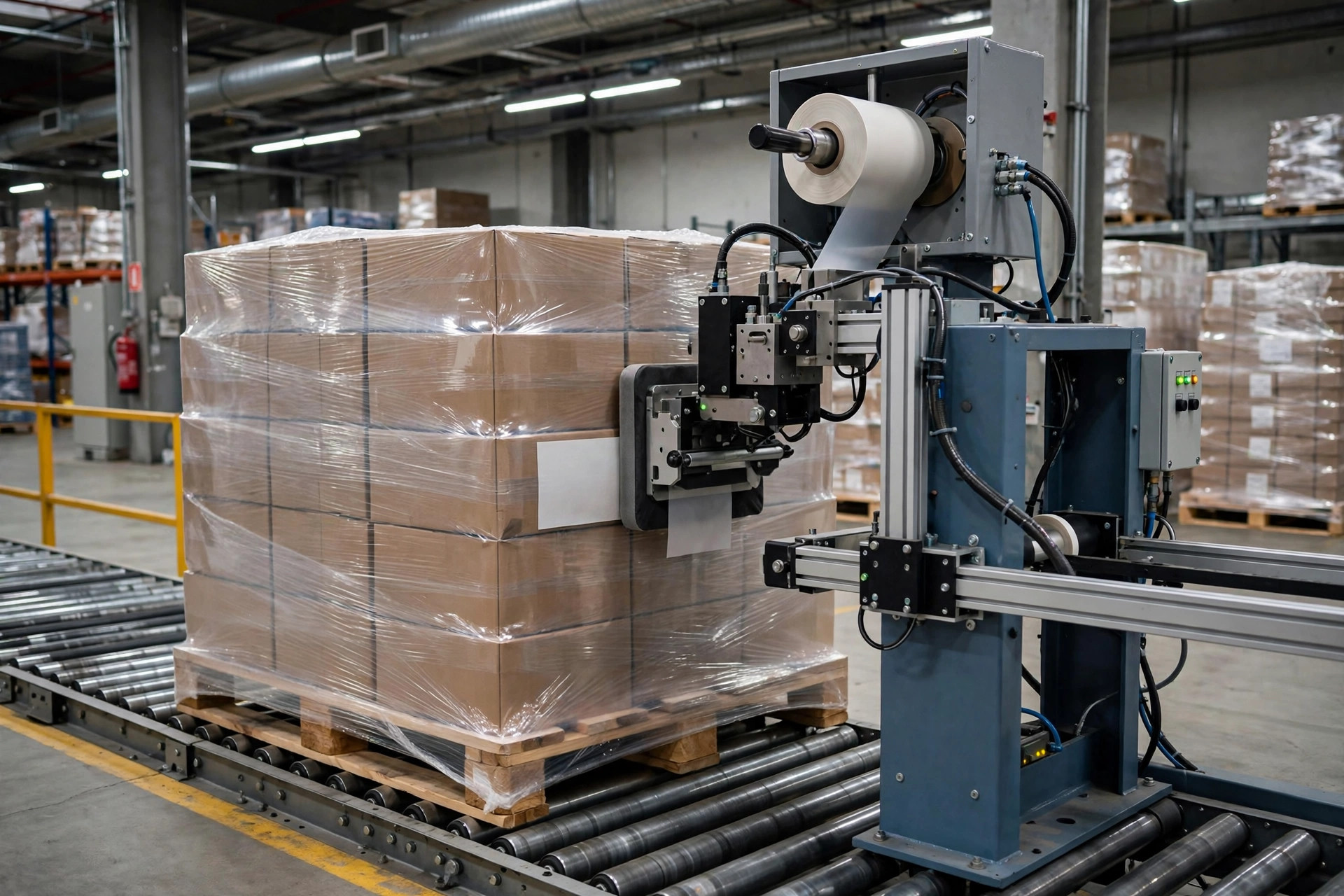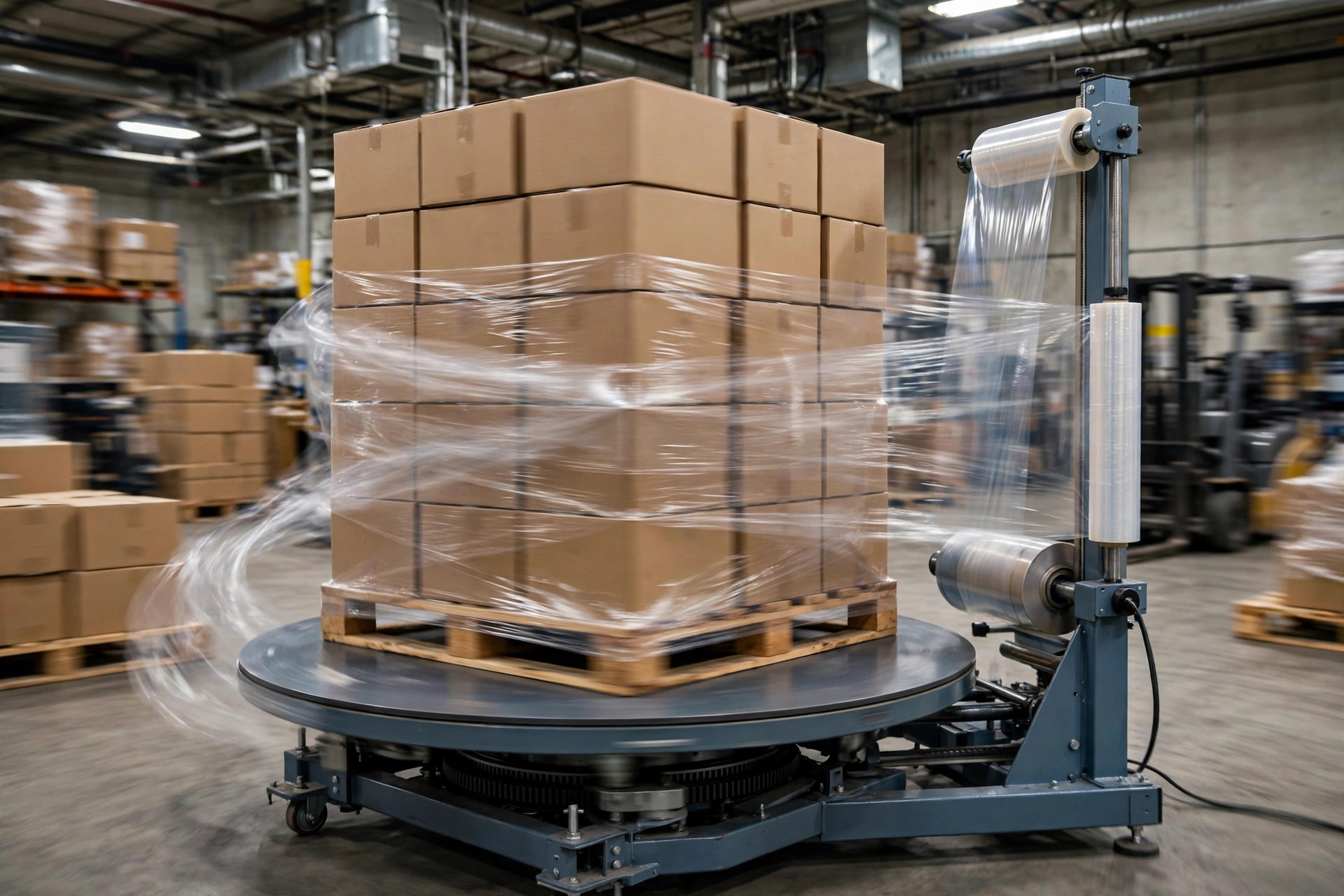
Same pallet. One operator burns through more than a pound of stretch film per wrap. Another uses less than a third of a pound.
That gap sounds trivial until you scale it. I ran the numbers at a third-party warehouse in Ontario, California: roughly two hundred pallets wrapped a day, and the difference in film cost between a well-tuned wrapper and a neglected one came out to several thousand dollars a year. Film is cheap. Film at volume is not.
The difference is not the brand of film. It is a single machine parameter called the pre-stretch ratio. Plenty of warehouses buy wrappers with powered pre-stretch and then leave the setting on the factory default forever, which is like paying for a feature and never switching it on. Here is the full picture: what pre-stretch ratio actually means, how to tune it on semi-automatic versus fully automatic machines, the old hands' rules for top and bottom wraps, and the real math on film savings versus damage claims.
What Pre-Stretch Ratio Actually Is
One sentence: the film gets stretched several times longer before it ever touches the pallet.
A powered pre-stretch carriage has two rollers spinning at different speeds. The rear roller turns slowly, the front roller turns fast, and the film gets elongated as it travels between them. Stretch it to 2.5 times its original length and you are at 150% pre-stretch. Stretch it to 4 times and you are at 300%.
Why stretch at all? Two reasons. First, you use less film per pallet, so one roll wraps far more loads. Second, stretched film has stronger elastic recovery, so it clamps the load tighter. Sounds like pure upside, right? The catch comes later.
In practice, pre-stretch ratios in the industry fall between 150% and 300%. Semi-automatic machines usually offer fixed gear-ratio settings, commonly 150%, 200%, and 250%. Fully automatic machines let you dial it in continuously on the panel, though I have seen far too many warehouses set it once and never touch it again.
Semi-Auto and Fully Automatic Machines Tune Completely Differently
On a semi-automatic turntable wrapper, the kind where an operator pushes the pallet on and hits start, tuning is "pick a gear, then trust your eyes." Choose the setting by load type first: light carton freight gets 150% to 200%, heavy, irregular, or loosely stacked loads get 200% to 250%. Then look at the result. Film that comes out glossy and hugging the boxes means you nailed it. Film that turns milky white or shows stretch lines means you overdid it, so drop down a gear.
On a fully automatic wrapper, the in-line kind where pallets ride through on their own, tuning is "save a recipe per pallet type." The panel typically lets you set the pre-stretch ratio, the number of extra wraps at the top and bottom, and the up-down cycle count. My advice: do not be lazy and store one universal recipe. Keep at least three, one for light standard pallets, one for heavy pallets, one for irregular loads. Switching recipes is one button press for the operator. No excuse.
Top and bottom wraps are where the old-timers' wisdom lives. The bottom needs at least 2 to 3 wraps to bite the film into the pallet base, because those wraps are what hold the load when a forklift brakes hard. Add 2 extra wraps at the top to keep the top layer of cartons from bouncing off in transit. Corners are where film tears most easily, so if the machine has corner slowdown or extra film on corners, turn it on; if not, add a wrap. Never economize on wraps in the middle layers. When things go wrong, it is always the head and the tail that fail.

The Film Savings Math and the Damage Math Are Two Separate Ledgers
First, get the measurement method right. The field method: weigh a fresh roll of film, count exactly how many pallets it wraps, then weigh the leftover core and remnant. Divide, and you know the film weight per pallet with no guesswork. Re-run the test every two or three months. Film batches change, film gets brittle in cold weather, and the settings may need to follow.
The formula is simple: film cost per pallet equals the roll weight divided by pallets wrapped per roll, times the film price per unit weight.
I will not invent a price per pound here, since every operation negotiates its own. But the magnitudes are fair game: a warehouse wrapping two to three hundred pallets a day, moving pre-stretch from 150% to 250%, can get close to half again as many pallets out of each roll. Over a year, that is real money in the low thousands of dollars, not some theoretical "optimization opportunity."
But, and I need to say the ugly part out loud, that money has a price.
In 2023, at that 200,000-square-foot facility in Ontario, the packaging supervisor cranked pre-stretch past 300% and cut two wraps to hit a cost-reduction target. Film costs did drop, for about three months. Then one LTL shipment to Texas arrived with two pallets collapsed. The damage claim plus the reshipment cost more than half a year's worth of film savings. Ever since, my rule has been this: if the film money you save cannot cover a single damage claim, you are losing money.
The test is brutally practical. After any tuning change, track your damage rate and customer complaints for a full month. If the damage rate climbs, you overshot, so dial it back. Film is a consumable. Freight is the asset. Never gamble the asset to save on the consumable.
Here is a checklist you can tape to the machine:
- Start with the right gear: 150-200% for light freight, 200-250% for heavy or irregular loads. Do not max it out on day one.
- Read the film: glossy and tight is right, milky white with stretch lines means over-stretched, step it down.
- Two to three wraps at the bottom, two extra at the top, mind the corners. That is insurance money, not waste.
- Weigh a roll and count pallets with the field method, re-test every two to three months, and always re-test when the film batch changes.
- Watch the damage rate for a month after tuning. If it rises, dial back. Film savings that cannot survive one claim are a loss.
The stretch wrapper is one of the most boring machines in the warehouse, and it spends your money around the clock. Ten minutes of tuning the pre-stretch ratio, a few thousand dollars a year back. You will not find many investments with that payback in a warehouse.