Let me open with the math, because that's the only thing that matters here.
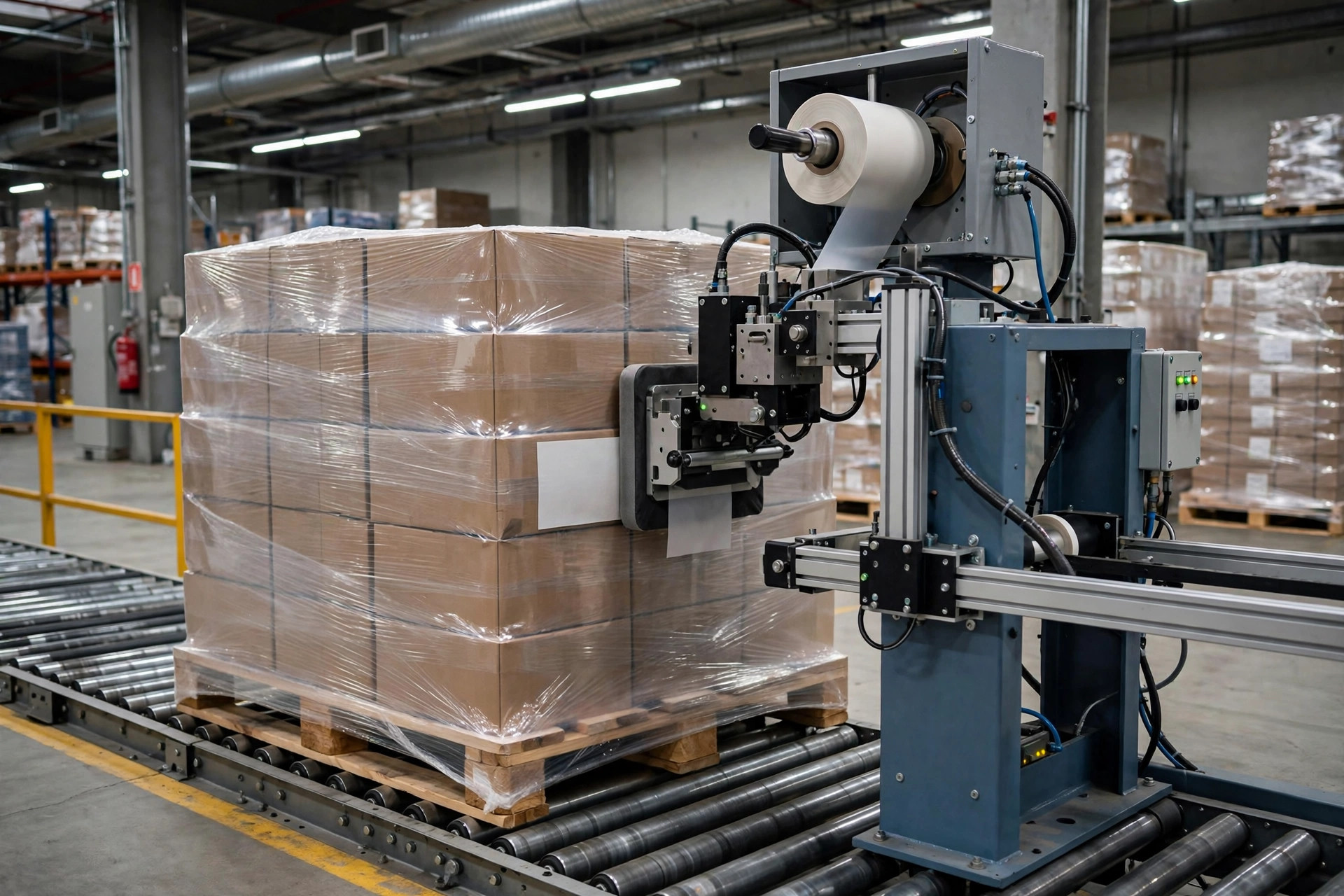
A warehouse shipping 300 pallets a day, hand-applying pallet labels, burns roughly $70,000 a year on labeling — and that money never shows up on any equipment purchase order. That invisible spend is exactly the baseline any print-and-apply pallet label applicator ROI calculation has to beat.
Here's the arithmetic. After stretch-wrapping, a worker walks around each pallet with a roll of pre-printed labels, applies one per side, about 45 seconds a pallet. At a fully loaded $26/hour (a standard estimating figure for US warehouse labor in 2025 — substitute your local wage), that's $0.33 of labor per pallet. 300 pallets × $0.33 × 300 days = $29,700. But I said $70,000? Because you're also paying for the person printing labels, the person reprinting labels when they're wrong, and the person peeling off misapplied labels and redoing them. One labeling station really occupies about 1.5 headcount, plus overtime in peak season. Done honestly, $70,000 is conservative.
One clarification before we go further, so this doesn't get confused with the October 5 piece on automatic labelers and shipping-label compliance. That article was about parcel-level applicators — machines applying shipping labels to small parcels, and courier label compliance. This one is about pallet-level print-and-apply: printing and applying GS1 logistics labels (the SSCC label) onto pallets. Equipment runs from a few thousand to several hundred thousand dollars, and the decision isn't "which model" — it's "how many months until payback." Completely different weight class. Don't apply parcel-labeler prices to pallet machines.
Print-and-apply tiers: $5K, $50K, $350K — you're buying three different things
Pallet labeling solutions fall into sharply separated tiers. All prices below are vendor quotes and industry-report figures, not transaction prices — there's plenty of negotiation room, so discount them before they go into your model.
| Tier | Form | Vendor-quoted price | Daily volume that justifies it |
|---|---|---|---|
| Manual | Pre-printed labels, hand-applied | ~$0 equipment | Under 50 pallets |
| Semi-auto | Desktop/semi-auto labeling station | $5,000–$9,900 | 50–150 pallets |
| Fully automatic print-and-apply | Line-integrated, print + tamp/wipe apply | $50,000–$200,000 per unit | 150–500 pallets |
| Robotic labeling | Robot + vision, multi-side application | $350,000–$750,000 total investment | Mixed pallet sizes, multi-face labeling |
The semi-auto tier is the most overlooked: a print station where labels are printed on demand and the worker just slaps them on the pallet. Under $10,000, and it solves the "pre-printed a whole roll wrong" problem. For a warehouse doing 100 pallets a day — full automation too expensive, pure manual too messy — semi-auto is the best value in the middle.
The fully automatic tier carries a vendor-quoted payback of 18–36 months, with annual labor savings of $45,000–$85,000 per system. Note the phrase "vendor-quoted" — the people selling the equipment obviously present the rosiest case. My formula: take your labeling station's true current labor cost (including overtime and rework), divide the total equipment investment (including installation, integration, and first-year maintenance), then multiply the resulting months by 1.3. That's the number you should believe.
The robotic tier — $350K to $750K total, 3–5 year payback per vendor figures. Honestly, buying a robot purely to stick labels on pallets rarely pencils out. The real buyers are operations with inconsistent pallet dimensions needing three-side or top application where humans simply can't place labels accurately. Buying a robot just to save labor? That money is wasted.
Tearing apart the cost structure: the machine is only the first check you write
When you build the TCO, the equipment price is roughly a third. The rest is three buckets:
Bucket one: consumables. Label stock plus ribbon. Pre-printed labels carry a hidden cost: get the information wrong and you throw away the whole roll. Warehouses with frequent order changes (mixed B2B e-commerce fulfillment, for example) scrap some every week. Print-on-demand eliminates exactly this waste. A PMMI 2025 report, cited via industry media, mentioned a 37% drop in label-related downtime and $0.02 saved per label after switching from pre-printed to on-demand — I haven't seen the original PMMI report, so treat that as a reference point, not a fact for your business case. But the direction is right: the more label variants and the more frequent the changeovers, the more on-demand printing is worth.
Bucket two: labor. Calculated above: a 300-pallet-a-day warehouse spends about $70K a year on labeling-related work. Full automation replaces part of it — but never 100%. You still need someone for exceptions and consumable changes. Assume 70% displacement: $49K a year saved. On a $100K machine, true payback is about 26 months. That's the gap versus the vendor's 18 months, and the gap comes entirely from the 30% you can't automate away.
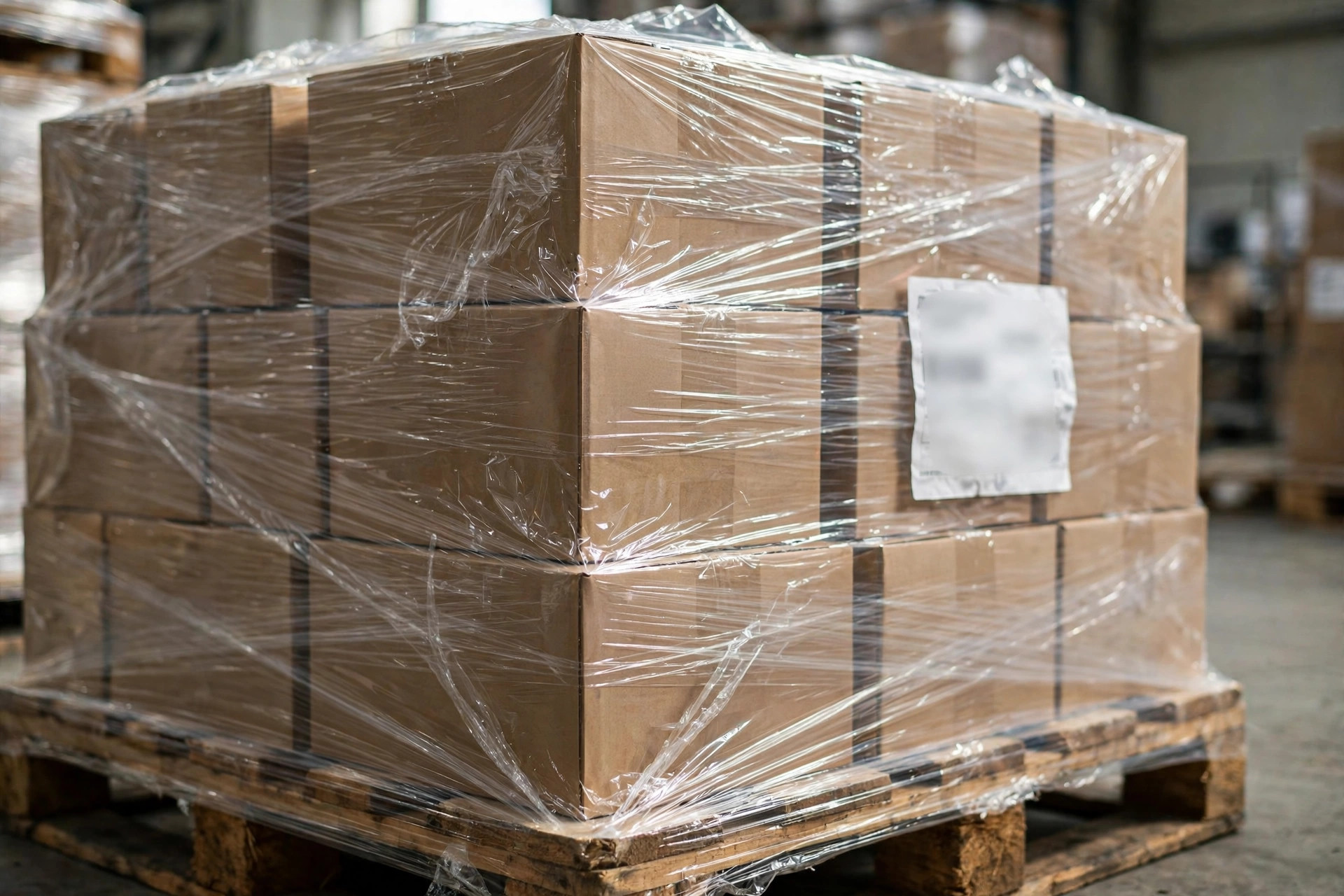
Bucket three: errors. The most expensive bucket, and the easiest to leave out of the model. Last fall, a 3PL in the Midwest showed me a chargeback: 22 pallets headed to a big-box retailer's DC, two pallets got each other's SSCC serial numbers, the whole truckload was refused. Detention fees, relabeling, redelivery — over $4,000, one incident, equal to two months' wages of a labeling worker. Misapplied labels, missing labels, labels applied crooked so they won't scan — nobody tracks the true error rate of manual labeling, but the DC refusal invoices are real. Half of print-and-apply's value is labor savings. The other half is deleting "applied wrong" from the process entirely.
GS1 pallet label compliance: the hidden return buried in the fine print
Pallet labels aren't just any piece of paper slapped on the wrap. Pallets going to big-box and chain retailers' DCs generally require GS1-standard logistics labels: unique SSCC codes, scannable barcode grades. Smudged print, crooked placement, data mismatching the ASN — minor cases get scorecard deductions, major cases get refused or fined. The specific penalties vary by retailer; check each one's current published policy — I won't quote numbers here.
Print-and-apply has a structural advantage on compliance: labels are generated in real time by the system, SSCCs come straight from the WMS, print quality is consistent, placement is fixed. The two biggest manual risks — grabbing the wrong label roll, labeling the wrong pallet — are eliminated at the root. The "avoided fines" return is hard to quantify precisely, but any warehouse doing big-box business knows: get refused twice in a year, and half the machine has paid for itself.
Here's the counterintuitive take: most ROI calculations only count saved labor, and that's calculating small. The real payback of labeling automation is in eliminated errors and compliance risk. Labor savings are linear. Error costs are pulsed — quiet for months, then a single incident costs thousands. If you only look at the labor math, the equipment always looks expensive. Put the refusal invoices next to it, and the math changes.
The print-and-apply payback formula: a conclusion you can use tomorrow
Simple formula:
Payback (months) = Total equipment investment ÷ (Monthly labor saved + Monthly average avoided error losses + Monthly consumable savings) × 1.3
The 1.3 is my experience factor, hedging against vendor-quote optimism. Plug in the 300-pallet-a-day warehouse: $100K equipment, $4,083/month labor saved ($49K/12), ~$1,500/month average error losses (a few small refusals a year), $400/month consumables. $100K ÷ $5,983 × 1.3 ≈ 21.7 months.
The conclusion: warehouses shipping 200+ pallets a day land in a true 18–30 month payback window for fully automatic print-and-apply — go. At 80–200 pallets a day, look at semi-auto first. Under 80 pallets a day, keep hand-labeling, get your label templates and verification process right, and spending this money now would be wasted.
One last warning: before buying the automatic unit, confirm your pallet dimensions are standardized. I watched a warehouse spend $120K on equipment, then discover their pallets varied in height, so label placement drifted every day — and they ended up assigning a person just to babysit the machine. Automation didn't eliminate labor; it added a new kind of labor called "serving the machine." The equipment isn't at fault. Standardize the process first, then bring in the equipment. Reverse the order and any amount of money goes down the drain.
By Lao Zhou, Logistics Cost Analyst