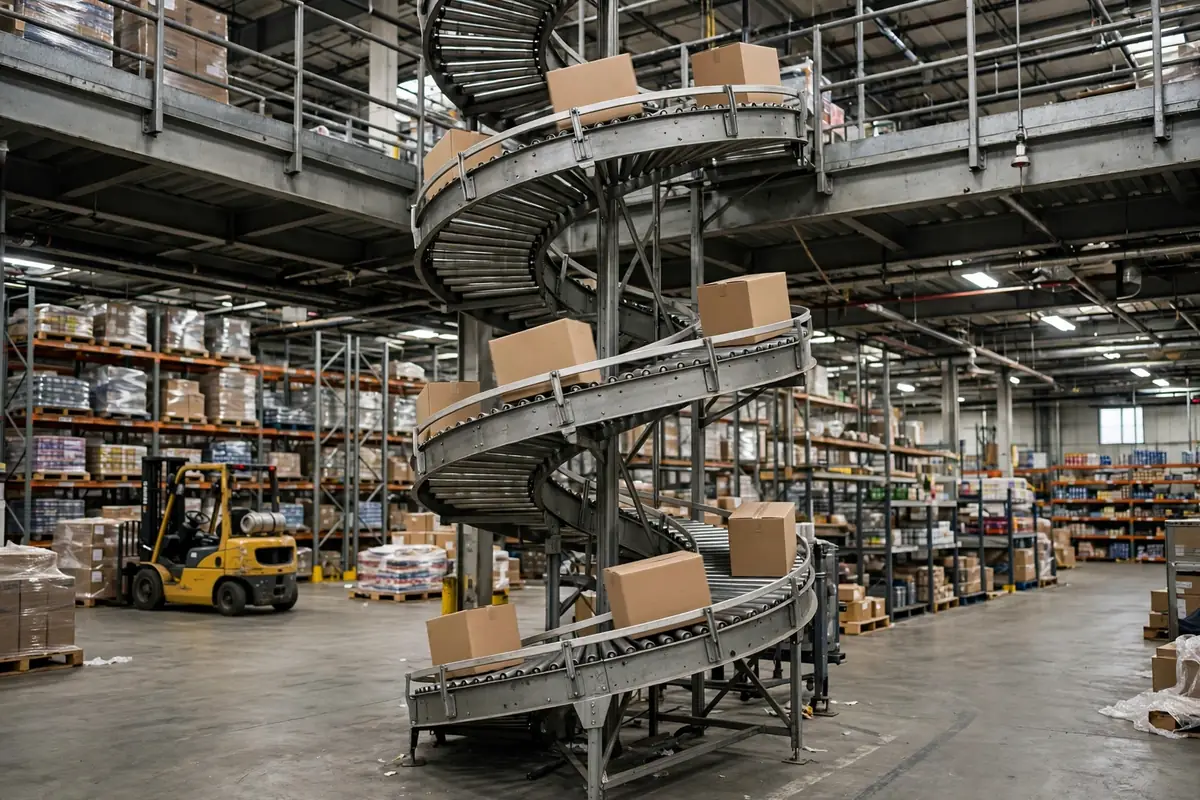
Any honest spiral conveyor warehouse selection starts with a confession: I almost bought one for the wrong reason. It looked fantastic. A gleaming spiral, cartons gliding up in a smooth circle — it makes a small warehouse look like a company ten times its size. We small warehouses cannot afford to burn money, but we burn it every day carrying boxes between floors. So here is my conclusion up front: for a small site, the first question is not speed. It is how many years are left on your lease, and how many cartons genuinely cross floors each day. Get those two numbers wrong and every option becomes the expensive option.
Spiral conveyor warehouse selection: do not buy the beauty shot
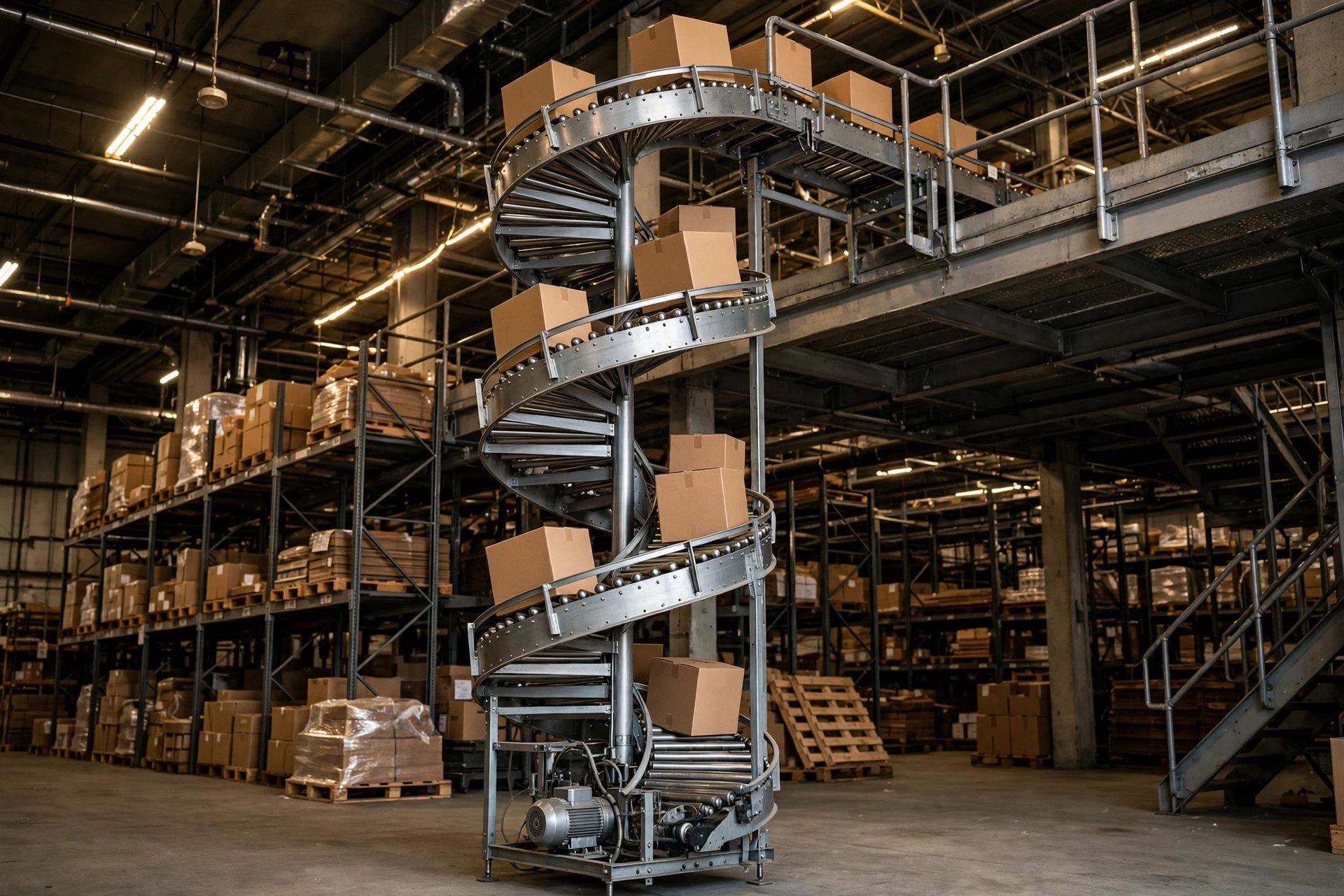
A spiral conveyor does one elegant thing: it turns vertical lifting and horizontal conveying into a single continuous motion. No waiting, no batching. The trade-offs are just as clear. It occupies a round footprint that is awkward to use for anything else, it costs real money, and when one point fails, the whole line stops to keep it company.
I first fell for one at a two-storey warehouse in Pinghu, Shenzhen. The site was roughly 2,800 square metres, moving about 1,800 cartons a day between floors — a figure the floor supervisor gave me verbally, not an audited number. At peak they had four people hauling cartons up the stairs alongside a simple lift, and the supervisor said peak-season breakage alone was painful. After installing a spiral, they kept just one person receiving upstairs. Inspiring story. Then I went home and counted my own volume: a little over 600 cross-floor cartons a day, one third of theirs. The same machine that pays back for them would have been very expensive furniture for me.
That leads to my counter-intuitive judgment: if your cross-floor volume is too low, the more reliable the spiral conveyor is, the more reliably you lose money. It saves variable cost while you carry fixed cost. Low volume means the labour saved never covers depreciation and maintenance.
The three-way ledger: spiral conveyor, goods lift, incline conveyor
Let me put the three contenders on one table. Every price and labour figure below is a labelled assumption to demonstrate the maths — replace them with current supplier quotes before you take this to your boss.
| Option | Assumed one-off cost | Footprint | Flow | Volume where it starts to make sense |
|---|---|---|---|---|
| Spiral conveyor | Assumed USD 25,000–50,000 | A cylinder of space, turning clearance needed | Continuous | Above roughly 1,500 cartons/day |
| Reciprocating goods lift | Assumed USD 7,000–17,000 | Hugs a wall, space-friendly | Batched, waiting is normal | Roughly 500–1,500 cartons/day |
| Incline belt conveyor | Assumed USD 4,000–11,000 | Eats length, needs a long run | Continuous, slope limits apply | Low rise and a long floor plate |
Now the honest arithmetic. Assume 800 cross-floor cartons a day, two people carrying them, and an assumed fully loaded labour cost of USD 850 per person per month. That is roughly USD 20,400 a year, which makes any machine look like a one-year payback. I made exactly that mistake. Those two people do not only carry boxes; they also label, check and handle exceptions. Realistically a machine saves about 1.2 people's effective hours, not two whole people — closer to USD 12,200 a year on those assumptions, before power, wear parts and the odd hour of downtime take their cut.
A friend running a small daily-goods warehouse in Kunshan taught me the next lesson. His floor-to-floor rise was about 4.2 metres, with roughly 1,100 cross-floor cartons a day. He was ready to sign for a spiral until the site survey found the floor opening clashed with a fire corridor, and the modification work added a cost he had not budgeted — he never gave me the exact figure, so I will not invent one. He chose a wall-mounted reciprocating lift plus a short roller section, staggered the upstairs runs at peak, and half a year later told me it was enough. The lesson: the machine price is never the total price. Building work, fire compliance and flow redesign are the big numbers hiding behind the quote.
I saw the maintenance version of that lesson in Yiwu, at an accessories e-commerce warehouse under 2,000 square metres across two floors. Peak volume could hit about 2,000 cross-floor cartons a day, but ordinary days sat near 700. They stretched for a spiral before peak season and loved the first two months. On day two of a major promotion, a belt joint failed and the line stopped for most of a day: goods upstairs could not come down, orders downstairs could not go out, and the whole team was back on the stairs. The owner later admitted the failure was not build quality — he had stocked no wear parts and had never agreed a peak-season response time. A single continuous channel is a single point of failure. Before you buy, plan the day it stops. If you cannot describe that day, you are not ready to depend on it.
My cheap small-warehouse method for spiral conveyor warehouse selection
Step one: count, do not guess. Log cross-floor cartons daily for two weeks, ordinary days and promotion days separately. Never size a multi-year machine on your best peak day. Step two: measure three things — floor rise, the length and width you can actually surrender, and what remains for fire lanes and forklift routes. Step three: ask every supplier three uncomfortable questions. Can cartons be unloaded by hand after a loaded stop? How often do wear parts need replacing, and are they stocked locally? During peak, how fast will an engineer actually arrive? Vague answers are a quote in themselves.
Here is my favourite low-budget trick: rent, or buy a used incline conveyor, for one peak season first. You will finish that season holding real data — true cross-floor volume, damage rate, labour hours — and only then decide whether a spiral conveyor warehouse selection upgrade is justified. There is no shame in this. Small warehouses survive by testing cheap before committing expensive.
Finally, my home-made scoring sheet. Score each option on four things: volume fit at 40 percent, lease length and cash-flow comfort at 30 percent, site modification difficulty at 20 percent, and downtime fallback at 10 percent. Do not laugh at that last 10 percent; it is where small sites get killed. The winner is rarely the fastest or the cheapest. It is the one you can still sleep with when it breaks on your busiest day.
So when is a spiral genuinely right? When volume is proven, the lease is long, and your carton mix is reasonably consistent. Even then, test your ugliest cartons — soft, uneven-bottomed, wildly different sizes — on the real machine, not the supplier's polished demo boxes, which are actors chosen for the part. Choose the cost structure, not the showroom. Small warehouses have their own way of living, and there is no shame in it.
By Xiao Ma, Small Warehouse Owner