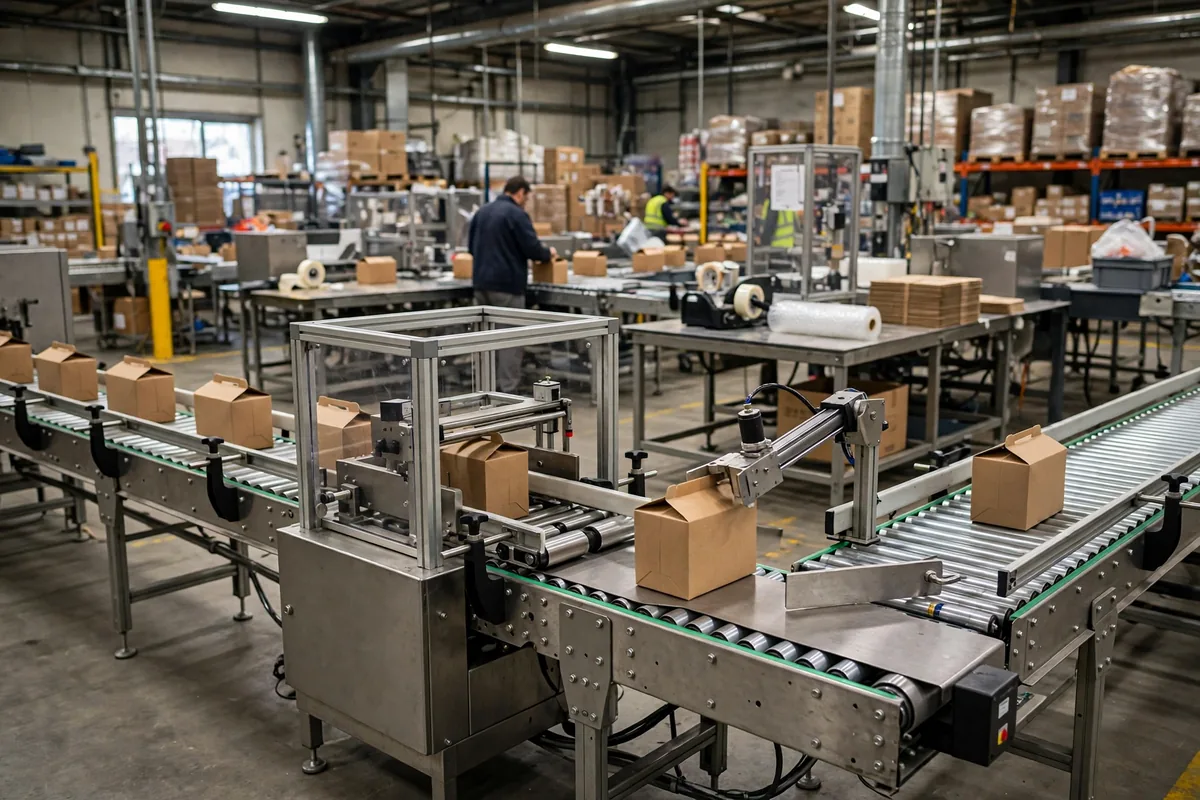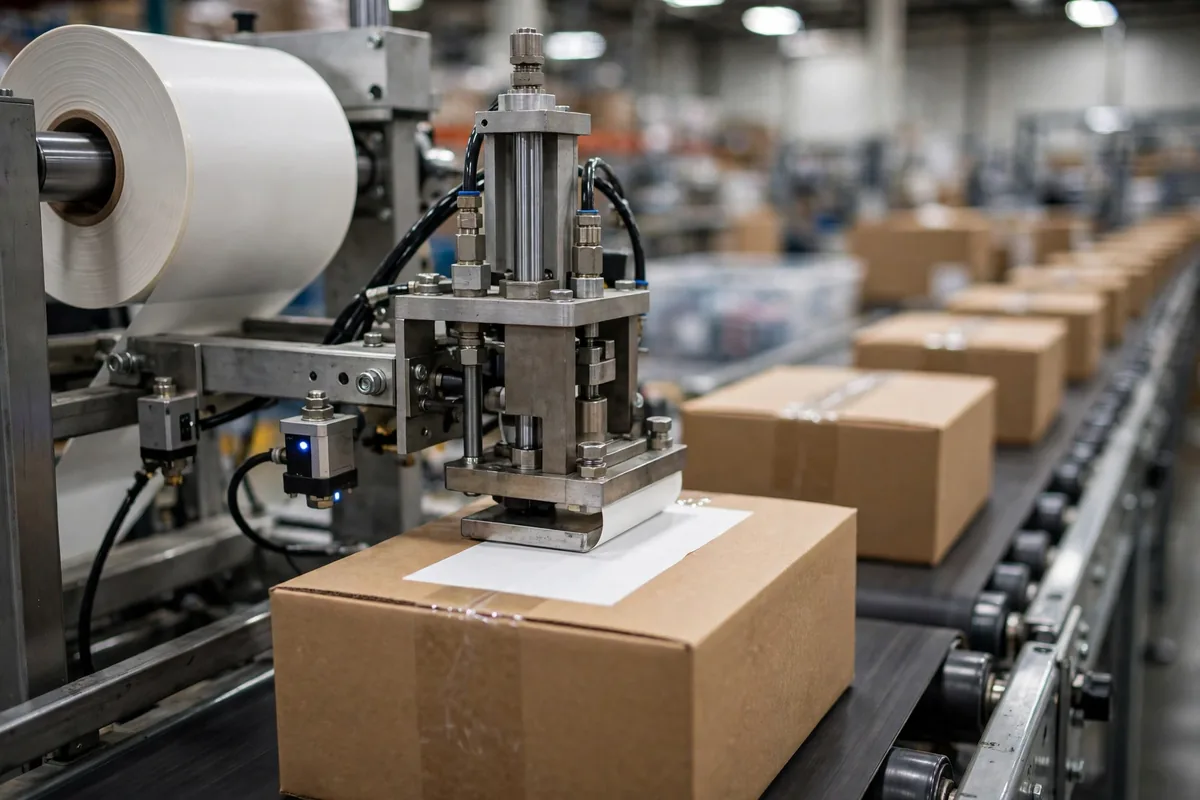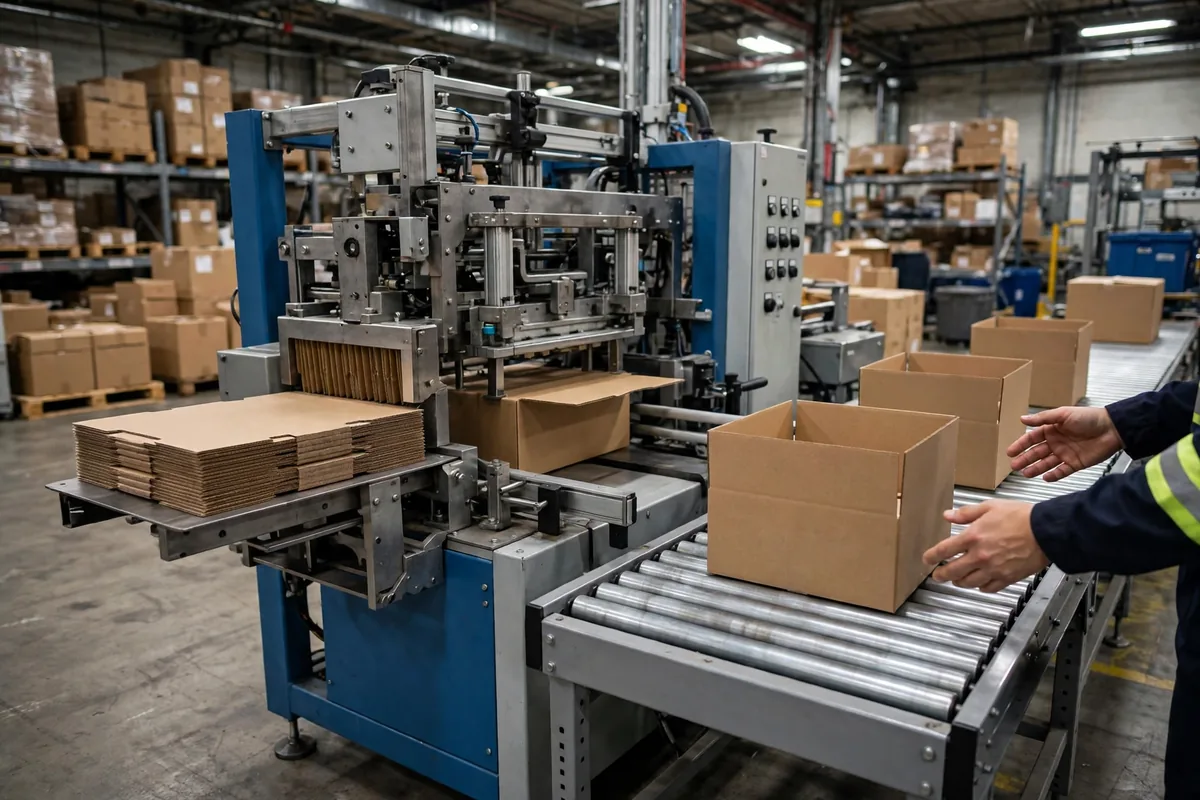
Start with the conclusion: case erector machine warehouse selection is not a question about the price of the machine. It is a question about how many cartons you actually form every day. Get that number wrong and everything after it is noise. I have worked in automation for years, and I have watched warehouses survive peak season on sheer headcount, buy an automatic case erector on impulse, and end up paying twice — a machine sitting idle half the time, plus the people kept on to rescue it.
Where the line sits in case erector machine warehouse selection
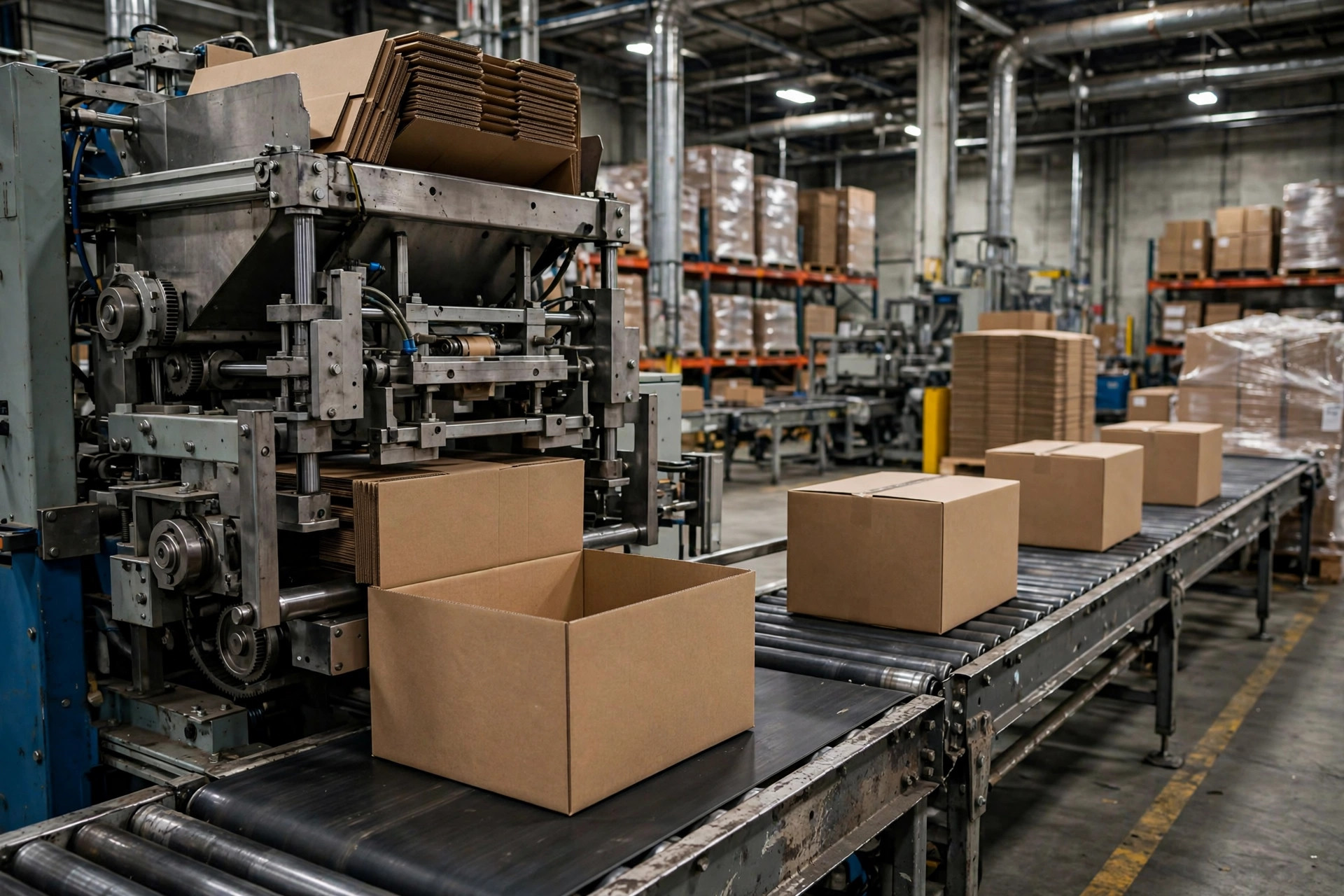
First, the principle. A case erector does three things: it pulls a flat carton open, folds the bottom flaps, and tapes the bottom shut, then sends it to the packing bench. Think of it this way: it does not replace a person, it replaces the single most repetitive motion at the front of the packing line — open, fold, tape. That motion is easy once. It is brutal thousands of times a day, when human speed and consistency fall off together.
How do you find the dividing line? Work through an illustrative example — and I will label it clearly: these are assumptions for the calculation, not a quote. Assume a trained worker needs a set number of seconds to form one carton by hand, and assume peak demand runs to several thousand cartons a day. On those assumptions, forming alone can consume two or three full shifts of labour. A machine forms cartons far faster than a person, but it cannot judge a damp, warped carton or tape that has lost its tack. So build the comparison honestly:
| Factor | Hand forming | Automatic erector |
|---|---|---|
| Labour | Dedicated staff at peak (illustrative: 2-3 people) | One operator watching machines and restocking |
| Consistency | Drops in the afternoon and at peak | Stable rate, consistent bottom seals |
| Format change | Pick up the next size, zero downtime | Adjustment needed; more sizes, more pain |
| Cost | Near zero, hire and release freely | Purchase plus maintenance, depreciates while idle |
The headcount figures above are modelling assumptions. Plug in your own local labour cost and your own carton volume — wage levels vary widely, so check the latest official policy and your local rates rather than copying anyone else's numbers.
Now a concrete case. In 2022, a small-appliance warehouse in Dongguan, Guangdong, had modest daily volume but many carton sizes and fragmented orders, with peak forming demand roughly doubling on busy days. They wanted the fastest model available. I spent a week on their floor counting. The bottleneck was not forming speed. It was changeovers: more than ten size changes a day, each stopping the line for a noticeable adjustment — the figures here are the order of magnitude recorded on site. The high-speed machine's advantage was eaten entirely by changeover time. They bought a mid-speed model with faster changeovers instead, and it was the better buy. That is the counter-intuitive judgment in this whole topic: for a multi-size warehouse, changeover time matters more than top speed. A beautiful rated speed with slow changeovers is furniture, not equipment.
The one number that decides, and the maintenance traps
At any warehouse, I ask for one number first: cartons formed per day, sustained — not the single busiest peak day. Why? A machine's cost is spread across the whole year. Size it on the peak and it idles in the off-season. Size it on the off-season and you are pulling people back to hand-form at peak. The correct calculation is annual average daily volume, multiplied by the labour and tape waste saved per carton, compared against annualised equipment cost plus maintenance.
Second case: in 2023, a jewellery accessories warehouse in Yiwu, Zhejiang, ran its payback calculation on labour savings alone and left out maintenance and downtime. In the first year, wear parts such as tape heads and vacuum cups went through several replacement rounds — check the manufacturer's official documentation for the actual service intervals on any model you consider, because they differ a lot by brand. Worse, the machine stopped twice during peak waiting for parts, and on those days temporary hand-forming labour cost more than the normal baseline. That does not mean the machine was a bad purchase. It means a payback figure that omits maintenance is fiction.
Three more maintenance traps, all paid for by someone else's tuition. First, carton quality. A machine is far pickier about board stiffness and dimensional tolerance than a person is. Switch to a cheaper carton supplier and your jam rate can double overnight; the savings go straight back out as downtime. Second, tape and environment. Cold rooms and dusty buildings degrade bottom seals noticeably, so state your real working environment during selection and do not judge a machine only in a clean showroom. Third, spares and service response. Ask whether there is a local service engineer and how many days common spares take to arrive. That answer is worth more than a small extra discount.
So which warehouses should not buy one? I will say it plainly: low daily forming volume, more than a dozen carton sizes changing constantly, or extreme seasonality with almost no off-season work. Do not buy yet. Consolidate your carton sizes and fix your packing flow first — those moves cost no equipment money and often pay back faster than a machine. The opposite profile should buy without much debate: stable daily volume, sizes concentrated in three to five formats, hard-to-hire labour, or a night shift that cannot keep up with forming.
I will finish where I started, with the one number. You can read spec sheets all week, but case erector machine warehouse selection comes down to this: how many cartons do you form on a normal day, and in how many sizes? Put those two numbers on the table and the answer — buy or not, and which class of machine — surfaces on its own. Cannot produce them? Go and count for a week before you listen to any salesperson, including me.
By Da Liu, Automation Engineer