Before you price a single machine, run the numbers. I've watched warehouses buy a baler on a hunch and park it in a corner as an expensive decoration, and I've watched others turn a $10,000 vertical unit into serious annual savings on hauling and labor. The difference is never the machine. It's three numbers: your daily carton volume, your local scrap cardboard price, and what you're paying for labor and waste hauling right now.
This article does one thing: put those three numbers in a table and tell you when to buy and when you'd be throwing money away.
Line One: How Many Cartons Do You Actually Produce
Before looking at equipment, look at your trash area. Track it for one week. Count the empty cartons broken down each day and convert to weight. Roughly three tiers:
| Daily volume | Typical operation | Verdict |
|---|---|---|
| Under 200 lbs | Small e-commerce shed, small storefront | Don't buy. Flatten by hand. The power and floor space cost more than the machine saves |
| 200–500 lbs | Mid-size e-commerce warehouse, regional depot | A vertical unit is worth pricing — after you run lines two and three |
| Over 500 lbs | Large DC, 3PL, returns center | Almost always worth it; the question is only vertical vs. horizontal |
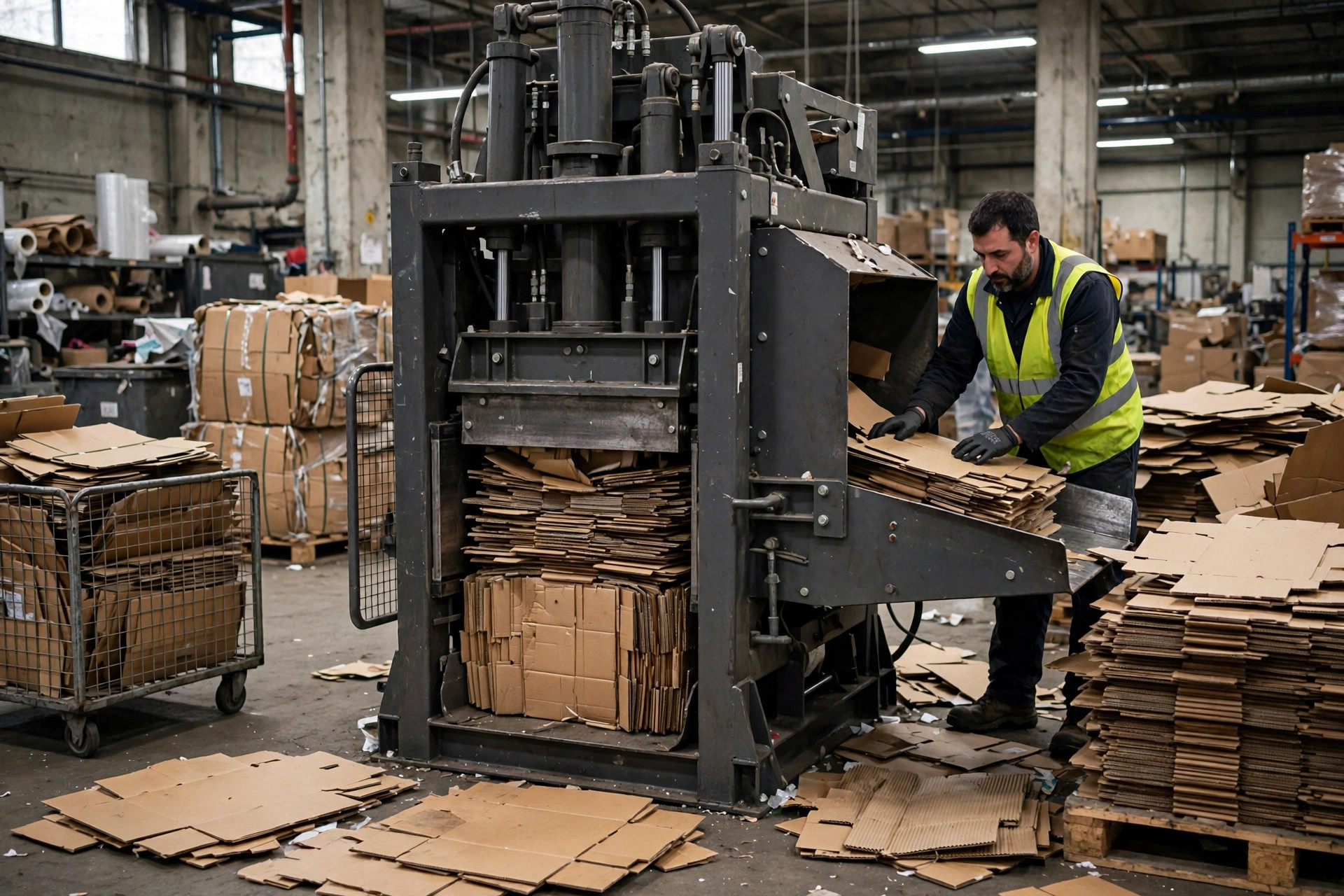
These cutoffs aren't guesswork. A new vertical baler runs $3,000–$12,000; used units save 30–50% but verify condition and warranty. Expected equipment life is 10–15 years. Spread over each day, if your volume is too thin, depreciation and floor space alone eat whatever the machine saves.
In 2023 I visited a home-goods exporter in Shenzhen whose owner bought a vertical baler for under $20,000 RMB. The problem: they produced a few dozen cartons a day. The machine ran twice a week, bales sat half-finished in the corner, and each baling cycle's power plus labor cost more than just calling the local recycler to haul the loose cardboard. Money wasted — wasted because nobody ran line one of the math first.
Line Two: Scrap Price Swings Drive the Baler's Payback Period
A baler earns in two ways: revenue from selling bales, and savings on dumpster hauling. Of the two, the scrap price is the volatile one.
Recycling prices vary widely by market. Public market data puts baled OCC (old corrugated cardboard) roughly in the $50–$100 per ton range (confirm with your local recycler — treat this as a band, not a quote). Loose cardboard either gets rejected or bought at a discount, and you're paying for the haul either way.
A concrete example. Say you buy a mid-range semi-automatic horizontal baler for $40,000:
- Labor saved: two people spending 2 hours a day breaking down and flattening cartons — roughly $10,000/year in labor cost avoided
- Hauling saved: compacted bales cut dumpster pulls from three times a week to once — roughly $5,000/year
- Bale revenue: 60 tons of bales a year at $70/ton — about $4,200
- Total annual benefit: ~$19,200 → payback around 2.1 years
Now move the scrap price. At $50/ton, bale revenue drops to $3,000 and payback stretches toward 2.5 years. At $90/ton, it compresses under 1.8 years. Every $10/ton swing in scrap price shifts a mid-range horizontal's payback by two to three months. Before signing a purchase order, call three recyclers, take the lowest quote, and run the math on that. If it still pays back, buy.
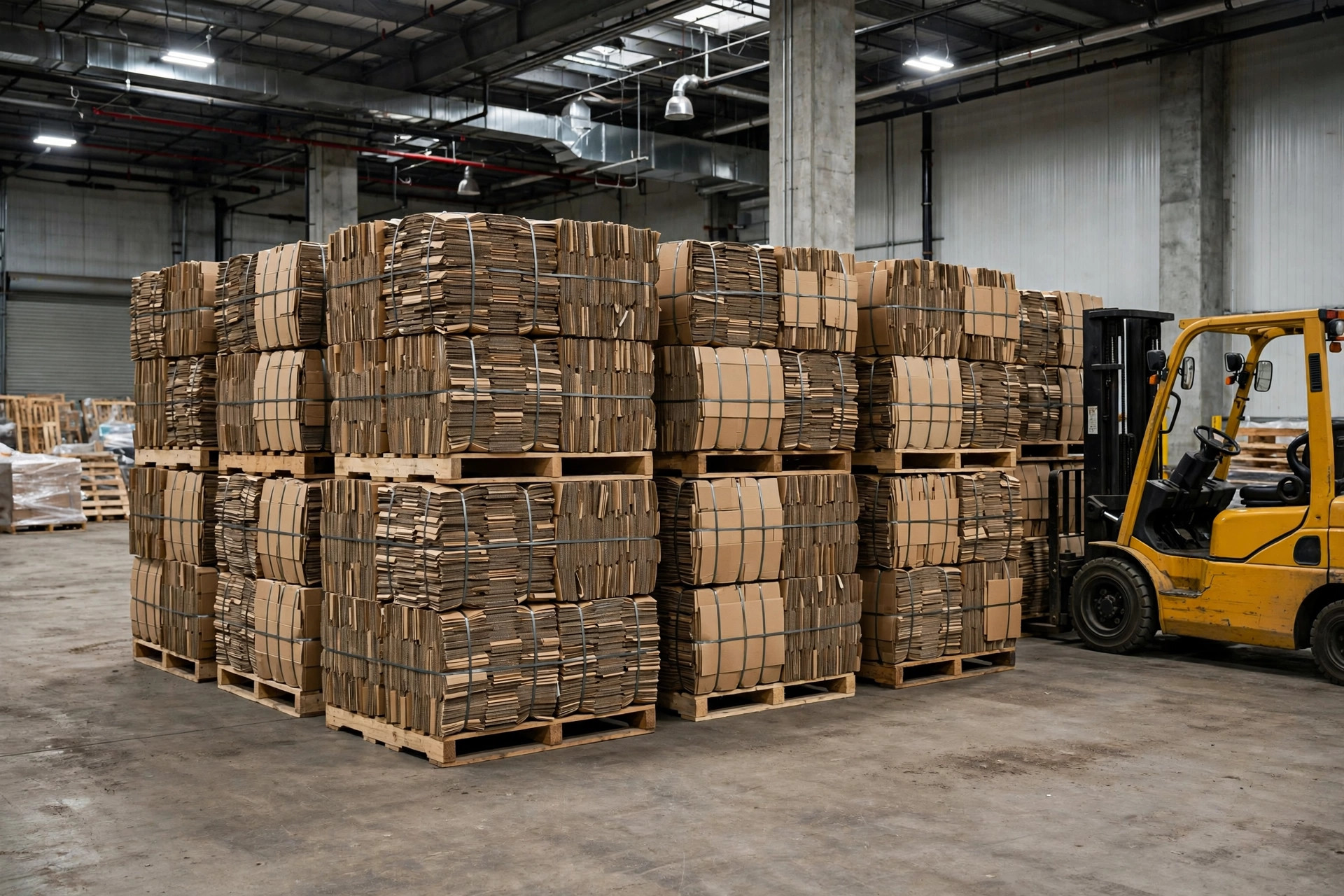
Here's the counterintuitive one: past a certain volume, a baler becomes redundant. A 3PL friend in Dongguan moves tens of thousands of cartons a day and never bought a horizontal unit — the recycler sends a truck to haul loose cardboard straight off the dock, pays by the ton, and the warehouse skips baling labor and machine depreciation entirely. When your volume is big enough that recyclers come to you, buying a machine means doing the recycler's work for free. Ask your recycler "at what volume do you do direct pickup" before you decide.
Line Three: Vertical vs. Horizontal Baler — Pick Wrong and It's Dead Money
| Vertical baler | Horizontal semi-auto | Horizontal full-auto | |
|---|---|---|---|
| Price range | $3,000–$12,000 | $15,000–$40,000 | $50,000–$100,000+ |
| Footprint | ~6 sq ft and up | 20+ sq ft | A full line |
| Cycle time per bale | 60–90 seconds | 30–50 seconds | Continuous output |
| Fits daily volume | Under 500 lbs | 3–8 tons | 15+ tons |
| Maintenance | Simple | Hydraulics need a skilled hand | Requires a service contract |
One iron rule for sizing: size for your peak, not your average. Peak-season carton volume can run triple the average. Buy for the average and the machine chokes during the holidays. Buy a full-auto line for the peak and it sits idle eleven months a year, depreciation eating every dollar it saves.
And there's a category of warehouse where a baler is dead on arrival, worth naming: operations with unstable carton flow. Five hundred cartons today, fifty tomorrow. The baler either idles or queues up, people get annoyed, and everyone goes back to stomping boxes by hand. Equipment doesn't die from being overused — it dies from nobody using it. Before buying, ask the floor supervisor one question: who feeds this machine every day? If there's no answer, don't buy. Fix the people problem first.
Three Hidden Costs Everyone Forgets: Power, Strapping, Repairs
Most payback math counts the big items and misses three small ones that quietly eat thousands a year.
First, power. A horizontal baler's motor isn't small — budget roughly 7–11 kWh per ton. At 60 tons a year that's a few hundred dollars, and in high-rate states like California it doubles. Run the payback on your local rate, not the national average.
Second, strapping and wear parts. Each bale takes 4–5 straps, plus hydraulic seals and blades as consumables. Figure around $2,000 a year. Get the consumables list with unit prices in writing when you buy — a salesman's verbal "consumables are cheap" counts for nothing.
Third, repair downtime. When hydraulics fail, a fix runs from several hundred to several thousand dollars, and cartons keep piling up while the machine sits dead. Before buying a horizontal unit, ask: is there a local service network, and how many weeks for parts? A cheap machine with no service coverage gives back most of your savings in a single breakdown.
Add these three into the formula and plenty of "18-month payback" plans turn out to be 22–24 months. Same rule as ever: run it on the most conservative numbers. If it still clears, buy.
The Decision Framework: Three Questions
- Is daily carton volume steadily above 200 lbs? No → don't buy.
- Running the math on your lowest local scrap quote, does payback land inside 24 months? No → don't buy, or go used (30–50% cheaper, but inspect the hydraulics and warranty).
- Is there a named person who will operate and maintain it daily? No → don't buy.
Pass all three, then argue vertical vs. horizontal. If capital is tight, look at leasing — many vendors offer 3–5 year terms with maintenance included, typically at 5–10% interest, which is far kinder to cash flow.
The Computable Conclusion
Whether a cardboard baler is worth it isn't a yes/no question — it's a number. Plug in your daily carton pounds, your lowest local scrap quote, and your current hauling and labor costs. Payback inside 24 months: buy. Beyond that: don't. Equipment that doesn't clear the math is expensive at any price; equipment that does is cheap at almost any price.
By Lao Zhou, Logistics Cost Analyst