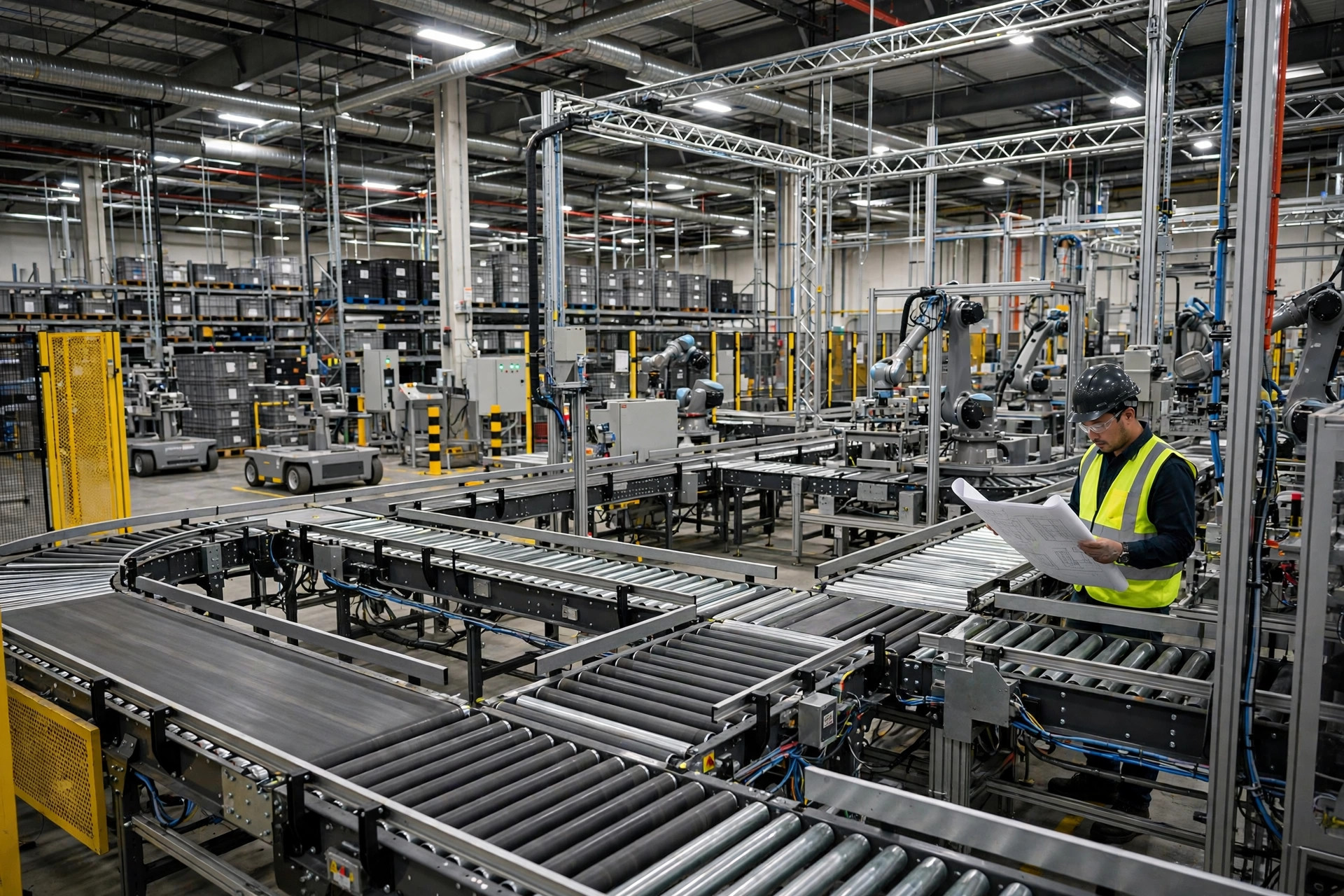
An automated warehouse system is, at its core, the product of three things: mechanical reliability × control-system responsiveness × the integrator's implementation capability. Think of it like buying a car: a great engine means nothing if the transmission is mismatched and the dealer vanishes after the sale. Most buyers focus their RFP on equipment brands — like judging the car by engine specs alone. That's step one of writing a useless RFP.
I spent 8 years as an integrator's technical lead, on projects from a few-million conveyor lines to hundred-million AS/RS builds. Today I'm telling it straight: how the RFP should actually be written, and exactly where quotes hide their padding.
The RFP: Write These 5 Pages First, Everything Else Is an Appendix
What actually determines quote quality and comparability is five pages of core parameters. A good RFP isn't thick. The appendices are thick; the kill zone is thin.
Page 1: Throughput and takt time.
Three numbers are mandatory: peak-hour throughput (units/hour), daily average, and the peak-to-valley ratio. Writing only "20,000 units/day average" is a con — e-commerce promo peaks hit 1:5 ratios, and a system designed for the average will explode on promo day. Takt time goes down to the machine level: sorter main-line speed (m/s), number of induction stations, single-AGV cycle time (seconds/trip). Think of it this way: the daily average is your "normal appetite," the peak is "a competitive eating contest" — the system must be designed for the latter.
Page 2: SKU profile and product characteristics.
Total SKU count, ABC distribution, max/min dimensions and weights, and the share of irregular items. This page draws the equipment dividing lines: if irregulars exceed 15%, forget cross-belt sorters — go sliding-shoe or tilt-tray. If single items exceed 30 kg, the AGV choice comes down to underride vs. forklift-type.
Page 3: Process flow and exception handling.
Anyone can draw the happy path. What matters is the exceptions: what happens when a sort chute fills up, how humans take over when an AGV faults, how orders are protected during a 30-minute system outage. Leave this page vague and the "software implementation fee" in the quote becomes a black box — the integrator quotes the simplest exception logic, discovers during implementation that you wanted something else, and the change orders start rolling in.
Page 4: Site and interface constraints.
Ceiling height, floor load capacity (kg/m²), fire zones, existing WMS interface method (API vs. staging tables), go-live window. This page is the cost watershed: a floor rated 3 t/m² vs. 1 t/m² means completely different AS/RS foundation work, with cost deltas up to 20%.
Page 5: Acceptance criteria and KPIs.
Uptime requirement (98% vs. 99.5% — that 1.5-point gap means two entirely different spare-parts and maintenance tiers), MTBF, MTTR, and the continuous fault-free test duration. Skip acceptance criteria in the RFP and you're telling the integrator "we'll figure it out later."
Where the Padding Hides: Four Spots
In my vendor years, quoting was a craft. Here's the buyer's-side teardown.
Padding #1: The "brand premium tax" in equipment unit prices.
The same conveyor line with domestic motors plus imported gearboxes vs. all-imported: 15%–25% price gap, but MTBF may differ by only 5%. Many quotes just say "conveyor line: $XXX" with no brand/model breakdown. Countermeasure: require a key-component brand list as a quote attachment, and reject "or equivalent." Those two words are the most expensive in any quotation.
Padding #2: The software implementation black box.
WCS/WMS integration, commissioning, shake-down — this fee is wildly elastic: $2M of equipment can pair with $800K or $300K of implementation. The difference is on-site shake-down time and stress-test rounds. The more detailed your RFP pages 3 and 5, the less padding survives here.
Speaking of change orders — a true story. In 2022, an e-commerce warehouse in East China bid out a conveyor plus tilt-tray sorter project. Three bids, 40% spread between highest and lowest; they picked the lowest. Mid-implementation, everyone discovered the RFP never specified full-chute handling logic. Six change orders recovered the 40% gap to the last cent — plus 8% extra. The lowest bid isn't the cheapest; change orders are the integrator's real profit center. Memorize that sentence.
Padding #3: The warranty "year game."
First-year free maintenance is industry standard, but year-two-plus pricing is full of tricks. Some quote "5% of equipment value/year," others "8%/year" — the difference is response time (4-hour on-site vs. 24-hour), whether spares are consigned on-site or shipped from the factory, and whether software upgrades are included. Require maintenance quotes broken down by year with service items listed individually, or in year three you'll discover you signed the cheap "phone-support-first" package.
Padding #4: The spare-parts hide-and-seek.
Which wear parts (belts, sensors, roller coatings) are included in the total price and which are extra — quotes love to stay fuzzy here. Nobody asks at acceptance; six months after go-live the first sensor dies, and the OEM part costs 3× market. Countermeasure: require a three-year wear-parts list with unit prices as a quote attachment, locking prices now.
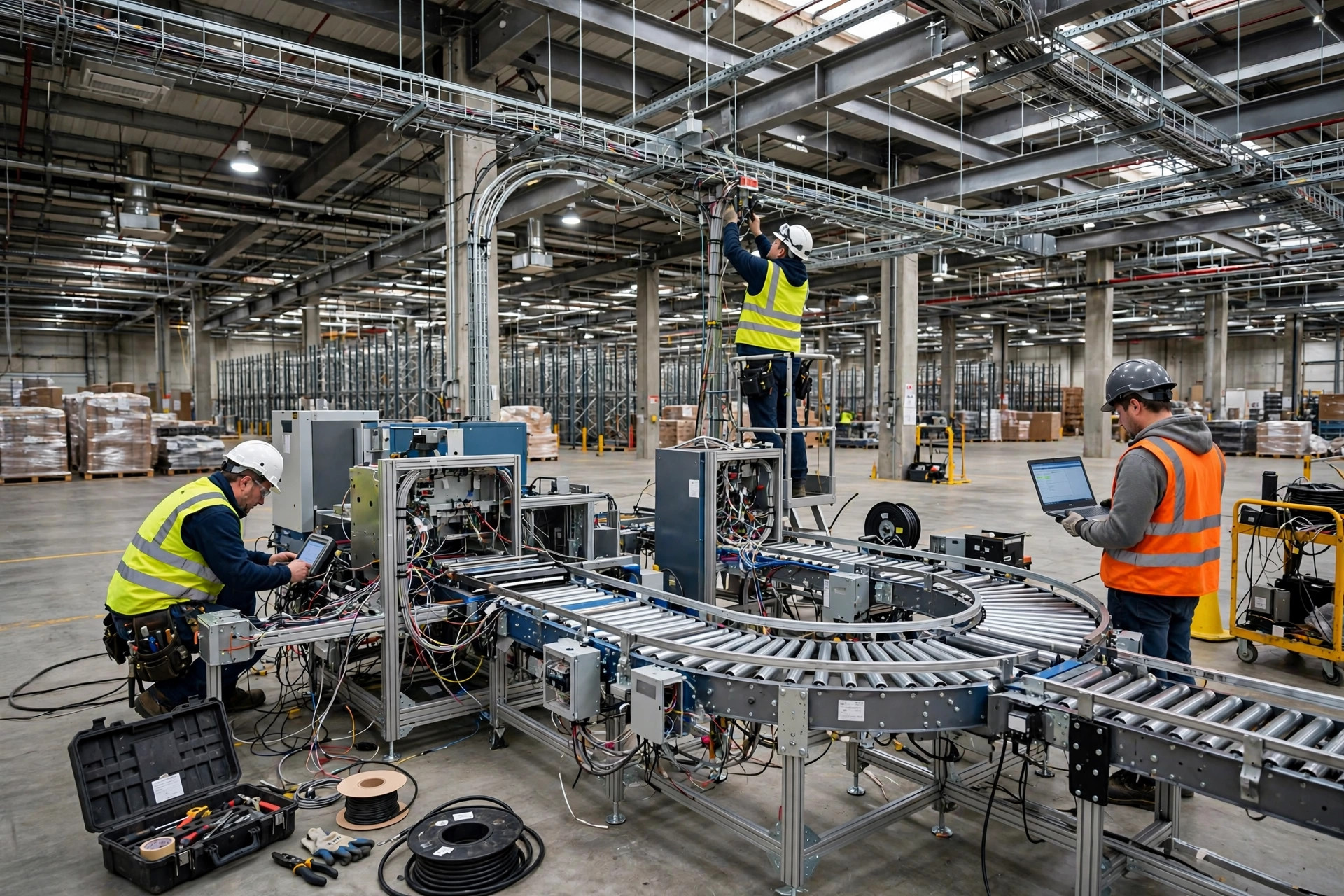
The Dividing Lines: Three Red Lines, Non-Negotiable
These three are hard dividing lines — write them into the RFP as disqualifiers so nobody argues at bid evaluation.
Red line one: pseudo-requirement detection. "We want a fully unmanned warehouse" is a pseudo-requirement — nine out of ten buyers saying it haven't even straightened out their in-warehouse flow. Automation solves repetitive, high-frequency, standardized motions. Ask first: what's the annual labor cost of this step? How many years to pay back? Payback beyond 5 years is a vanity project, not cost reduction. Blunt version: fix the process first, then talk equipment.
Red line two: tie uptime promises to spares. An integrator promising 99.5% uptime must put in the contract: the consigned spares list and MTTR-breach penalties. It's like buying insurance by staring at the coverage amount and ignoring the deductible — a con.
Red line three: turnkey vs. split-bid, decided once. Turnkey is worry-free but 10%–15% more expensive; splitting the bid is cheaper but every interface fight lands on you. Neither is wrong — it's a choice. But lock it in the RFP, once. Switching midstream voids every quote and wastes three months.
Do the Full Math: The TCO Model
Don't compare equipment totals. Buyers who can count look at 5-year TCO (total cost of ownership):
| Cost item | Rough share | Notes |
|---|---|---|
| Equipment purchase | ~55%–65% | one-time |
| Software implementation & shake-down | ~10%–15% | higher with complex exception logic |
| 5-year maintenance | ~12%–18% | compare year-by-year, not as a lump |
| Spares & wear parts | ~5%–8% | lock three-year unit prices |
| Downtime loss (risk item) | hidden | each 1% of uptime lost raises annual loss a notch |
Read this table and you'll see: equipment is only ~60%. A buyer haggling 5% off the total would save more by negotiating the maintenance terms properly. The real bargaining doesn't happen at the negotiation table — it happens on RFP pages 3 and 5.
The Maintenance Pitfalls: Acceptance Is When It Starts
Maintenance pitfalls last, because 80% of buyers fall into them.
Pitfall one: two days of operator training. Last year a food DC went live after 2 days of operator training; first-month misoperation stoppages outnumbered equipment faults. Write it into the RFP: operator training minimum 5 days, including exception-handling drills — delivery isn't complete until operators pass the assessment.
Pitfall two: source code and configurations never handed over. Some integrators' WCS is a black box — every parameter tweak needs the OEM, and a single site visit starts at several thousand. The contract must state: configuration sources, PLC programs, and electrical drawings all transfer, or no final payment.
Pitfall three: spares held hostage by "customization." Non-standard sensors, non-standard belt sizes — buyable only from the OEM at multiples of market price. Add one RFP line: key components prefer standard parts; custom parts need written approval. That single line saves serious money over five years.
Whether the Money Was Worth It: Watch This One Number
After all that, the ending keeps one number: automation cost per unit = 5-year TCO ÷ total units processed over 5 years.
Put it next to your current labor cost per unit. Under 70% of labor cost — the money was well spent. Between 70%–100%, it depends on your call about volume growth over the next 3 years. Above labor cost — don't buy. Go back, fix the process, kill the pseudo-requirements.
Bidding isn't about the lowest total. It's about who's still standing strong five years later. Write the RFP clearly, and the quotes won't dare stay fuzzy.
By Da Liu, Automation Engineer