Here's my verdict up front: whether a pallet return loop is worth it has nothing to do with how big your warehouse is. It comes down to one number — how many hours a day your forklift drivers spend moving empty pallets. Over an hour a day, the conversation is worth having. Under half an hour, drop it and spend the money elsewhere.
This cuts both ways. On one side, the hidden cost of manual handling: driver hours, damaged pallets, aisles choked with empties, safety exposure. On the other, the price of the fix: capital outlay, floor space, maintenance, and a line that stops everything when it faults. Plainly put, you're trading certain spending for uncertain savings. Let's put every line item on the table.
Cold water first: three kinds of buildings should never touch a return loop. One, pallets are rented with sizes locked by the pooling company — those colored rental pallets come with their own recovery system, and your line would be redundant. Two, receiving and shipping on the same end, under 50 meters apart — workers hand-carry without thinking, and a line would be pure performance art. Three, highly seasonal buildings — do you size the line for peak or average? Either way you're wrong. Those three should keep it manual and keep the money.
What I've Seen Too Many Times: How Empty Pallets Drag a Building Down
2021, a 3PL in Ontario. Receiving on the east end, shipping on the west, 200-plus meters apart. Empty pallets rode back on forklifts "whenever a driver happened to be going that way." In slow season it worked. Peak season hit, and nobody was going that way anymore. Shipping drowned in empties stacked near the sprinklers while receiving had fresh freight with nothing to put it on. The ops manager jumped on a forklift himself. He told me, standing right there: "Lao Mi, my building isn't being crushed by orders. It's being crushed by empty pallets."
The other one was worse in a different way. They spent real money on a powered return loop — good equipment — but never standardized pallet sizes. 48×40 GMA pallets mixed with 42×42s, jamming at every corner, the maintenance tech becoming the busiest person in the building. Eventually workers just walked around the line. A six-figure investment became a monument, and everyone started saying "automation is a scam." Was it? No. The scam was skipping the unglamorous work of standardizing pallets before pouring concrete.
Two traps: one is never doing the labor math, the other is never doing the physics math. Let's do both.
Three Tiers: From the Dirt-Cheap Fix to the Full Powered Loop
I split pallet return into three tiers. Different buildings, different tiers — don't force it.
Tier one: manual plus forklift, zero capital. Fits buildings with low empty-pallet flow and short receiving-to-shipping distance. One rule: make "bringing back empties" an assigned responsibility, not a favor. Goodwill evaporates on day one of peak season.
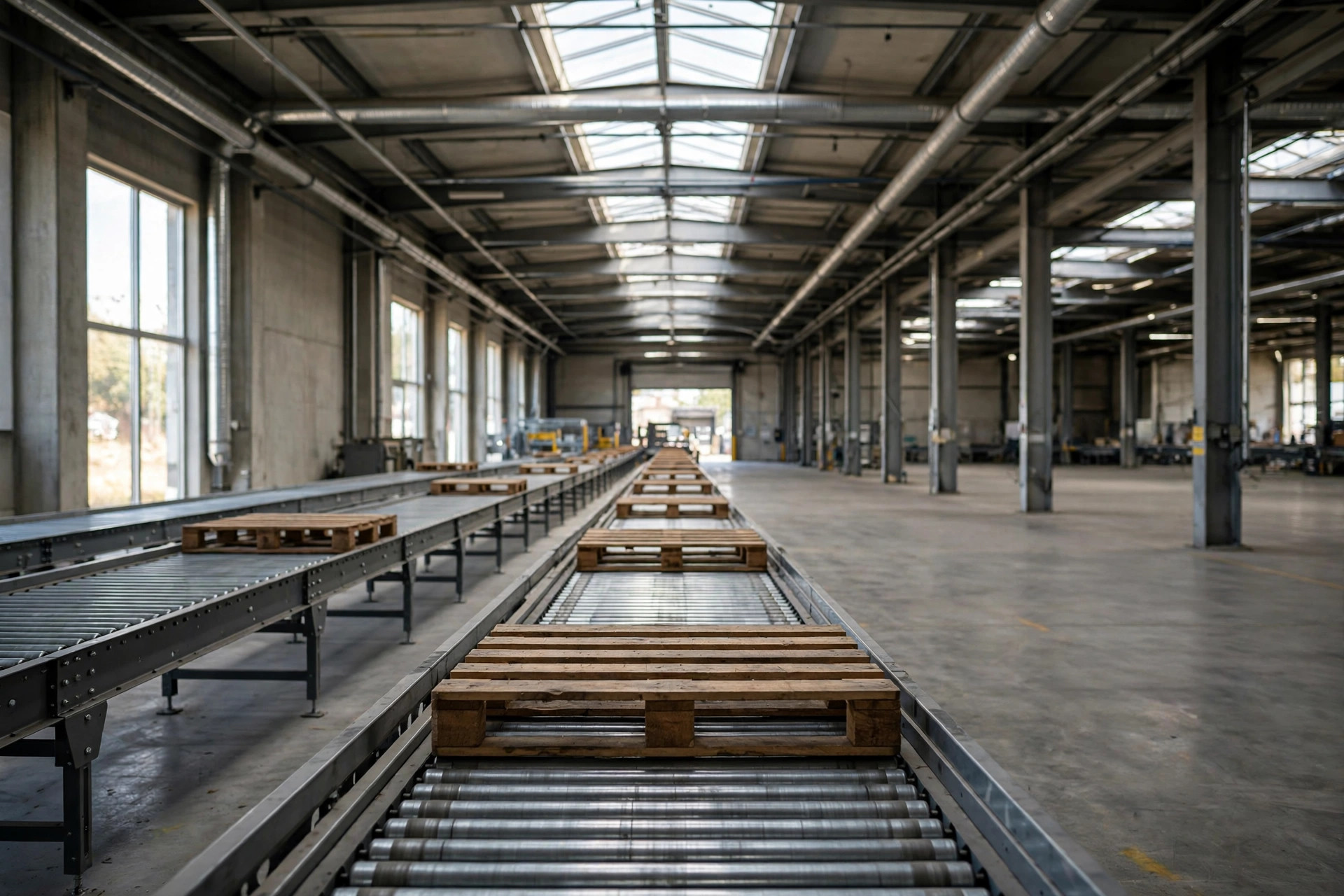
Tier two: gravity line plus forklift at both ends. Lay a gravity roller section between receiving and shipping; forklifts only load and unload the ends, gravity does the middle. Cheap, nearly nothing to break, works during a power outage. Limitation: straight runs only, no turns, and grade control gets fussy over long distances.
The cheapest retrofit I ever did: a food warehouse in Texas, 120 meters in a straight shot between receiving and shipping. A hundred-plus meters of gravity roller, a pallet buffer at each end, total spend under $20,000. Drivers got an hour a day back; payback in 11 months. The owner tells everyone it was the best $20,000 he ever spent. The humble fix, in the right place, beats the impressive one.
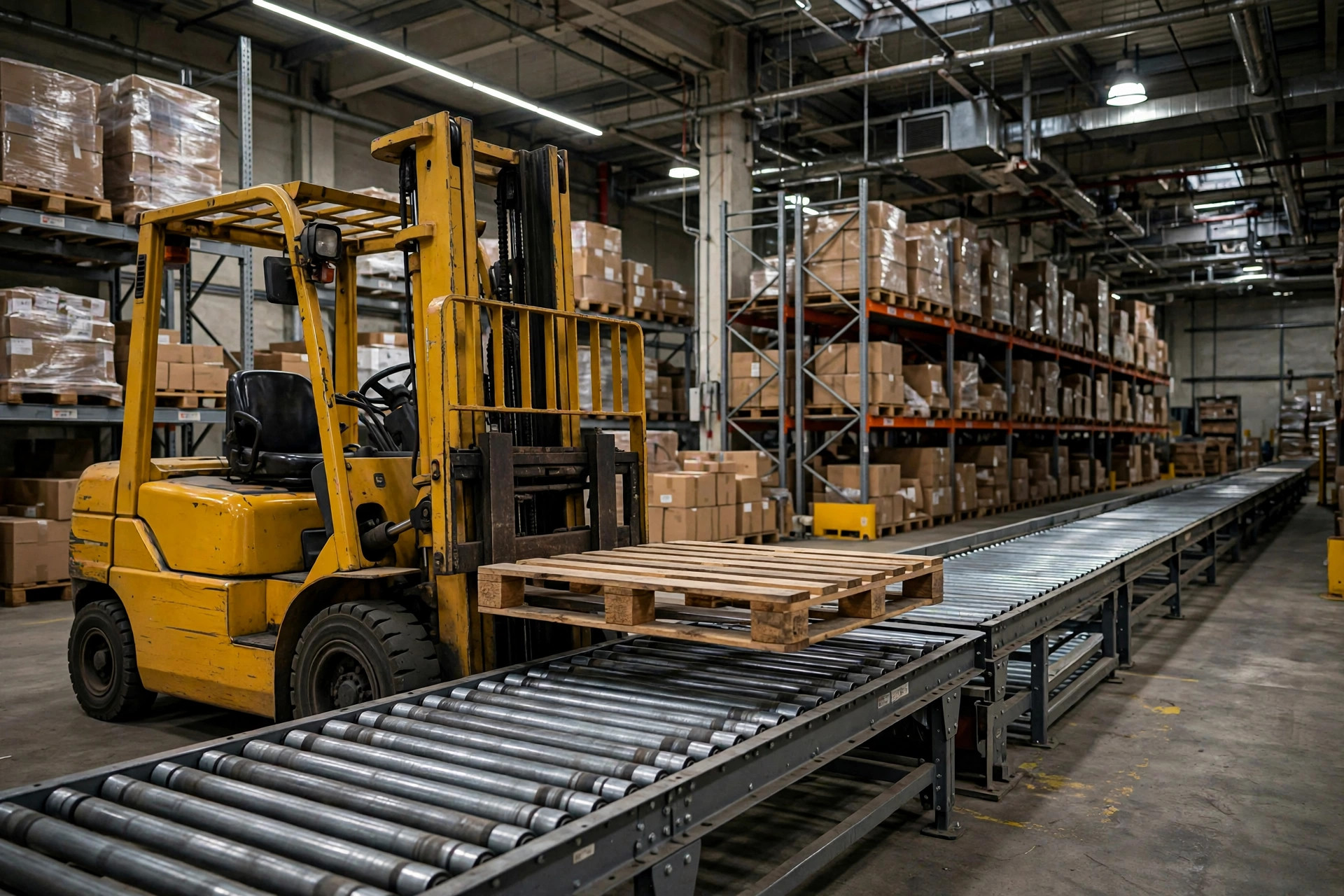
Tier three: full powered loop with an automatic stacker/destacker. This is the real "return loop" — empties ride the powered line, the stacker builds them into stacks, shipping destacks as needed. The stacker is the soul of the whole system. Without it, you're still stationing people at both ends to hand-stack, and the labor savings evaporate.
A few iron rules of design — break any one and the line is wasted money: never route the line across a main forklift artery, or you've manufactured an accident point; use turntables or merges at corners, never hard 90-degree turns — pallets aren't cartons, hard turns always jam; standardize pallet sizes first, because mixed 48×40 and odd sizes will defeat any engineer; and give empty pallets a virtual inventory location in the WMS — if the system can't see pallets, the loop is blind.
The Cost Math: Three Tiers Side by Side
| Manual/Forklift | Gravity + Short Haul | Full Powered Loop + Stacker | |
|---|---|---|---|
| Capital | Zero | Gravity line, tens of dollars per foot | Powered pallet conveyor, equipment plus install in the hundreds of dollars per foot — get a real integrator quote |
| Floor space | Zero | One straight run | Loop plus stacker needs at least two lanes' width |
| Labor | 0.5–2 driver-hours/day | 10–20 min loading/unloading at each end | Nearly unmanned, inspection rounds only |
| Failure points | Driver calls in sick | Almost none | Motors, sensors, stacker photo-eyes |
| Fits daily empty-pallet flow | Under ~100 | ~100–400 | 400+, with real distance between docks |
Concrete math for a mid-size building. Two forklift drivers, 1.5 hours a day each moving empties, fully loaded driver cost at $30/hour, 250 working days: 2 × 1.5 × 30 × 250 = $22,500 a year — before pallet damage and the invisible cost of blocked aisles. A 200-foot powered return loop with one stacker lands in the low six figures; amortized over 5 years, roughly $30,000 a year. Looks like a wash, maybe slightly negative — but labor costs climb every year while equipment cost is locked in once. That's the other side of the trade-off: you're not buying savings, you're buying certainty.
Here's the counterintuitive part: most people think money is the biggest enemy of a return loop. Wrong. It's non-standard pallets and nobody owning the thing afterward. The stacker's photo-eyes cake with dust, a sensor drifts out of alignment, nobody wipes or adjusts anything, and the line stops. Automation's worst enemy isn't price — it's being abandoned the day after commissioning.
One Line to Close
Do one thing when you get back: have a supervisor shadow a forklift driver for a shift and count how many empty-pallet trips he makes and how many minutes each takes. Multiply by the hourly rate, multiply by 250 working days. If that number stings, the return loop is ready for a proposal. If it doesn't, your building isn't there yet — and that's fine. Sometimes the smartest capital decision is not spending it.
By Lao Mi, Supply Chain Veteran (20 yrs)