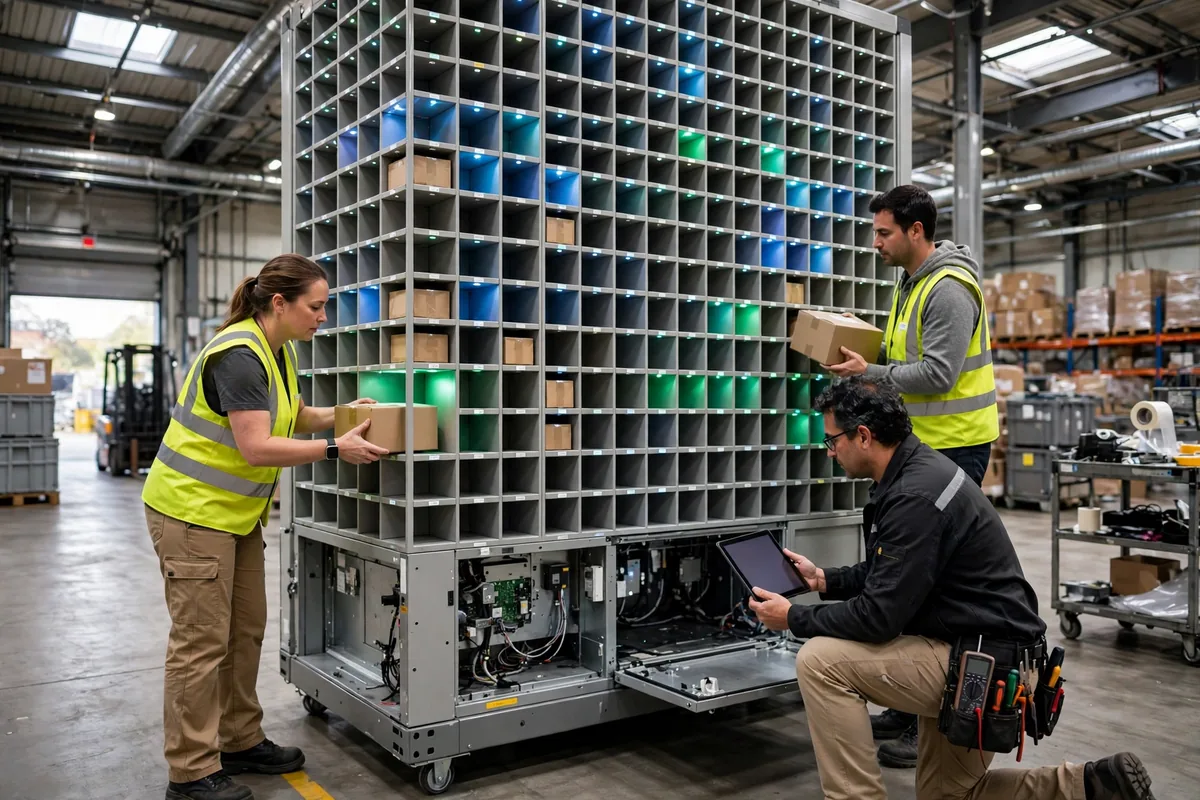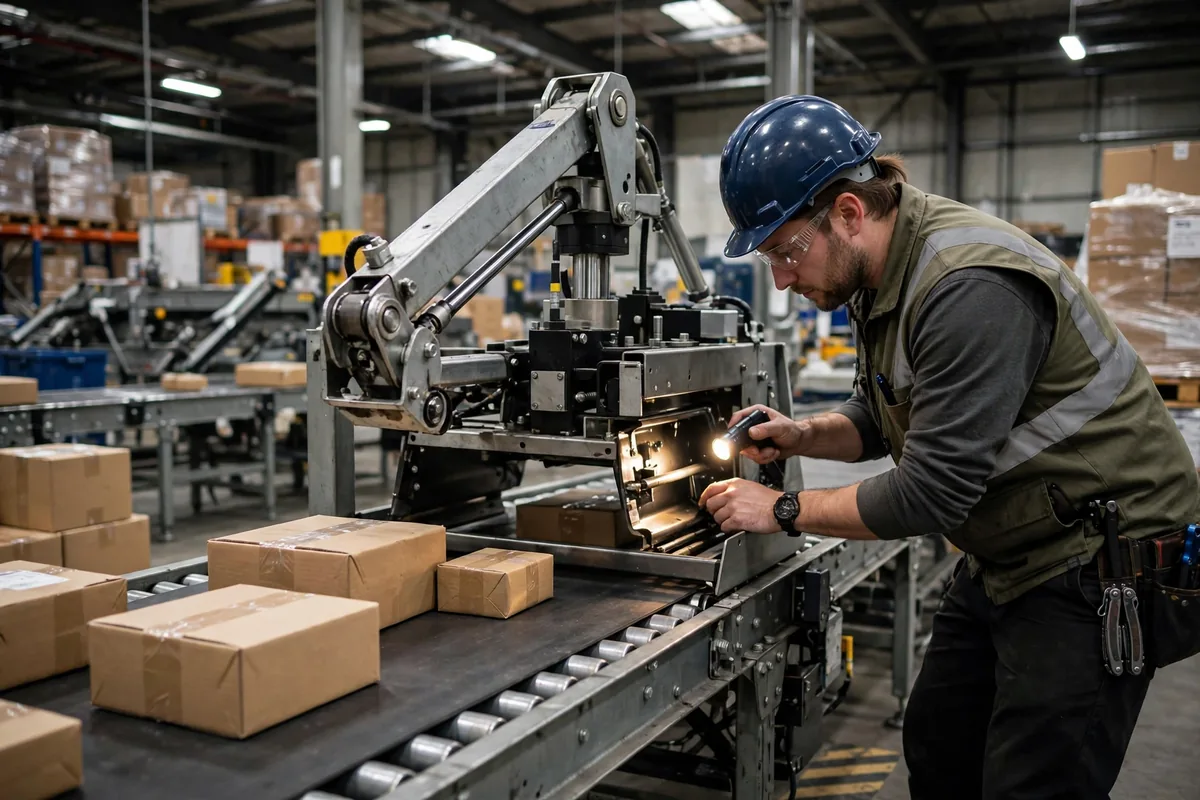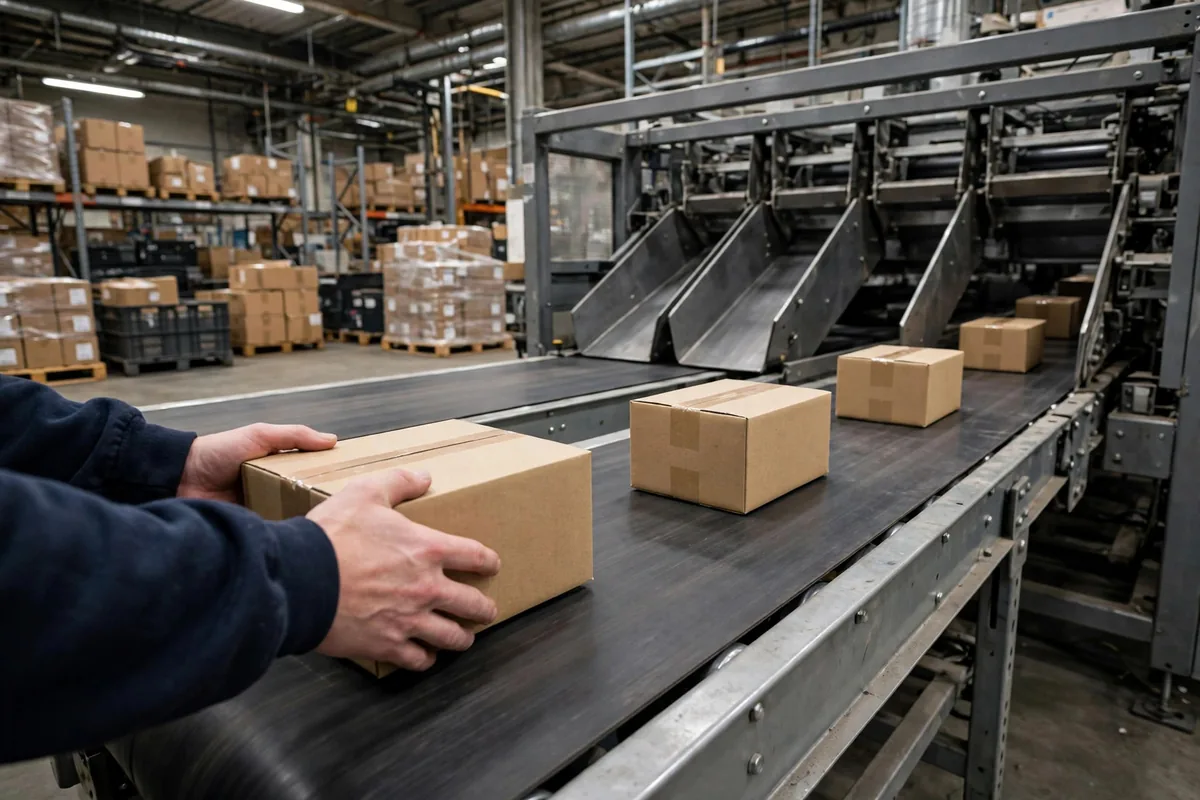
Here is the conclusion up front: in a sorter induction singulation warehouse setup, the bottleneck is rarely the sorter itself. It is the induction end. The machine's rated throughput looks great on paper, but if parcels cannot get in — or get in tangled, doubled up, and badly spaced — all that sorting capacity sits idle.
This cuts both ways. Automatic singulation looks modern: steady pace, no fatigue. But it hates irregular items, soft polybags, and two parcels stuck together. Manual induction looks crude, yet a good operator flips, separates, and straightens odd freight without thinking. The right choice is not about which is more advanced. It is about what your parcels look like and how much volume you actually run.
Do the pace math first in a sorter induction singulation warehouse
I have seen too many warehouses where the sorter arrived, and induction immediately piled up into a small mountain. The machine was fine. The feed end simply could not keep up.
Run the numbers, all assumed here only as a worked example: assume the sorter is rated at 6,000 parcels an hour, but induction can only feed a steady 4,000. Your real line capacity is 4,000, and a good share of the sorter budget is wasted. Assume a skilled manual induction station feeds fewer per hour than an automatic line, but manual stations can be added side by side, while one automatic induction line is a single throat — when it jams, the whole line stops. Do this math with your own parcel mix and wave profile, not with the clean numbers from a demo hall.
Judge your induction end on three numbers only: actual peak-hour infeed, not the daily average; the share of jams and double-fed parcels; and how many minutes the sorter starved while induction was down. If you cannot produce those three numbers, you are not ready to talk about new equipment.
Manual induction versus automatic singulation: the sorter induction singulation warehouse trade-off
| Factor | Manual induction | Automatic singulation |
|---|---|---|
| Best parcel mix | Irregular, soft, long, mixed freight | Regular, rigid cartons |
| Pace stability | Depends on people, shifts, fatigue | Steady, until an odd item interrupts |
| Jam handling | Fixed on the spot, by hand | Often needs a stop or intervention |
| Investment shape | Stations and labor, added step by step | One large spend, costly to rework |
| Scaling | Add people, flexible | Hard ceiling; excess volume queues |
Case one: an apparel warehouse where polybags and soft packs dominated peak season. They installed automatic induction early on. The bags were soft, slippery, and prone to stacking, and the singulator regularly sent two bags through as one, scrambling barcode reads and weighing downstream. At peak they bypassed the automatic section entirely and ran manual induction. The equipment was not broken. The freight was wrong for it.
Case two: a 3PL warehouse handling small appliances — rigid cartons, tight size range. Automatic singulation worked beautifully there. Two people watching for exceptions replaced a whole row of induction labor, who moved to packing. Same class of equipment: a burden in one building, a bargain in another. The difference was never the machine. It was the freight.
Here is the counterintuitive part: the more automated your induction, the more disciplined your inbound freight must be. Many warehouses do not have an induction problem at all. They have an inbound problem — supplier cartons in every shape, floppy courier bags — and an expensive singulator becomes a machine for paying for everyone else's mess. Sorting out inbound standards and pre-sorting first is often far cheaper than replacing induction equipment.
When automatic induction is not worth it
Use these as hard tests. If two or more apply, hold off:
- Irregular, soft, or long items are a large share, and you cannot change the inbound mix soon.
- Your waves swing hard — slammed at peak, idle off-peak — so utilization never fills the machine.
- Your real bottleneck is packing, checking, or outbound, not induction.
- Nobody on site can maintain it, so every singulator alarm means waiting for the vendor.
- Your order profile is still shifting, and the equipment would lock you into today's parcel shape.
When the opposite holds — regular freight, high and steady volume, and induction provably capping peak throughput — then price automatic singulation on total cost: maintenance, spares, and downtime, not just purchase price.
There is also a middle road many warehouses run well: semi-automatic. People pre-separate and orient parcels, the machine controls feed and spacing. People do the judging, the machine does the repeating. Jam rates fall without betting the whole budget in one step.
A sorter induction singulation warehouse is ultimately not a contest of equipment specs. It is a test of how well you know your own parcels. If you cannot state your irregular-item share, every purchase is a gamble. Get the three numbers first, then decide where the money goes — agreed?
One more operational point that rarely makes it into vendor brochures: jam clearance is a labor cost, not a footnote. Every jam on an automatic singulator has a price — the stop itself, the parcels that back up behind it, the sorter slots that run empty while the line restarts, and the exception parcels someone now has to re-induct by hand. When you compare manual and automatic induction, count jams per thousand parcels and minutes lost per jam on your own floor. A line that is faster on clean freight but stops six extra times a shift can easily lose to a slower, steadier manual setup over a full peak day.
Irregular freight deserves its own lane, not a fight. Long items, tubes, soft bags, and anything with straps or loose tape should be pulled out at a pre-sort point before induction and sent to a manual induction station or a manual sort area. Let the automatic line run regular freight at speed, and let people handle the odd shapes they are good at. Warehouses resist the extra touch, but compare it honestly with an automatic line stopped repeatedly by freight it was never built for — the extra touch is the cheaper option almost every time.
Case three: a returns processing warehouse, where inbound parcels arrived in every shape imaginable, often with crushed corners and torn packaging. They tried to run returns through automatic induction and spent their days pulling debris and loose tape out of the equipment. They switched returns to fully manual induction and kept only new outbound freight on the automatic line. Equipment faults dropped sharply. Same building, two different answers for two different flows — and that is fine. Expecting one induction method to serve every flow is how budgets get burned.
Finally, staff induction to the wave, not to the clock. When a wave builds, add hands at induction and pre-sort; when it ebbs, move those people to packing. A fixed headcount all day guarantees a pile-up at peak and idle time off-peak. Induction is a valve. Staff it like one.
By Lao Mi, Supply Chain Veteran (20 yrs)